194 people, numbered by ahnentafel: #1 is me, each person’s father is double their number, each mother is double plus one. Every entry carries its dates, relationship, evidence grade, story, evidence notes, and text descriptions of every photograph and evidence scan.
Ahnentafel #256 · his father’s father’s father’s father’s father’s father’s father’s father (8 generations back) · Hypothesis — a candidate, not tied in
He appears in 1784 in Claremont County, already styled “Planter,” buying a neighbour’s entire personalty — an enslaved woman named Ann, the horses, the beds, nineteen cattle — and three years later giving every bit of it back to that neighbour’s children “for love, good will and affection,” which in the language of that century usually means family. He farmed the Black River country beside Frederick Bell and the Newmans, proved deeds across the line in Darlington, and on the day after Christmas 1803, “very sick & weak in body,” divided a plain farmer’s world — a plantation, stock, feather beds, a cow already called his daughter Elizabeth’s — among a wife, two daughters and nine sons, the second of whom was Archibald.
Evidence
Also recorded: planter of Claremont County; earliest record the Isaac Higgs appraisement, Kershaw District, 21 June 1784 (⚠ #279 withdraws #275 — the Stokes deed is 1787, not 1777); later of Salem, Sumter District; will 26 Dec 1803; administration with the will annexed granted 15 Apr 1809 to Charles Williams — his named executor Moses Gordon never served
⭐ The one link on this branch that is ASSERTED in a document: his will of 26 December 1803 — “I give & bequeath unto my beloved sons, John Bell, Archibald Bell, Thomas Bell, William Bell, James Bell, Drury Bell, Jesse Bell, Benjamin Bell, & Robert Bell…” — recorded 15 March 1809, executor Moses Gordon, witnesses Lewis Bell, Mary Stuckey and a Douglas [BELL-152, BELL-181]. ⭐ And the will names TWO DAUGHTERS as well as the nine sons, which the roster usually quoted omits: MARY BELL (a feather bed) and ELIZABETH BELL (a bed, “& One Cow & Calf which is now call’d hers” — the only line in the document about a child’s own particular possession). ⚠ Never used as research handles, and they should be: daughters marry, and married daughters sign receipts under their husbands’ names [BELL-630]. Wife Mary took a life estate; the land was to be sold at her death or remarriage and divided among the nine sons — that sale, not yet found, would name the whole sibling generation in one instrument.
⭐ His documented life: buying Micajah Stokes’s whole personalty in 1784; settling it on Stokes’s children “for love, good will and affection” in 1787 (the language of kinship); land co-surveyed with Frederick Bell — a documented Revolutionary claimant — on the North Branch of Black River in 1787; co-signing a Darlington-proved deed with Frederick, Mary and John Bell in 1794 [BELL-182].
⭐⭐ 11 Sep 2026 [BELL-718] — HE IS NOW DOCUMENTED IN CAMDEN DISTRICT IN 1787, HOLDING LAND ADJOINING FREDERICK BELL. The grant of 1,000 acres to Frederick Bell, 7 March 1787, recites the tract as “Situate in the District of Camden on the No Branch of Black River … N.E. on Land Surveyed for Wm Rasor Bell, Frederick Bell, Jonathan Newman and Lewis Mathews” — read off the printed grant form. ⭐ Frederick is the man who administered John Bell of Camden’s 1786 estate, and Jonathan Newman is Archy’s own neighbour — the man Archy witnessed for in 1805, and who appraised W.R.B.’s estate in 1809. The neighbour set holds across three generations on one line of one grant. ⚠⚠ Association, NOT paternity — and the record-class fallacy applies with full force: these are the documents that happen to survive, not a census of the relationships that existed. ⭐ A 1794 instrument carries four Bells at once — “Witnesses Wm. Rasor Bell / John Bell / John x Ward ‖ Fredk Bell / her Mary x Bell mark” ⚠ (a TYPED TRANSCRIPT volume, not the manuscript — PROBABLE). ⛔ LEAD — one witness in FIVE filmings, not five witnesses: SCDAH’s index carries “KERSHAW, JOSEPH … SURVIVORS OF ELY KERSHAW VS WILLIAM RASOR BELL, JUDGMENT ROLL, 1785.”Outstanding: ⛔ Why this node is `hyp`, stated as its OWN defect and not node 128’s (corrected 6 Sep 2026 after a three-node grade audit + adversary pass): the 256→128 link — that the Archibald Bell named in W.R.B.’s 1803 will is our Archy Bell of Sumter who died in 1839 — rests on ZERO asserting sources. Across every decade 1780s–1850s of Sumter (1,850 records), Kershaw (670) and Darlington (637), not one instrument styles Archibald Bell as anyone’s son, and not one names a distributee or legatee of William Rasor Bell [BELL-484], [BELL-503], [BELL-512], [BELL-557]. Adjudicated and refused SEVEN times, twice under the explicit heading “128↔256”. ⚠ This node would still be `hyp` if node 128 closed tomorrow — the previous wording of this field stated node 128’s defect instead of this one, which made a single problem look like three on the board. ⭐ What would move it to probable: one line naming Archibald Bell as a distributee of William Rasor Bell — SCDAH Returns Books L 43049 vol. 1 / Journals L 43051, unfilmed paper in Columbia, item ② of the request filed 4 Sep 2026 [BELL-602]. ⛔ 2 Oct 2026 [BELL-775]: SCDAH found no William Bell in the Returns Books index (volumes and spellings checked not stated; Archibald’s returns not addressed), and the Journals L 43051 are unindexed, so staff will not search them. This route now needs a paid researcher in Columbia. ⛔ Separately, and NOT what this badge grades: no document yet ties our John F. Bell of Barbour Co. to Archibald — that is node 128’s own `hyp`. ⛔ His own parents are unidentified; the leading frame is the Raccoon Swamp Bell clan of Albemarle Parish, Surry/Sussex Co., Virginia — narrowed hard on 14 Aug 2026: Rev. James Bell’s will (Sussex WB C p.310, proved 15 Oct 1778) was read off the will book and names six children — no William, no Frederick, no Lewis — ELIMINATING the patriarch’s heir-branch [BELL-193]. Hannah Bell’s will (WB B p.153, proved 17 Mar 1768) reveals the two places a father can still hide: an unnamed SON WHO DIED before 1765 (father of grandsons Silvanus & Zadock Bell), and an ABSENT son Benjamin — “provided he comes himself in person” — gone from Virginia by 1765 [BELL-194]. The patriarch’s own 1746 will, read the same day [BELL-196], names FIVE sons — John Jr., Burrell, Benjamin, Balaam, James — no William in the clan’s senior generation; if WRB belongs here it is as an unnamed grandson via BURRELL or BALAAM — the adversary-verified register work [BELL-197, BELL-199] closed John Jr.’s issue at two sons (Sylvanus & John, by PHOEBE STOKES — Micajah’s sister), and found the second dead son: Balaam Bell d. 1755, widow Mary, posthumous daughter Phoebe — his 1745×55 window fits WRB’s birth. Silvanus STOKES Junr witnessed the 1746 will — the Stokes intimacy begins in Virginia, a generation before WRB’s kinship-language settlement on Micajah Stokes’s children. Otherwise the descent runs outside the clan, e.g. Richard Bell of Lawne's Creek, d. 1734, whose sons include a William [BELL-183–185, BELL-191, BELL-196]. ⛔ The “Rasor” name — likely his mother’s or grandmother’s family — has no located source; no Rasor appears in the parish register. ⭐ His own Patriot case is ONE PRINTED INDENT — Book G No. 30, “Issued the 22d. April 1784 To Mr. William Bell for Eleven pounds Eight Shillings and Seven pence Sterling for two Horses impressed for Militia Use in October 1780.” It is the only William Bell indent in South Carolina unattributed to any man, and no DAR or SAR lineage claims it. ⚠ Nothing yet ties its claimant to him rather than to one of at least six other South Carolina William Bells, and the Chester “W:m Bell Sen:r” is not excluded. ⛔ 29 Sep 2026 [BELL-774]: SCDAH read the ORIGINAL stub (reply of 21 Sep) — it says exactly what the print says, with no district, auditor, assignee or attached slip in its margin, and the Treasury’s Schedule of indents cancelled (S126171 Book 1 p. 85) writes nothing off against it. The stub route to seating it is closed; it stays open, unseated and unexcluded. Frederick’s is now PROBABLE: three indents incl. 50 days at the Siege of Charleston in Capt. John Nelson’s company — a company three pensioners place in the Black River / Salem country of old Camden District [BELL-192, BELL-195].
⭐⭐ Where the case stood after the sweep of 19–20 August 2026 [BELL-382–406].Book G No. 30 survived three separate attempts to take it off the board in four days and remains unseated and unexcluded. What strengthened: the printed text was transcribed from the surviving counterfoil itself — Wates’s asterisk/dagger marks are a survival map, Book G’s stubs go missing only from No. 251, and No. 30 is unmarked, 220 entries inside the intact run [BELL-385]. The evidence type is pre-approved with an exact precedent: DAR ancestor A008802 carries 46 approved lineages on a single stub-entry citation [BELL-392]. The rival Abbeville claimant is now excluded on his own itemised schedule, and the Chester man’s claims fell from three to two — one of them proved to be William Ball — so £11.8.7 no longer sits between his sums but above both [BELL-395]. What was closed off: no second October-1780 impressment claim exists anywhere in the twelve printed volumes [BELL-384, BELL-391]; his neighbours left six indents between them in 12,242, so no cohort argument can be built [BELL-394]; and the numbered Treasury returns were alphabetical work-batches, never geographic [BELL-396]. Book G No. 30 is cited by nobody in either lineage society, checked against the full source citation of every South Carolina Bell in both [BELL-392].
⭐ And his own paper trail was pushed back and sharpened. There is no South Carolina record of him before 1785, tested across seven name-forms — the apparent 1777/1778 hits are index frames carrying the 1785 judgment roll [BELL-400, BELL-406]. He has two 1785 surveys, not one: 150 acres on Bane Branch, 30 April, and 400 acres on Lynches Creek, 15 June — and both grants issued to Samuel Boykin, who paid the treasury fee, which was the local norm [BELL-400]. ⭐ His own plat survives and is cited to the page — Surveyor-General, Land Plats vol. 9Q p. 383 — and the Surveyor-General’s own index dates it 30 April 1784, a year before the grant’s recital. Volume 9Q is one of six Q-volumes never microfilmed; it is the arbiter of whether his South Carolina floor is 1784 or 1785 [BELL-406]. The Micajah Stokes transaction is four instruments over two days in April 1787, including a gift of land to a seventh child, Drury Stokes, not previously known [BELL-406]. ⚠ Origin, still hypothesis: a royal warrant of January 1773 lays out Duplin County, North Carolina land to Fredrick Bell “on the S. side of Bare Swamp joining his own & W:m Rasor Bells Line” — read at the ink, and it is a Bell, not a Ball. Frederick Bell is documented in Camden District, South Carolina on 8 May 1777 [BELL-404], so the brother’s crossing is proved; William’s is not. ⛔ The survey run on that same warrant fourteen months later names a different neighbour, so his entire North Carolina footprint is one clause in one clerk’s hand [BELL-397, BELL-402].
⭐⭐ 31 Aug 2026 [BELL-557] — four new documents, and the watershed objection answered. A Revolutionary bounty grant of 7 Sept 1795 puts 80 acres “on Charleston Road between Black River and Lynches Creek, bounded N.W. by William Rasor Bell and Fred:k Bells Land … N.E. by Samuel Boykins” — so his land lay on both watersheds at once, which removes the standing objection that he was a Black River man while Archy sat on Lynches Creek. He appraised the Isaac Higgs estate in Kershaw District in June 1784 beside Humphrey Higgs and James Parnal (outside the window [BELL-517] searched). ⛔ His “from 1777” date is WITHDRAWN (#279): the Micajah Stokes deed is 16 April 1787, and the 1777s were FS’s OCR misreading the clerk’s 87. His earliest record is the Kershaw appraisement of 21 June 1784. And Jonathan Newman — Archy’s neighbour, and the man Archy witnessed for in 1805 — appraised his estate in 1809: the neighbour set follows the family. ⚠ But no instrument anywhere in Sumter, Kershaw or Darlington, 1780s–1850s, styles Archibald Bell as anyone’s son, and none names a distributee of this estate — now a provably exhaustive negative. The grade does not move. ⭐ New avenue on his wife: he gave 150-acre plantations outright “for love good will and affection” to Drury and Burrel Stokes, sons of Micajah — and his own will names a son Drury Bell. Mary was probably a Stokes (probable). ⛔ And the packet itself is now closed at the file: images 26–34 walked by hand, Bundle 10 Package 3 holds only the cover, two will copies, the inventory, the warrant and the bond — no sale bill, no distribution account, no legatee receipt.
⭐ 31 Aug 2026 [BELL-558]. The 1786 will’s three male names — Frederick, John and William Rasor — are, fourteen years later, exactly the three Bell heads of household in Salem County (1800, pp. 607/608/611), and all three are returned “45 and upwards.” ⛔⛔ THE JOHN LEG OF THAT IS WITHDRAWN [BELL-725], 11 Sep 2026. A certified paleography read of the manuscript — Ancestry coll. 7590 img 4440836_00187, at maximum zoom against a same-column control — finds John Bell’s M45+ cell EMPTY and his household FIVE, not six.John of Salem is 26–44, born 1766×1774, and is of the NEXT GENERATION — so the 1800 shape is not three brothers but two older men and a younger man. ⭐ That cuts both ways: it removes a support from the “set of brothers” reading of the 1786 will, and it makes John of Salem exactly the right age to be W.R.B.’s own son — the John standing first among the nine sons of the 1803 will, keeping his own house two doors away. ✔ Untouched: the Frederick-vs-W.R.B. arithmetic rests on pp. 608 and 611, which that lane did not read. ⚠ That is the shape of a set of brothers — but the bracket is open-ended and cannot distinguish a man of 46 from a man of 76, so it cannot settle whether Frederick is his brother or his father (#277). ⛔ And the Stokes marriage hypothesis is refuted: Silvanus Stokes’s 1758 Sussex County will names every daughter and there is no Mary (#BELL-558). The 1787 transactions were a two-day straw-man family settlement, not a marriage settlement — but Frederick Bell witnessed all three instruments, and the replacement hypothesis now up for adversary attack is that Ann, wife of Micajah Stokes, was a Bell.
Mary (living 1809 Sumter District SC)
Ahnentafel #257 · his father’s father’s father’s father’s father’s father’s father’s mother (8 generations back) · Hypothesis — a candidate, not tied in
Evidence
Also recorded: widow of William Rasor Bell; living, unremarried, when his will was proved in 1809
Named in her husband’s will of 26 December 1803 with a life estate in the plantation and stock “for the benefit of my children, if she remains single” [BELL-181]. A “Mary x Bell” signs by mark on the 1794 Darlington-proved family deed [BELL-182] — possibly her, possibly Frederick’s wife.
Outstanding: ⛔ Her maiden name is unproven — the “Mary English” of online trees is an unverified compiled claim [BELL-148] and is not adopted here. ⛔ Her death date — which triggered the sale of the land among the nine sons — is unknown and is itself a research target. ⛔ On the chart at Alec’s direction. ⚠ Her badge follows her husband’s: node 256’s link down to Archy Bell rests on zero asserting sources (see node 256, corrected 6 Sep 2026) — not, as this field previously said, on node 128’s separate and differently-evidenced problem.
William Pigford Sr. (d. 1803 New Hanover Co. NC)
Ahnentafel #290 · his father’s father’s mother’s father’s father’s father’s mother’s father (8 generations back) · Probable — the IDENTIFICATION or the LINK rests on one source, or is in conflict
William Pigford Sr., remembered in family tradition as "Lost Billie," is believed to have been a shipwrecked orphan who was bound out by court order to Benjamin Fussell in March 1740 or 1741, on the petition of Rebecca Perry. He grew into a landowner on both banks of Sill's Creek in New Hanover County, North Carolina, where he wrote his will on 27 March 1801; it was proved in March 1803. That will named nine children, including "my daughter Elizabeth Aiken." The identification rests on a later transcription of the will rather than the original document itself, so it is probable rather than fully proven.
Evidence
Also recorded: known in family tradition as “Lost Billie”; will proved March 1803, New Hanover Co., North Carolina
⭐ ADDED at PROBABLE, 10 Aug 2026, adversary-confirmed [BELL-50/-VERDICT]. The shipwrecked orphan of the family tradition — bound by court order to Benj. Fussell, March 1740/41, on Rebecca Perry’s petition — who died a landowner on both banks of Sill’s Creek. His 1801 will (known through the 1967 family book’s transcription, re-verified word-for-word) names nine children incl. “my daughter Elizabeth Aiken” — the record naming node 145’s father in his own words. Probable, not Documented: the will-book image is unread.
Outstanding: the New Hanover will-book image (FS full-text); Sill’s Creek located vs Moores Creek; nclandgrants (AJAX, headed browser).
Sarah Pigford (fl. 1801 New Hanover Co. NC)
Ahnentafel #291 · his father’s father’s mother’s father’s father’s father’s mother’s mother (8 generations back) · Probable — the IDENTIFICATION or the LINK rests on one source, or is in conflict
Sarah was the wife of William Pigford, named in his 1801 will as "Sarah, my dearly beloved wife," who was left a life estate in the home plantation and named executrix. Her own surname was never recorded; family tradition passed down around 1896 described her only as "a woman of Dutch descent." She and William are believed to lie in unmarked graves in the Penderlea area, near the old Pigford burying ground.
Evidence
Also recorded: named in her husband's 1801 will; maiden name unknown
ADDED at PROBABLE, 10 Aug 2026 [BELL-50/-VERDICT]. “Sarah, my dearly beloved wife” — life estate in the home plantation, executrix. ⚠ The circulating “Sarah FUSSELL” is a KILLED TRAP: Fussell was the master her husband was apprenticed to as a boy (court order 1740/41); the family book states her surname is “beyond the reach of this recorder.”
Outstanding: her surname — a marriage bond if one survives; her death.
10 Aug 2026 [BELL-60]: the 1967 book's whole text swept — NO maiden name exists in it; family tradition (Cevilla, ~1896) styles her “a woman of Dutch descent”; graves unmarked, Penderlea area (Potts Memorial / Old Pigford Cemetery). Tradition, not record.
Moore Stephens's father (Orange Co. NC → Greene Co. AL)
Ahnentafel #320 · his father’s mother’s father’s father’s father’s father’s father’s father (8 generations back) · Known unknown — the person existed; the name does not survive
The father of a large family of Stephens children lived in Orange County, North Carolina, by 1817, before the family moved to Greene County, Alabama, sometime between 1819 and 1824. Ten of his children shared equally in an estate settled in 1846, proving that such a man existed and headed this family, but his own name has not survived in any record found so far.
Evidence
Also recorded: of Orange Co., North Carolina by 1817; family removed to Greene Co., Alabama, 1819×1824; name not recorded
KNOWN UNKNOWN, 10 Aug 2026, adversary-confirmed [STEPHENS-31/-VERDICT]. The ten equal heirs of 1846 — Moore among five sons, with three daughters’ own marriage records cross-confirming the birth-surname — prove a Stephens father under EITHER reading of Mary Thorn (mother or sister of the ten): the inference is independent of node 321’s open question. Candidate pool mapped: the lone “STEPHENS, John” of the 1779 rump-Orange tax list (the right generation); the 1755 pair David & William; the Caswell cluster held as texture only.
Outstanding: the Chilton deed-blog Stephens sweep 1790–1825 (a patriarch deeding to the five sons = named in one document); the un-OCR’d 1800 Orange census reel; the Caswell will books past their truncation points.
Mary Thorn / Thorne (d. 1844 Greene Co. AL)
Ahnentafel #321 · his father’s mother’s father’s father’s father’s father’s father’s mother (8 generations back) · Hypothesis — a candidate, not tied in
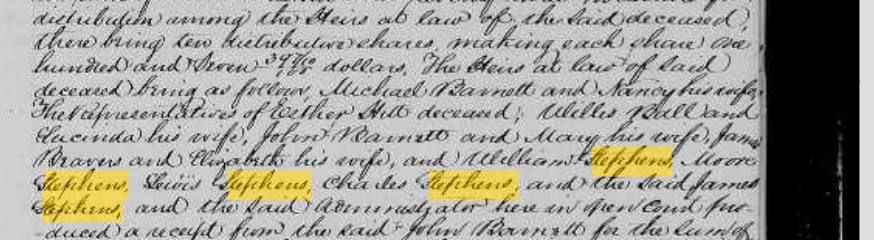
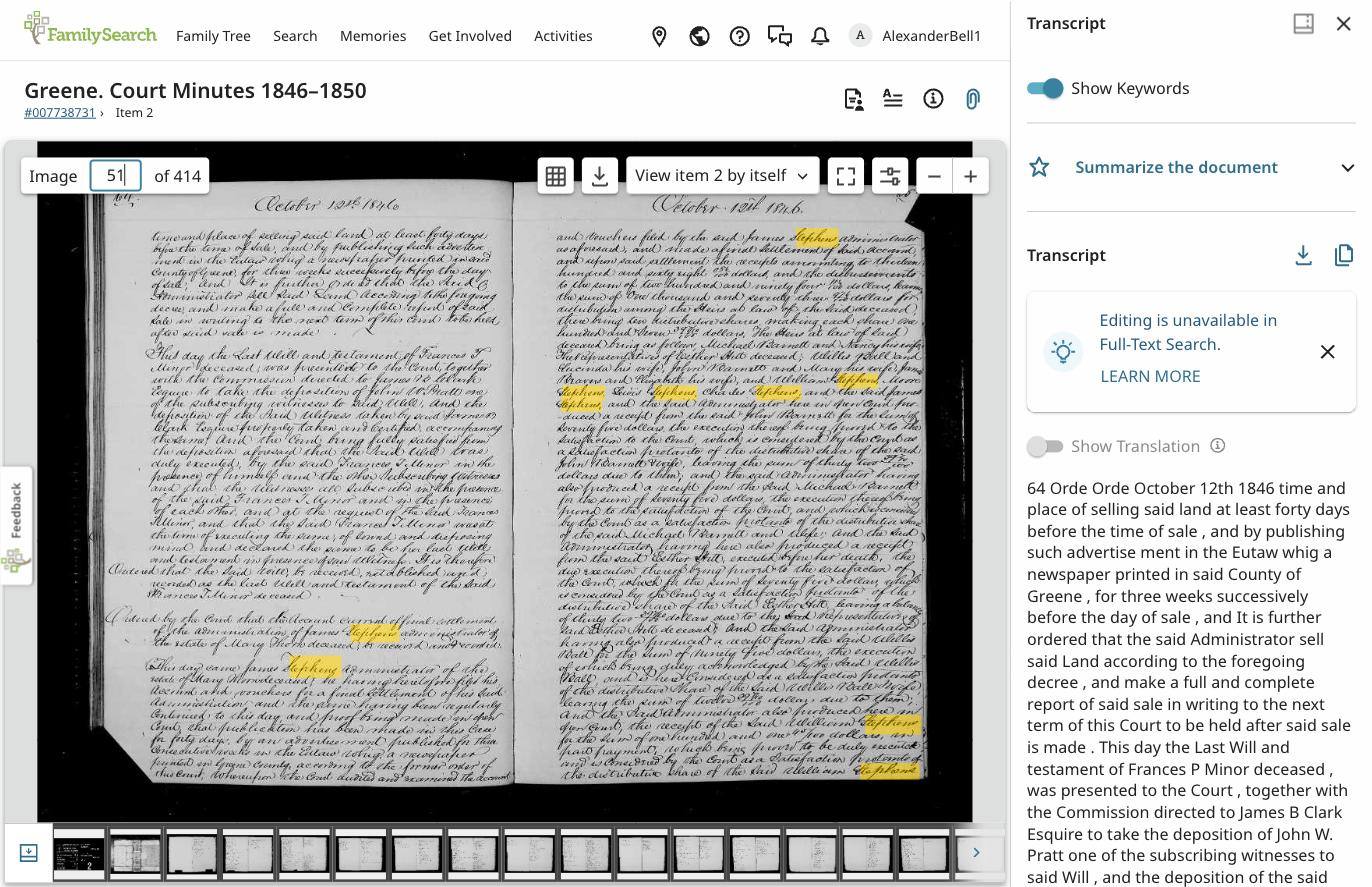
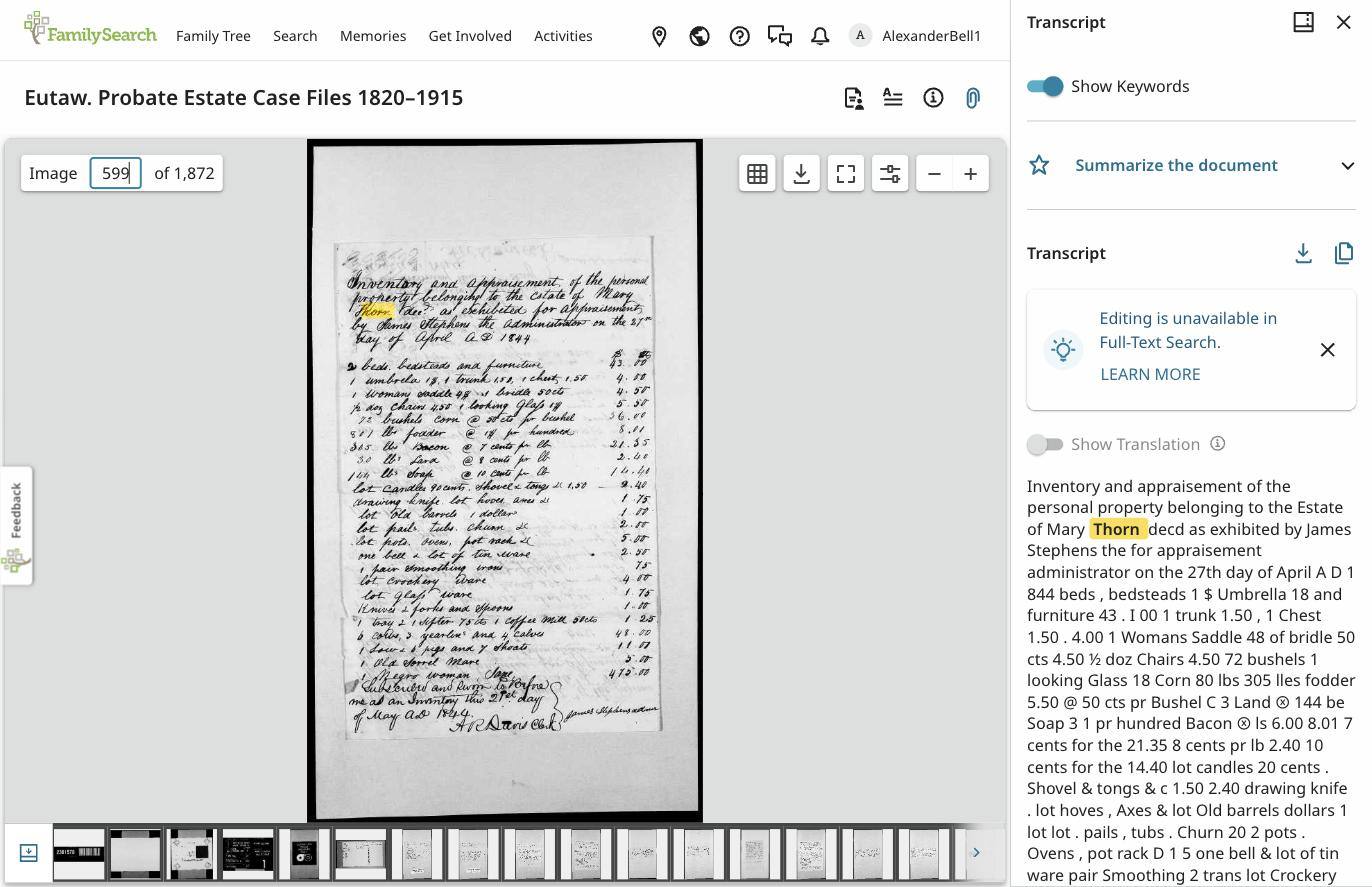
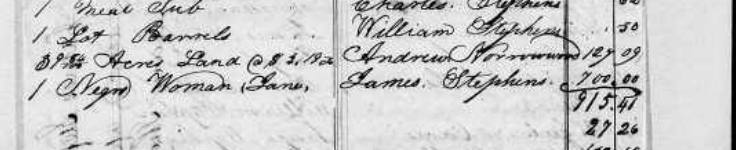
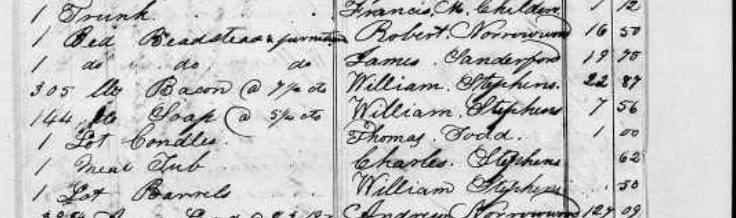
Mary Thorn, also spelled Thorne, was the widow of James Thorn of Greene County, Alabama, and died shortly before 23 January 1844. She is believed to have been born a Stephens and to have been the mother, by an earlier marriage, of ten children — Moore, James, Lewis and William Stephens, and daughters Esther Hitt, Lucinda Ball and Elizabeth Bevers — who inherited her estate in equal shares. Among her possessions was an enslaved woman named Jane, sold for $700 in April 1844, easily the largest part of everything she owned. The tie between Mary and these ten Stephens children is a strong hypothesis rather than a settled fact, since no surviving document actually calls them her children.
Evidence
Also recorded: widow of James Thorn; d. shortly before 23 Jan 1844, Greene Co., Alabama
⭐⭐⭐ STEPHENS-21, folded into the chart 7 August 2026 — the strongest indication yet that she was a SECOND WIFE whose own next of kin were Stephenses.
The final settlement of James Thorn’s estate, Greene Co., Alabama Orphans’ Court Minutes, 14 October 1844 (p. 274), distributes his legacies to Jesse W. Thorn, Nazareth Thorn, James Thorn, William Henry Thorn and Elizabeth Crisp, plus the seven children of a predeceased son Kennedy Thorn. ⭐ Mary Thorn is not among the legatees — as widow she took a widow’s share, a different thing — and the Thorn sons formally released all claims against her estate, which was administered by a STEPHENS. Had she been their mother, her estate would have gone to them and no Stephens would have been appointed to it.
⚠⚠ A strong indication, not a proof. This node stays a hypothesis. ⭐ But it dates the document that should name JANE: Mary was James Thorn’s widow, so he died first, and Jane must have come to Mary out of his estate at the assignment of the widow’s share — a proceeding that itemises people by name and value. Greene County, probably 1841–1843.
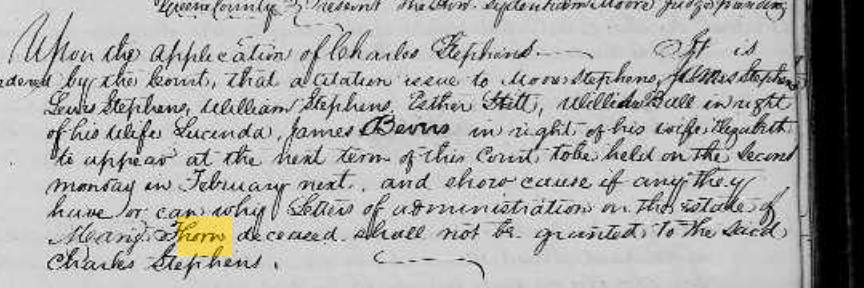
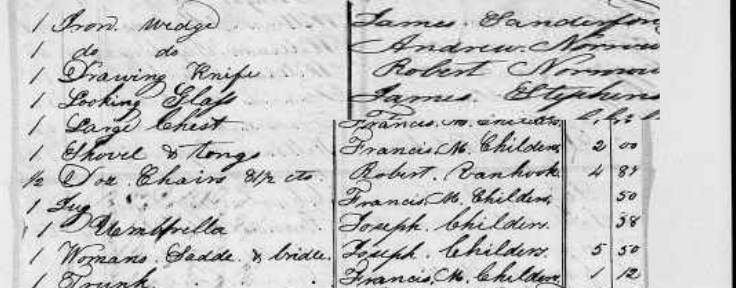
⭐⭐⭐⭐⭐⭐ SHE HAD A HUSBAND, AND HE IS NAMED — 7 Aug 2026 [STEPHENS-20].Greene County Orphans’ Court Minutes 1839–1845, ark 3:1:3Q9M-C91H-HSD8-M, image 723, page 274, 14 October 1844:“This day came Jesse W Thorn and William H Thorn administrators with the will annexed of JAMES THORN deceased … and JAMES STEPHENS administrator of the Estate of MARY THORN deceased (WHO WAS THE WIDOW OF THE SAID JAMES THORN) also appearing in open Court … the said James Stephens administrator as aforesaid acknowledge satisfaction in full of THE SHARE OF THE SAID WIDOW, his said intestate, to the estate of the said James Thorn deceased, and the said Jesse W Thorn and William H Thorn … release and discharge all claim or claims which they have or hold against the Estate of the said Mary Thorn deceased.” ⭐⭐⭐⭐⭐ AND THIS BEARS ON THE VERY DOUBT WRITTEN INTO THIS NODE. The outstanding note has said for days: “NO document yet uses the word ‘children.’ A childless woman’s next of kin can be nephews and nieces.”She now turns out to be a woman who died bearing the surname THORN BY MARRIAGE, whose next of kin are all named STEPHENS.The most economical explanation is that STEPHENS was her FIRST married name and THORN her second — which would make Moore, James, Lewis, William, Esther, Lucinda and Elizabeth her CHILDREN by the first marriage, exactly as the ten equal shares and Esther Hitt’s per stirpes “Representatives” already suggested. ⚠⚠ STRENGTHENED, NOT PROVED. The alternative survives: Stephens could be her MAIDEN name and the Stephens heirs her brothers and their families. The node stays ‘hyp’ until a document says so. ⭐⭐⭐ AND THE TWO DOCUMENTS THAT WOULD SETTLE IT ARE NOW NAMED AND LOCATABLE:① a marriage of MARY STEPHENS to JAMES THORN (Greene Co., Ala., or earlier in Orange Co., North Carolina, where Moore Stephens married in 1817); ② JAMES THORN’S WILL — the court calls his administrators “with the will annexed,” so a will exists, and a will names a wife and usually her children. ⭐ NEW NAMES: JESSE W. THORN and WILLIAM H. THORN, his administrators and very likely his sons. ⚠⚠⚠ AND IT REACHES JANE. Mary’s estate was paid the widow’s share of James Thorn’s estate. In Alabama in 1844 a widow’s share of an estate that held people WAS people.JANE — sold out of Mary’s estate on 29 April 1844 for $700 [STEPHENS-13] — may well have come to Mary out of JAMES THORN’S estate, and his WILL is the first document that could name her before the sale. ——— Earlier note:NEW NODE, 6 Aug 2026 — and NOT yet proved. The Greene County Orphans’ Court cited Moore, James, Lewis and William Stephens, Esther Hitt, Lucinda Ball and Elizabeth Bevers as her NEXT OF KIN on 23 Jan 1844 [STEPHENS-07], and distributed her estate among TEN heirs in equal shares in 1846 [STEPHENS-06]. Three of the sisters are proved born Stephens by their own Greene County marriage records [STEPHENS-08], and Esther Hitt’s share went per stirpes to her “Representatives” — the treatment a court gives a predeceased CHILD. ⭐ She held promissory notes on Charles Stephens ($15.13, $32.40) and Lewis Stephens ($100) — she was banking her sons [STEPHENS-12]. ⭐ Her inventory of 27 Apr 1844 lists her whole world down to an 18-cent umbrella and a woman’s saddle — and “1 Negro woman JANE — 475.00,” worth more than everything else combined [STEPHENS-11].
Outstanding: ⚠⚠ NO document yet uses the word “children.” A childless woman’s next of kin can be nephews and nieces. She is drawn here as a HYPOTHESIS. The petition to sell land, or a Stephens × Thorn marriage, would settle it. ⚠⚠⚠ JANE, 6 Aug 2026 — FOUND: the account of sales reads “1 Negro Woman Jane ... James Stephens ... 700.00,” sold 29 April 1844 to the administrator, Moore’s own brother [STEPHENS-13]. She was 65% of the whole estate ($700 of $1,075.86), so roughly $70 of Moore’s $107.39 share was her price. In 1850 James Stephens held 13 people in Greene Co.; Jane is very probably the 38-year-old woman, but that schedule names no one [STEPHENS-14]. ⭐⭐⭐⭐⭐ HER NAME IS ON THE OUTSIDE OF THE FILE [STEPHENS-19]: the clerk endorsed the packet “1105 · Greene County, Ala. · 1 NEGRO WOMAN JANE · Inventory of Notes · Estate file · Thorn, Mary · 1844 · James Stephens, administrator.”Everything Mary Thorn owned was summarised in two lines on the wrapper, and the first line is Jane. ⛔⛔ The packet is now BOUNDED — images 591–600, all read. The HIRE BOND and any PETITION TO SELL LAND are NOT in the loose papers (601 starts an 1825 estate; 589 is an 1861 guardian bond). Both must be sought in the GREENE CO. ORPHANS’ COURT MINUTE BOOKS 1844–46. ⚠ And the land was sold at the ordinary sale (Andrew Norwood, $127.09) — so a separate petition may never have existed, in which case this node may not be movable off ‘hyp’ by that route at all. Still owed: the 1870 census of Greene & Sumter Cos. for Jane.
Evidence images (described)
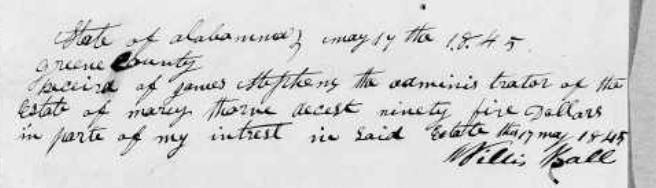
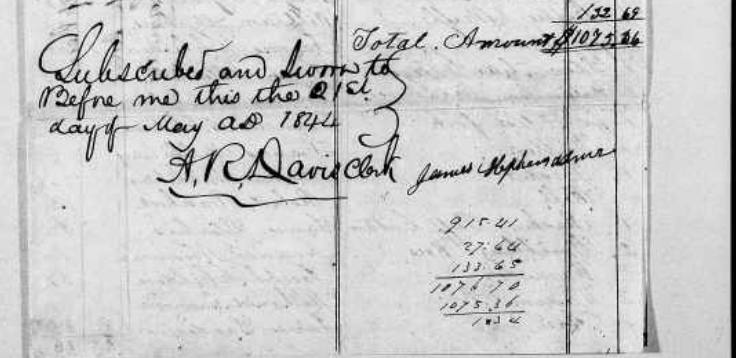
1846 estate settlement naming Mary Thorn's heirs — An Alabama court divided Mary Thorn's small estate among ten heirs in 1846, and one of them, Moore Stephens, may well have been her own son.Court minutes, full page — the Mary Thorn estate — The full page of the 1846 court record dividing Mary Thorn's estate among her ten heirs, with Moore Stephens counted among them.1844 citation to Mary Thorn's next of kin — In January 1844 an Alabama court summoned Mary Thorn's closest relatives to settle her estate, tying the Stephens siblings to her as next of kin.1845 receipt from the Mary Thorn estate — A receipt signed by heir Willis Ball in 1845 helped researchers track down where Mary Thorn's scattered family had settled by then.Mary Thorn's estate inventory, 1844 — A room-by-room inventory of everything Mary Thorn owned when she died in 1844, down to her farm tools and household goods.Inventory listing the enslaved woman Jane, $475 — The final line of Mary Thorn's 1844 inventory lists a woman named Jane, enslaved by the family and valued at $475, a hard fact worth remembering plainly.Account of Jane's hire and the estate's sale proceeds — This account shows Jane, the woman Mary Thorn had enslaved, was hired out for seventeen months before the rest of the estate's goods were sold.Bill of sale: Jane sold to James Stephens, 1844 — The 1844 sale record shows Jane was sold for $700 to James Stephens, keeping her within the same family rather than sending her elsewhere.Mary Thorn's estate, account of sales, page 2 — Another page from the 1844 sale of Mary Thorn's estate, itemizing the household goods and livestock auctioned after her death.Mary Thorn's estate, account of sales, page 2 — A further page from the same 1844 estate sale, listing what Mary Thorn's modest household brought at auction.Estate sale total and administrator's sworn oath, 1844 — The bottom of the sale account, showing the total money raised and the administrator's sworn oath that the figures were honest.
Elisha Truitt or Noel Truett (1786–1864 / 1769–1850 — disputed)
Ahnentafel #352 · his father’s mother’s mother’s father’s father’s father’s father’s father (8 generations back) · Hypothesis — a candidate, not tied in
Two men have been proposed as the father of Rev. William Hampton Truett: Elisha Truitt, who lived from 1786 to 1864, and Noel Truett, who lived from 1769 to 1850. Elisha is thought the more likely candidate, since a grandson, John Wesley Truett, named his own son Elisha Dozier Truett in 1877, a naming pattern common when honoring a grandfather. The question remains unsettled and awaits South Carolina and early Alabama land and probate records.
Evidence
The tree offers two conflicting fathers for Rev. William Hampton Truett. One piece of real evidence points to Elisha: John Wesley Truett named a son Elisha Dozier Truett in 1877, and families of this period named children for grandfathers with great regularity.
Outstanding: Not settled — needs South Carolina and early Alabama land and probate records. “Dozier” is itself a surname and may carry another connection.
Susan Wiggins (1789 – 1860)
Ahnentafel #353 · his father’s mother’s mother’s father’s father’s father’s father’s mother (8 generations back) · Hypothesis — a candidate, not tied in
Susan Wiggins lived from 1789 to 1860. She is carried in the family record alongside both of the men proposed as her husband, since it has not yet been determined which of the two candidates she actually married.
Evidence
Shown with both candidate husbands.
Gershom Tuttle II (1738 Farmington Conn. – 1818)
Ahnentafel #384 · his mother’s father’s father’s father’s father’s father’s father’s father (8 generations back) · Documented — person and parent-link established · Revolutionary patriot
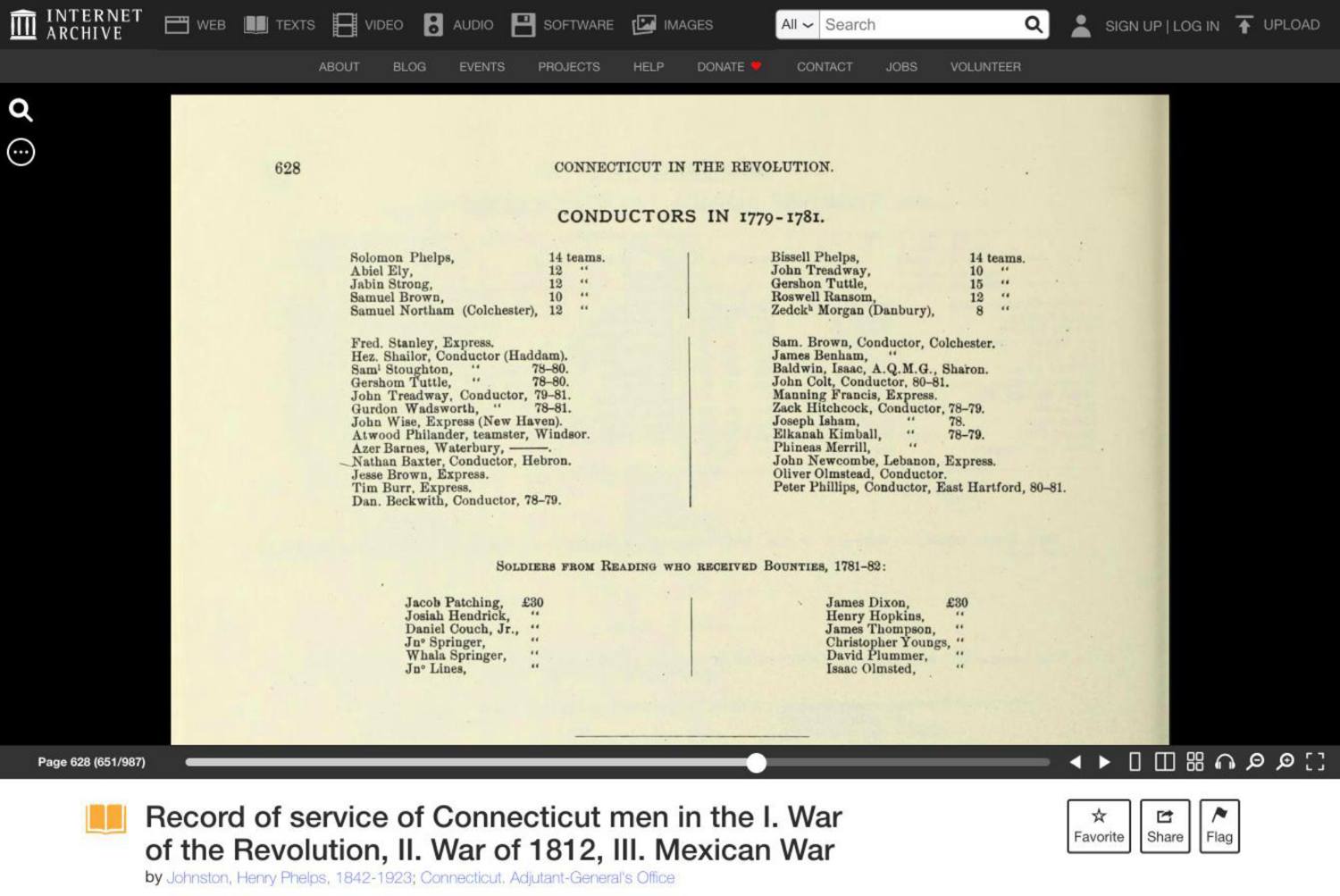
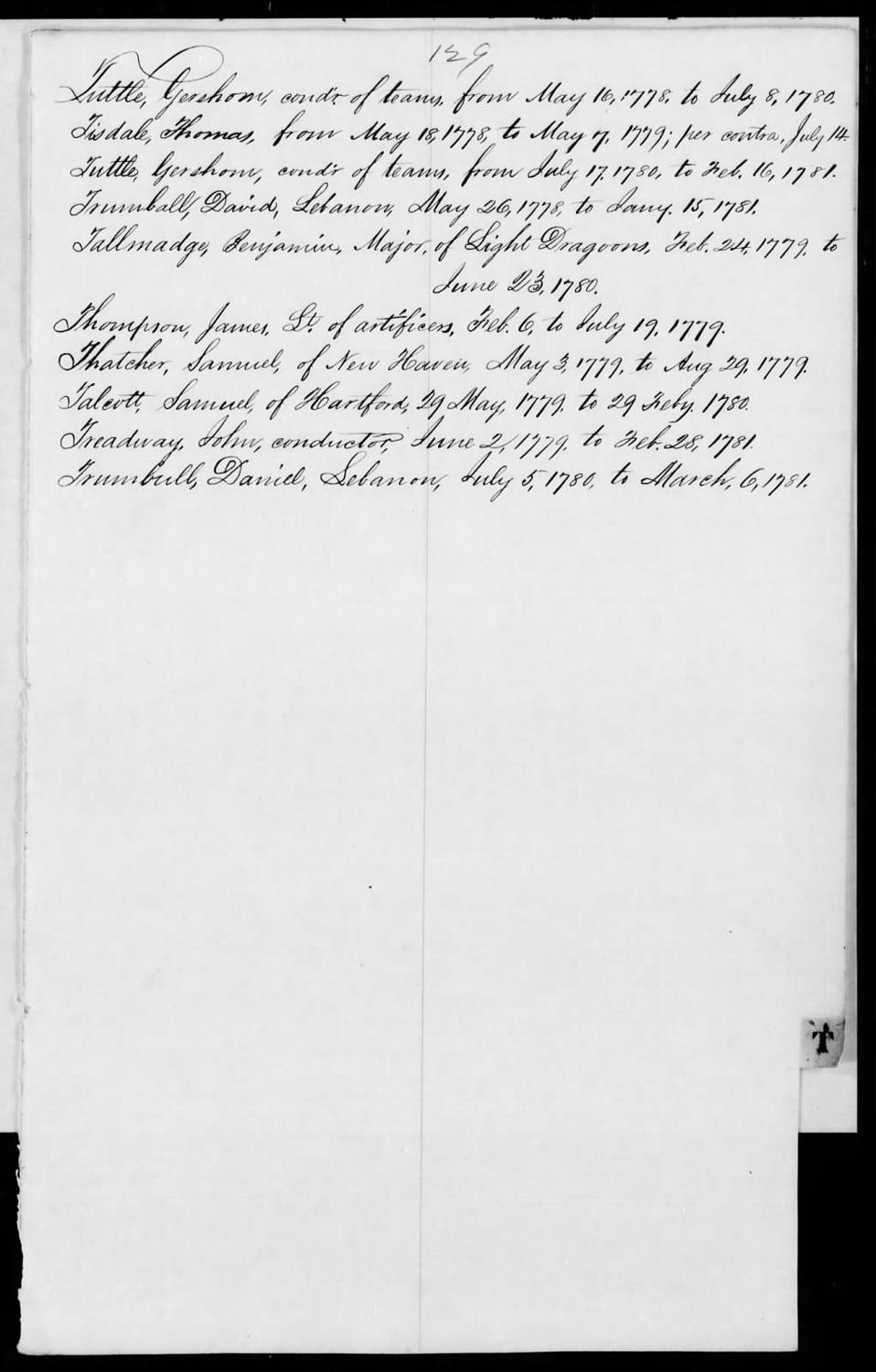
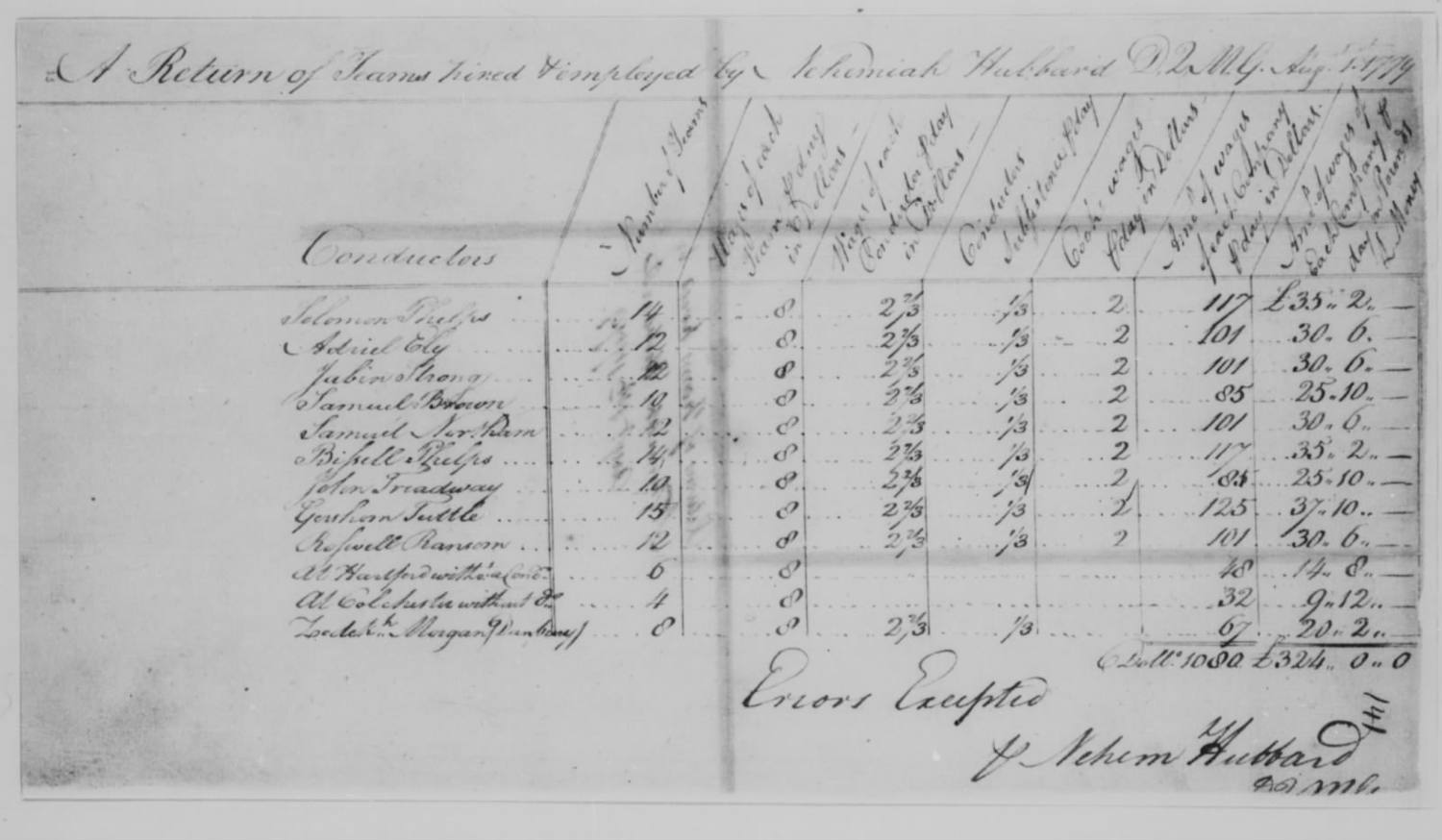
Gershom Tuttle II, remembered as "the Patriot," was born 22 August 1738 in Farmington, Connecticut (in the New Cambridge parish, now Bristol), and died, according to the family genealogy of 1883 and the DAR’s record, on 5 January 1818. During the Revolutionary War he served as a teamster, conducting wagon trains of army provisions — an operation that hauled some 3,000 barrels of supplies, roughly 500 tons, from Connecticut into New York State. The Connecticut General Assembly paid him for this service in 1780, and he is recognized today as Daughters of the American Revolution Patriot Ancestor A131791.
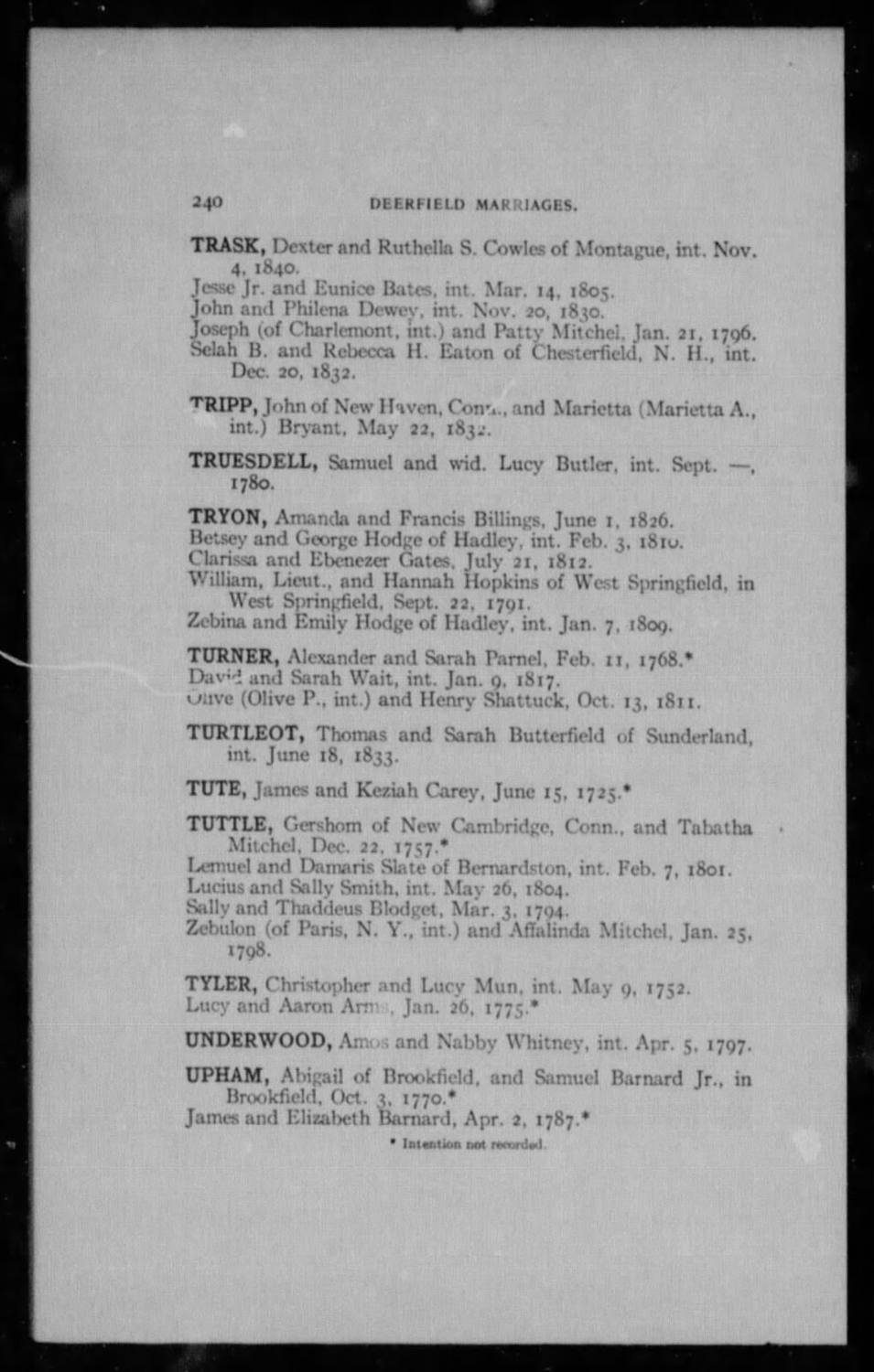
He married Tabitha Mitchell at Deerfield, Massachusetts, on 22 December 1757. The couple later moved first to Claremont, New Hampshire, where his father had died and where he signed a town petition in 1789 and was counted in the 1790 census, then to Clinton in Oneida County, New York, and finally to Watertown, New York, where the family genealogy of 1883 makes him the first deacon of the town's first church, organized in 1803. The church's own historian, who read its minutes, dates the Tuttle deaconship to 1808 and takes that Gershom Tuttle to be his son the colonel, so the honour may belong to the son.
Evidence
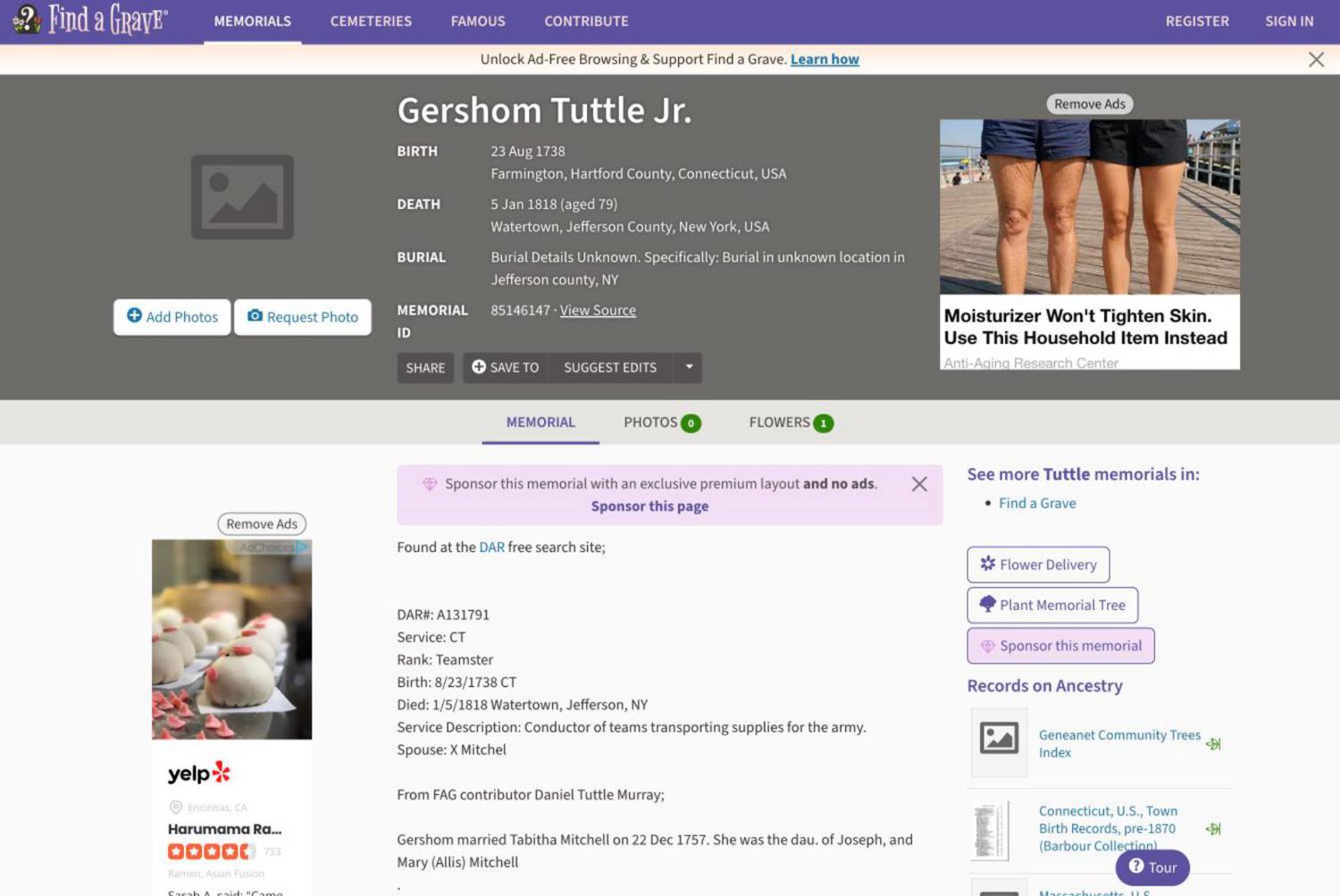
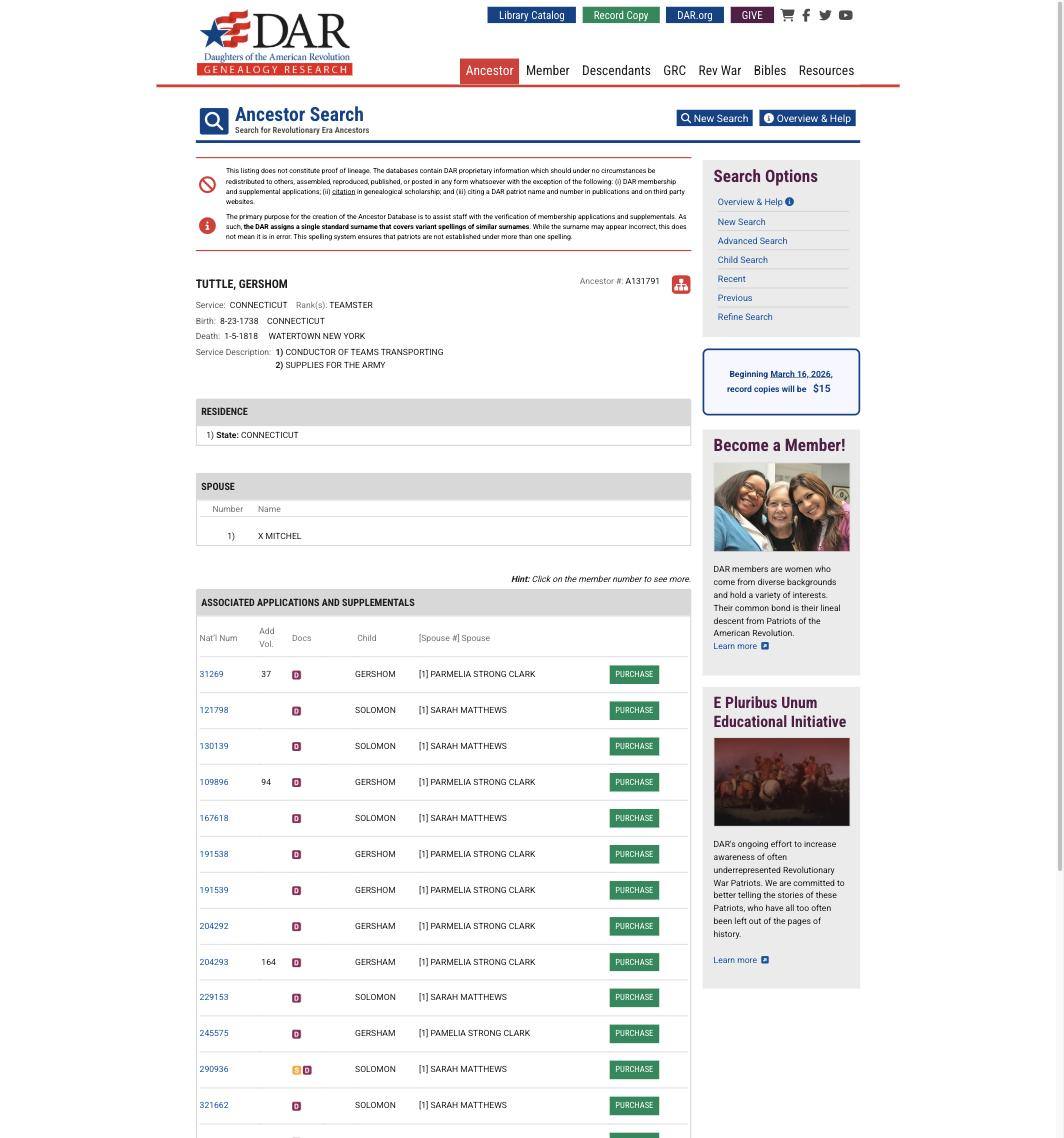
⭐⭐⭐⭐ THE DAR’S OWN RECORD, READ 7 AUGUST 2026 [TUTTLE-46].Ancestor # A131791 — TUTTLE, GERSHOM — Connecticut, rank TEAMSTER — b. 23 Aug 1738 — d. 5 Jan 1818, WATERTOWN, NEW YORK — “Conductor of teams transporting supplies for the army.”
⭐⭐ This settles two long-running conflicts in this project. The birth year is 1738, not 1739 — the DAR and the Farmington birth record agree. And he died at Watertown, New York, not in Indiana; the Otter Creek burial belongs to his son the colonel. (13 Sep 2026: the Indiana version was never in any source, and the DAR shows no source for Watertown — see Outstanding.) ⚠ One small gap survives: the Farmington register was read here as 22 August, the DAR says 23rd. Settle it from the register image before the SAR application is filed.
⭐ Eight of the DAR’s nineteen approved applications on this patriot descend through exactly our couple — “child GERSHOM, spouse PARMELIA STRONG CLARK” — including National No. 536770, which is the record copy already sitting in the frozen SAR Evidence folder [SAR_32]. The other nine descend through his son Solomon.
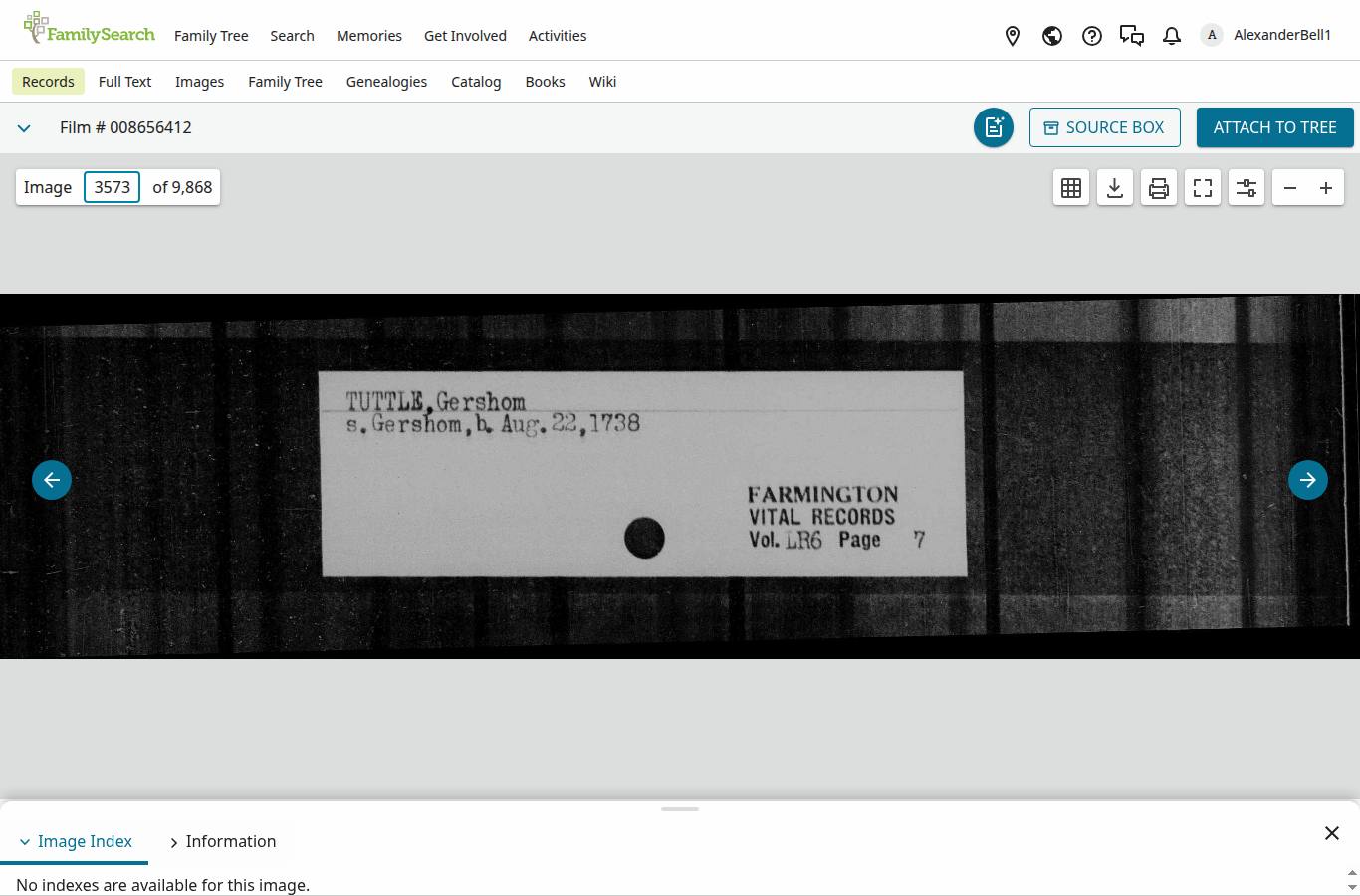
⚠ NUMBERED 6 Aug 2026 at Alec’s correction — he is GERSHOM II, between his father Ensign Gershom I (node 768, d. 1777) and his son Col. Gershom III (node 192, d. 1823). The 1777 headstone [TUTTLE-33] is his FATHER’S, not his — this man died 5 January 1818, forty-one years later. ⭐⭐⭐⭐⭐ HIS BIRTH RECORD FOUND 6 Aug 2026, AND IT NAMES A FATHER:“Gershom Tuttle, birth 22 August 1738, Farmington, Hartford, Connecticut — Father’s Name: GERSHOM TUTTLE” [TUTTLE-15]. ⚠ Our notes said 23 Aug 1739 Bristol; the record says 22 Aug 1738 Farmington. Bristol IS Farmington — Bristol was the parish of New Cambridge inside Farmington township until 1785, which is exactly how the 1757 Deerfield marriage styles him. The place is confirmed, not contradicted; the YEAR 1739 in our notes is probably wrong. THE PATRIOT. A conductor of teams. On 23 May 1780 the Connecticut General Assembly paid him £285.13.8 in wages and £60.13.11 for forage IN ADVANCE, and still owed him £200.2.8; he is listed first of nine conductors. The operation: 3,000 barrels of provisions — 500 tons — hauled from Connecticut into New York State, averaging 115 miles. DAR ancestor A131791. ⭐⭐⭐⭐⭐ 6 Aug 2026 — ENTRY 9251 OF THE 1883 GENEALOGY, IN FULL [TUTTLE-30]:“Gershom Tuttle, b. Aug. 23, 1738; d. Jan. 5, 1818, in his 80th yr.; served, it is said, as Capt. in Rev. army through the war. He went first to NEW HAMPSHIRE, thence, about 1790 to CLINTON, ONEIDA CO., N.Y., afterward joined the settlement at WATERTOWN, JEFFERSON CO., N.Y., and with William Fellows, elected the FIRST DEACON of the first Cong. chh., organized June 3, 1803.”This is the entry that validated the numbering ladder and broke the wall at his father. ⚠ DATE CONFLICT, RECORDED NOT RESOLVED: the entry prints Aug. 23 (first misread here as 28 — self-correction #461 [TUTTLE-148 §③]); his father’s child-list on the facing page prints “I. Gershom, b. Aug. 22, 1738”, and the Farmington town record says 22 August. The town record wins; the printed 23 is the book’s error (the DAR repeats it) and is logged, not dropped. ⭐ The New Hampshire stage is new, and Clinton/Oneida is now confirmed from a second direction.
Outstanding: ⛔ The “live conflict on his death place” is WITHDRAWN (13 Sep 2026, self-correction #462 [TUTTLE-148 §④]). The 1883 genealogy never says he died “on his son’s farm” at Otter Creek: his own entry (p. 508) gives only “d. Jan. 5, 1818, in his 80th yr.” with no place, and the Otter Creek removal on pp. 511–512 is his son’s. The phrase was a summary line in the frozen SAR evidence index that merged the two entries. ⚠ His death is still not documented by a record. “5 Jan 1818” is the book’s (no source) and “Watertown” the DAR’s (A131791 shows no sources); Find a Grave 85146147 copies the DAR. No Gershom Tuttle is in Jefferson County in the 1820 census, and four county histories and the Rutland and Watertown cemetery transcriptions record no death. ✅ The Bristol church entry “Loyal, his father d. Jan. 5, 1817, Æ 80” is Ebenezer Tuttle, the patriot’s first cousin, whose death at Bristol on 4 Jan 1817 aged 80 a contemporary newspaper reported (Hale abstract, 21 Jan 1817) — a same-name collision, not this man’s death misdated. The death is a loose end; identity and parentage stand on his father’s will.
Lead, 12 Sep 2026 [TUTTLE-146 §⑤]: FamilySearch full text indexes the 1777 will of Gershom Tuttle of Farmington (ark 3:1:3QS7-L92K-1NM8, proved 27 Sep 1777) naming “my three Sons Gershom, Oliver and Samuel Tuttle” and appointing “my Son Gershom” executor — the ensign naming the patriot. Image not yet opened (FamilySearch blocked the VM before the lane reached it); read it at the page and this rung is documented by the father’s own will.
⭐⭐⭐ DOCUMENTED BY HIS FATHER’S WILL, read at the page 13 Sep 2026 [TUTTLE-147 §⑤]: the will of Gershom Tuttle of Farmington, 9 May 1777, proved 27 Sep 1777 (Farmington District Probate Records vol. 1–3, p. 441; the original signed paper survives in estate file No. 2757) gives “my wellbeloved Wife Lois” a third for life and “all the remaining Part of my real & personal Estate unto my Three Sons Gershom, Oliver and Samuel Tuttle,” and appoints “my Son Gershom Tuttle whole and sole Executor.” The executor’s account of “Gershom Tuttel Executor” was allowed 25 Jan 1779. This supersedes the 12 Sep lead that rested on the full-text OCR alone.
⭐ NEW HAMPSHIRE, 1789–90, ON RECORD [TUTTLE-148 §⑤]: at Claremont on 17 Dec 1789 “Gershom Tuttle” and, next below him, “Gershom Tuttle Jr.” signed a recommendation of Ambrose Cossitt as justice of the peace, with Oliver Tuttle and Solomon Tuttle (N.H. State Papers vol. 11, 1882, p. 382, a printed transcript). The 1790 census of Claremont lists Gershom Tuttle (one man, one boy, three females) beside Oliver and Solomon — the only Gershom Tuttle household in the 1790 index. His father had died at Claremont in 1777. Beside his brother Oliver and his son Solomon, this is almost certainly the patriot, and it is the book’s “went first to New Hampshire” on record.
⚠ THE “FIRST DEACON, 1803” IS DOUBTFUL FOR HIM [TUTTLE-148 §⑨]: Kimball, Years of Faith (1953), who read the Session minutes, has the first deacons as Thomas Sawyer and Solomon Caulkins (17 June 1804) and “Gershom Tuttle and William Fellows” appointed deacons on 5 May 1808; he identifies the founding member Gershom Tuttle, in whose Rutland ballroom the church met, as the War of 1812 colonel. The 1883 book’s entry for this man may carry his son’s Jefferson County facts.
Photographs (described)
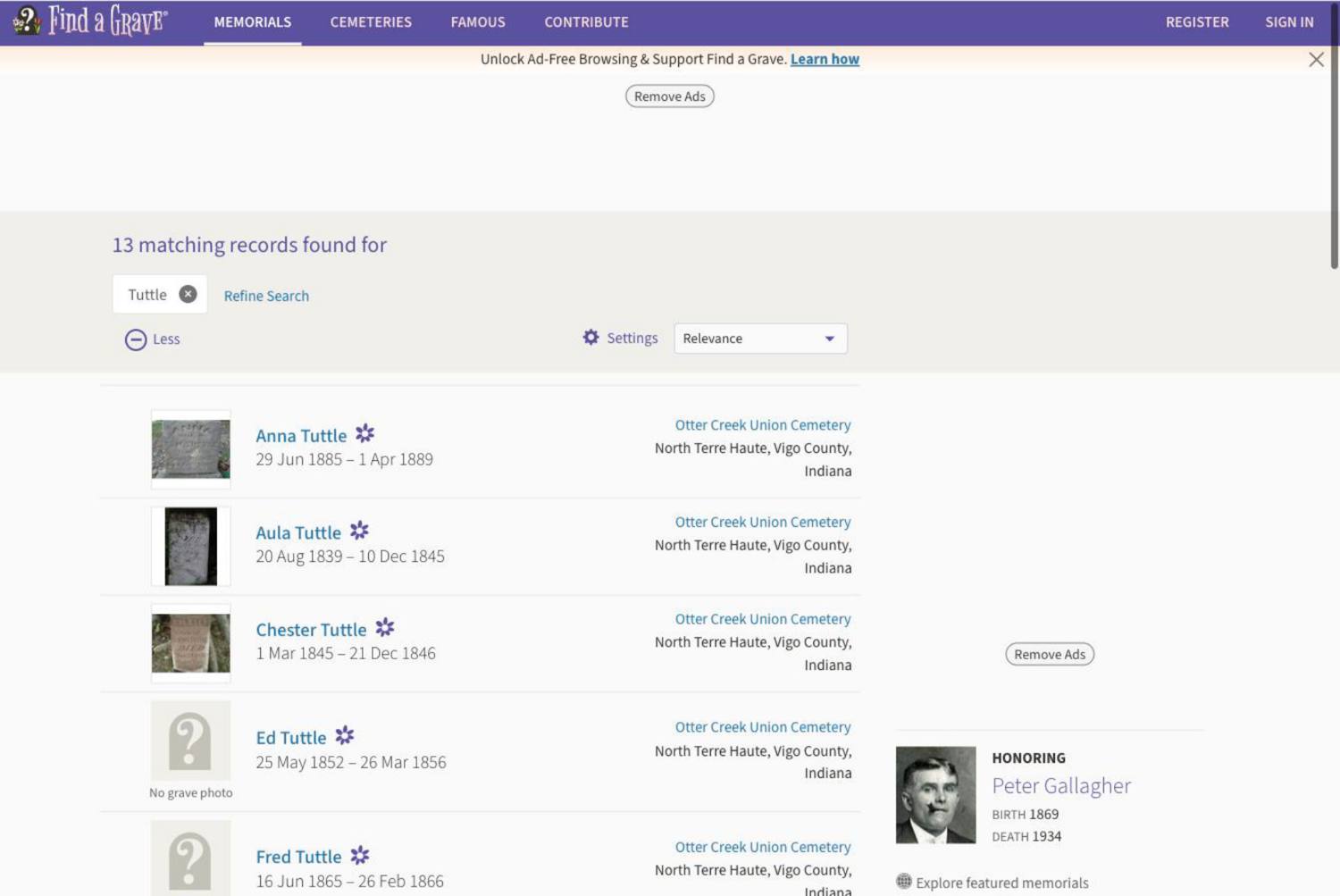
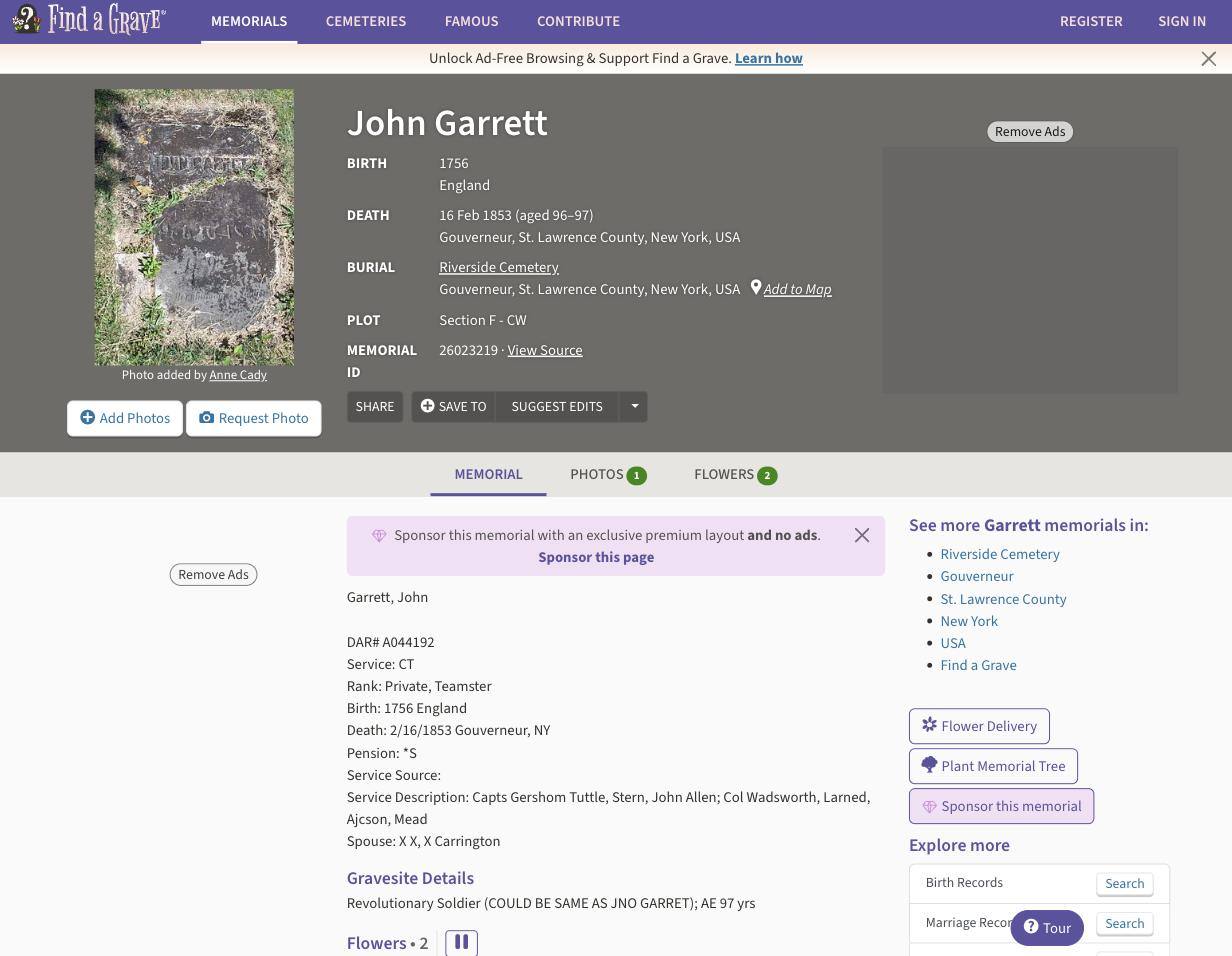
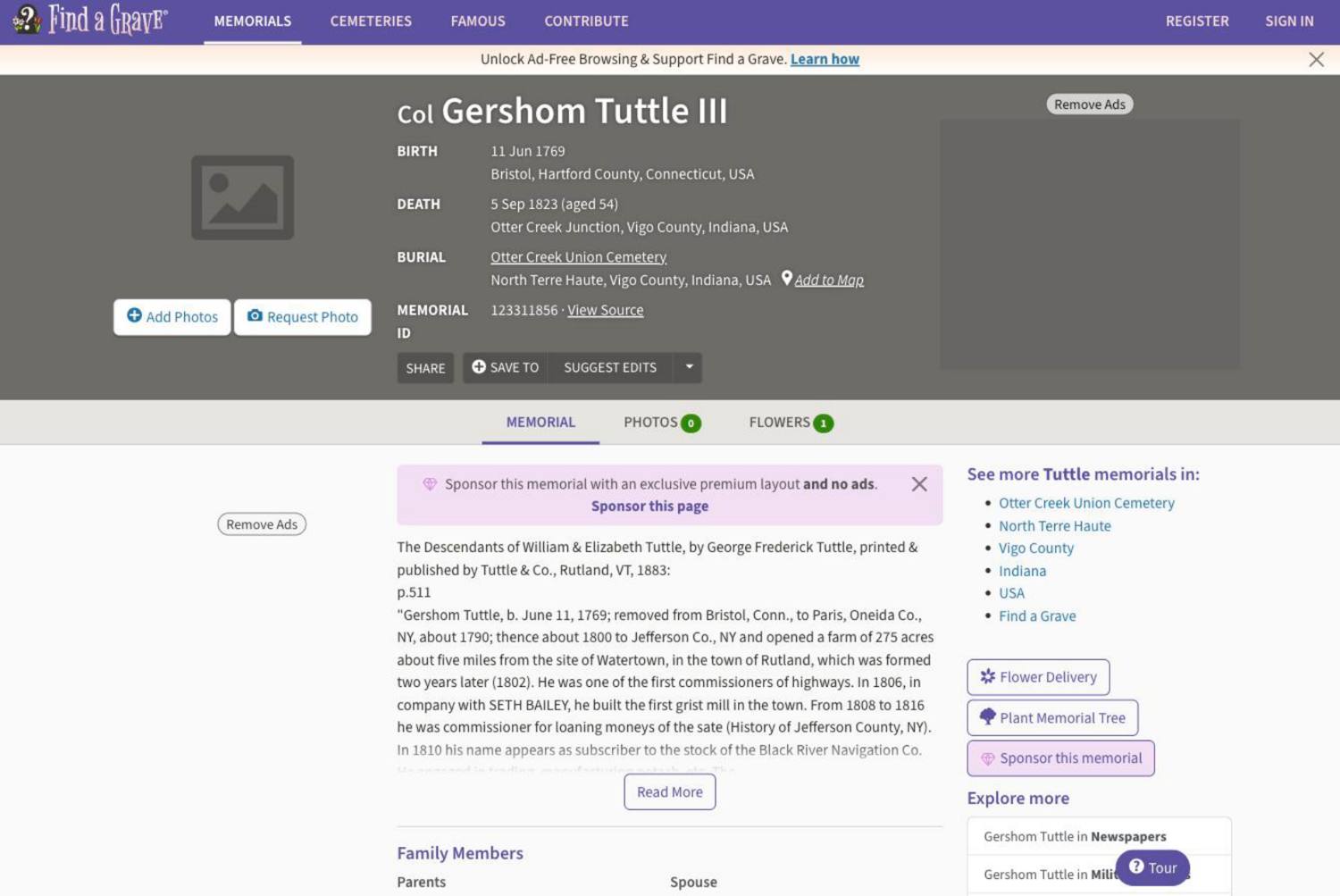
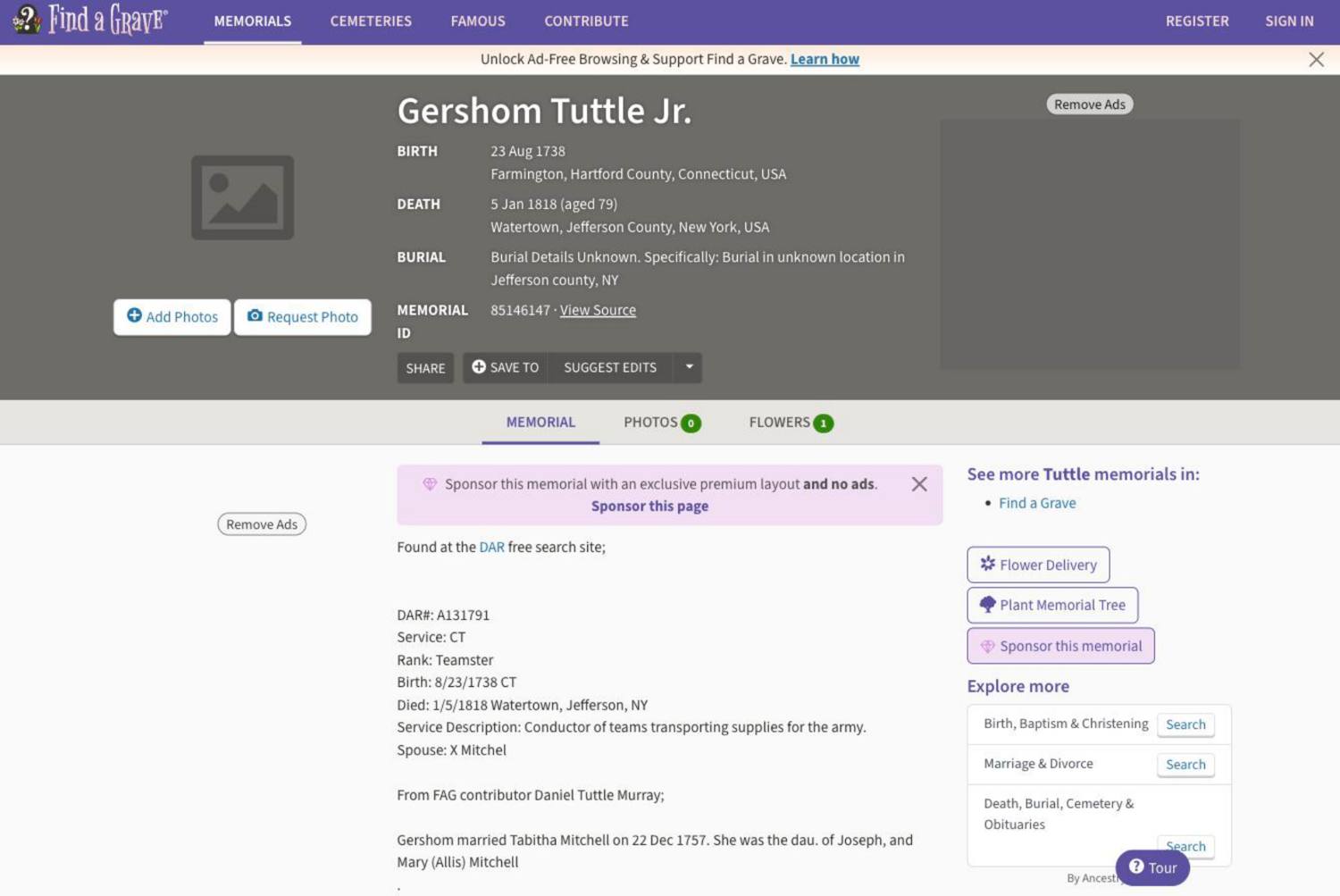
Find a Grave memorial for the Patriot Gershom Tuttle — This Find a Grave memorial carries the DAR's own service record for Gershom Tuttle, the Revolutionary War Patriot, though it disputes his burial place against the family's Indiana tradition.Otter Creek cemetery memorials, page one — These Find a Grave memorials from Otter Creek Union Cemetery help sort out a long-standing mix-up between patriot Gershom Tuttle and his son, the colonel, over who is buried there.Grave of a fellow Revolutionary soldier — This Find a Grave memorial for John Garrett, a Revolutionary War veteran, notes his own pension testimony naming Captain Gershom Tuttle.Otter Creek cemetery memorials, page two — This second page continues sorting out which Otter Creek Union Cemetery burial belongs to patriot Gershom Tuttle and which to his son Colonel Gershom Tuttle.Otter Creek cemetery memorials, page three — This third page completes the Find a Grave documentation resolving where patriot Gershom Tuttle and his son Colonel Gershom Tuttle are actually buried.
Evidence images (described)
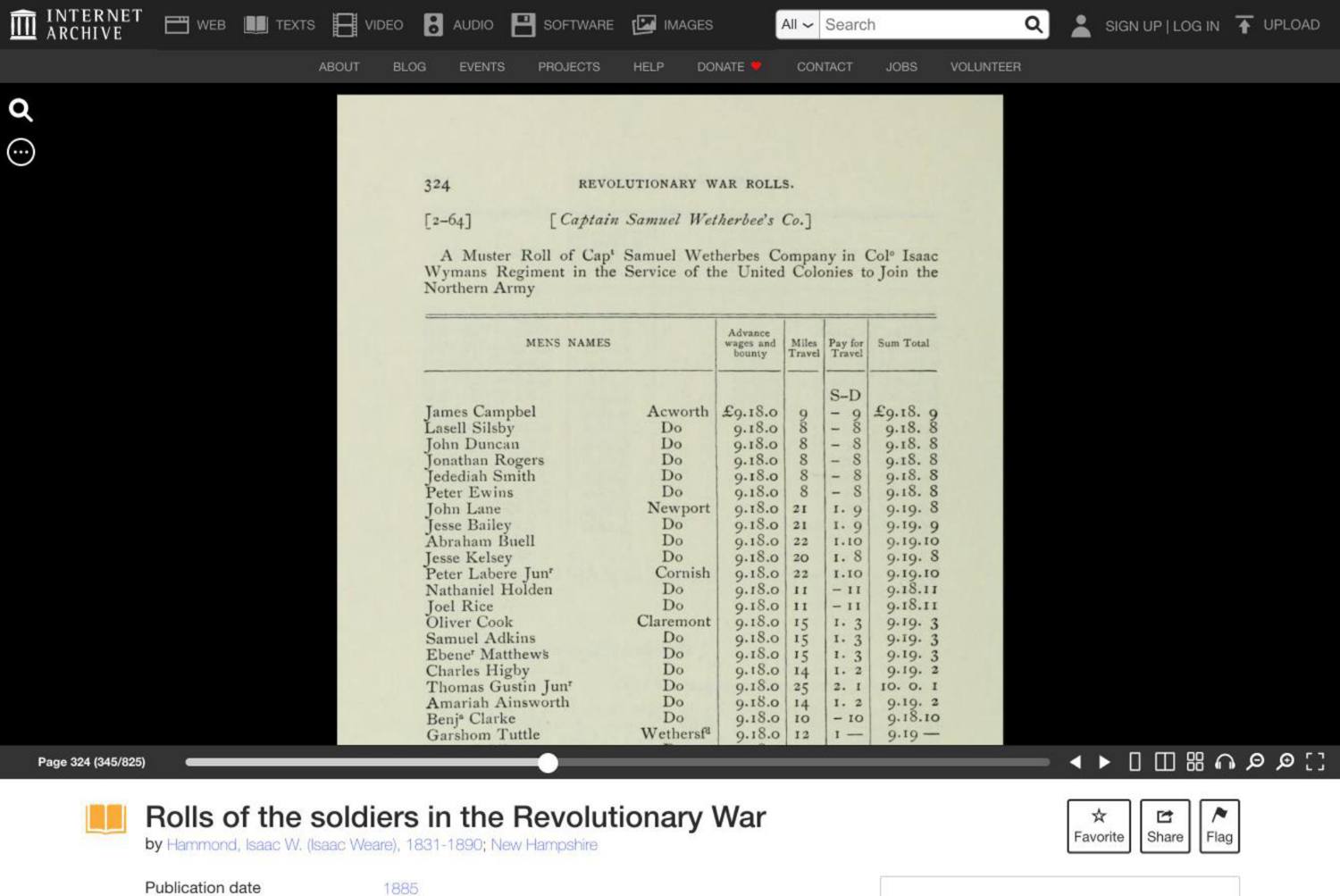
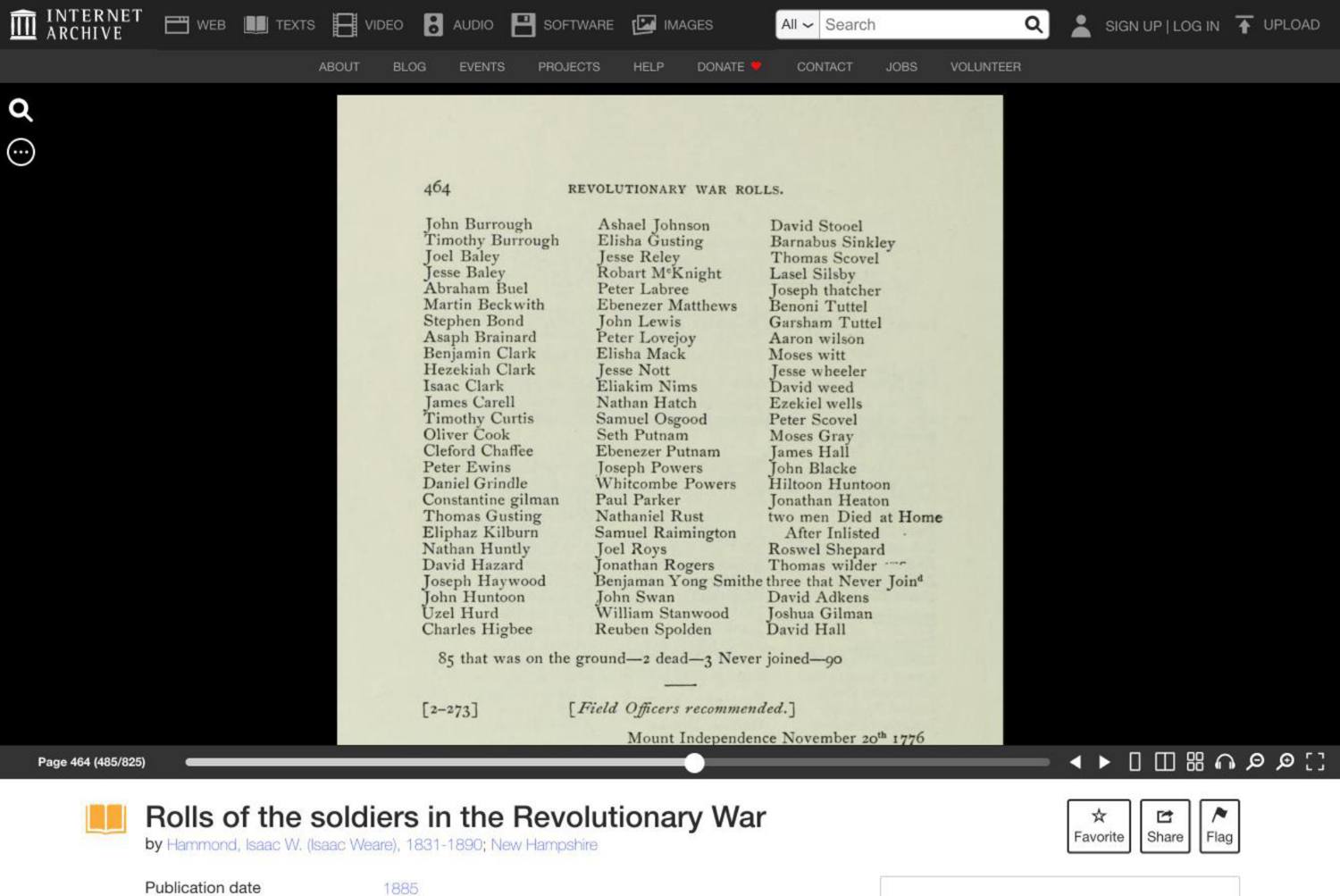
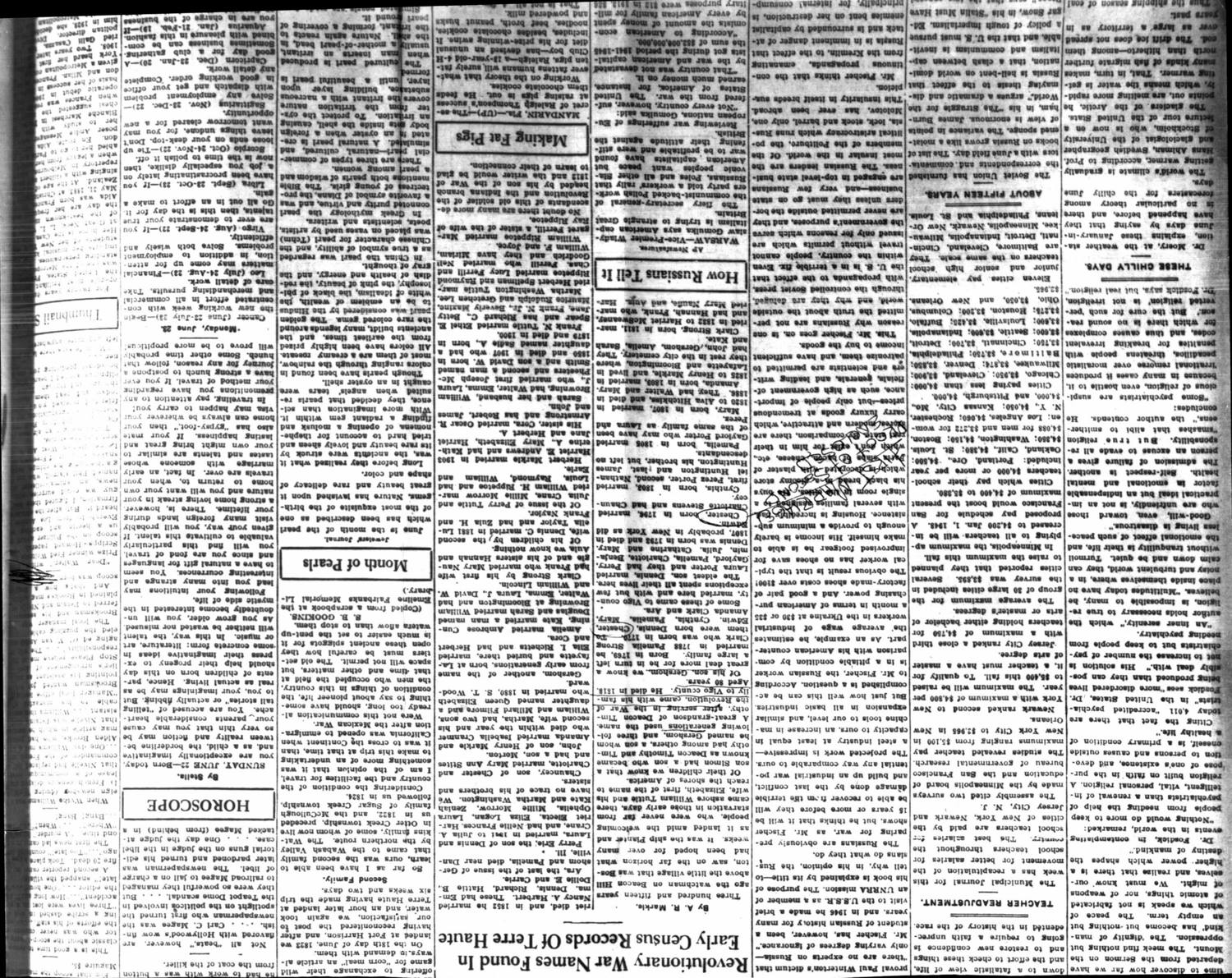
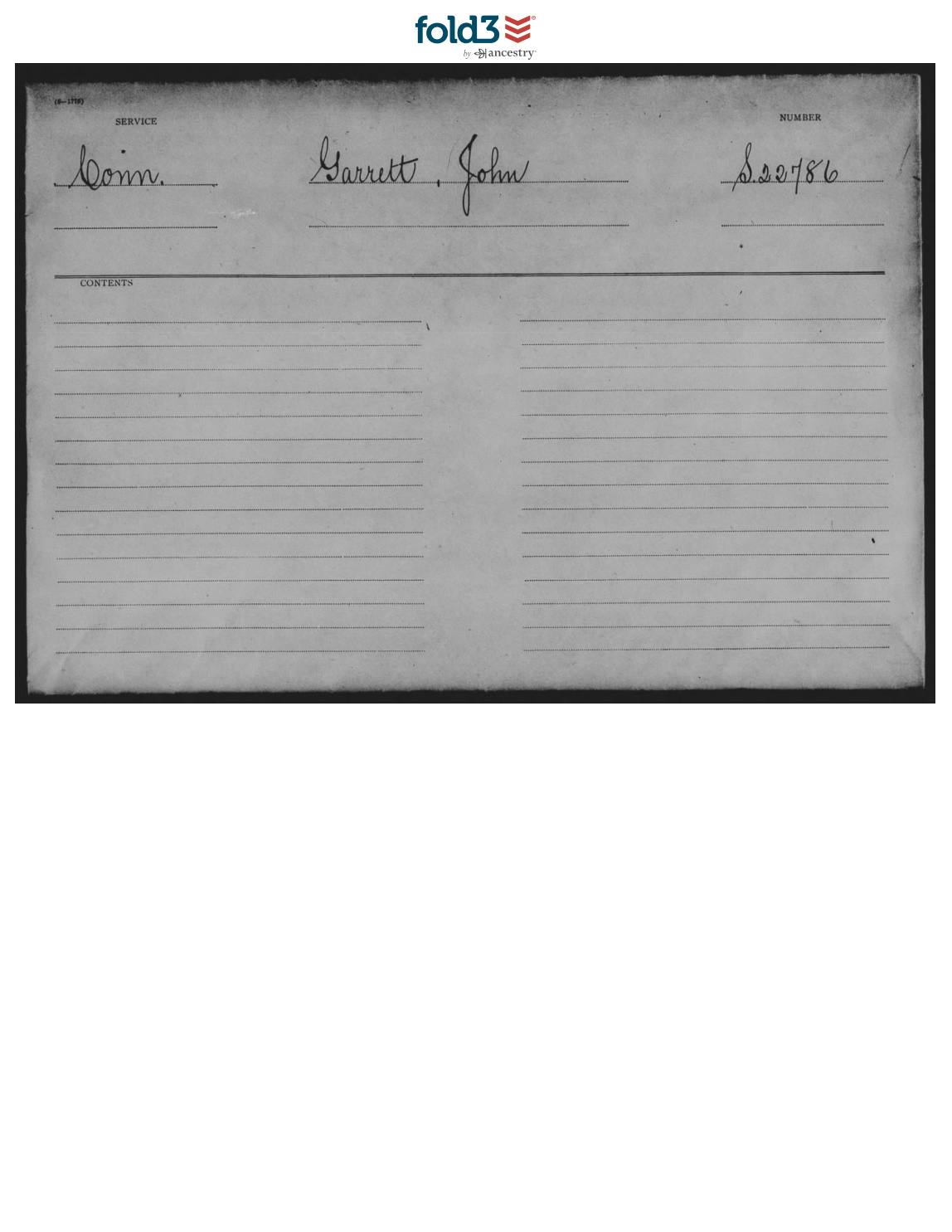
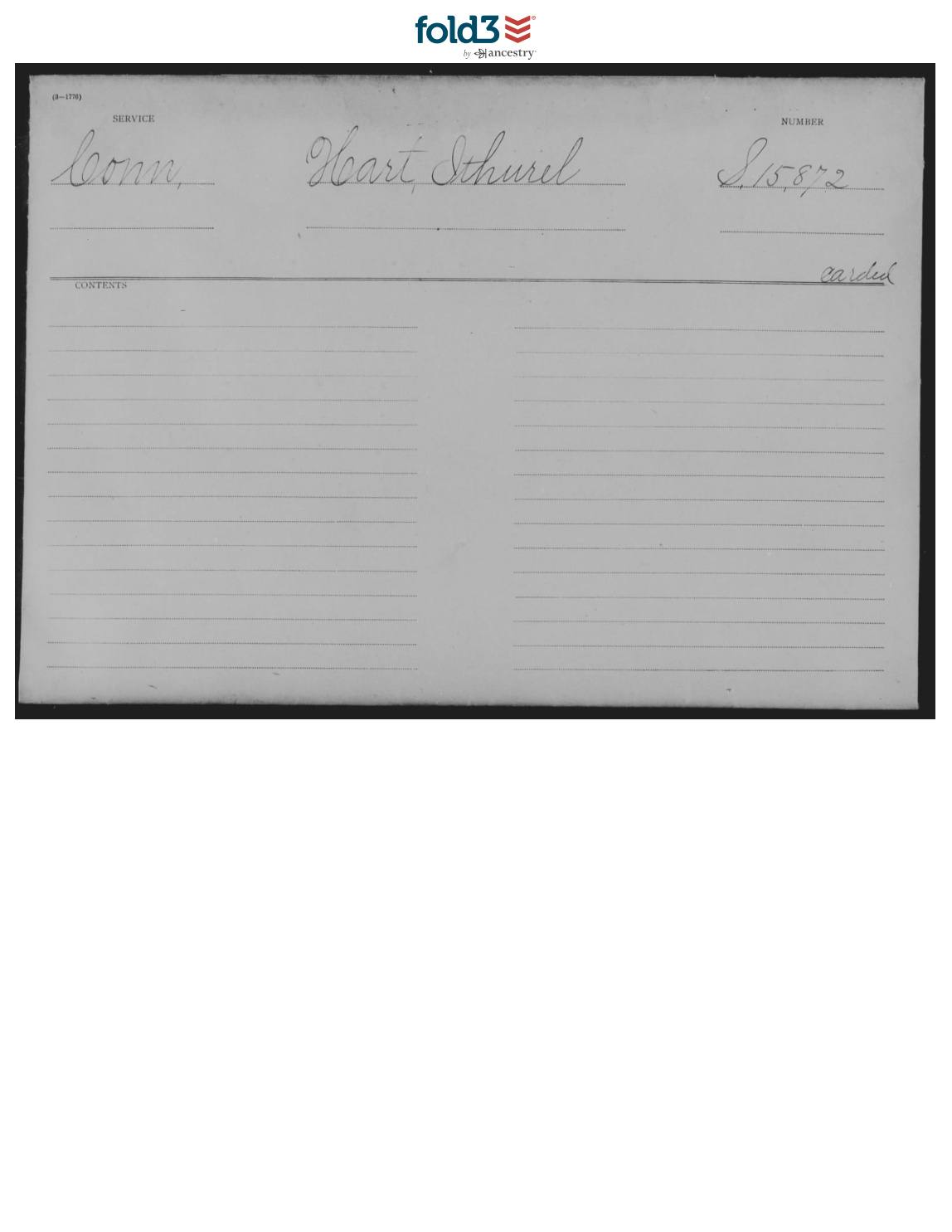
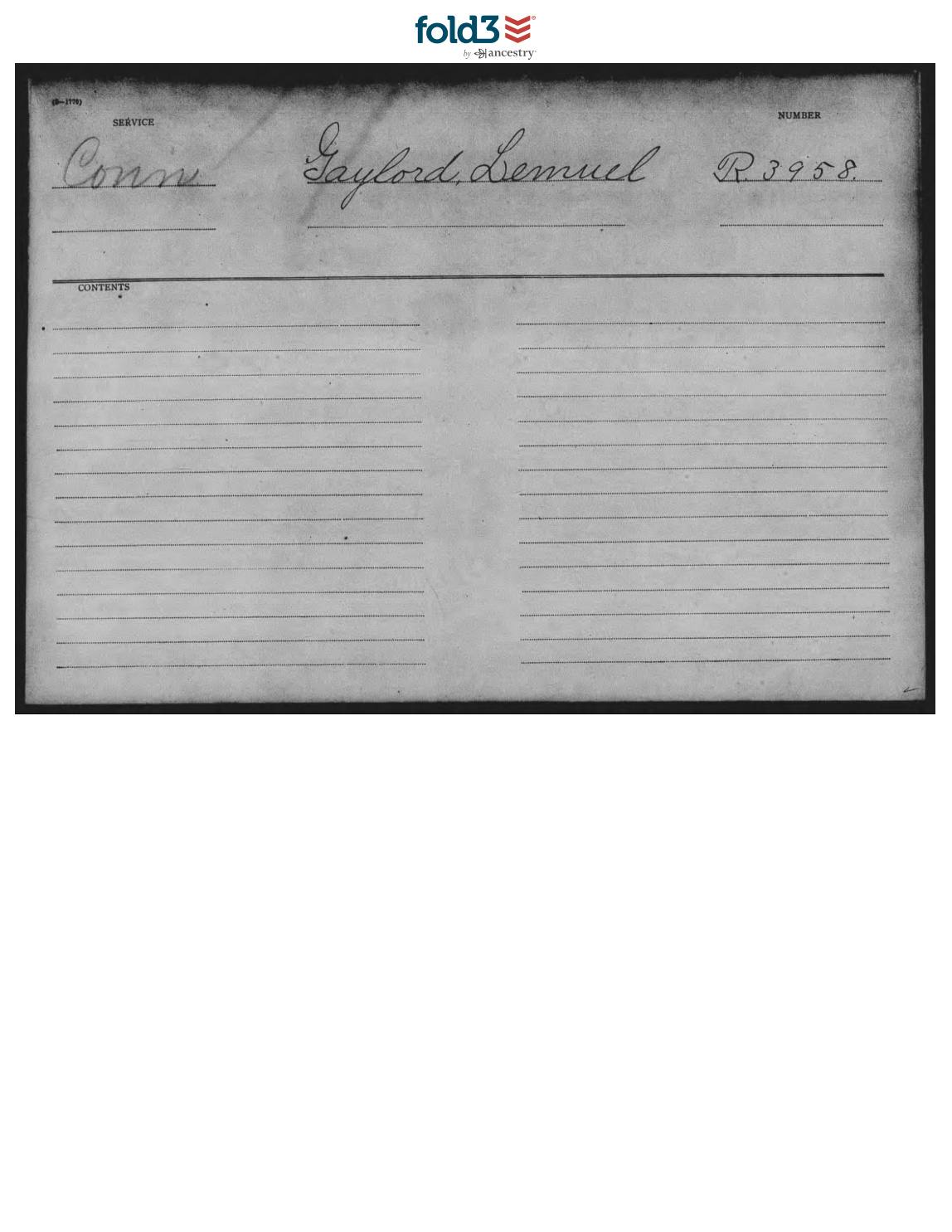
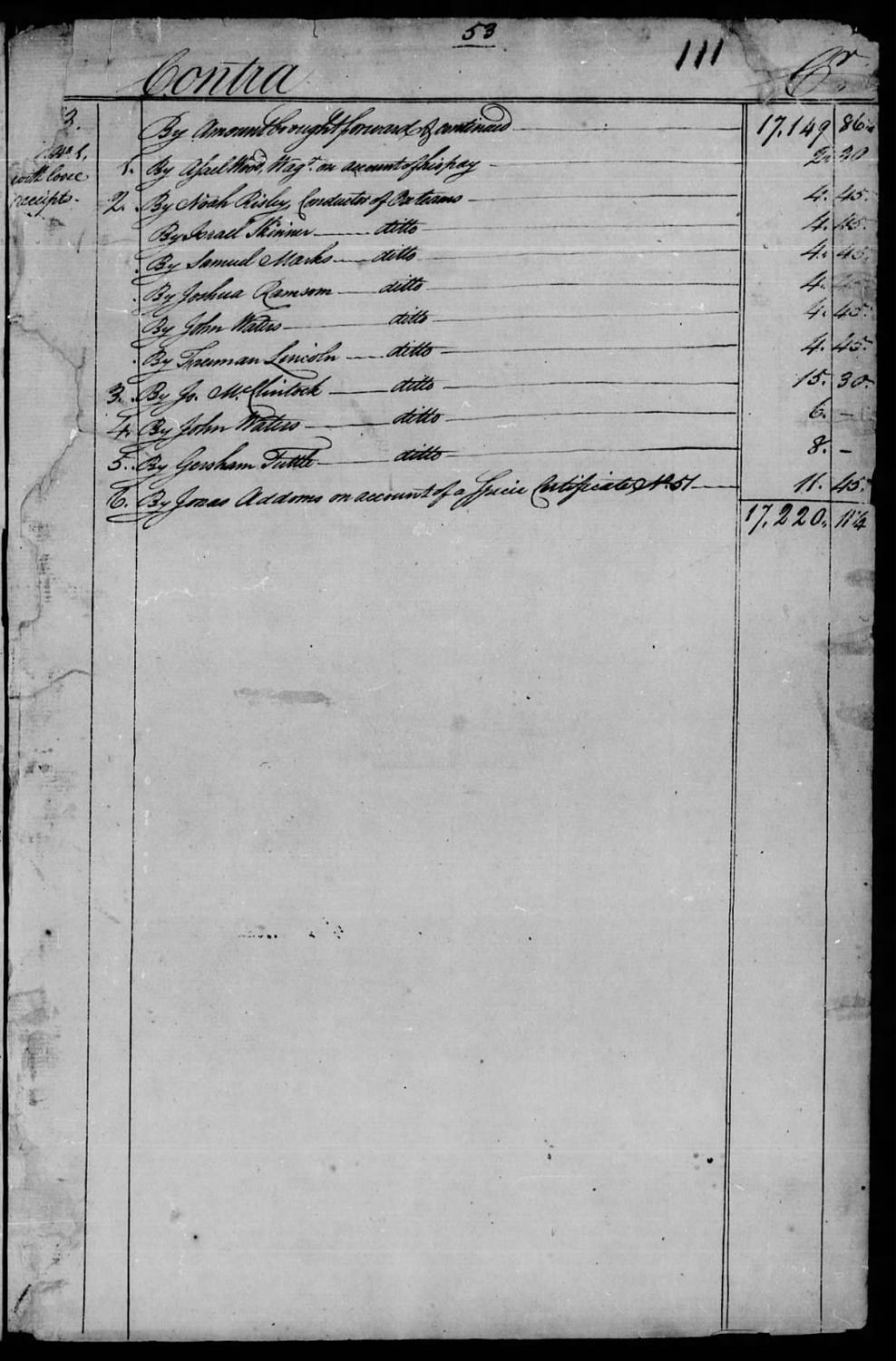
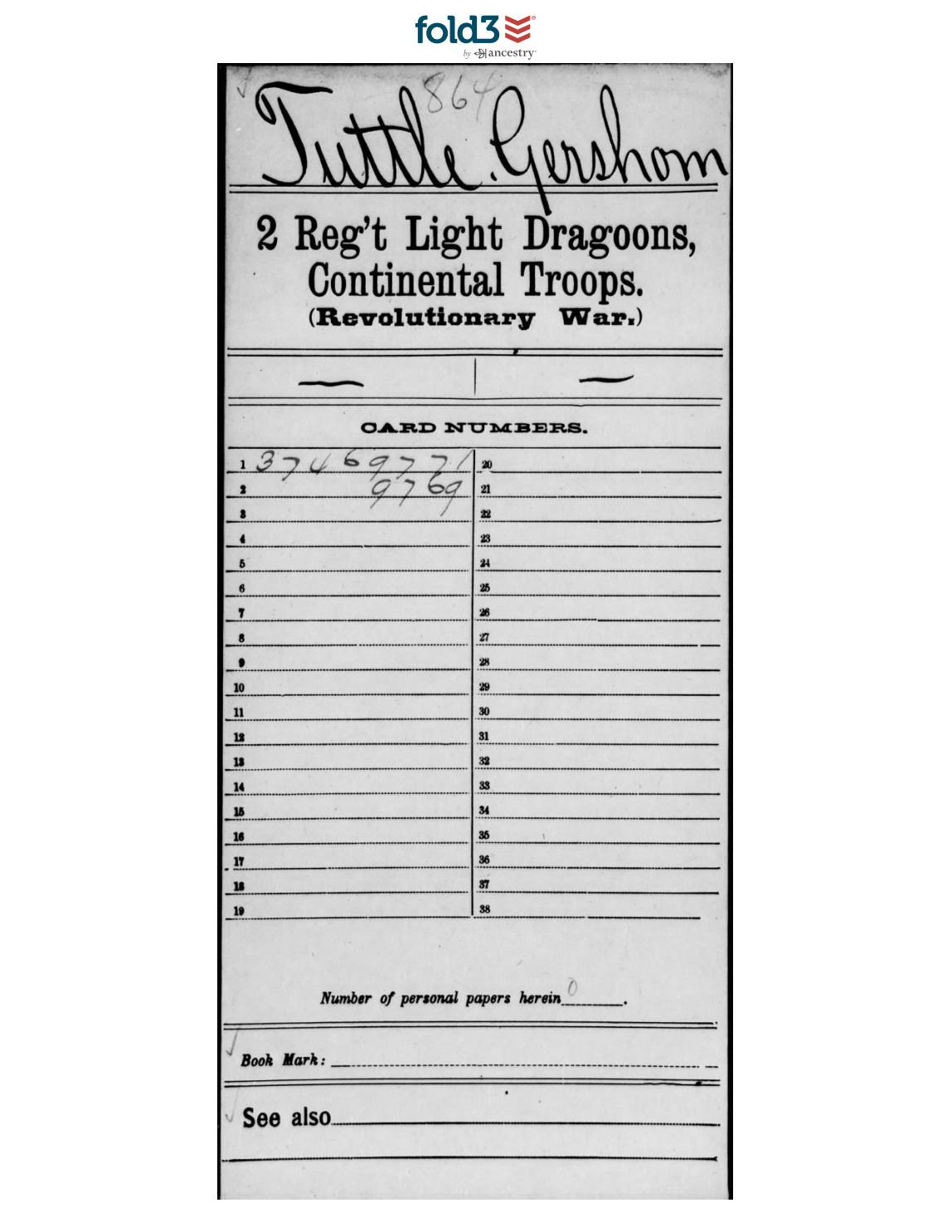
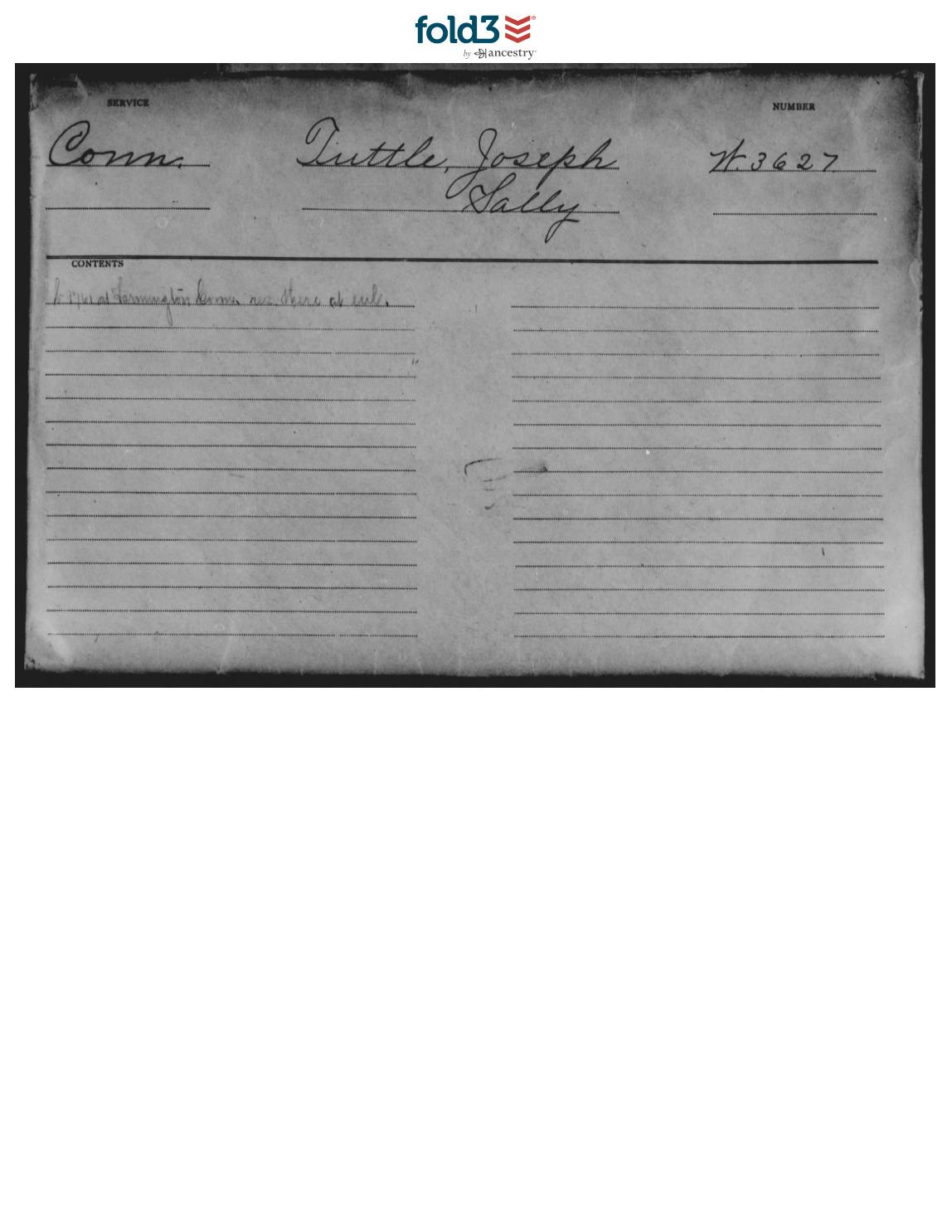
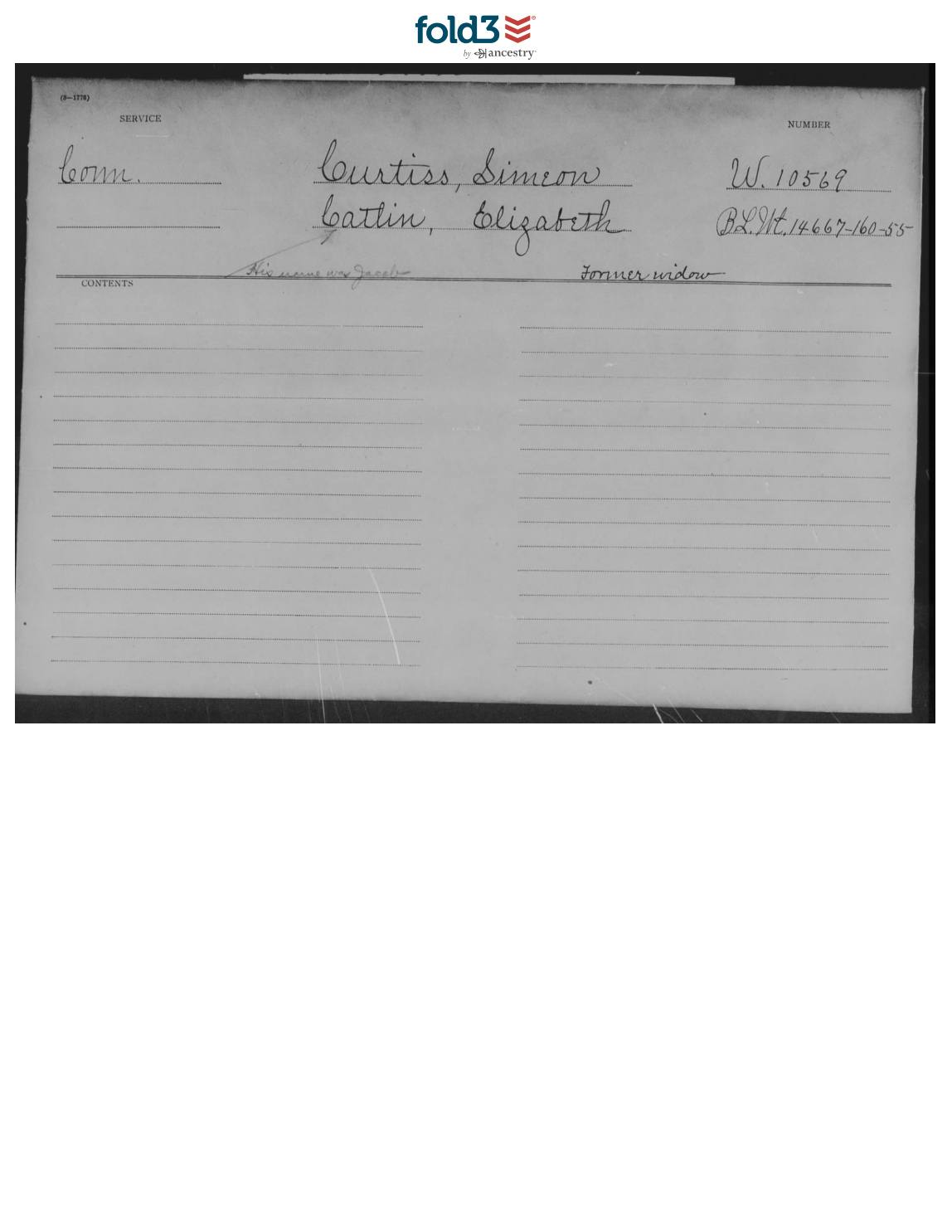
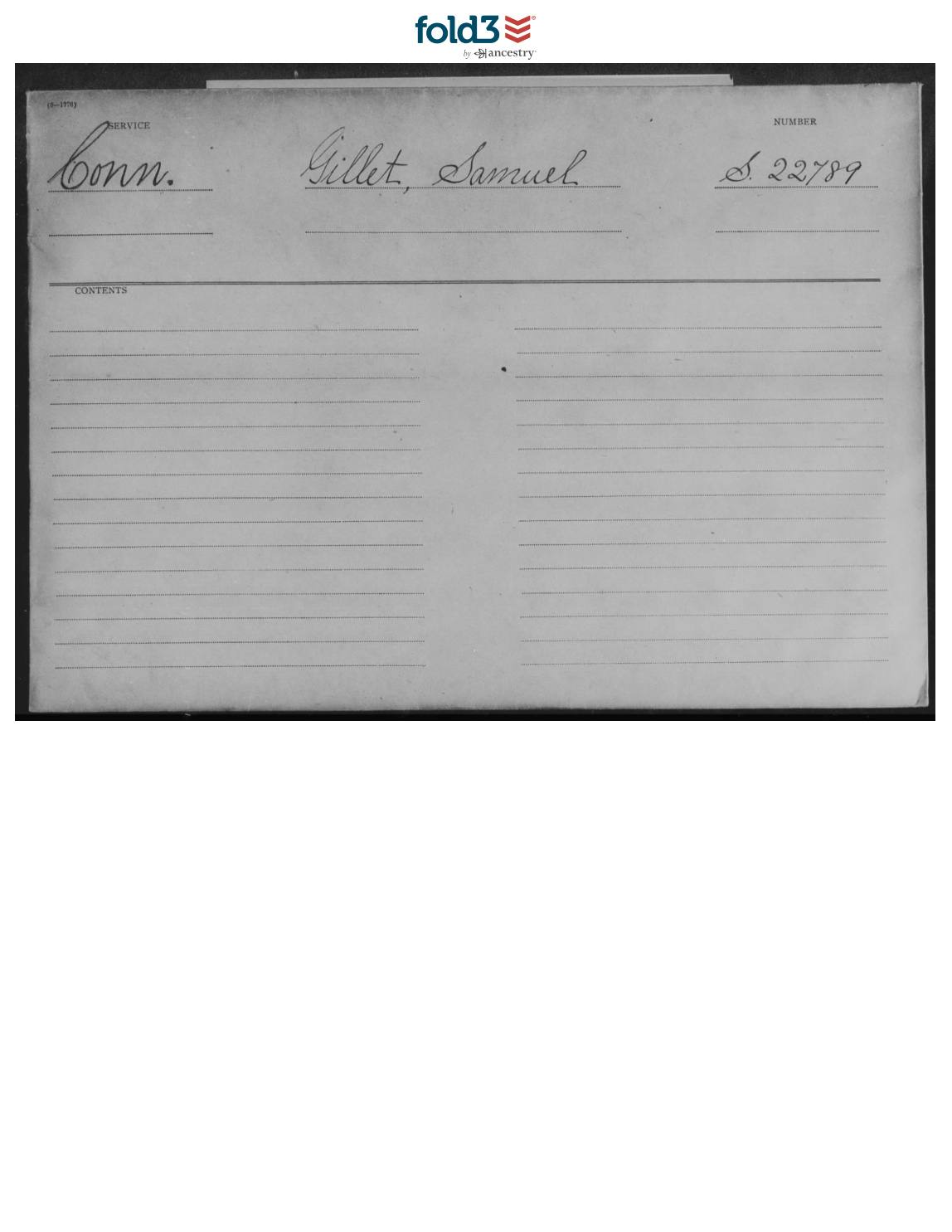
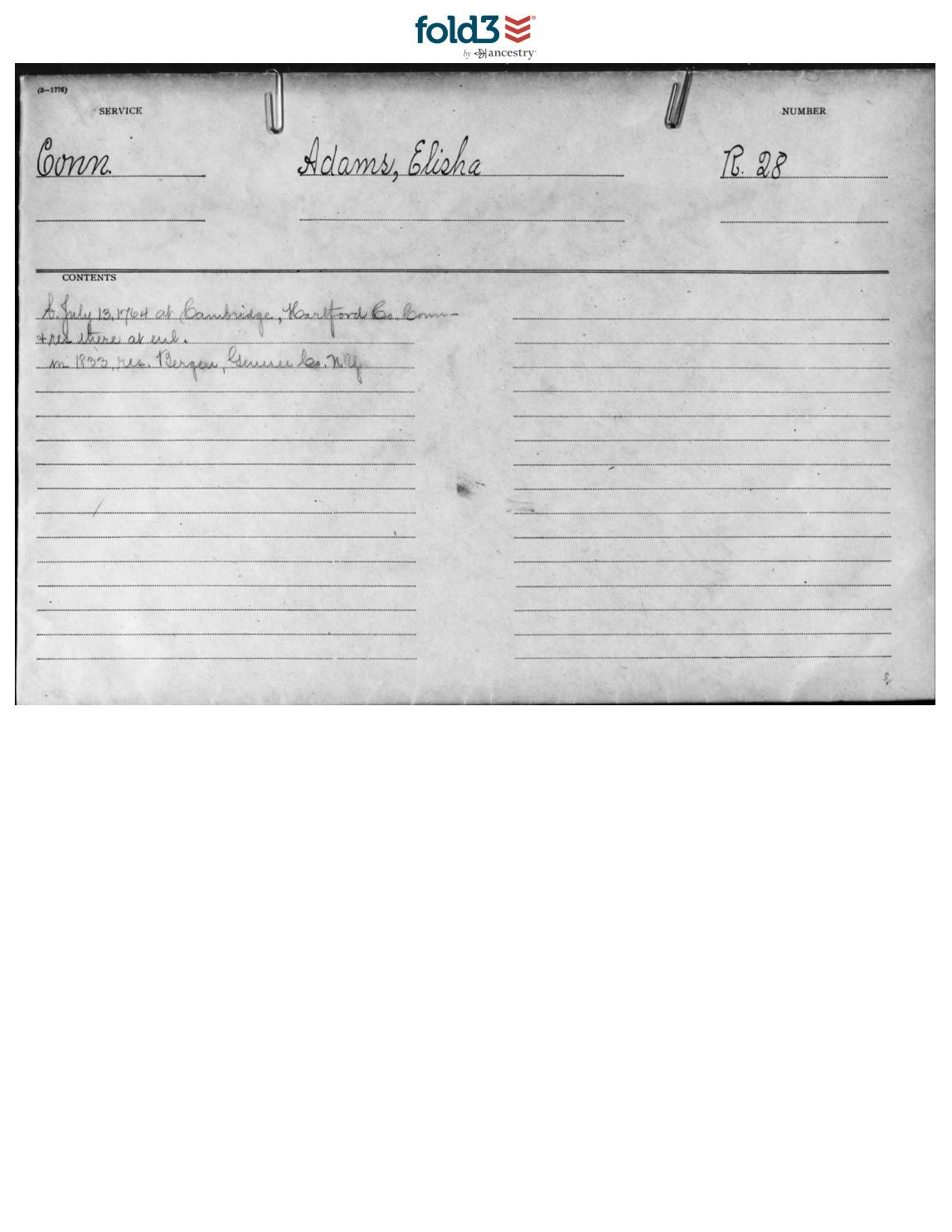
Barbour vital-record slip, Gershom Tuttle's birth, 22 August 1738 — A single handwritten slip from Connecticut's statewide vital-record index settles once and for all that Patriot Gershom Tuttle was born on the twenty-second of August, 1738, not the twenty-third.DAR patriot record — Gershom Tuttle and son's marriage to Pamelia Clark — A Daughters of the American Revolution record confirming Gershom Tuttle as a documented Revolutionary War patriot, and his son's marriage to Pamelia Strong Clark.Connecticut's 1889 Revolutionary War service record — This 1889 Connecticut record lists Gershom Tuttle as a Conductor of army supply teams from 1778 to 1780, the wartime service that anchors his Patriot standing.New Hampshire militia muster roll, 1776 — This 1776 New Hampshire muster roll lists Gershom Tuttle among Captain Samuel Wetherbee's volunteers, backing up family tradition about his early war service.A second 1776 company roster naming Gershom Tuttle — This separate New Hampshire roster, dated November 1776, again lists Gershom Tuttle in Captain Wetherbee's company, an independent record reinforcing his militia service.1947 newspaper column on the Tuttles — A 1947 Terre Haute newspaper genealogy column traced the Tuttle family from patriot Gershom Tuttle through his son the colonel down to Clark Strong and Richard Tuttle.DAR's file on patriot Gershom Tuttle — The Daughters of the American Revolution's own record for patriot Gershom Tuttle backs up his Revolutionary War service with supporting documentation.Veteran's pension testimony naming Captain Tuttle — Revolutionary War veteran John Garrett's 1832 pension application describes serving in the team company commanded by Captain Gershom Tuttle.Bristol veteran's testimony about Captain Tuttle — Ithurel Hart of Bristol, Connecticut testified in his pension file that he served as a teamster under Captain Gershom Tuttle.Teamster's pension file naming Captain Tuttle — Lemuel Gaylord's pension file describes his 1780 service in Captain Gershom Tuttle's company of teamsters and includes his discharge signed by Tuttle.Quartermaster ledger dating Tuttle's service — A Revolutionary War quartermaster record book lists the exact dates Gershom Tuttle served as conductor of teams, from 1778 into 1781.Quartermaster ledger recording Tuttle's pay — A quartermaster payment ledger records wages credited to Gershom Tuttle for his Revolutionary War work moving Army supplies by team.1779 return listing Tuttle's teams — A 1779 Continental Congress return lists Gershom Tuttle among the men supplying fifteen teams to move Army supplies during the Revolution.Gershom and Tabitha's 1757 marriage record — This printed Deerfield, Massachusetts marriage record documents Gershom Tuttle of New Cambridge marrying Tabitha Mitchell on December 22, 1757.Light Dragoons payment record, 1782 — Wartime payment orders place Gershom Tuttle within the 2nd Regiment of Light Dragoons during 1782 and 1783, more evidence of his Revolutionary War service.Patriot's son testifies to his service — Joseph Tuttle's own pension file describes serving in his father Captain Gershom Tuttle's company, a son's firsthand testimony to the patriot's command.Teamster's testimony about Captain Tuttle — Simeon Curtiss's pension application recounts his 1780-81 service as a teamster serving under Captain Gershom Tuttle during the Revolutionary War.Discharge paper signed by Captain Tuttle — Samuel Gillet's pension file includes his Revolutionary War discharge paper, personally signed by Captain Gershom Tuttle.Veteran recalls knowing Captain Tuttle — Samuel Andrus testified in his pension application that he well knew Captain Gershom Tuttle of Bristol, Connecticut.Veteran names Tuttle's two sons — Elisha Adams's pension file names Captain Tuttle's own sons, Gershom and Joseph, tying the patriot directly to his family.Quartermaster return crediting Tuttle's teams — Jason Warner's pension paperwork includes a quartermaster return crediting Gershom Tuttle with fifteen teams supplied to the Army.Fellow conductor's pension file, context — John Colt's pension file, as a fellow team conductor, provides supporting context for Gershom Tuttle's Revolutionary War role.Fellow conductor's file, Hubbard context — Bissell Phelps's pension file, as a fellow conductor serving under the same quartermaster, corroborates the wartime operation Gershom Tuttle worked within.Veteran recalls Captain Tuttle's company — Reuben Brooks's pension application places him in Captain Tuttle's company in 1782, further testimony to the patriot's command.
Tabitha Mitchell (b. 1736/7 – m. 1757 Deerfield)
Ahnentafel #385 · his mother’s father’s father’s father’s father’s father’s father’s mother (8 generations back) · Documented — person and parent-link established
Tabitha Mitchell was born 9 February 1736/7 and married Gershom Tuttle II on 22 December 1757 at Deerfield, Massachusetts. She was the daughter of Joseph Mitchell, a weaver, and his wife Mary Allis — and because Mary Allis's sister Lois had married Gershom's own father a generation earlier, Tabitha and Gershom were first cousins when they wed.
Evidence
Full dates: b. 9 Feb 1736/7 – m. 22 Dec 1757, Deerfield; daughter of Joseph Mitchell and Mary Allis
⭐⭐⭐⭐⭐ THE DAR DOES NOT KNOW HER GIVEN NAME — AND WE DO [TUTTLE-46, 7 August 2026]. On DAR ancestor record A131791 the patriot’s wife is listed only as “X MITCHEL” — surname, no more. This project has her as Tabitha Mitchell, married at Deerfield 22 December 1757, with her parents Joseph Mitchell and Mary Allis and her grandfather Michael Mitchell of Wallingford, all from records. Alec is in a position to give the DAR something it does not have — worth saying to the registrar when the application goes in.
⭐⭐⭐⭐⭐⭐ HER PARENTS FOUND — AND GERSHOM II MARRIED HIS FIRST COUSIN [TUTTLE-41].History of the Town of Sunderland, image 567:“MITCHELL, Joseph, m. Nov. 2, 1726, MARY, dau. WILLIAM ALLIS.”And from the Allis side, image 355:“Ch.: MARY, b. Feb. 18, 1705; m. Joseph Mitchell. … LOIS, b. Jan. 13, 1708; m. Oct. 17, 1737, Gershom Tuttle.” ⭐⭐⭐⭐⭐⭐ MARY ALLIS AND LOIS ALLIS WERE SISTERS.Lois married Gershom Tuttle I. Her sister Mary married Joseph Mitchell. Twenty years later Lois’s son married Mary’s daughter.TABITHA MITCHELL WAS GERSHOM II’S FIRST COUSIN, and the 1757 Deerfield marriage stops being a mystery entirely — he married inside his mother’s family. ⭐ It also explains the Deerfield venue: the bride was local and the groom was styled “of New Cambridge” [TUTTLE-26] — the DEERFIELD hypothesis, preferred over the Farmington one in TUTTLE-24, is confirmed. ⛔⛔ AND IT HALF-CLOSES THE MAYFLOWER DOOR [MAYFLOWER-01].Her MOTHER’S line is the ALLIS line already on this chart — Braintree freeman 1640, Massachusetts Bay, not Plymouth. The Mayflower question now rests on her FATHER Joseph Mitchell alone, whose origin the Sunderland book does not give. ——— Earlier note: ⭐⭐⭐⭐⭐⭐ HER BIRTH AND HER FAMILY FOUND — 6 Aug 2026 [TUTTLE-40].Sheldon, History of Deerfield vol. 2, image 505, in the MITCHELL genealogy:“Ch.: Joseph, Mar. 3, 1726-7, in SUND[ERLAND]. TABITHA, Feb. 9, 1736-7; m. Dec. 22…”The marriage day and month match ours exactly — 22 December 1757 — and the birth of 9 February 1736/7 sits inside the c.1735–40 window TUTTLE-24 predicted for her when the Farmington Mitchel hypothesis was killed. ⭐⭐⭐⭐⭐ AND THE FAMILY WAS AT SUNDERLAND. Her brother was born there in 1726-7. Sunderland is the town where the groom’s own parents married in 1737 [node 769].Father and son married women from the same small Connecticut Valley town, twenty years apart. That is not coincidence; that is a family that kept its Massachusetts ties. ⚠ Her father is almost certainly JOSEPH MITCHELL of Deerfield — Sheldon has daughters Hannah (m. Zadock King 1751), Thankful, Mary (m. Samuel — of Ashfield, 1753) and Lydia all styled “dau. Joseph Mitchell”, plus the son Joseph. Recorded as a strong identification, not yet a proved one — the head-of-family paragraph has not been read. ⭐⭐⭐⭐ AND THIS IS THE ONE PLACE A MAYFLOWER LINE COULD ENTER THIS TREE [MAYFLOWER-01]. The Plymouth Colony Mitchells descend from EXPERIENCE MITCHELL, who came on the ANNE in 1623 and married JANE COOKE, daughter of FRANCIS COOKE, MAYFLOWER PASSENGER, 1620. ⭐ And Sheldon’s own pages carry the tell: “FULLER, John; m. July 12, 1774, EXPERIENCE MITCHELL of Ash[field]” — the given name “Experience” running in this very Mitchell family in this very valley is the classic marker of descent from him. ⚠⚠ A MARKER IS NOT A DESCENT. Mitchell is a common name and no link is shown. Nothing about the Mayflower goes on this chart until Joseph Mitchell’s own father is documented. ——— Earlier note: Married at Deerfield, Massachusetts — “TUTTLE, Gershom of New Cambridge, C[onn.] … Mitchel, Dec. 22, 1757.” ⭐⭐⭐⭐⭐ 6 Aug 2026 — THE FIRST CHECKABLE LEAD ON HER FAMILY [TUTTLE-23]: the complete signer list of the October 1742 New Cambridge petition — the one GERSHOM TUTTLE SR. signed — includes “Joel mitchel.”A MITCHEL was living in that small Connecticut parish fifteen years before the groom’s son married a Tabitha Mitchell.
Outstanding: ⚠⚠ A LEAD, NOT A PROOF — Joel is not shown to be her father. ⚠ And it cuts both ways: the Deerfield entry styles the GROOM “of New Cambridge” but gives the bride no parish, which is what a clerk does for a LOCAL bride. Test both hypotheses in parallel: ① a TABITHA MITCHELL born at Farmington c.1735–1740 (cheapest test; would give her parents for the first time); ② Joel Mitchel’s own family; ③ the Deerfield/Hampshire Co. Mitchells. ⚠⚠ TESTED ONE TURN LATER AND LARGELY FAILED [TUTTLE-24]. Joel Mitchel is confirmed real and really at Farmington — his eldest child Mary was born there 2 Sept 1743, eleven months after the petition — but his first recorded child is 1743, AFTER Tabitha’s c.1735–40 birth window, no Tabitha appears among his seven children, and he moved to WETHERSFIELD from 1746 onward. ⛔ By the 1757 marriage the Mitchels had left New Cambridge. ⛔ And no Connecticut or Massachusetts birth for a Tabitha Mitchell 1730–1742 exists in the FS index at all — 3,822 results, and the only New England hit is the 1757 marriage itself. At that point she still had no parent, no birth date and no place. ⛔ SUPERSEDED WITHIN THE WEEK — self-correction #385, 10 Sep 2026.[TUTTLE-40] and [TUTTLE-41], at the top of this node, gave all three: born 9 February 1736/7, father Joseph Mitchell, mother Mary Allis, the family at Sunderland. This sentence is retained only to show what the search looked like before it landed — it is not the current state of the question. ⭐ The DEERFIELD hypothesis is now the stronger one — the entry styles the GROOM “of New Cambridge” (an outsider) and gives the bride no parish (a local). NEXT: the Deerfield and Hampshire Co. Mitchells, and the 1757 entry read AT THE IMAGE — the printed abstract may drop a father or a parish the register carries.
⭐⭐⭐⭐ HER FATHER’S WILL, read at the page 13 Sep 2026 [TUTTLE-147 §⑤]: the will of Joseph Mitchell of Deerfield, dated 14 April 1792 and proved 25 Nov 1794 (Hampshire Co., Mass. Probate Records vol. 19–20, entry 91): “I give to my Daughter Tabitha Wife of Gersham Tuttle Twelve Pounds,” beside her sisters Mary Belding and Hannah Bigelow and the children of “my late Son Joseph.” This documents Tabitha’s parentage and her marriage by record, and shows her ALIVE in April 1792 — the unsourced “1737–1782” is refuted. It contradicts SAR’s Patriot Research System entry for P-308288, which gives the patriot’s spouse as “Catherine Stevens” from a 2002 index. The Joel Mitchel lead above is superseded.
Evidence images (described)
DAR patriot record — Gershom Tuttle and son's marriage to Pamelia Clark — A Daughters of the American Revolution record confirming Gershom Tuttle as a documented Revolutionary War patriot, and his son's marriage to Pamelia Strong Clark.Gershom and Tabitha's 1757 marriage record — This printed Deerfield, Massachusetts marriage record documents Gershom Tuttle of New Cambridge marrying Tabitha Mitchell on December 22, 1757.
Pamelia Clark's father (Farmington, Connecticut)
Ahnentafel #386 · his mother’s father’s father’s father’s father’s father’s mother’s father (8 generations back) · Known unknown — the person existed; the name does not survive
Pamelia Clark's father was a man of Farmington, Connecticut, of the Revolutionary generation, whose daughter was born there on 4 November 1770 — but his own name has not been recovered. He is remembered indirectly through his grandson, General Newman S. Clarke of the United States Army, who was born in Connecticut, commissioned an officer in 1812, and went on to command the Department of the Pacific before his death in 1860.
Evidence
Also recorded: of Farmington, Connecticut; name not recorded
⭐⭐⭐⭐⭐ NEW NODE, 7 August 2026 — AND THIS IS THE SINGLE HIGHEST-VALUE GAP ON THE CHART [TUTTLE-46]. He is a Farmington, Connecticut man of the Revolutionary generation with a daughter born 4 November 1770. Naming him serves both of Alec’s stated priorities at once — it opens a whole colonial branch and he is a strong candidate to be a patriot in his own right.
⭐ Two levers, neither of them used before. (a) The nephew.Gen. Newman S. Clarke, USA — Heitman’s Historical Register confirms the Tuttle book in every checkable particular: “Clarke, Newman S. Conn. Vt. Ens 11 inf 12 Mar 1812 … col 6 inf 29 June 1846 … bvt brig gen 29 Mar 1847 … died 17 Oct 1860” — born in Connecticut, commissioned from Vermont, died at San Francisco commanding the Department of the Pacific. His father was necessarily one of Pamelia’s brothers. ⛔ Appleton’s Cyclopædia gives him a full career paragraph and no parentage. (b) The brother at the arsenal. ⛔ He was NOT the commandant — the Watervliet Arsenal’s official chronology 1813–1993 contains no Clark anywhere in the 1813–1850 narrative, and no commander died in office; Weise’s History of the City of Troy yields eleven arsenal references and no Clark. So he was a military storekeeper or ordnance officer, and the Registers of Officers and Agents for 1826 and 30 September 1835 both tabulate storekeepers against the station “Ar. Watervliet.”
Outstanding — the one record to pull: the Barbour Collection, FARMINGTON — the birth of Pamelia Clark, 4 November 1770, which names her father outright, and the marriage Tuttle × Clark, 8 July 1788. ⚠ Also worth one query: the DAR Child Search (child Parmelia Clark, spouse Gershom Tuttle) — it was attempted and could not be submitted; a control query with known-good values failed identically, so nothing was concluded from the blank result.
George Roush (1761 Frederick VA – 1845 Meigs OH)
Ahnentafel #480 · his mother’s mother’s mother’s father’s father’s father’s father’s father (8 generations back) · Probable — the IDENTIFICATION or the LINK rests on one source, or is in conflict · Revolutionary patriot
George Roush was born in July 1761 in Frederick County, Virginia, and died 31 May 1845 in Sutton Township, Meigs County, Ohio. He served in the Revolutionary War, enlisting in the autumn of 1779 under his own brother, Captain John Roush, with further tours of duty in 1780 and 1781, and later drew a pension while living in Ohio. He is recognized today as Daughters of the American Revolution Patriot Ancestor A098975.
Evidence
Also recorded: July 1761, Frederick Co., Virginia – 31 May 1845, Meigs Co., Ohio
⭐⭐⭐⭐⭐⭐ A REVOLUTIONARY PATRIOT, AND THE DAR HAS ALREADY APPROVED THE DESCENT [ROUSH-54, 7 August 2026].
DAR Ancestor # A098975 — Service: VIRGINIA, rank Private. Service description: “1) Capts John Roush, Joseph Pugh; 2) served as a substitute, Capt All.” Residence of record: Shenandoah Co., Virginia. Pension S18579. He enlisted in the autumn of 1779 and served two months in his own brother Captain John Roush’s Virginia company, with further tours in 1780 and 1781, and was pensioned in 1832 while living in Ohio.
⭐⭐ Five approved DAR applications descend through this man’s son JOHN and his wife REGINA ROUSH — National Nos. 426059, 671858, 728245, 569934 (vol. 871) and 976675. That is Alec’s own line, already accepted.
⚠ A printed error corrected here. The 1928 Roush genealogy prints his pension as “S. 8579”, and the Roush Family Association’s own website repeats it. S8579 is Jacob Goss of North Carolina — read in full and checked. The book dropped a digit; the true number is S18579.
⛔ 11 Sep 2026 — DEMOTED documented → probable [BELL-714], adversary-confirmed. His own Revolutionary service is NOT in question (pension S18579, read in full). What is single-sourced is his place in this pedigree: the link to his son John (node 240) rests on the 1928 History of the Roush Family in America plus DAR GRS database printouts — under the SAR standard a 19th/20th-c printed genealogy is the guide’s own worked example of documentation that FAILS, and a research-system printout is barred outright. ⭐ Node 240 already graded probable on identical evidence; this removes a chart self-contradiction. The patriot flag stays — a grade chip is not a retraction of a soldier. Outstanding: his own pension file, read as images rather than as an abstract — it should name Catharine and their children.
Catharine Zerkel (Shenandoah Co., Virginia)
Ahnentafel #481 · his mother’s mother’s mother’s father’s father’s father’s father’s mother (8 generations back) · Probable — the IDENTIFICATION or the LINK rests on one source, or is in conflict
Catharine Zerkel was the first wife of George Roush, named as such independently by both the 1928 Roush family genealogy and the Daughters of the American Revolution's own record for her husband.
Evidence
⭐⭐⭐ NEW NODE, 7 August 2026 [ROUSH-54]. Named as George Roush’s first wife independently by two sources that did not consult each other: the 1928 Roush genealogy (Catharine Zerkel) and the DAR ancestor record for A098975, which lists spouse “CATHERINE ZIRKLE”. The DAR’s approved applications through son John are all marked to spouse [1] — i.e. to her, not to George’s second wife.
⭐ ZERKEL / ZIRKLE / ZERCKEL is a name that keeps recurring around this family — a Zerkle man was living in the household where James Nease appears in two censuses, two Mason County Neases married Zerkel women in 1845 and 1852, and Moses B. Roush’s third wife was a Margaret A. Zerkle. Recorded as a pattern, not a conclusion.
⛔ 11 Sep 2026 — DEMOTED documented → probable [BELL-714], adversary-confirmed. Named only by the 1928 Roush genealogy and a DAR GRS spouse field — both excluded classes. ⭐ Her own father’s node (962) already grades the identical evidence probable, saying in terms “single ultimate source = Probable”; the two badges contradicted each other and now do not. Outstanding: her dates, her parents, and the marriage record itself.
Jonas Roush (1763 Frederick VA – 1850 Mason VA)
Ahnentafel #482 · his mother’s mother’s mother’s father’s father’s father’s mother’s father (8 generations back) · Probable — the IDENTIFICATION or the LINK rests on one source, or is in conflict · Revolutionary patriot
Jonas Roush was born in September 1763 at Holman's Fort, Frederick County, Virginia, and died 14 December 1850 in Mason County, Virginia. He served in the Revolutionary War as a substitute for his brother Henry in the summer of 1781, and on a second tour was present at the siege of Yorktown and Cornwallis's surrender on 19 October 1781. He later told his story in his own sworn pension statement of 6 November 1832, and is recognized today as Daughters of the American Revolution Patriot Ancestor A098985. His brother Henry Roush was also honored as a Revolutionary patriot.
Evidence
Also recorded: Sept 1763, Frederick Co., Virginia – 14 Dec 1850, Mason Co., Virginia
⭐⭐⭐⭐⭐⭐ A REVOLUTIONARY PATRIOT WHO WATCHED CORNWALLIS SURRENDER [ROUSH-54, 7 August 2026].
DAR Ancestor # A098985 — Service: VIRGINIA, rank Private; “Capt All; Cols Bird, Darke.”Pension S4785, and the file has been read in full transcription. In his own sworn statement of 6 November 1832, made from Mason County, Virginia, he says he “entered the service as a substitute for his Brother Henry Roush who was drafted for a tour of three months in the summer of 1781,” served under Captain All in Colonel Bird’s regiment at Falmouth near Fredericksburg, and on a second three-month tour was present at the siege of Yorktown and at Cornwallis’s surrender, 19 October 1781. He fell ill near Fredericksburg while escorting prisoners. Pensioned at $20 a year from 4 March 1831; the pension was transferred to Meigs County, Ohio in 1837.
⭐⭐ Two approved DAR applications descend through his daughter REGINA and her husband JOHN ROUSH (National Nos. 569934 and 1076887). ⭐⭐⭐ And member 569934 is approved on BOTH Jonas and George — that member carries the same double descent Alec has.
⭐ He was living in Mason County when he applied — the very county where his great-grandson John G. Roush would later marry and die. ⚠ A conflict to hold: the pension says he removed to Meigs County, Ohio in 1837 and the 1928 book says he died in his daughter’s house there, but the DAR records his death in Mason County, Virginia. Not resolved.
⛔ A bounded negative worth knowing: the pension file does not name his wife Barbara or any child, including Regina. It records only that his wife died in February 1837 and that he had a daughter in Ohio. The file corroborates the descent; it does not by itself prove it.
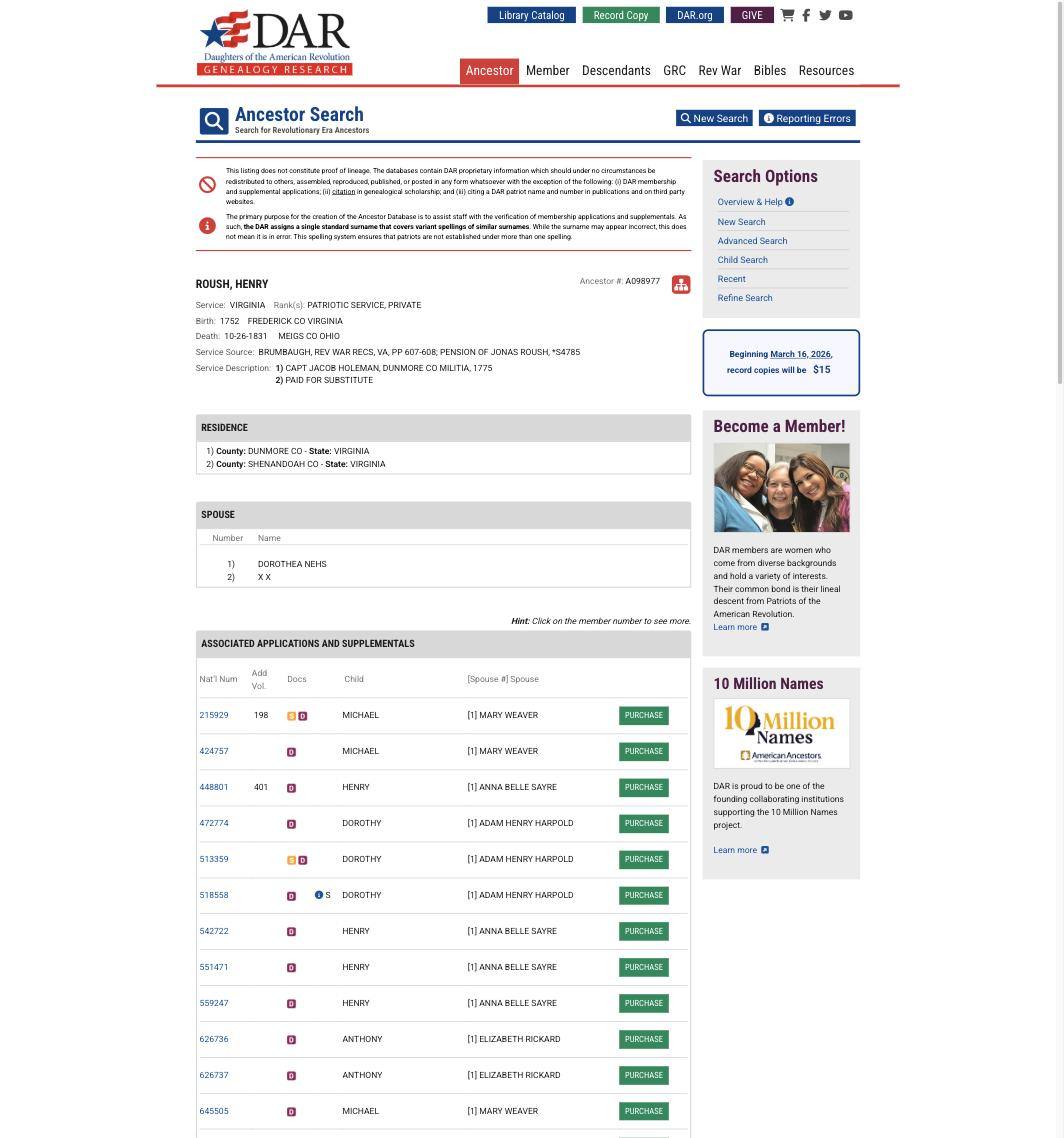
⭐ His brother is a patriot too:HENRY ROUSH, DAR # A098977, b. 1752 Frederick Co., Va., d. 26 Oct 1831 Meigs Co., Ohio — “Capt Jacob Holeman, Dunmore Co. Militia, 1775; paid for substitute” — and the DAR’s cited source for Henry’s service is Jonas’s own pension file. The two brothers’ service is documented out of the same sheaf of paper.
Outstanding: ⛔ 11 Sep 2026 — DEMOTED documented → probable [BELL-714], adversary-confirmed. His service is documented from pension file S4785, read in full, including his sworn statement placing him at Cornwallis’s surrender — that is untouched, and the patriot flag stays. But the pedigree rung is book-borne: the file does not name his wife Barbara or any child, including Regina. The node’s own words: “The file corroborates the descent; it does not by itself prove it.” ⭐ Node 241 already graded that same link probable.
Barbara Fox (d. 1837)
Ahnentafel #483 · his mother’s mother’s mother’s father’s father’s father’s mother’s mother (8 generations back) · Probable — the IDENTIFICATION or the LINK rests on one source, or is in conflict
Barbara Fox was the wife of Jonas Roush and died in February 1837, the same year her husband moved to Ohio to live with their daughter. She is named as his wife in both the 1928 Roush family genealogy and Daughters of the American Revolution records.
Evidence
⭐⭐⭐ NEW NODE, 7 August 2026 [ROUSH-54]. Named as Jonas Roush’s wife by the 1928 Roush genealogy and, independently, by the DAR ancestor record A098985, which lists spouse “BARBARA FOX.”
⭐ Her death is dated by her husband’s pension file, which records that his wife died in February 1837 — the same year he moved to Ohio to live with his daughter. ⚠ The file does not name her; the name comes from the book and the DAR.
⛔ 11 Sep 2026 — DEMOTED documented → probable [BELL-714], adversary-confirmed. Named as Jonas’s wife by the 1928 book and a DAR spouse field; the pension records only that “his wife died in February 1837” without naming her. Outstanding: her birth, her parents, and a marriage record — Shenandoah County, Virginia, probably in the 1780s.
Henry Roush Sr. (1752 – 1831 Plants Cemetery)
Ahnentafel #500 · his mother’s mother’s mother’s mother’s father’s mother’s father’s father (8 generations back) · Probable — the IDENTIFICATION or the LINK rests on one source, or is in conflict · Revolutionary patriot
Henry Roush Sr. lived from 1752 until 26 October 1831 and was buried at Plants Cemetery, Letart Falls, Meigs County, Ohio, where his gravestone gives his age as 79. He probably served in the Revolutionary War as a private in Captain John Tipton's company, paid off at Romney after eighty-eight days of service, and his brother Jonas's own pension application recalls serving three months as a substitute for him. He is probably the same man recognized by the Daughters of the American Revolution as Patriot Ancestor A098977, though this has not yet been confirmed from the DAR's own record.
Evidence
Full dates: 1752 – 26 Oct 1831, Plants Cemetery, Meigs Co., Ohio
⭐⭐ ADDED at PROBABLE, 8 Aug 2026, adversary-confirmed [ROUSH-64/-VERDICT]. Fourth son in the minute-book table (printed pp.60–61); gravestone quoted (“died October 26, 1831, aged 79 years”); Revolutionary service certified: private, Capt. John Tipton’s Co., paid off at Romney, 88 days, receipt 25 Oct 1775 (Virginia State Library certification, 1926, quoted in full) — plus Jonas’s pension: “served three months for his brother Henry.” Signed the 1793 Solomonburg church deed “HENRICH ROUSH (in German).” ?= DAR A098977 (b. 1752 Frederick Co., d. 26 Oct 1831 Meigs Co. — triple date/place match; DAR page unread). The Anthony link is book-only — hence Probable.
Outstanding: the DAR A098977 page (browser); LVA’s Romney pay-roll manuscript; Bertha descends from TWO patriot Roush lines if this holds.
Evidence images (described)
DAR patriot record — Henry Roush Sr., Meigs Co. Ohio — A Daughters of the American Revolution record for Henry Roush Sr., a candidate Revolutionary War patriot of Meigs County, Ohio, and his wife Dorothea.
Dorothea Roush (fl. 1793)
Ahnentafel #501 · his mother’s mother’s mother’s mother’s father’s mother’s father’s mother (8 generations back) · Probable — the IDENTIFICATION or the LINK rests on one source, or is in conflict
Dorothea, whose surname has not been recovered, was the wife of Henry Roush Sr. She signed a church deed by her mark in 1793, the same document her husband signed in German, and is believed to be buried beside him at Plants Cemetery.
Evidence
Also recorded: signed by her mark, 1793; maiden name unknown
ADDED at PROBABLE, 8 Aug 2026 [ROUSH-64/-VERDICT]. “Henry Roush and wife, Dorothy” in both book threads; witnessed the 1793 Solomonburg church deed “DOROTHY ROUSH (her mark)” — her husband literate in German, she by mark, same page. Buried beside Henry at Plants Cemetery per the book’s reading of the adjacent marker. Surname unknown (the table’s “(Nease?)” hedge noted and NOT adopted).
Outstanding: her surname; the adjacent Plants Cemetery stone by eye.
Evidence images (described)
DAR patriot record — Henry Roush Sr., Meigs Co. Ohio — A Daughters of the American Revolution record for Henry Roush Sr., a candidate Revolutionary War patriot of Meigs County, Ohio, and his wife Dorothea.
Elizabeth Rickard's father
Ahnentafel #502 · his mother’s mother’s mother’s mother’s father’s mother’s mother’s father (8 generations back) · Known unknown — the person existed; the name does not survive
The patriarch of the Rickard family came from Germany by way of Maryland and settled in Mason County, in what later became West Virginia. He was the father of four immigrant brothers — Michael, Jacob, John and Joseph Rickard — as well as of daughters Elizabeth and Susannah, but even the family's own 1928 genealogy could not recover his name, printing only a blank dash in its place.
Evidence
Also recorded: Germany → Maryland → Mason Co., (West) Virginia; name not recorded
KNOWN UNKNOWN, 10 Aug 2026 [ROUSH-67/-VERDICT]. Father of the four immigrant brothers — Michael, Jacob, John, Joseph Rickard — and of Elizabeth (node 251) and Susannah: the 1928 compiler printed a literal dash for his name (“She was of the ——— Rickard family,” p.537). Recovery path: the Rickard Cemetery stones, White Church, Mason Co.
Elizabeth Rickard's mother
Ahnentafel #503 · his mother’s mother’s mother’s mother’s father’s mother’s mother’s mother (8 generations back) · Known unknown — the person existed; the name does not survive
The wife of the Rickard patriarch has not been named in any record found so far, though her existence is implied by the large family she and her husband raised.
Evidence
Also recorded: name not recorded
KNOWN UNKNOWN, 10 Aug 2026 [ROUSH-67/-VERDICT]. Wholly unnamed in every source read.
John Bell of Camden District (candidate) (~1710/30 – 1786 Camden SC)
Ahnentafel #512 · his father’s father’s father’s father’s father’s father’s father’s father’s father (9 generations back) · Hypothesis — a candidate, not tied in
If the abstract is right, he is the man who sat on Bear Swamp in Duplin County before the war, sold his plantation to his eldest son in 1765 for £100 and went on living on it, and then — somewhere after January 1773 — came four hundred miles south to the Black River country, where he died leaving a will that claims three of his family in his own voice, by rank: my eldest son Frederick Bell, my eldest daughter Penelope Stuckey, wife Mary. It then hands money to two more men — John Bell, and William Rasor Bell — with nothing attached but a bare to. Which of those two, if either, was his son is precisely what this card does not know, and it is the question the whole line above him waits on. Penelope’s own children would carry the name of their “Grandfather John Bell” into the deed books of two states. And if he is who the Bertie papers suggest, his own father could not write — he signed with a big interlocked R B — while John and his brothers all signed their names.
Evidence
Full dates: b. probably c.1710–1730 (if Robert Bell of Bertie's son John, b. before c.1717); seated on Bear Swamp, Duplin Co., N.C. by 1762, there 1773; will dated 18 Oct 1786, Camden District, S.C. (abstract only)
⭐⭐⭐ A named, located candidate — still not tied in (22 Aug 2026). Holcomb’s 1978 abstract of a will dated 18 Oct 1786 names wife Mary, “eldest son Frederick Bell,”William Rasor Bell and “eldest daughter Penelope Stuckey”; the Kershaw General Index to Estates reads “Bell, Jno — Frederick Bell — Adm’r — Apt 6 — Pkg 180” (apartment and package read directly; year cell illegible). Independent support: John Stuckey of Duplin’s wife was Penelope (1779); Lewis Stuckey’s 1792 deed says his property “descended to me from my Grandfather John Bell” and by 1794 he is “now of the County of Salem, South Carolina”; in 1790 there was exactly one Frederick Bell in the state; and a 1787 Claremont deed puts Jacob Hurst beside Frederick [BELL-446–448, 458, 481, 482].
⭐⭐ The family this John probably belongs to is now documented in its own right: Robert Bell of Chowan and Bertie Co., N.C., died intestate 1738; his children signed for their shares — George (“his Eldest Son and heir at Law”), John, Archibald, Penelope — with William Byrd as son-in-law; the family moved to Duplin by 1754 (Archibald “of Duplin County” 1756), and Sampson County was cut out under them in 1784. A literate John Bell Sr of Bear Swamp, seated by 1762, sold to Frederick Bell in 1765, was “Sr” in 1773, and then vanishes from every North Carolina record [BELL-472, 475, 478, 481]. The working hypothesis is that this John is Robert’s son and the 1786 testator.
⛔ Why still hypothesis, not probable: the only text calling William Rasor a son is a 2004 message-board condensation; Holcomb’s own index returns “William Rasor Bell” on p. 5 but refuses “son William Rasor Bell” (adversary, [BELL-458]); and no John Bell or Mary Bell appears anywhere near Frederick in Camden District 1775–90, on ground where the corpus finds Frederick by name seven times [BELL-482]. The Camden probate books for 1786–91 were lost to the Claremont courthouse fire of 1801 [BELL-463–464].
Outstanding: read Holcomb, Camden District Wills and Administrations, printed p. 5 (2017 reprint, ~$20) — does it say son?; then the packet, SCDAH L 49055 Apt 6 Pkg 180. Patriot question: the 1783 Camden petit-juror “Bell, John” is probably the Broad River John [BELL-461–462]; only the engrossed 1783 schedule (SCDAH S 165001) could revive it.
⭐⭐⭐ 23 Aug 2026 — the ladder above hardened dramatically. The originals were read at the ink: Henry Woodnot’s 1718 will names Anne, a widow Ferguson, as Robert Bell’s wife; John Clemet’s 1734/5 will names “his two Sons John Bell and Archiball Bell” — Robert’s son John is documented twice over; John’s Bertie record (patent on Pellmell Pocoson 1739 as “John Bell, Junior”; last land sold Feb 1746/7) stops dead in the exact 1747–49 window the whole kin-group — Bells, Kings, Snells, Herrings — relocated to Duplin, and Archibald pairs with John at both ends (Bertie 1738/1749; the 1766 Duplin witness line). “John of Bertie = Bear Swamp John Sr” is now graded PROBABLE — the adversary’s own kill-tests all passed (no John Bell on any Bertie tax list 1751–63; the ten-year-late witness-oath proof of his last deed; the 1737 “second John” an OCR phantom) and the ruling adversary promoted it 24 Aug [BELL-497–498], with the explicit boundary that the promotion must not leak upward into THIS node’s rung; the Bear-Swamp-John-to-this-testator rung is still the hypothesis this node’s grade rests on [BELL-486–492]. See 00_BELL_LINEAGE.html for the full ladder.
⛔⭐⭐ 24 Aug 2026 [BELL-500] — the abstract’s “son-” prefix was the poster’s, not Holcomb’s. A controlled phrase-oracle over the 1978 volume (two passes, 700+ logged queries [BELL-500, 505]) proves page 5 reads “my eldest son Frederick Bell,” “my eldest daughter Penelope Stuckey,” “wife Mary” — and then TWO formally parallel bare bequests: “to John Bell” and “…sterling to William Rasor Bell” (cash, not land), neither with a kin term — the classic shape of legacies to grandsons or kinsmen; Holcomb’s own 1978 index binds the W. Rasor Bell of p.35 to the man of p.5 (the words “his” and “children,” which the 2004 condensation rests on, occur zero times on the page). The candidacy is not dead — W.R.B. stands in the will as a legatee of unstated relation (son-unstyled, grandson, or kinsman), and the Stuckey and Kershaw-index corroboration hold — but the relationship itself is now known to be UNSTATED in the abstract, and only the original packet can state it. If W.R.B. should prove Frederick’s son, the ladder renumbers — flagged, not adopted.
Outstanding: ⛔⛔ 11 Sep 2026 [BELL-718] — THE STUCKEY ROUTE IS CLOSED PERMANENTLY, AND FOR A REASON RATHER THAN A SHRUG. The hoped-for converter was John Stuckey’s Duplin County estate file, which would have named Penelope as his widow and listed her children. ⛔ IT DOES NOT EXIST — two independent finding aids show the alphabetical run stepping straight from Stroud to Sullivan. ⭐ And the reason is documented: he was RUINED before he died. He and three others lost a judgment to the administrators of William Kenan for £1,658 11s 0½d; the sheriff took his plantation on the west side of Bear Swamp, and a Duplin deed of 1822 still tracks the land as “formerly owned by John Stuckey, which said land was sold by virtue of an execution.”There was no estate left to administer, so the document was never created. ⛔ Do not re-run this route. ⭐⭐ The competing Penelope is disarmed: John Stuckey’s daughter of that name is documented four ways as PENELOPE BLOUNT, wife of Benjamin Blount — a married woman under a different surname in another state, not an anonymous rival. ⚠ Still owed: testing the 1800 Salem “Penelope Stucky” household against her specifically rather than against a name. ⛔⛔ And the one source that could still settle this node is COPYRIGHT-WALLED on every free lane — Holcomb’s Camden District Willsp. 5, on whether W.R.B. is called a son or stands as a bare legatee: HathiTrust limited-view with search-inside 403, Google Books no preview. A library copy is now the path. ⚠ A second known gap, recorded because this node had NO Outstanding field at all until today: the Camden probate books for 1786×91 were lost to the Claremont courthouse fire of 1801, and SCDAH L 49055, Apartment 6, Package 180 has never been read — that is not a negative. ⭐ 2 Oct 2026 [BELL-775]: SCDAH holds the packet on its own film C9228 (frames 73–85, 13 images) and has quoted it at $13 (order 2258, $58 in all). Nothing moves until it is read.
Mary (—) Bell (candidate) (living 1786 Camden District SC)
Ahnentafel #513 · his father’s father’s father’s father’s father’s father’s father’s father’s mother (9 generations back) · Hypothesis — a candidate, not tied in
Evidence
Also recorded: living 18 Oct 1786, Camden District, S.C.
Named only as “wife Mary” in the abstract of John Bell’s 1786 will. No Mary Bell appears in Camden District 1777–1790 — none as grantor, witness, deponent or head of household — in a corpus that finds Frederick Bell repeatedly on the same ground [BELL-482]; a Mary Bell who witnessed by mark in Salem County in 1788 cannot be told from Frederick’s or William’s wives of the same name [BELL-460]. The Mary Bell whose Sumter estate was administered in 1819 is Jonathan Bell’s widow [BELL-468]. Stands or falls with node 512.
Outstanding: ⛔ Created 11 Sep 2026 [BELL-719] — this node was graded `hyp` with NO field saying why, which the audit now refuses to allow. ⭐ What is actually known about her is one clause in one abstract: Brent Holcomb’s 1978 abstract of the will dated 18 Oct 1786, Camden District, names a wife MARY alongside “eldest son Frederick Bell,” William Rasor Bell and “eldest daughter Penelope Stuckey.” ⛔ Her maiden name is unknown, no record of her has ever been read, and she is not documented apart from her husband. ⚠⚠ She stands or falls entirely with node 512 — if that identification fails she is simply a different woman, and nothing here would survive it. ⛔⛔ Why this cannot presently be improved, stated so nobody re-runs it: ① the original will is unread, and Holcomb’s p. 5 — the page that would show whether the relationships are stated or merely listed — is COPYRIGHT-WALLED on every free lane (HathiTrust limited-view, search-inside 403; Google Books no preview) [BELL-718]; ② the Camden probate books for 1786×91 were lost to the Claremont courthouse fire of 1801; ③ SCDAH L 49055, Apartment 6, Package 180 has never been reached — that is an unrun lane, NOT a negative; ④ the Stuckey route is now closed permanently — John Stuckey left no Duplin estate file because the sheriff stripped him before he died [BELL-718]. ⭐ What would move this node: the original 1786 packet, or a Camden/Kershaw instrument naming Mary Bell as widow or relict of John Bell. ⚠ Beware: at least three Mary Bells are documented in this district across these decades — a name alone will not do.
Sarah Pigford's father
Ahnentafel #582 · his father’s father’s mother’s father’s father’s father’s mother’s mother’s father (9 generations back) · Known unknown — the person existed; the name does not survive
Sarah Pigford's father lived in New Hanover or Duplin County, North Carolina, in the mid-eighteenth century, but his name has not survived. Even the family's own genealogist, writing in 1967 after searching the marriage records of both counties, concluded that "her family name continues to be beyond the reach of this recorder."
Evidence
Also recorded: of New Hanover or Duplin Co., North Carolina, mid-1700s; name not recorded
KNOWN UNKNOWN, adversary-confirmed 10 Aug 2026 [BELL-57/-VERDICT]. Sarah (291) is documented by the 1801 will's life estate; her family name defeated the family's own 1967 genealogist after a bounded search of BOTH New Hanover and Duplin marriage records — “Her family name continues to be beyond the reach of this recorder.” ⚠ The circulating “Sarah FUSSELL” is a killed trap: Fussell was the master William was apprenticed to, not her family.
Outstanding: Vogt's bride index (TLS-dead to tools — browser); pp. 45–470 of the 1967 book (no search layer — reader); the original 1801 will image.
Sarah Pigford's mother
Ahnentafel #583 · his father’s father’s mother’s father’s father’s father’s mother’s mother’s mother (9 generations back) · Known unknown — the person existed; the name does not survive
Sarah Pigford's mother likewise lived in New Hanover or Duplin County, North Carolina, in the mid-eighteenth century. Like her husband, her name has not survived in any record found so far.
Evidence
Also recorded: of New Hanover or Duplin Co., North Carolina, mid-1700s; name not recorded
KNOWN UNKNOWN, adversary-confirmed 10 Aug 2026 [BELL-57/-VERDICT]. Same bounded two-county negative as node 582.