194 people, numbered by ahnentafel: #1 is me, each person’s father is double their number, each mother is double plus one. Every entry carries its dates, relationship, evidence grade, story, evidence notes, and text descriptions of every photograph and evidence scan.
Ahnentafel #160 · his father’s mother’s father’s father’s father’s father’s father (7 generations back) · Documented — person and parent-link established
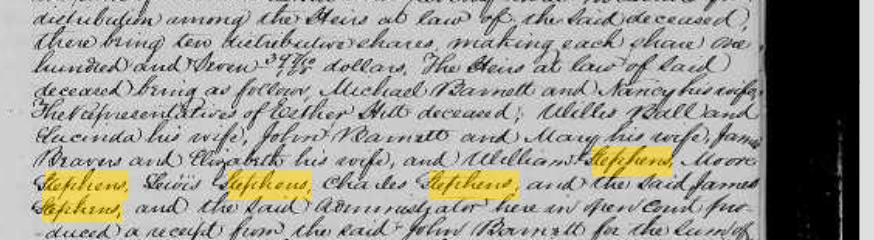
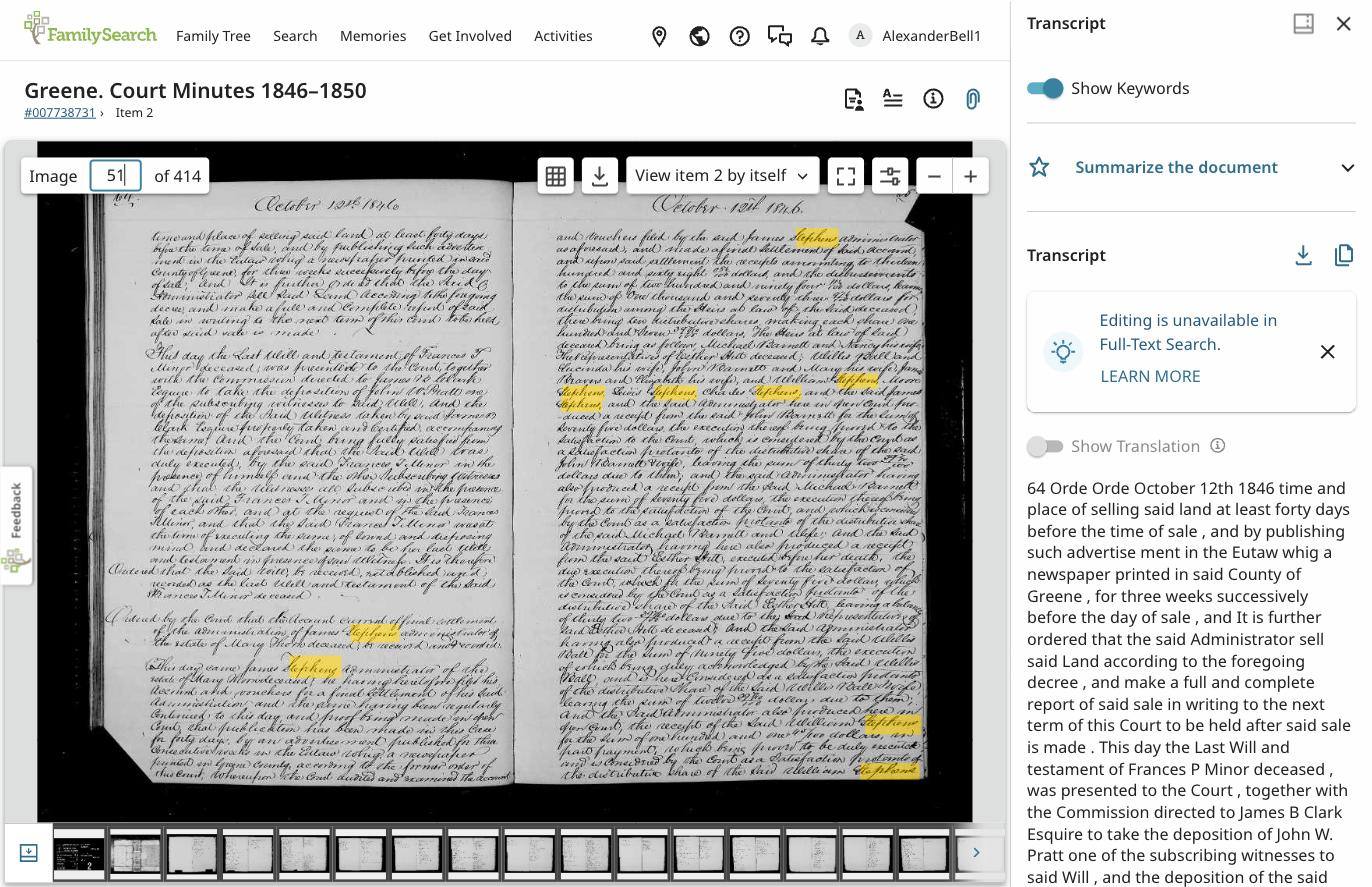
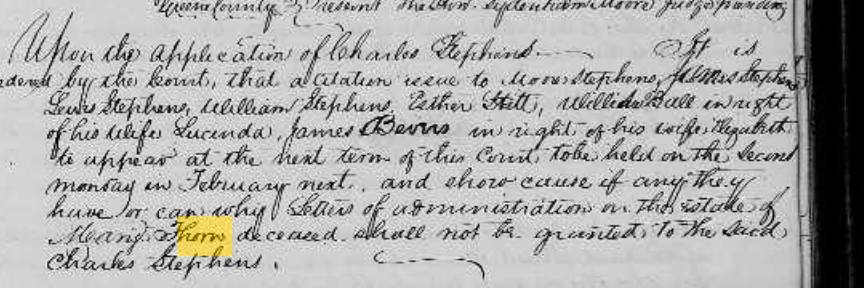
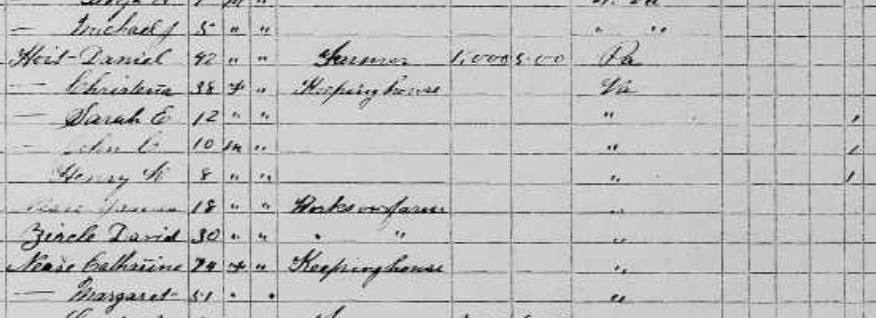
Moore Stephens was born about 1796 in North Carolina and was still living in Sumter County, Alabama, in 1850, later moving on to Newton County, Mississippi. He married Rebecca Moize on 3 September 1817 in Orange County, North Carolina, and the two were still together, and still recorded as North Carolina-born, in both the 1850 and 1860 census. He was one of ten heirs at law of Mary Thorn's 1846 Greene County, Alabama estate, alongside nine named siblings — William, Lewis, Charles, and James Stephens, and sisters Nancy Barnett, Mary Barnett, Lucinda Ball, Elizabeth Beavers, and Esther Hitt.
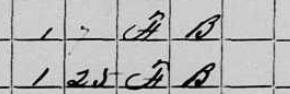
After his sister Esther's death, he and Rebecca raised her two orphaned children alongside their own, naming a daughter Easter in her memory. The 1850 slave schedule for Sumter County records that Moore held one enslaved person, an unnamed Black girl about seven years old.
Evidence
Full dates: b. c.1796 North Carolina; m. 3 Sept 1817 Orange Co., NC; of Sumter Co., Alabama 1850
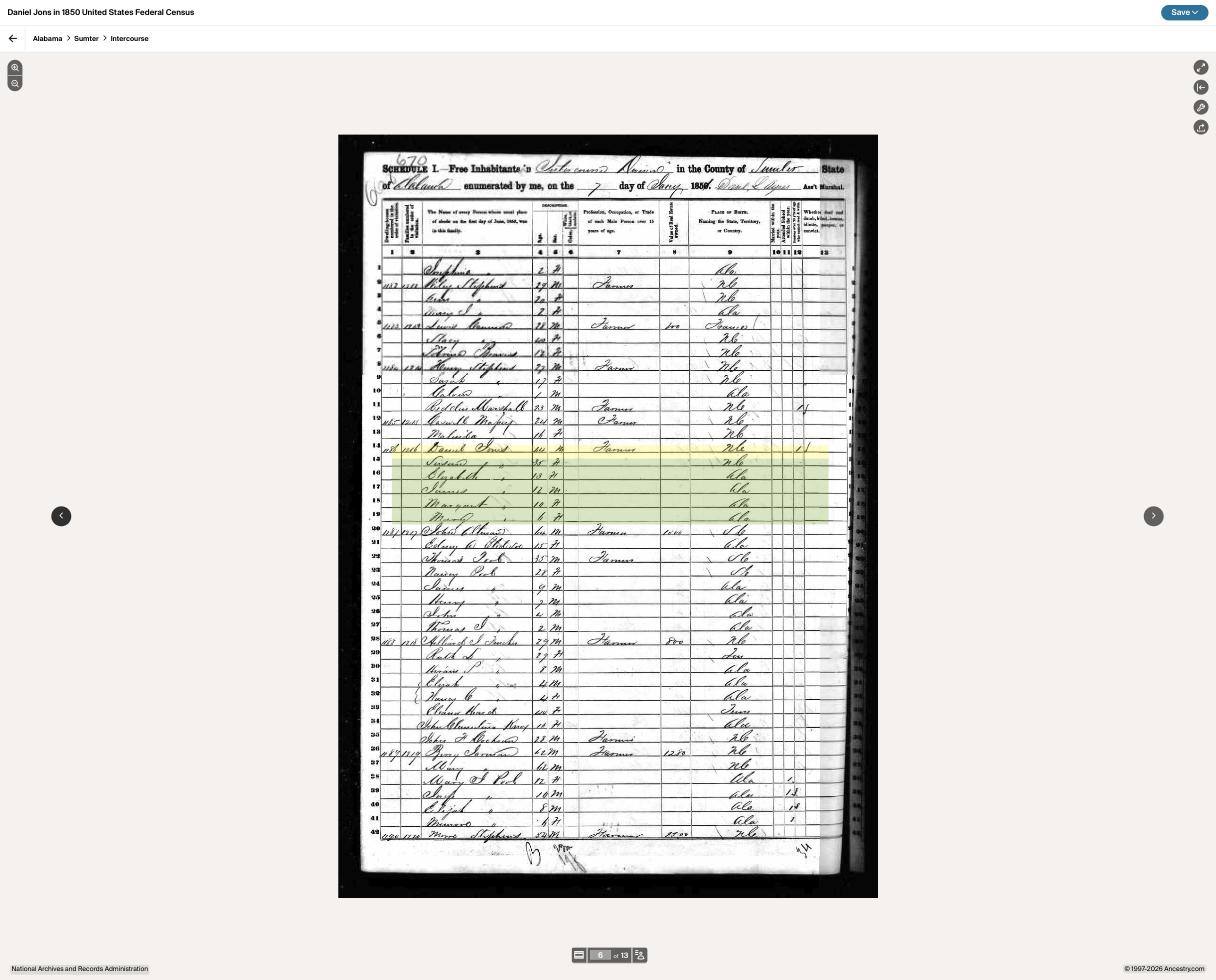
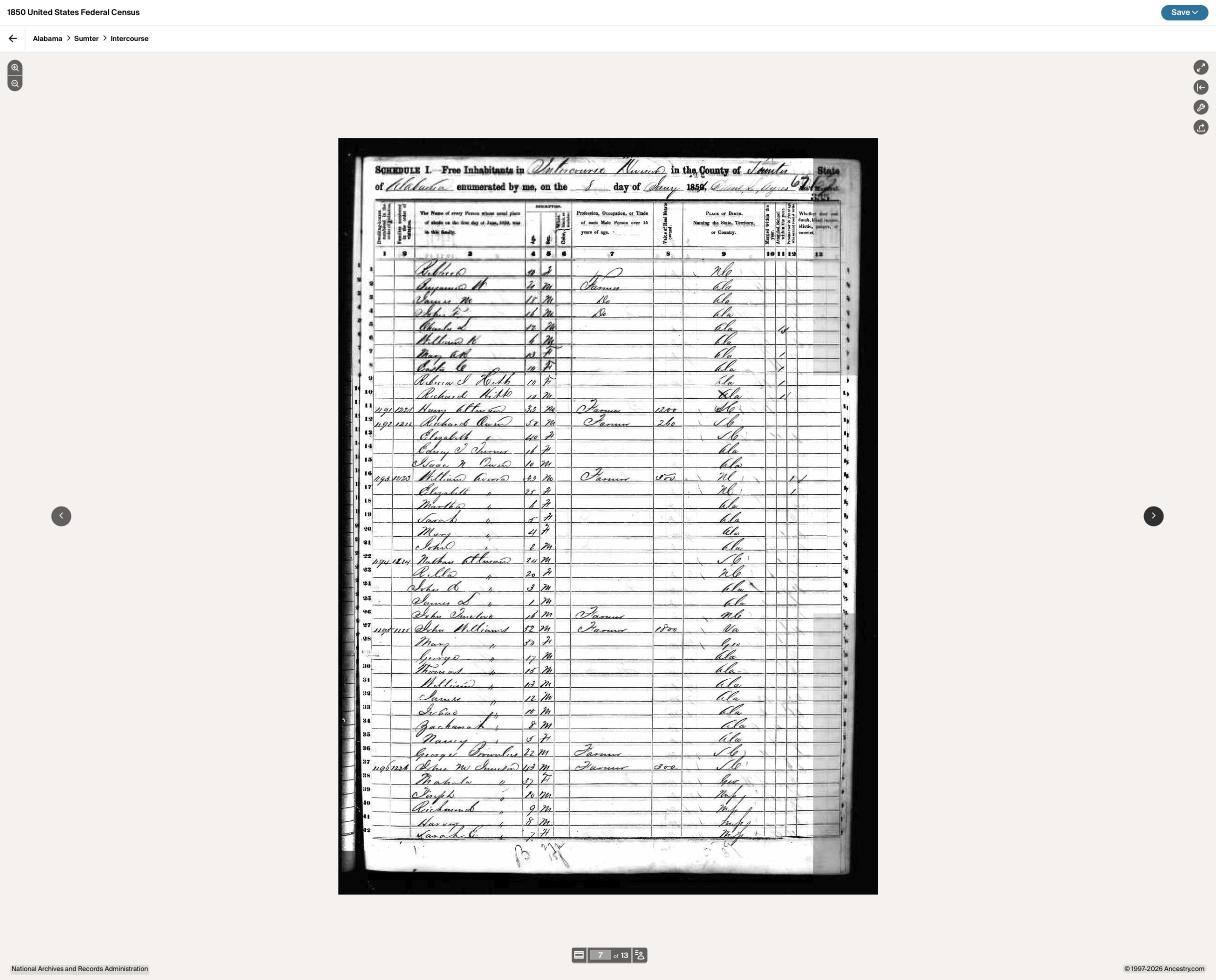
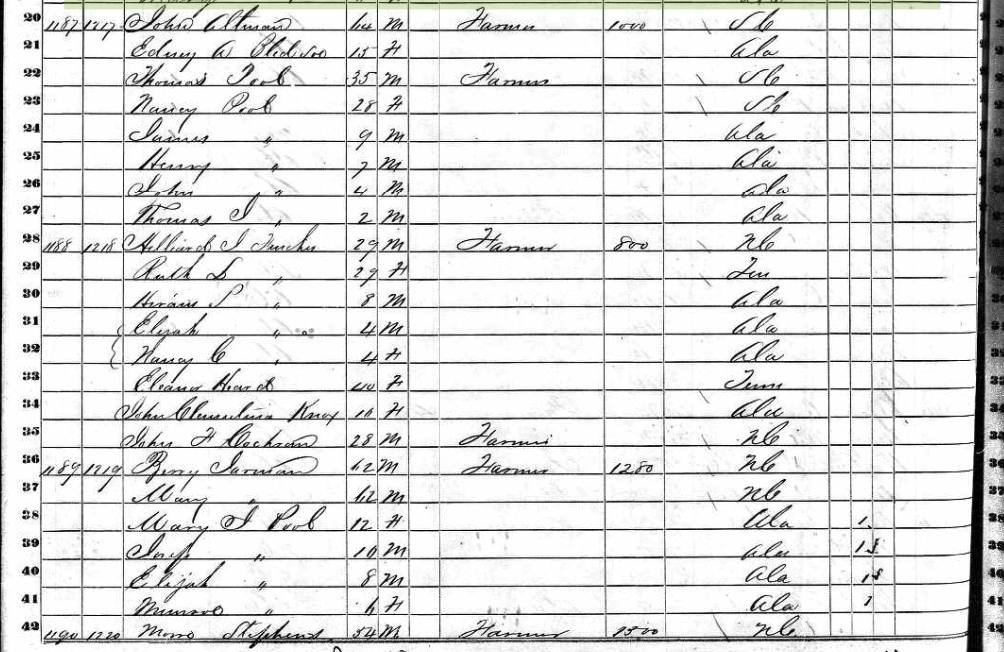
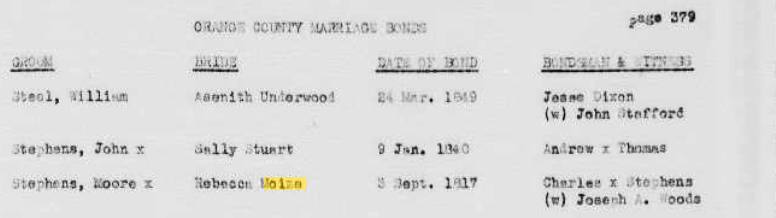
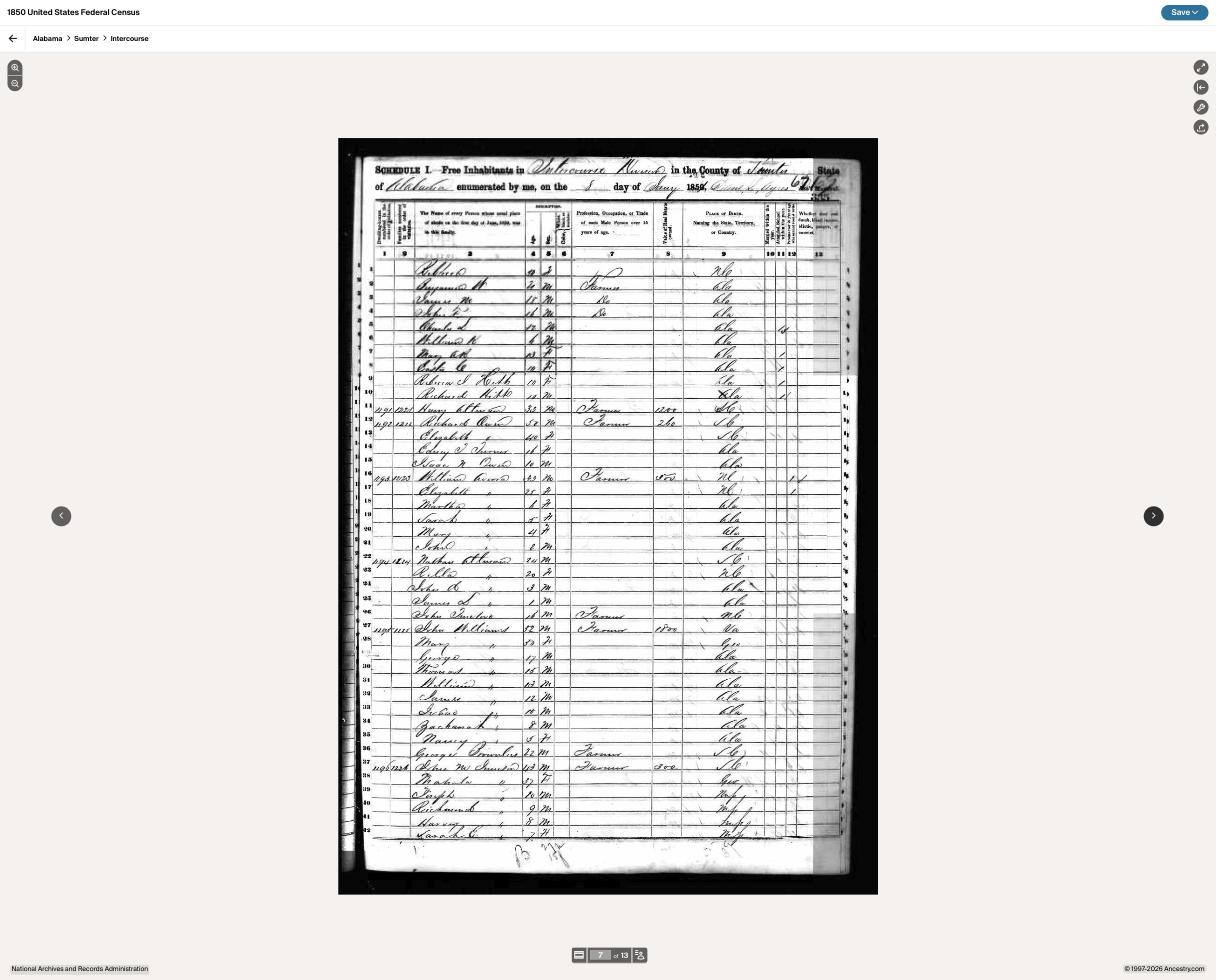
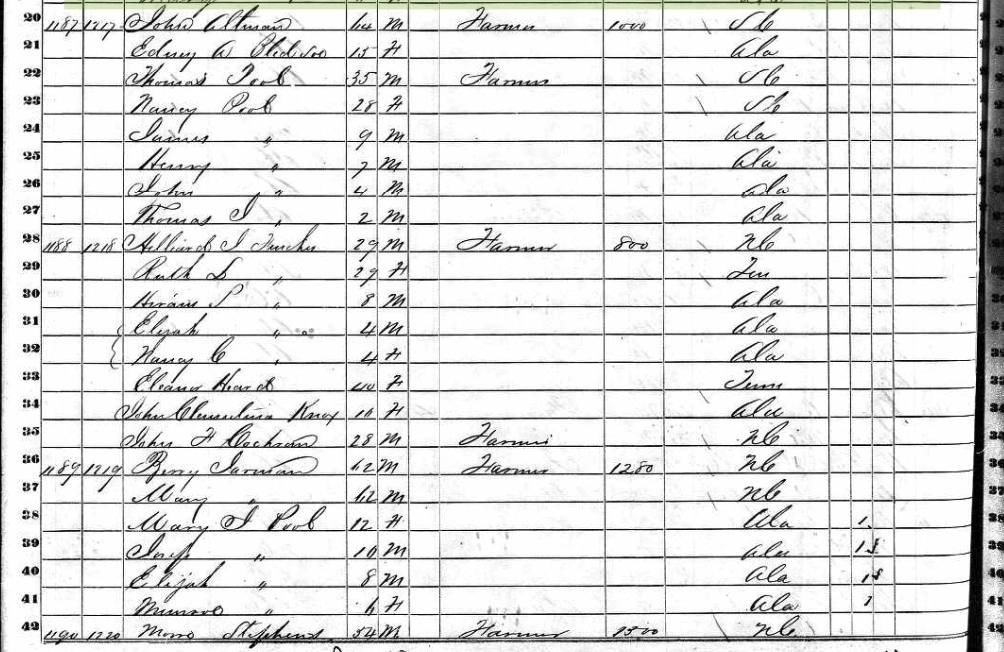
⭐⭐⭐⭐⭐ FOUND IN THE 1850 CENSUS, 6 Aug 2026:Moore Stephens, 54, born NORTH CAROLINA — Sumter county, Alabama, household 1220, with REBECCA, 50, born North Carolina (alive at 50 — his 1817 bride), Benjamin W. 21, James M. 18, John F. 16, Mary A. R. 13, Charles L. 12, Easter C. 10, William K. 6, and Rebecca J. and Richard HITT, both 10 — his dead sister Esther Hitt’s orphans, the “Representatives of Esther Hitt” of the 1846 distribution, being raised in his house. He named a daughter Easter (Esther) for that sister [STEPHENS-15]. ⭐⭐ Sumter County explains the cost bill’s “Heirs of SUMTER CO., ALA.” — and explains why he alone of the brothers bought nothing at his mother’s sale: he did not live there. ⭐⭐ His marriage bond found 6 Aug 2026: Orange County, North Carolina, Marriage Bonds index p.379 — “Stephens, Moore ✗ | Rebecca MOIZE | 3 Sept. 1817 | bondsman CHARLES ✗ STEPHENS, witness Joseph A. Woods”. Both men signed with a mark [STEPHENS-05]. ⭐⭐⭐ And his whole family found the same night: Greene County, Alabama, Orphans’ Court, 12 October 1846 — he is one of TEN heirs at law of MARY THORN, deceased, taking a distributive share of $107.50, receipted at $95 [STEPHENS-06]. His nine siblings are named: William, Lewis, Charles and James Stephens; Nancy Barnett, Mary Barnett, Lucinda Ball, Elizabeth Beavers and Esther Hitt. ⭐ Charles Stephens is his BROTHER, not his father — co-heirs in equal shares are siblings, and the “Gen 9 candidate” label on Charles is withdrawn.
Outstanding: ⭐ The migration is now dated: Orange Co., N.C. (Sept 1817) → Greene Co., Alabama (Aug 1824), window 1819×1824 — and corroborated 6 Aug 2026: his brother James is recorded in the 1850 census as born NORTH CAROLINA, c.1801 [STEPHENS-14]. ⚠⚠⚠ The estate he inherited from was two-thirds a human being. Mary Thorn’s sale of 29 Apr 1844 realised $1,075.86, of which $700 was the price of the woman JANE, bought by his brother James [STEPHENS-13]. Moore’s share was $107.39; about $70 of it was Jane. ⛔ Moore himself does not appear in the 1850 slave schedule index — held open, since he has not been found in the 1850 population census either. ⚠⚠⚠ VERIFIED FROM THE IMAGE, same night [STEPHENS-17]: Sumter Co. 1850 slave schedule, right-hand half, line 31 — “MOORE STEPHENS” in a clear hand (the index’s “Moon” is a transcription error). He held ONE enslaved person: a Black FEMALE, age indexed 7 (the age cell alone is faint). Born c.1843; about twenty-two at emancipation; not named, because the schedule was designed not to name her. ⭐ She is the likeliest person in this family to be findable BY NAME in the 1870 census of Sumter County. ⭐⭐⭐⭐⭐ 1860 FOUND [STEPHENS-18]: MOORE STEVENS, 66, born North Carolina — NEWTON COUNTY, MISSISSIPPI, p.117, with Rebeca 55, Mary 23, Emeline 21, Luis 18, Rebeca 18, William 15. He left Sumter Co., Alabama for Mississippi in the 1850s — and node 80 already has HENRY H. STEPHENS in NEWTON CO. MS in 1860 too. Father and son moved together again (in 1850 they were six houses apart). ⭐⭐ It also frames the Mary Thorn cost bill’s “Heirs of Tishomingo County, Mississippi” — the westward pull on this family is now documented. ⚠ An FS tree calls him “1796–1860” — unsourced, NOT entered, but worth testing against a Newton Co. probate or the 1860 mortality schedule, which would give him a death date for the first time. ⚠ Two children (Luis 18, Rebeca 18, b. c.1842) are not in the 1850 household — unresolved; this family has taken in others’ children before.
Evidence images (described)
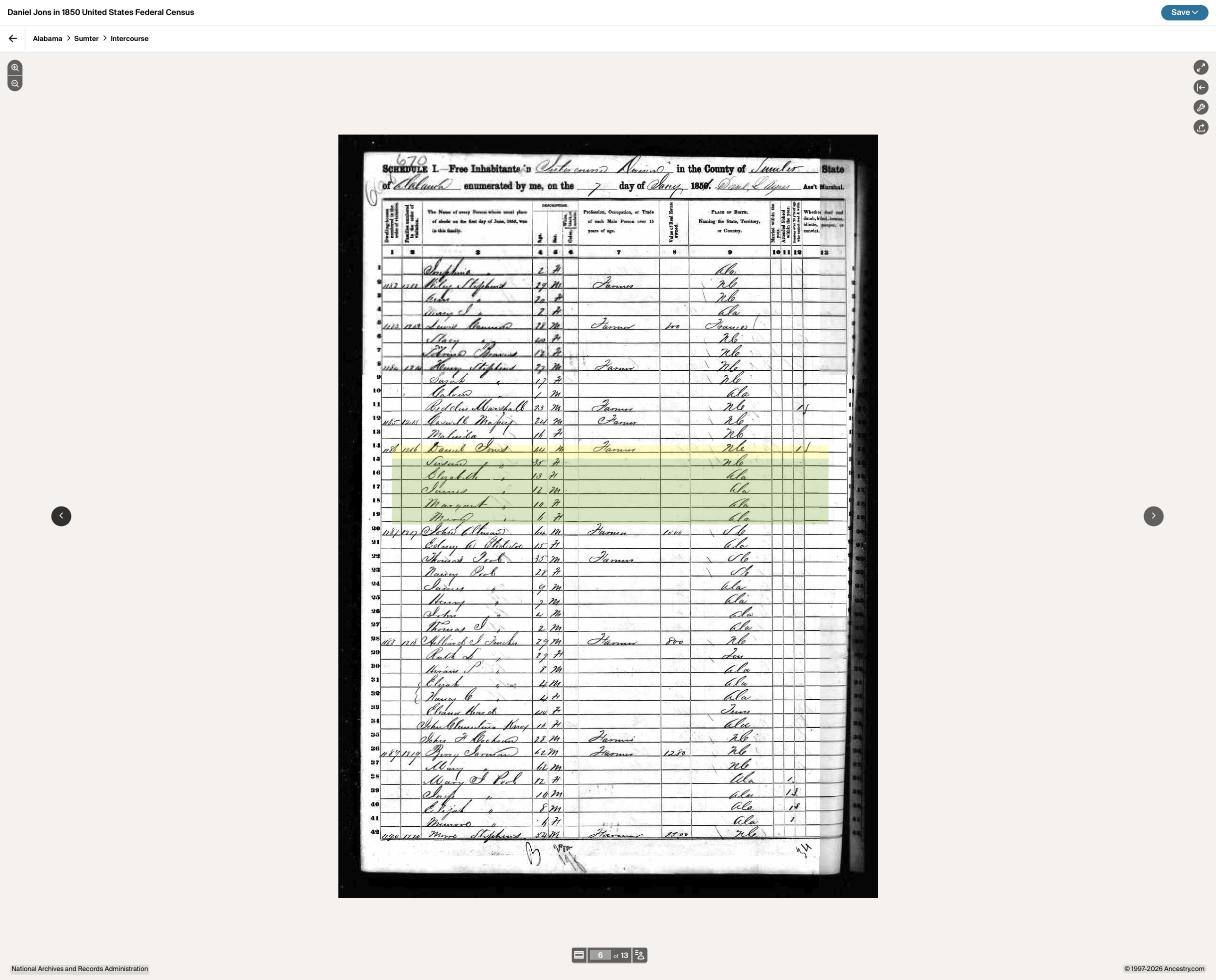
1850 census page — the Stephens and Jones neighbors — A single 1850 census page from Sumter County, Alabama, where the Stephens and Jones families lived just a few doors apart, neighbors who later became family through marriage.1850 census, continuation — the Moore Stephens household — The next page of the same 1850 census, continuing Moore Stephens's large household in Sumter County, Alabama.1850 census detail — the Moore Stephens household — A close-up of Moore Stephens's large household on the 1850 census, the family patriarch of this branch of the Stephens line in Sumter County, Alabama.1817 marriage bond, Moore Stephens and Rebecca Moize — The 1817 North Carolina marriage bond for Moore Stephens and Rebecca Moize, signed with their marks and backed by a bondsman named Charles Stephens, likely a relative.1846 estate settlement naming Mary Thorn's heirs — An Alabama court divided Mary Thorn's small estate among ten heirs in 1846, and one of them, Moore Stephens, may well have been her own son.Court minutes, full page — the Mary Thorn estate — The full page of the 1846 court record dividing Mary Thorn's estate among her ten heirs, with Moore Stephens counted among them.1844 citation to Mary Thorn's next of kin — In January 1844 an Alabama court summoned Mary Thorn's closest relatives to settle her estate, tying the Stephens siblings to her as next of kin.1850 slave schedule, verified Moore Stephens entry — After an earlier misreading was corrected, this faint 1850 record was confirmed to belong to Moore Stephens, the family's Alabama patriarch.1850 slave schedule, faint age cell on Moore Stephens's line — A close-up of the same faded 1850 record, needed to make out the age written beside Moore Stephens's name.1850 census, Sumter Co. AL — Henry Stephens and Daniel Jones households — A full page of the 1850 Sumter County, Alabama census listing the households of Henry Stephens and Daniel Jones side by side, near the family's Alabama neighbors.1850 census, Sumter Co. AL — the Moore Stephens household continued — The following census page continues the same neighborhood, recording the household of Moore Stephens and the families living around him in 1850 Sumter County, Alabama.1850 census close-up — the Moore Stephens household — A close-up of the 1850 census showing Moore Stephens and Rebecca among their Alabama neighbors, the Altman, Fincher, and Jordan families next door.
Rebecca Moize (b. ~1800 NC – Sumter Co. AL 1850)
Ahnentafel #161 · his father’s mother’s father’s father’s father’s father’s mother (7 generations back) · Documented — person and parent-link established
Rebecca Moize was born about 1800 to 1805 in North Carolina. She married Moore Stephens on 3 September 1817 in Orange County, North Carolina, at about seventeen years old, and was still recorded beside him, and still North Carolina-born, in both the 1850 census in Sumter County, Alabama, and the 1860 census in Newton County, Mississippi — forty-three years and two states after her wedding. The Moize family remained settled in Orange County for generations afterward, and her own parents have not yet been identified.
Evidence
Full dates: b. c.1800 North Carolina; m. 3 Sept 1817 Orange Co., NC; living Sumter Co., Ala. 1850
⭐⭐⭐⭐⭐ ALIVE AND FOUND, 6 Aug 2026:“Rebecca Stephens, 50, born North Carolina” in Moore Stephens’s household, Sumter county, Alabama, 1850 [STEPHENS-15]. Married at about seventeen and still his wife thirty-three years later, a state away. ⭐⭐⭐⭐⭐ AND FOUND IN 1860 [STEPHENS-18]: “Rebeca Stevens, 55, born North Carolina,” Newton County, Mississippi, still beside Moore.Married in Orange Co., N.C. at about seventeen and still his wife forty-three years later, two states away.Her death is now after 1860, not merely after 1850. ⚠ The two censuses give her birth as c.1800 and c.1805 — census ages drift; recorded as b. c.1800–1805. Bride on the 1817 Orange County marriage bond [STEPHENS-05]. ⚠ The bond does NOT name her father — the bondsman carried the groom’s surname, not hers. ⭐ MOIZE is a settled Orange County surname: the family is still in Lebanon Township, Orange County in 1880, and Moize deaths registered at Durham into the 1950s still give “Orange County, N.C.” as birthplace.
Outstanding: Her parents are unnamed. Look for a Moize groom of the 1780s–1810s in the same Orange County bond index — he would be her father or brother. ⭐ Also: the Greene Co. cost bill shows “Chas. Stephens & wife” and three other Stephens wives relinquishing dower — if Moore is in the unread part of that list, the deeds name Rebecca.
Evidence images (described)
1850 census page — the Stephens and Jones neighbors — A single 1850 census page from Sumter County, Alabama, where the Stephens and Jones families lived just a few doors apart, neighbors who later became family through marriage.1850 census, continuation — the Moore Stephens household — The next page of the same 1850 census, continuing Moore Stephens's large household in Sumter County, Alabama.1850 census detail — the Moore Stephens household — A close-up of Moore Stephens's large household on the 1850 census, the family patriarch of this branch of the Stephens line in Sumter County, Alabama.1817 marriage bond, Moore Stephens and Rebecca Moize — The 1817 North Carolina marriage bond for Moore Stephens and Rebecca Moize, signed with their marks and backed by a bondsman named Charles Stephens, likely a relative.
Daniel Jones (~1806 NC – bef. 1869 Sumter Co. AL)
Ahnentafel #162 · his father’s mother’s father’s father’s father’s mother’s father (7 generations back) · Probable — the IDENTIFICATION or the LINK rests on one source, or is in conflict
Daniel Jones was born about 1806 in North Carolina and died by December 1869 in Sumter County, Alabama. He is believed to have been the father of Sarah Ann Jones, based on the bonding of her sons Caswell, Calvin, and John as his "minor heirs" in December 1869 — an inheritance only possible through a lineal, and by then deceased, child. He lived two doors from the Stephens family in the 1850 census and repeatedly stood as co-surety with Moore Stephens in the 1850s, reflecting a close and long-standing connection between the two families.
Evidence
Full dates: b. ~1806 North Carolina; d. by Dec 1869, Sumter Co., Alabama
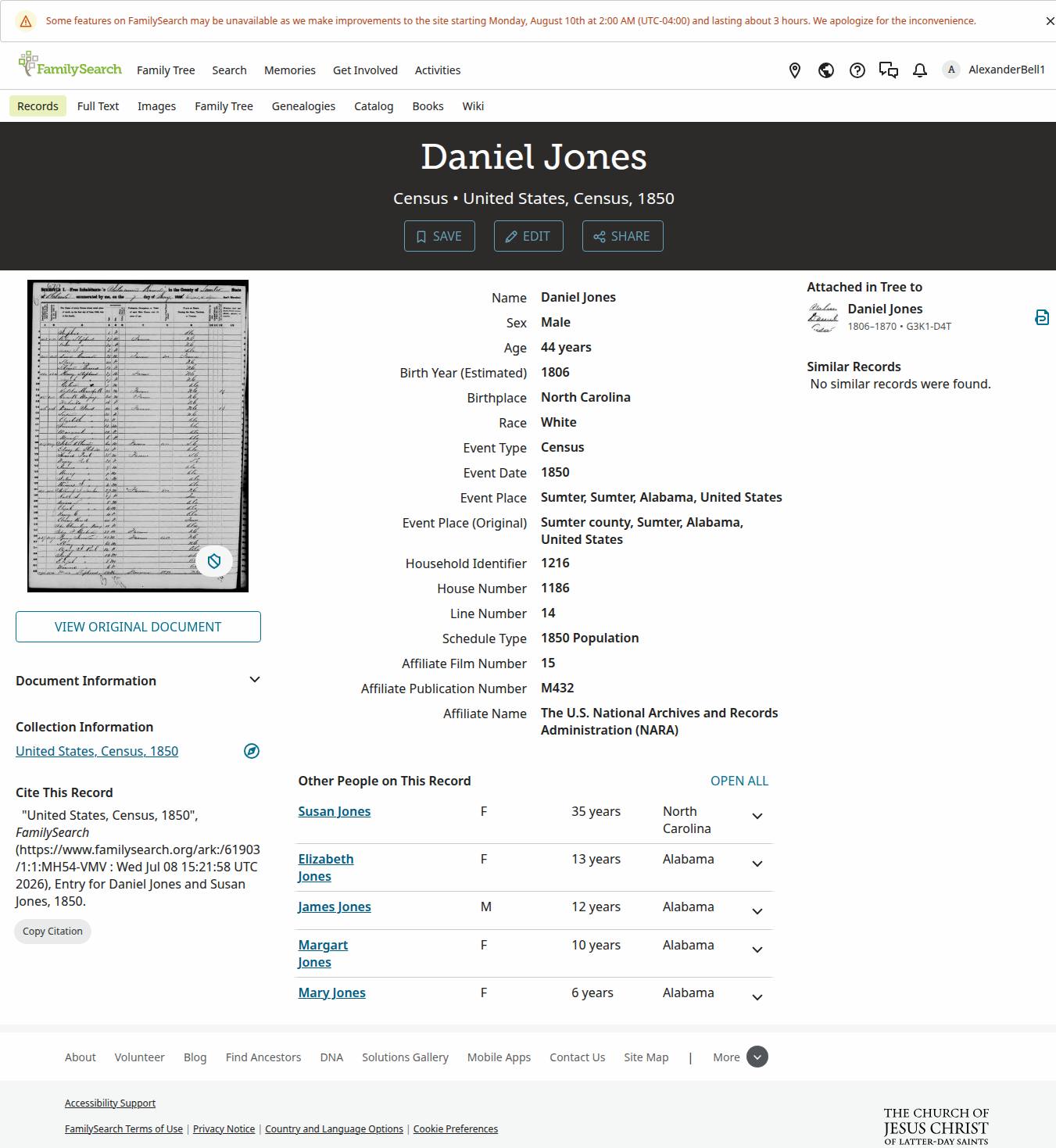
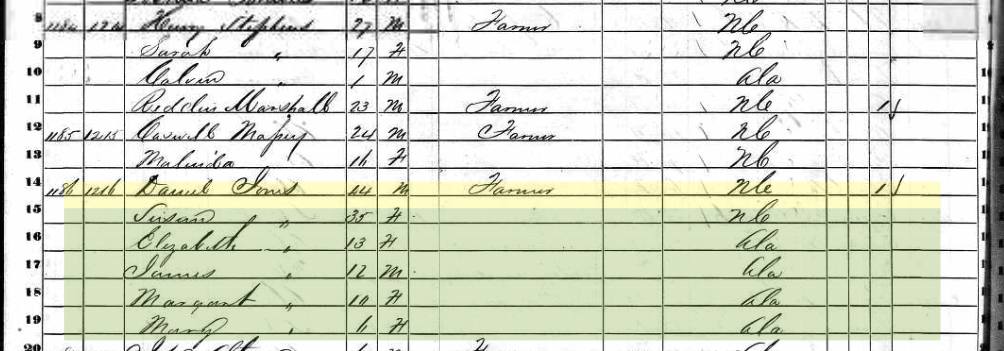
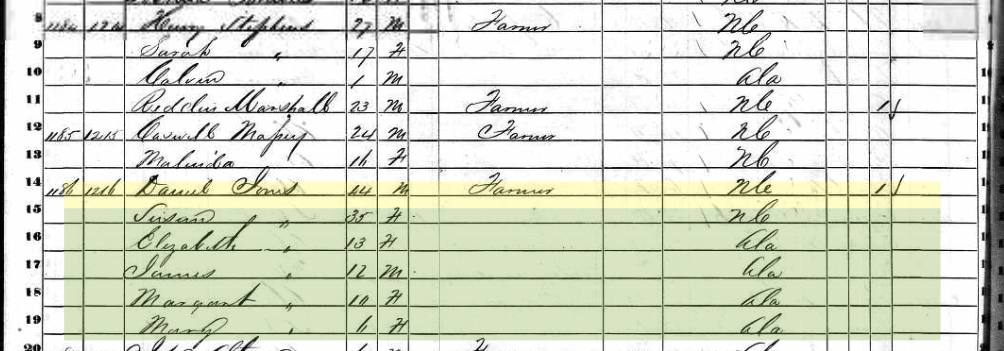
PROBABLE, adversary-confirmed 10 Aug 2026 [STEPHENS-33/-34/-35/-VERDICT]. Father of Sarah Ann Jones (81). The hard link: her sons Caswell, Calvin, John bonded 31 Dec 1869 as his “minor heirs” — per-stirpes inheritance possible only through a lineal predeceased link, their dead mother. Converging web: 1850 household 1216 (Daniel 44 NC · Susan 35 NC · Elizabeth 13 · James 12 · Margaret 10 · Mary 6) TWO DOORS from Henry’s 1214 [STEPHENS-35a]; repeat co-surety with Moore Stephens (160) 1853–54; adult surety by 1839; the lone adult Daniel Jones in 1850 Sumter; the NC POA sibling set (Daniel, Elijah, David, Sarah; brother Joel d. ~1843 Sumter). Sororate: daughter Elizabeth = Henry’s 1854 second wife (inference — age+name+two doors).
Outstanding: the decider — his own 1869 administration/distribution (Probate Records 1868–74 / Estate Case Files; “daughter Sarah, deceased” recital upgrades, different heirs falsify); Henry’s 1860 household (never pulled — Caswell’s maternity primary-check); the Elizabeth-identity document; post-1850/adjacent-county same-name residue.
Evidence images (described)
1850 census, Sumter County — the Daniel Jones household — The 1850 census household of Daniel Jones in Sumter County, Alabama, whose daughter Elizabeth may have become Henry Stephens's second wife after her sister Sarah died young.1850 census page — the Stephens and Jones neighbors — A single 1850 census page from Sumter County, Alabama, where the Stephens and Jones families lived just a few doors apart, neighbors who later became family through marriage.1850 census detail — Henry Stephens and Daniel Jones — A close-up of three neighboring 1850 census households: Henry Stephens, a farmer named Caswell Massey, and Daniel Jones, whose name resurfaced two years later as a Stephens baby's own.1850 census, Sumter Co. AL — Henry Stephens and Daniel Jones households — A full page of the 1850 Sumter County, Alabama census listing the households of Henry Stephens and Daniel Jones side by side, near the family's Alabama neighbors.1850 census close-up — Henry Stephens and Daniel Jones — A closer look at the 1850 census lines for Henry Stephens and Daniel Jones, neighboring families in Sumter County, Alabama.
Susan Jones (b. ~1815 NC; living 1850)
Ahnentafel #163 · his father’s mother’s father’s father’s father’s mother’s mother (7 generations back) · Hypothesis — a candidate, not tied in
Susan Jones, whose maiden name is not known, was born about 1815 in North Carolina and was living in 1850 as the wife of Daniel Jones. Whether she was the mother of Sarah Ann Jones, who was born around 1833 when Susan would have been only about eighteen, is not established, and Daniel may have had an earlier wife instead. She remains a candidate rather than a confirmed ancestor.
Evidence
Full dates: b. ~1815 North Carolina; living 1850
HYPOTHESIS, adversary-graded 10 Aug 2026 [STEPHENS-35-VERDICT]. Daniel’s wife in the 1850 household (35, b. NC). Her maternity of Sarah Ann (b. ~1833) is UNPROVEN — she would have been ~18 at the birth; a prior wife is fully possible. Candidate only.
Outstanding: a marriage record Daniel × Susan (Sumter or NC); her fate after 1850 (the 1860 household); whether the 1838–40 “I Sarah Jones consent” deed [STEPHENS-33] is an elder kinswoman.
Evidence images (described)
1850 census, Sumter County — the Daniel Jones household — The 1850 census household of Daniel Jones in Sumter County, Alabama, whose daughter Elizabeth may have become Henry Stephens's second wife after her sister Sarah died young.1850 census page — the Stephens and Jones neighbors — A single 1850 census page from Sumter County, Alabama, where the Stephens and Jones families lived just a few doors apart, neighbors who later became family through marriage.1850 census detail — Henry Stephens and Daniel Jones — A close-up of three neighboring 1850 census households: Henry Stephens, a farmer named Caswell Massey, and Daniel Jones, whose name resurfaced two years later as a Stephens baby's own.
Rev. William Hampton Truett (1806 Sumter SC – 1870 Henry Co. AL)
Ahnentafel #176 · his father’s mother’s mother’s father’s father’s father’s father (7 generations back) · Documented — person and parent-link established
The Reverend William Hampton Truett was born in 1806 in Sumter, South Carolina, and died in 1870 in Henry County, Alabama. As a preacher, he was part of the generation that carried the family out of the Carolina low country and onto the Alabama frontier. He married Alcey Wiggins on 10 October 1831 in Benton County, Alabama.
Evidence
A preacher — the generation that carried the family out of the Carolina low country and onto the Alabama frontier. m. Alcey Wiggins 10 Oct 1831, Benton Co., AL.
Outstanding: Only five sources on his profile.
Alcey Wiggins (1813 – 1880)
Ahnentafel #177 · his father’s mother’s mother’s father’s father’s father’s mother (7 generations back) · Documented — person and parent-link established
Alcey Wiggins was born in 1813 and died in 1880. In her final years she lived in the household of her son John Wesley Truett, appearing there, aged about 67, in the 1880 Clarke County, Alabama census — a single enumerator's page that ties three generations of the family together.
Evidence
Living in her son John Wesley’s household in the 1880 Clarke County census, aged about 67 — one enumerator’s page tying Gens 6, 7 and 8 together.
William H. Ward (~1806 SC – 1860/69)
Ahnentafel #178 · his father’s mother’s mother’s father’s father’s mother’s father (7 generations back) · Documented — person and parent-link established
William H. Ward was born about 1806 in South Carolina and died sometime between 1860 and September 1869, in Rowville Beat No. 5, Henry County, Alabama. He gave his written consent to his daughter's marriage in 1854. He died without a will, and a petition sworn before the Judge of Probate in September 1870 named his children as heirs.
Evidence
Full dates: b. about 1806 in South Carolina – d. between 1860 and Sept 1869
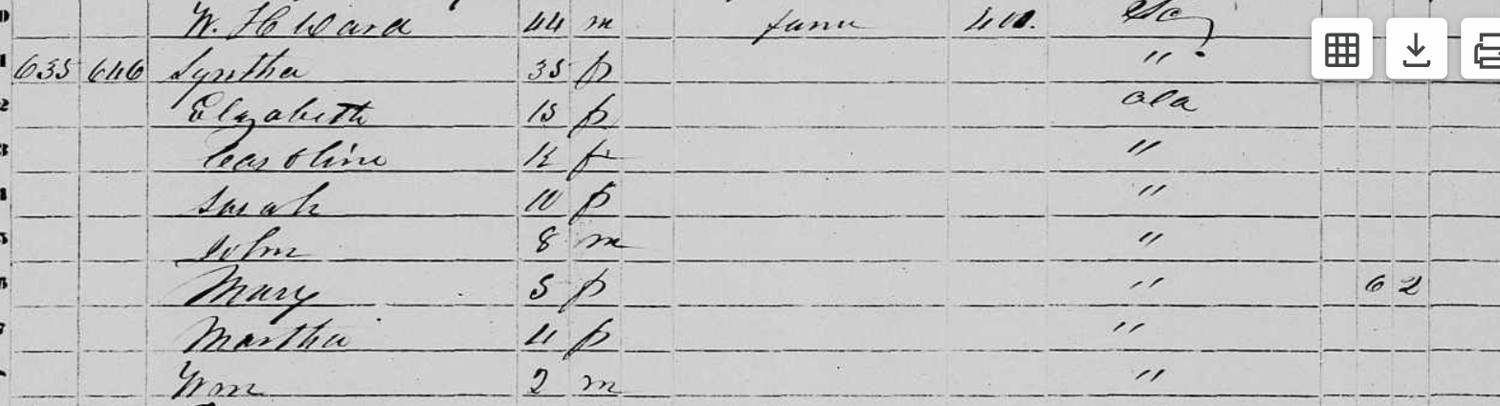
Of Rowville Beat No. 5, Henry County, Alabama. He gave written consent to his daughter’s marriage in 1854. ⭐ His death narrowed 6 Aug 2026 from 1860×1880 to 1860 × September 1869 by the dower proceeding of 18 Sept 1869 [TRUETT-24]. He died INTESTATE — Henry County Orphan Records p.774, petition sworn by C. J. Hutto 28 Sept 1870 before L. B. Appling, Judge of Probate, which spells his name out in full and names the children [TRUETT-23].
Outstanding: His estate file itself, and the Henry County Register notice by publication, autumn 1869.
Evidence images (described)
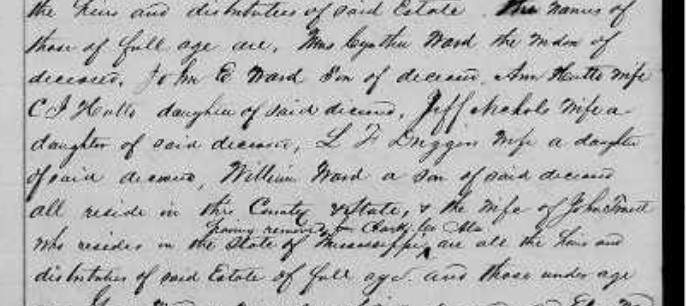
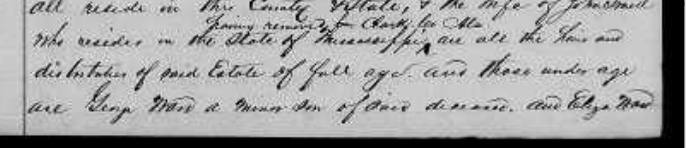
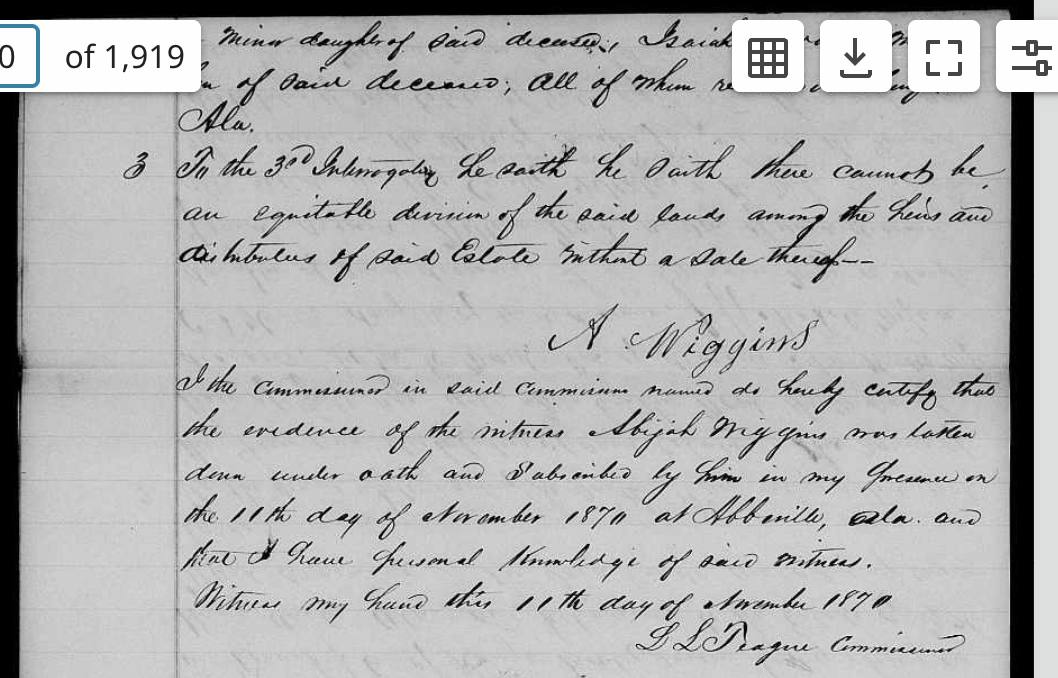
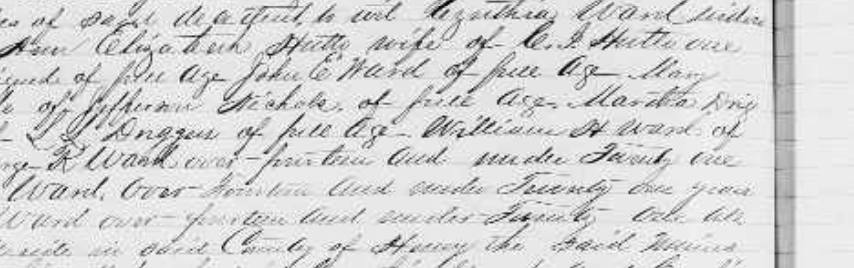
William H. Ward's consent to his daughter's marriage — William H. Ward's own written consent for his daughter Emily's marriage in 1854, the clearest proof yet of who her father was.1850 census, Henry County — the William H. Ward household — The 1850 census finally located William H. Ward's household in Henry County, Alabama, with his wife Syntha and young daughter Caroline.Estate deposition naming William H. Ward's heirs — An 1870 court deposition naming William H. Ward's heirs, including the daughter who by then was the wife of John Truett.Estate deposition: Caroline's move and the minor heirs — The same 1870 estate record notes that William H. Ward's widow had moved to Clarke County, Alabama, with two still-underage children.Estate deposition sworn before the commissioner, 1870 — William H. Ward's minor son Isaiah gave sworn testimony in 1870 as the family's estate was settled in Abbeville, Alabama.Petition naming William H. Ward's heirs by name, 1870 — A petition from William H. Ward's Alabama estate that spells out every one of his children's given names, settling who his family really was.
Syntha / Cyntha Ward (~1813 SC – 1880/1900)
Ahnentafel #179 · his father’s mother’s mother’s father’s father’s mother’s mother (7 generations back) · Documented — person and parent-link established
Syntha, also recorded as Cyntha, Ward was born about 1813 in South Carolina and died sometime between 1880 and 1900. As William H. Ward's widow, her dower share was allotted on 18 September 1869 in Henry County, Alabama, and she was later described in a sworn deposition as "Mrs Cyntha Ward the widow of deceased." By 1880 she was living, widowed, in the household of her son Isaiah, and that census recorded both of her own parents as having been born in North Carolina.
Her maiden name, despite appearing in several records connected to her husband's estate, has never been given, and remains unknown.
Evidence
Widow of William H. Ward. ⭐ Her dower was allotted 18 September 1869, Henry County — notice by publication in the HENRY COUNTY REGISTER, J. H. Simonton guardian ad litem for the minors [TRUETT-24]. Named as “Mrs Cyntha Ward the widow of deceased” in Abijah Wiggins’s deposition sworn 11 Nov 1870 at Abbeville [TRUETT-22]. In 1880 she is 66, widowed, keeping house in her son Isaiah’s household; that schedule gives both her parents as NORTH CAROLINA-born — Generation 9, placed but unnamed.
Outstanding: ⚠⚠ HER MAIDEN NAME IS THE PROJECT’S FOUR-TIME NEGATIVE — the dower proceeding, the 1870 petition, the Wiggins deposition and the estate file all decline to give it. PARKED. It will come from a Bible, an obituary, or a Ward estate in South Carolina.
Evidence images (described)
1850 census, Henry County — the William H. Ward household — The 1850 census finally located William H. Ward's household in Henry County, Alabama, with his wife Syntha and young daughter Caroline.Estate deposition naming William H. Ward's heirs — An 1870 court deposition naming William H. Ward's heirs, including the daughter who by then was the wife of John Truett.Estate deposition: Caroline's move and the minor heirs — The same 1870 estate record notes that William H. Ward's widow had moved to Clarke County, Alabama, with two still-underage children.Petition naming William H. Ward's heirs by name, 1870 — A petition from William H. Ward's Alabama estate that spells out every one of his children's given names, settling who his family really was.
Colonel Gershom Tuttle III (1769 – 1823)
Ahnentafel #192 · his mother’s father’s father’s father’s father’s father’s father (7 generations back) · Probable — the IDENTIFICATION or the LINK rests on one source, or is in conflict
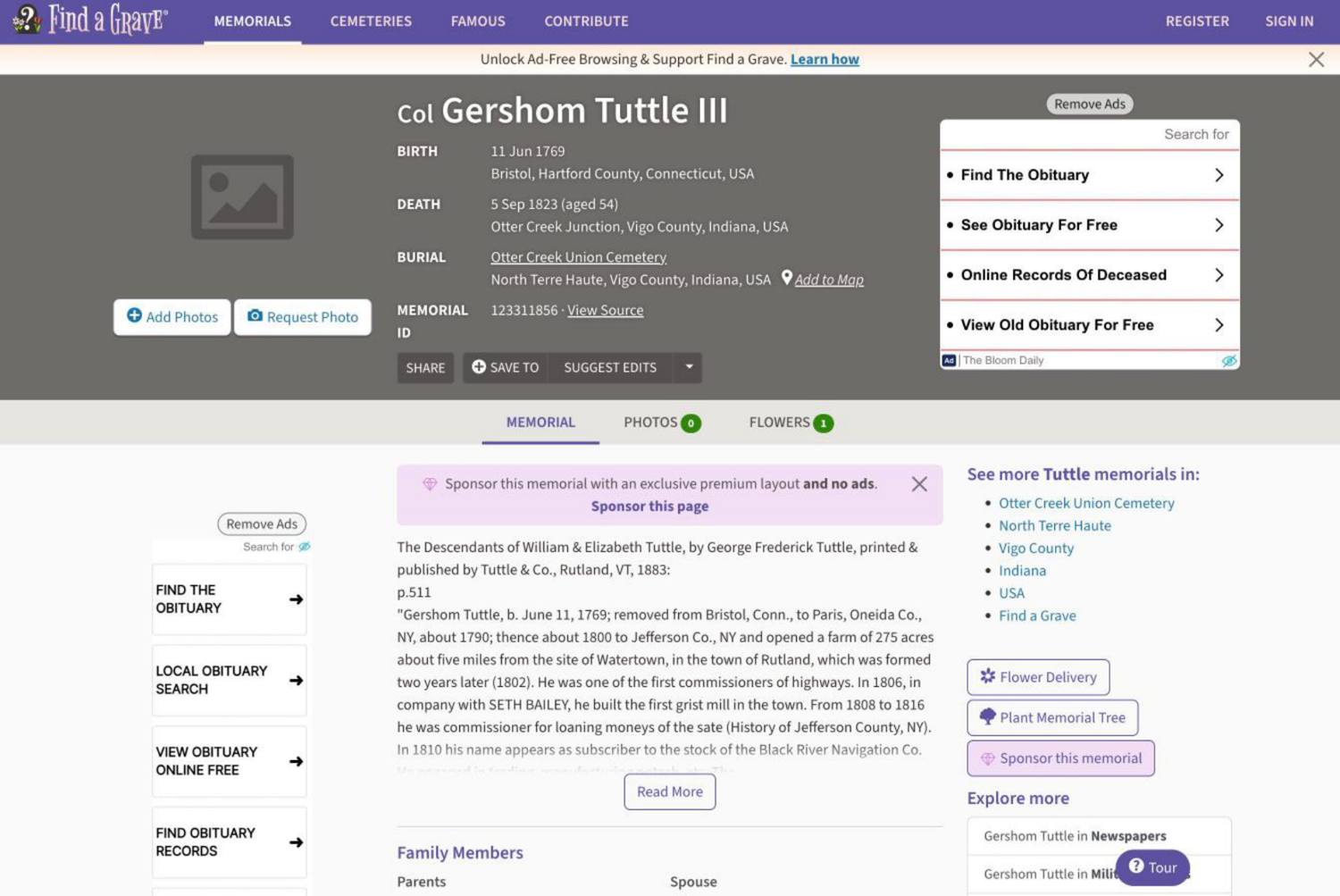
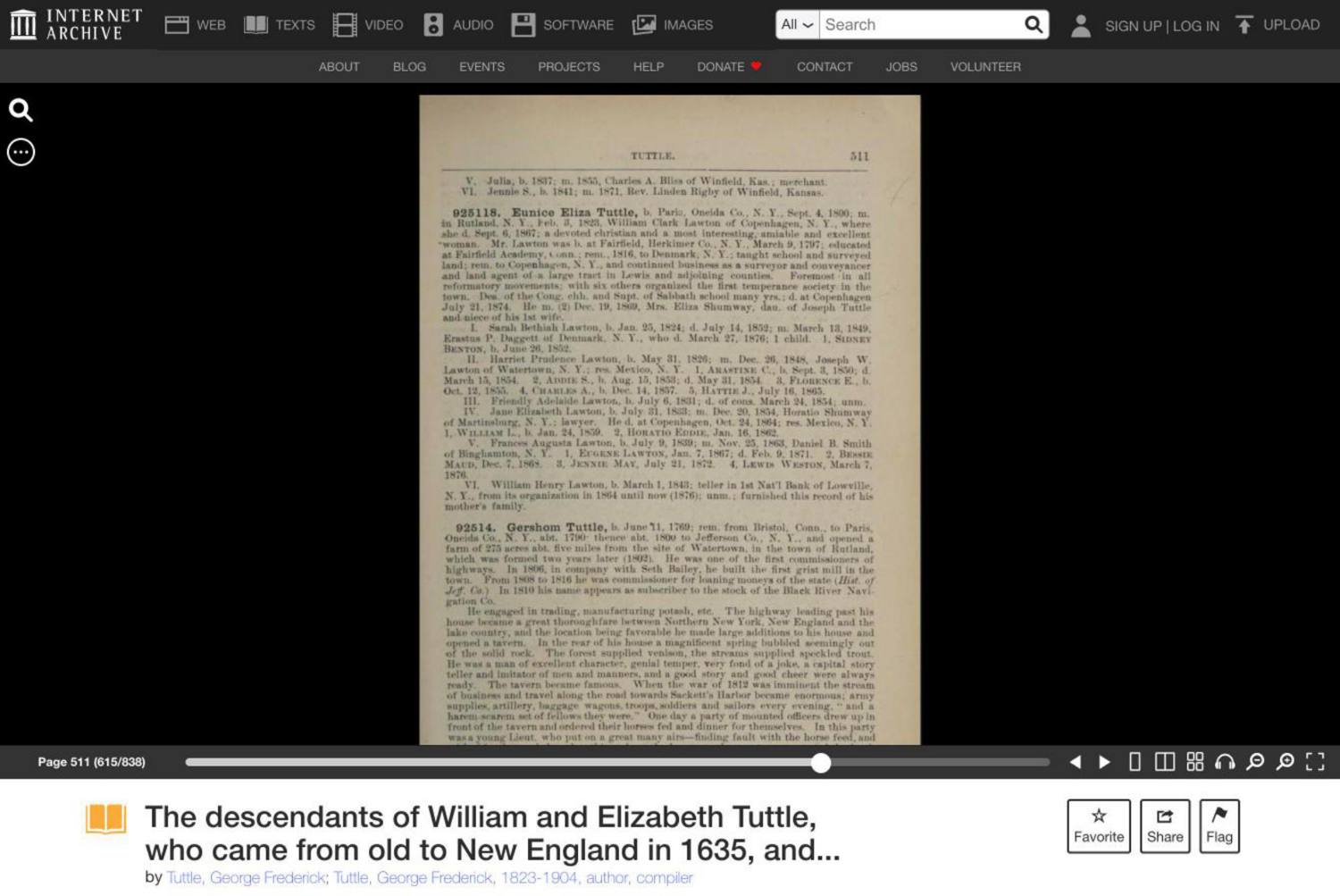
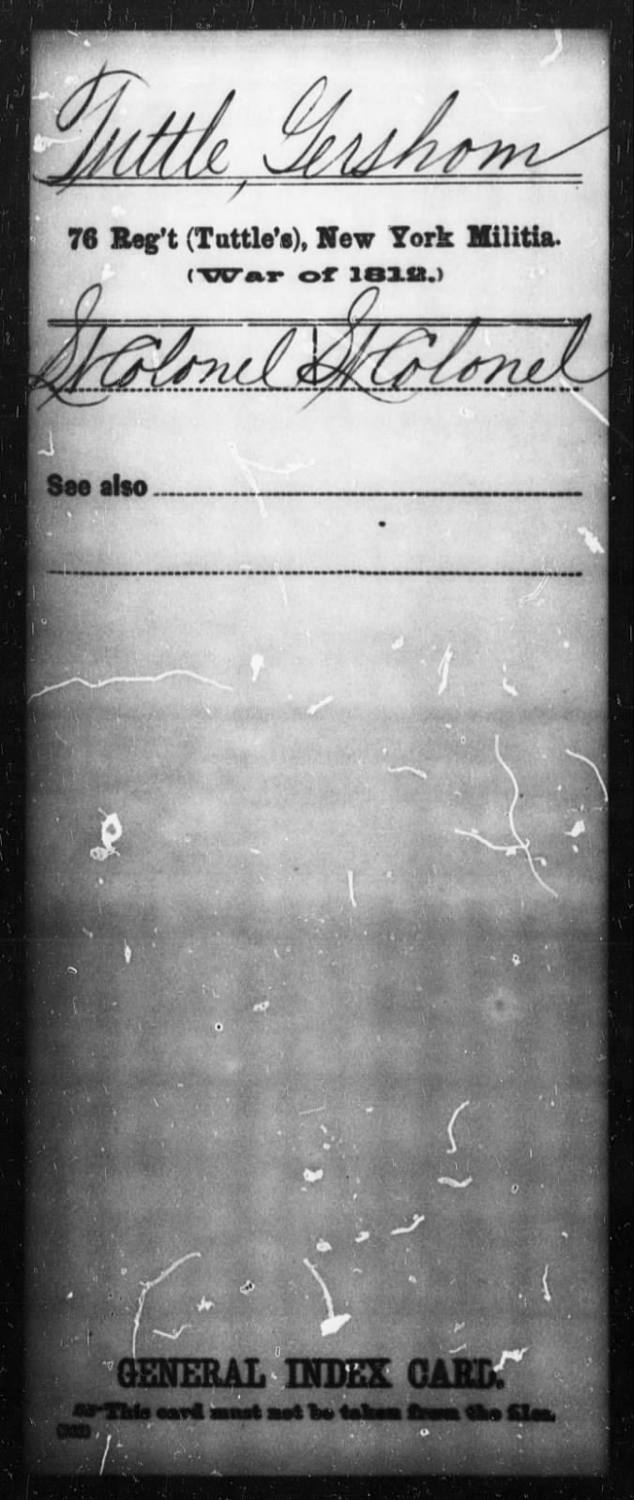
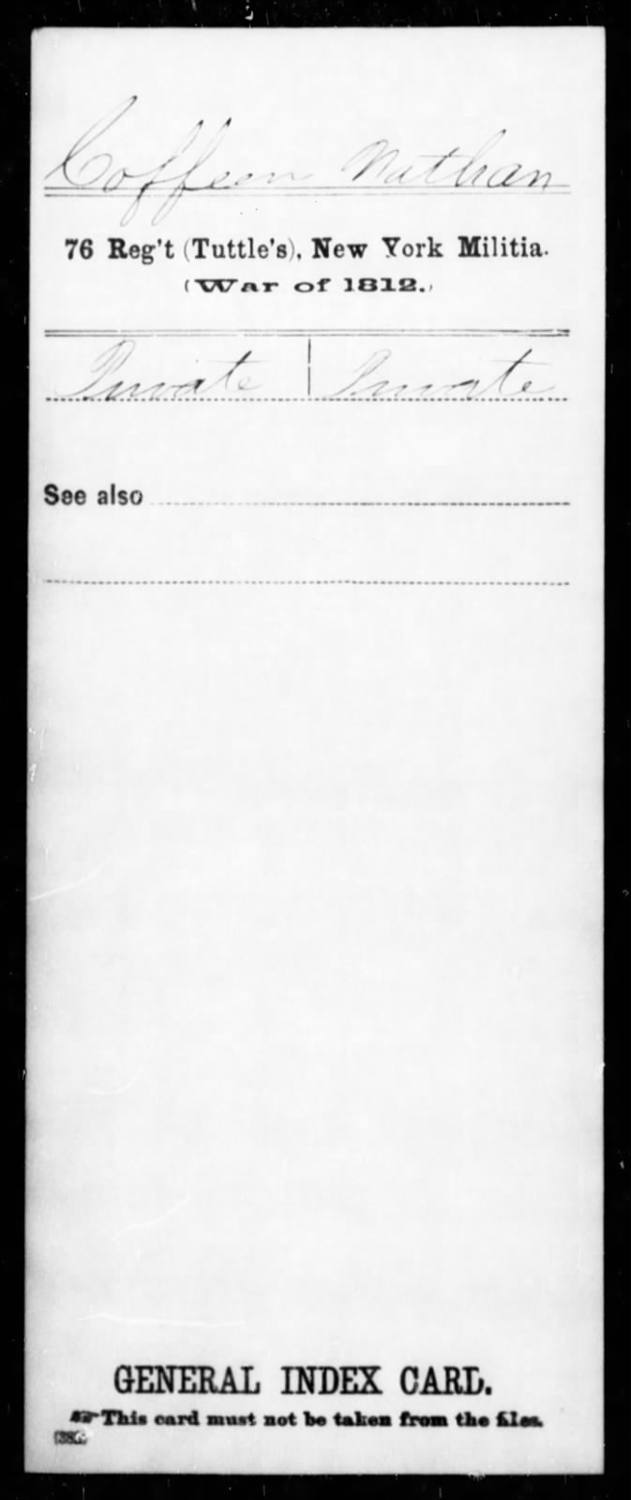
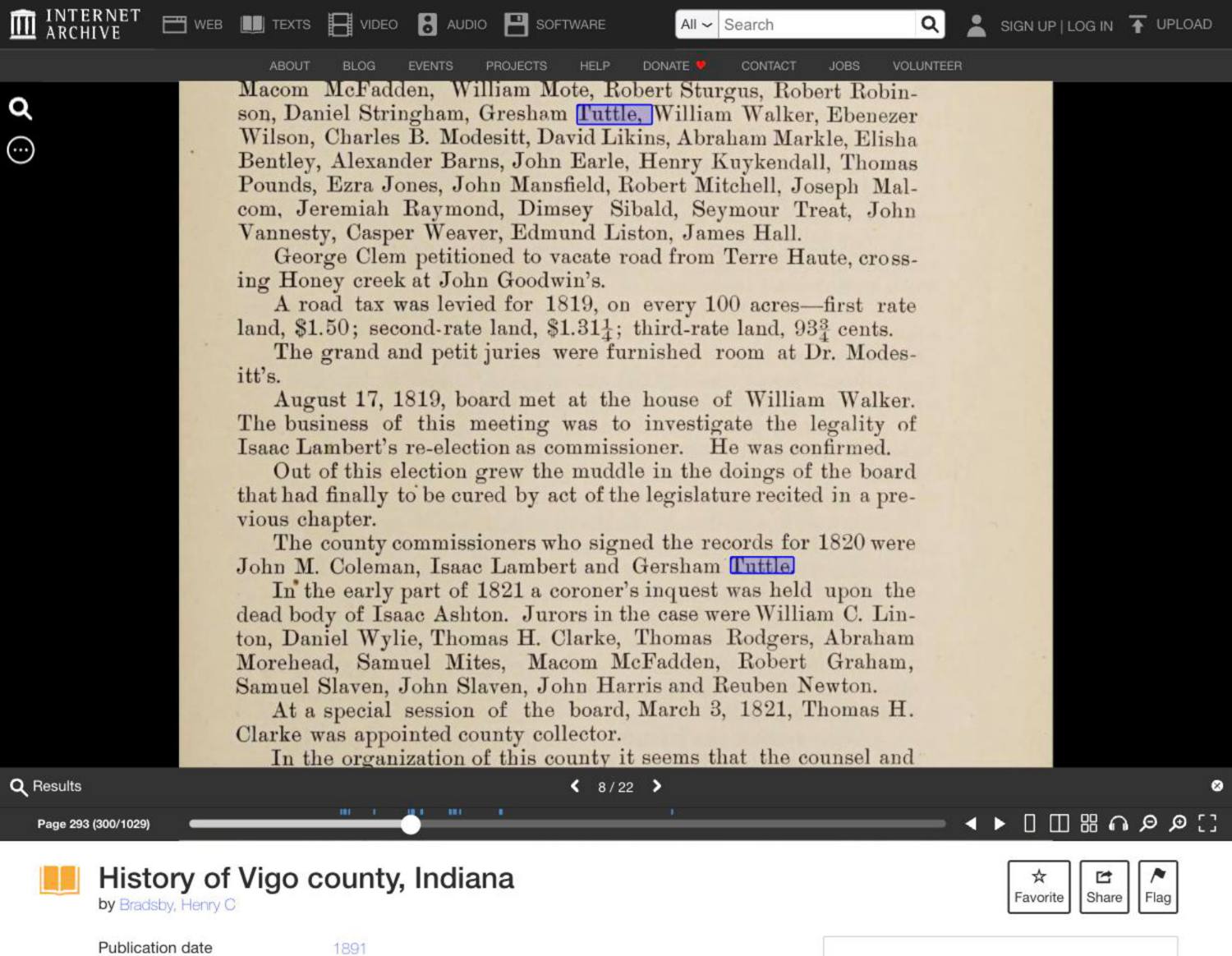
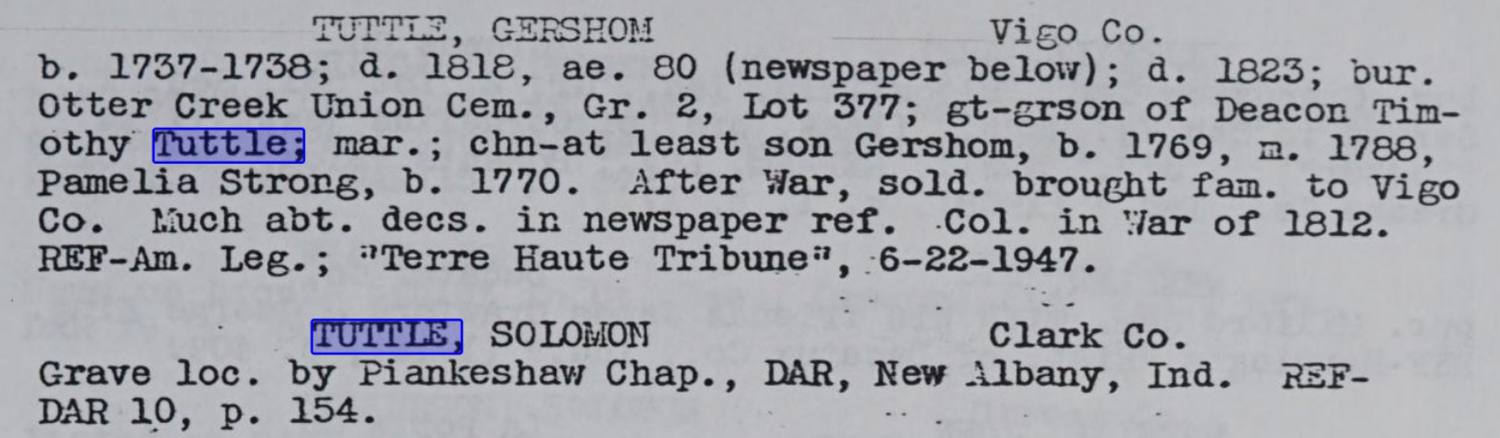
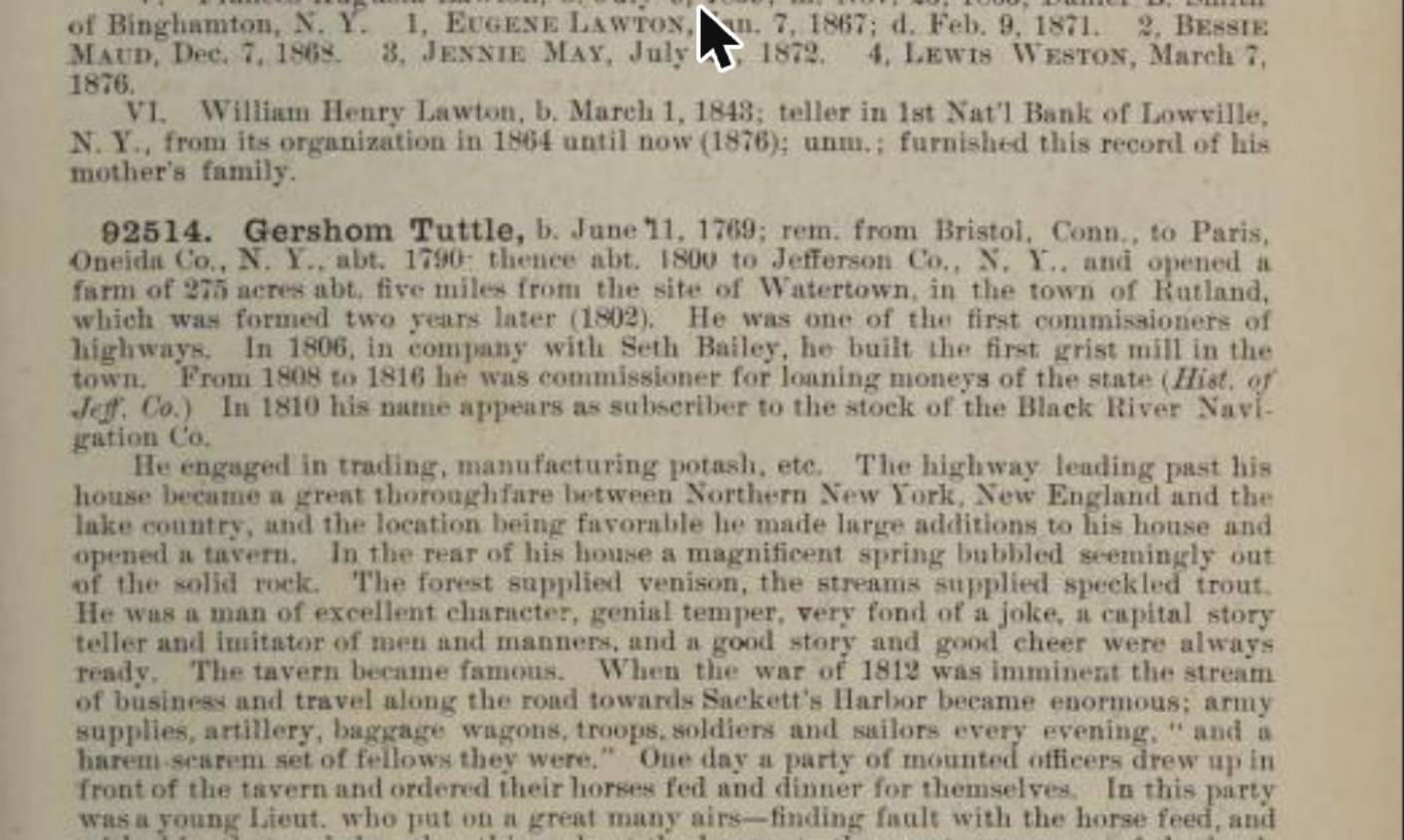
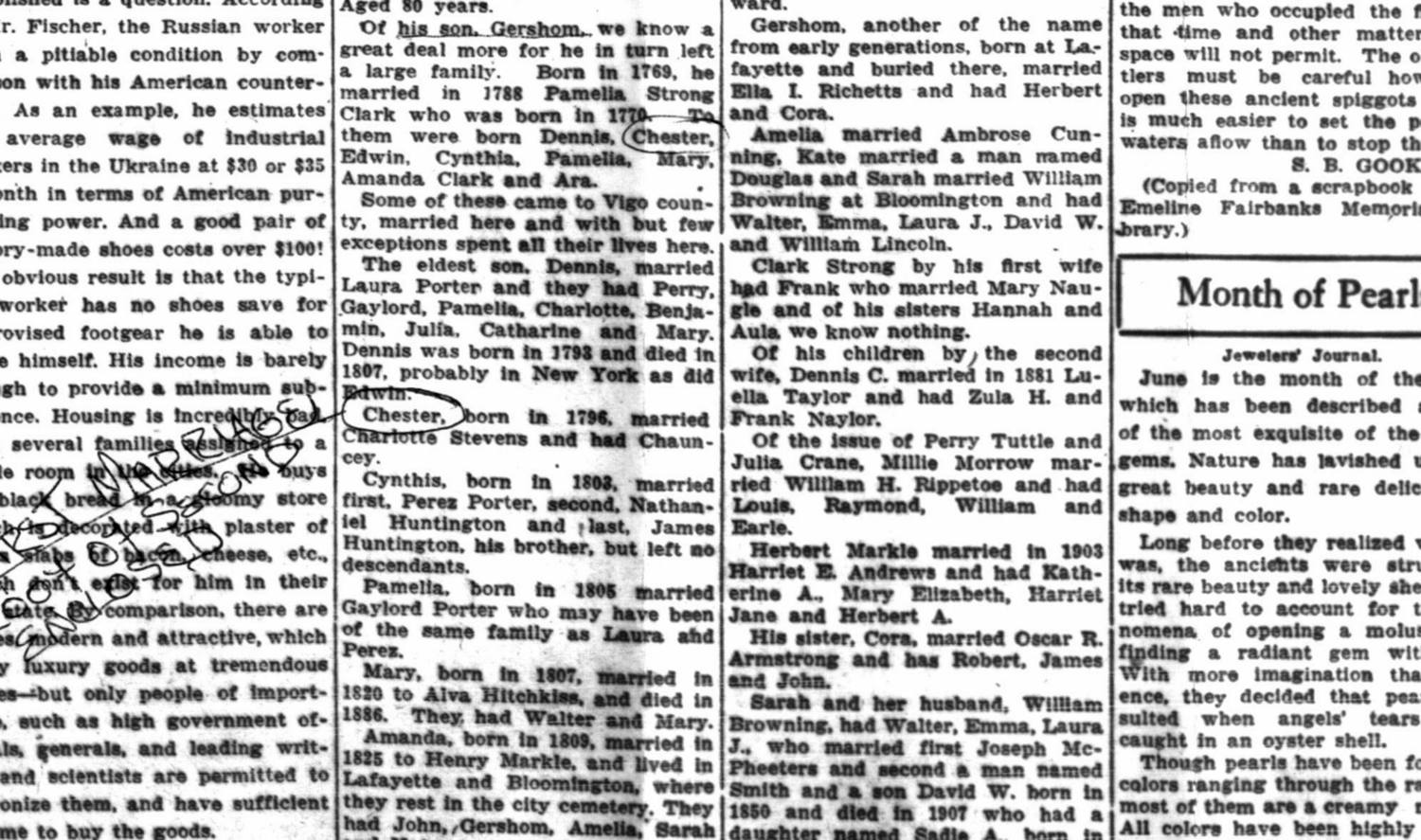
Colonel Gershom Tuttle III was born on 11 June 1769 and died on 5 September 1823. According to the 1883 Tuttle genealogy, he moved from Bristol, Connecticut, to Paris in Oneida County, New York, about 1790, and then around 1800 to Jefferson County, New York, where he opened a 275-acre farm near what became Watertown. He was one of the town's first highway commissioners, helped build the first grist mill in the town of Rutland in 1806, and opened a tavern on the main highway to the lake country that became famous during the War of 1812, in which he served as Lieutenant Colonel of the 76th New York Militia, a regiment that bore his name.
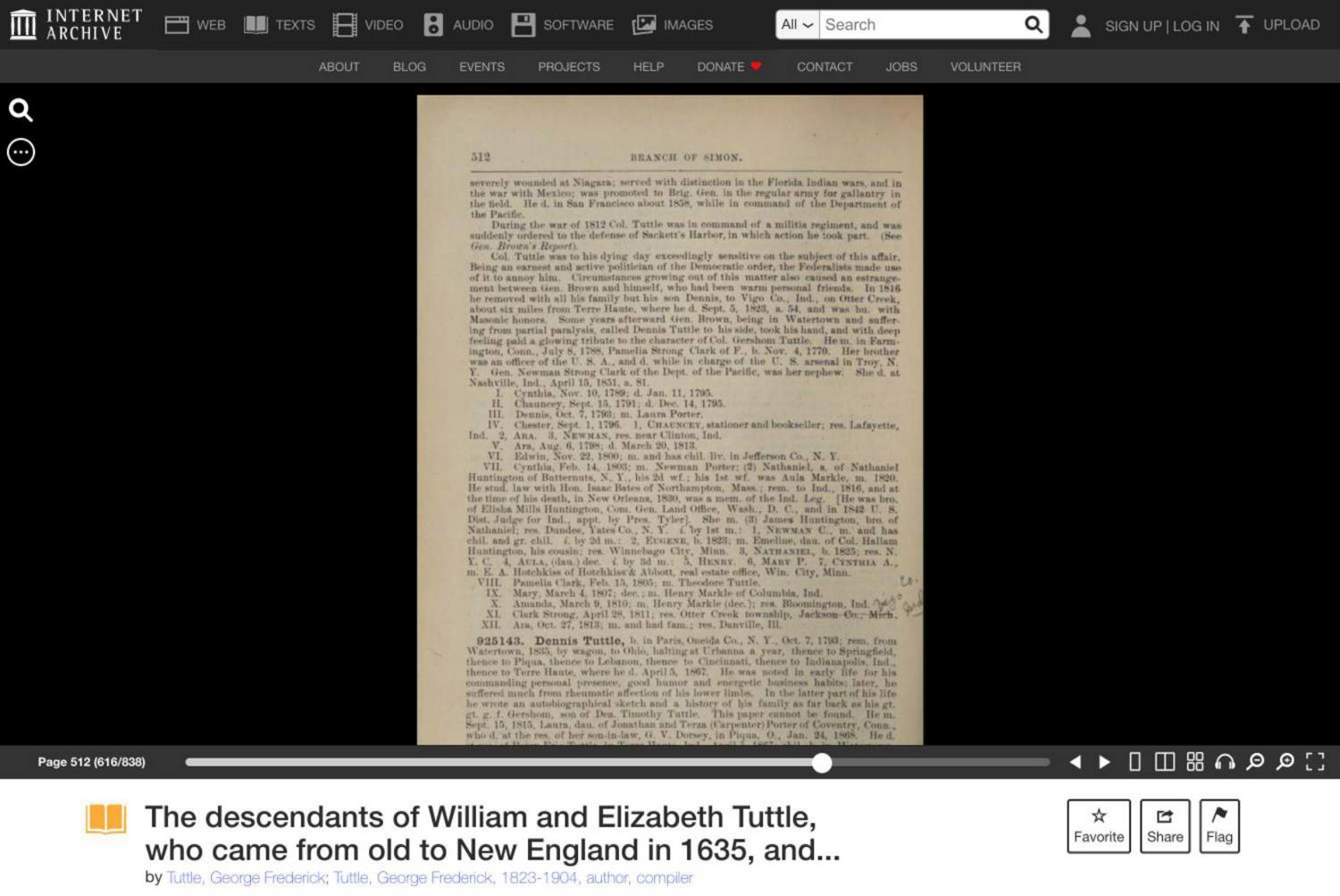
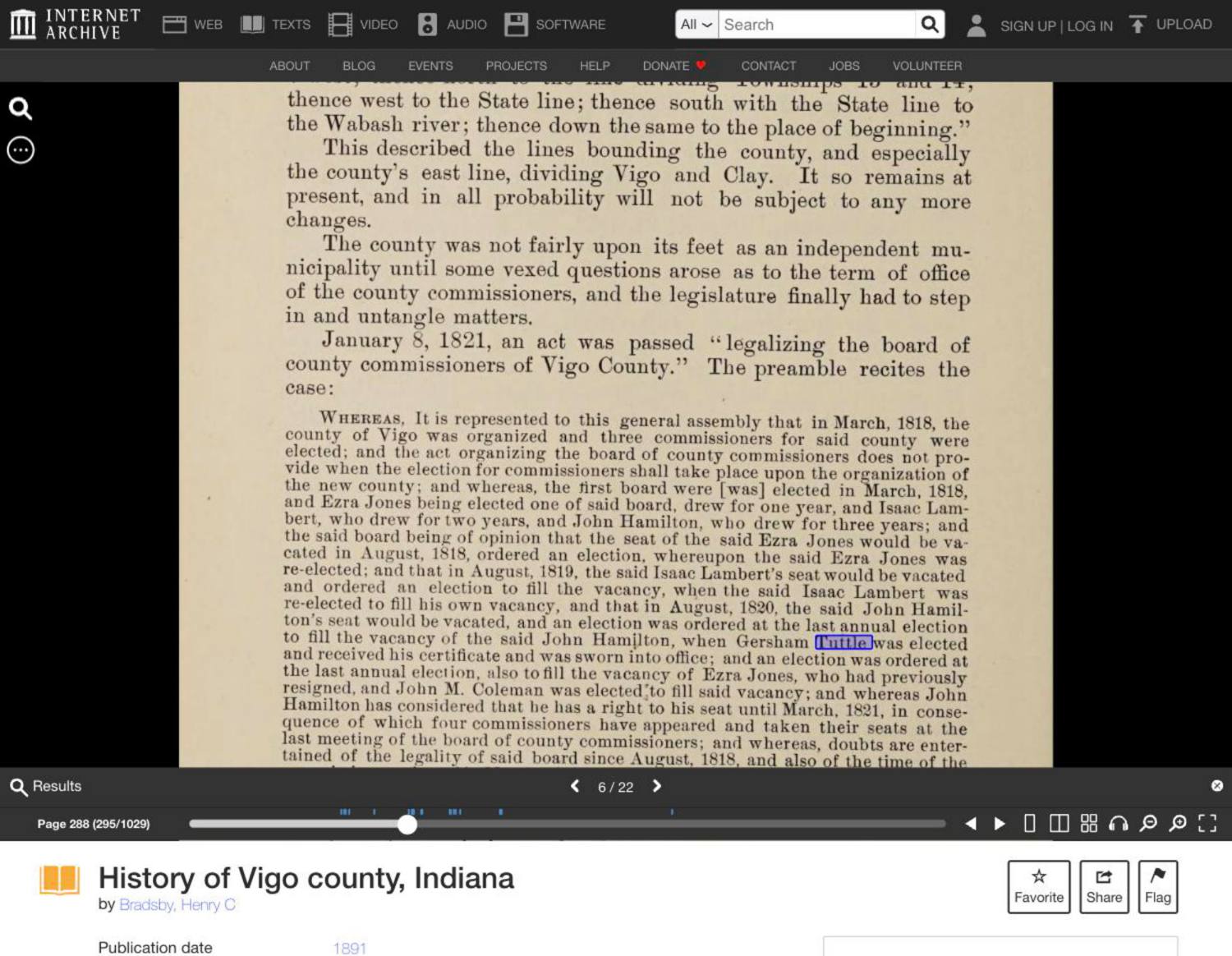
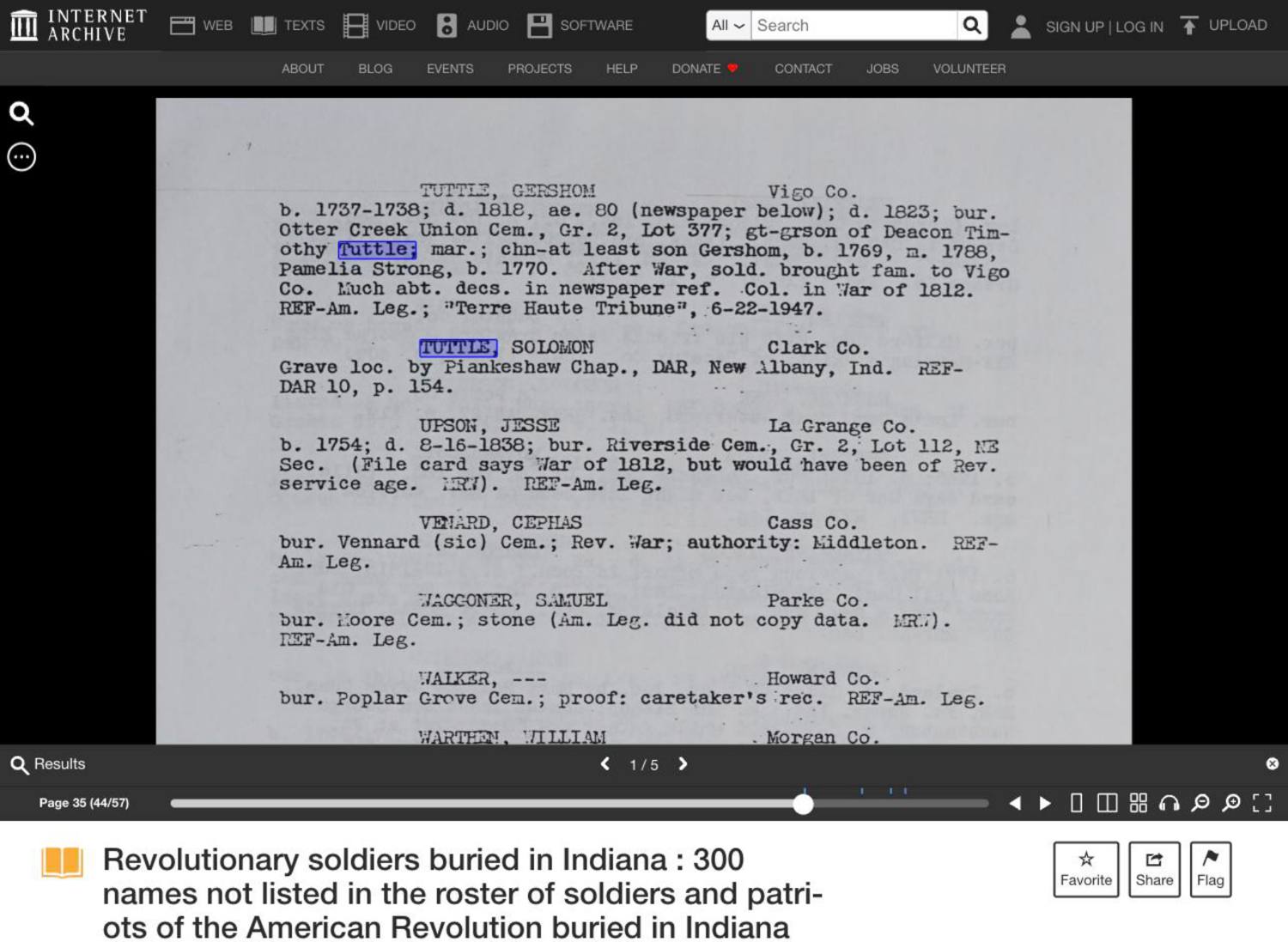
He married Pamelia Strong Clark on 8 July 1788 in Farmington, Connecticut, and the family later removed to Vigo County, Indiana, in 1816, where he served as county commissioner from 1820. He was described by his contemporaries as a man of excellent character and genial temper, fond of a joke and a capital storyteller, and he is buried at Otter Creek Union Cemetery, North Terre Haute, in Vigo County, Indiana.
Evidence
Full dates: 11 Jun 1769 – 5 Sep 1823
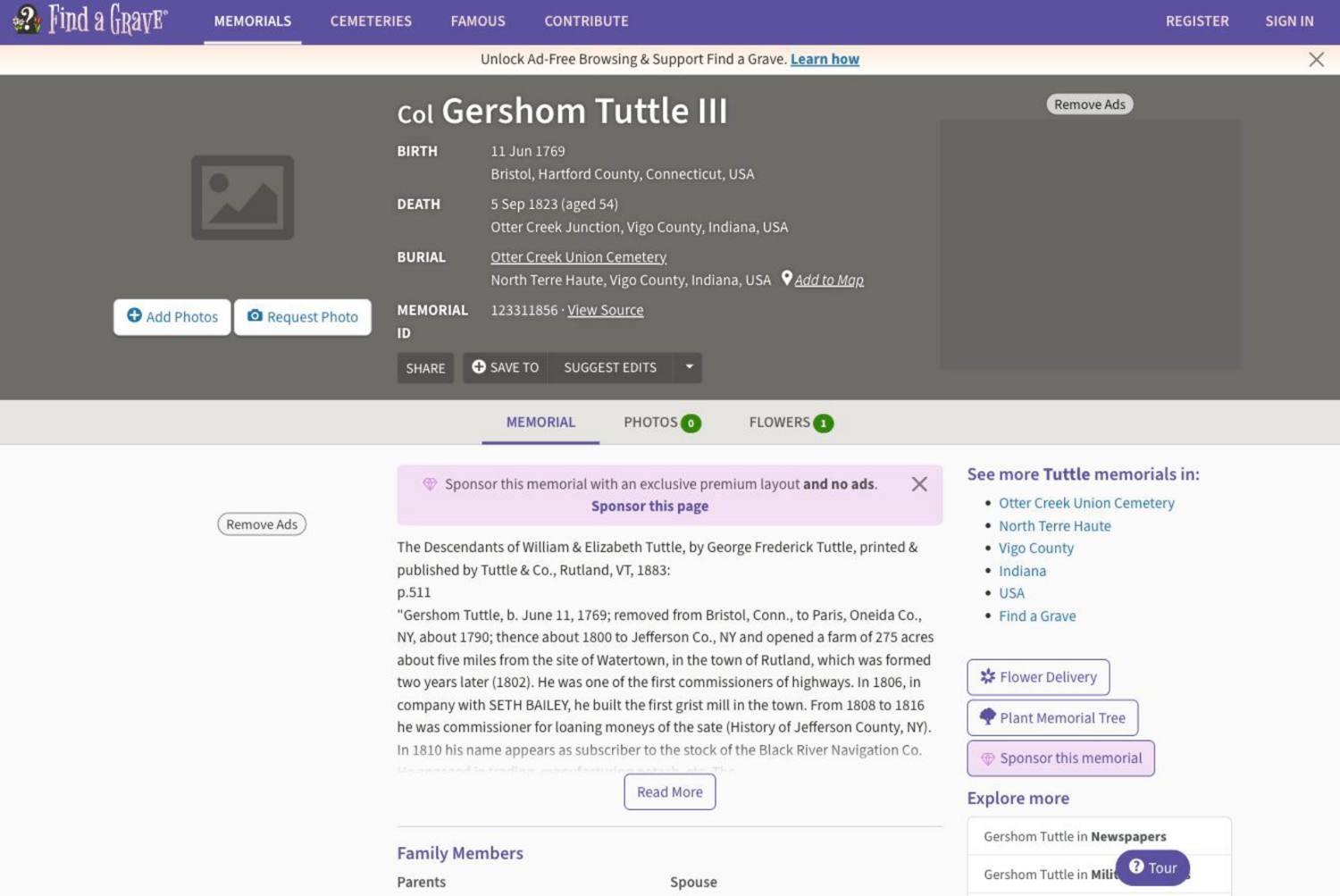
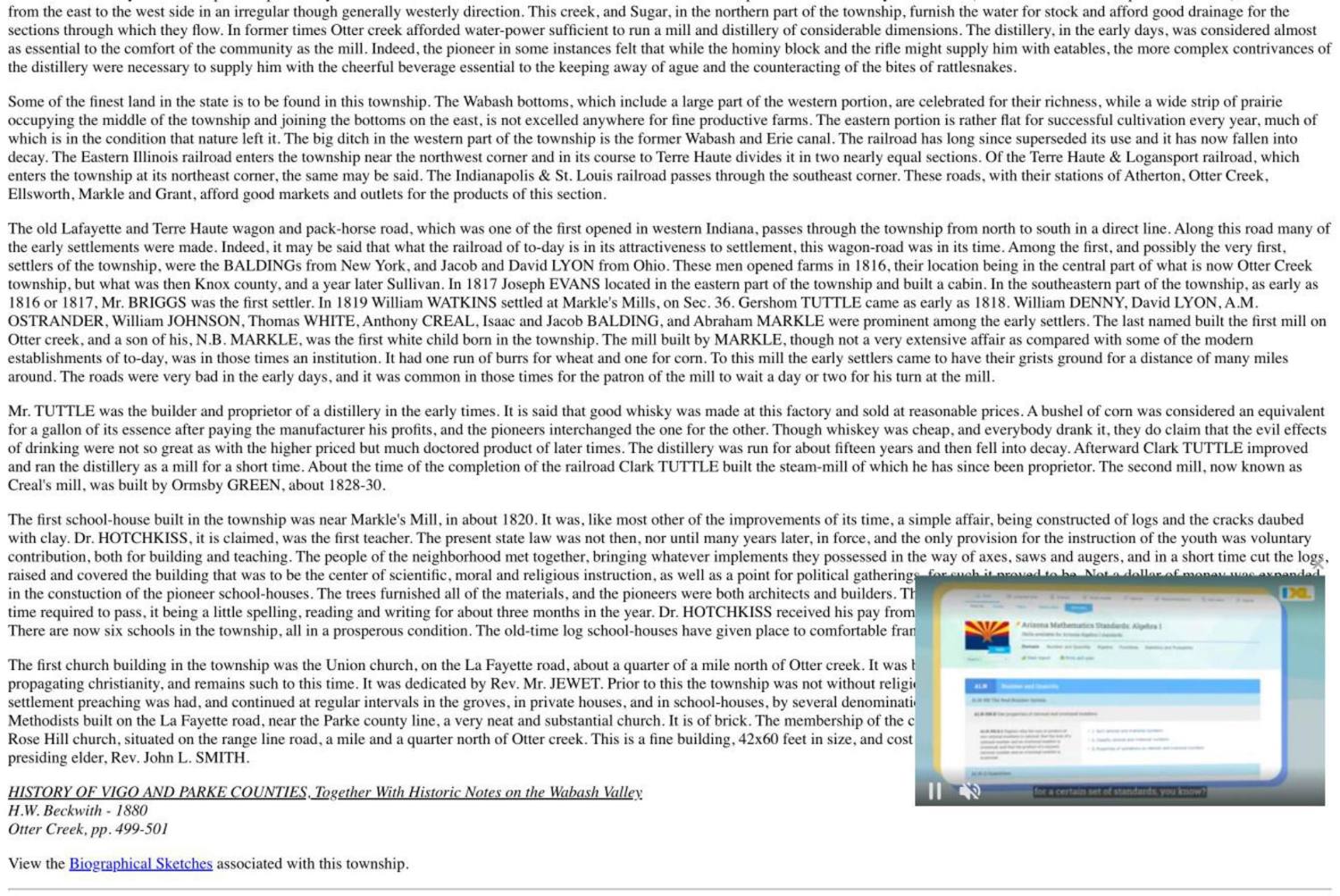
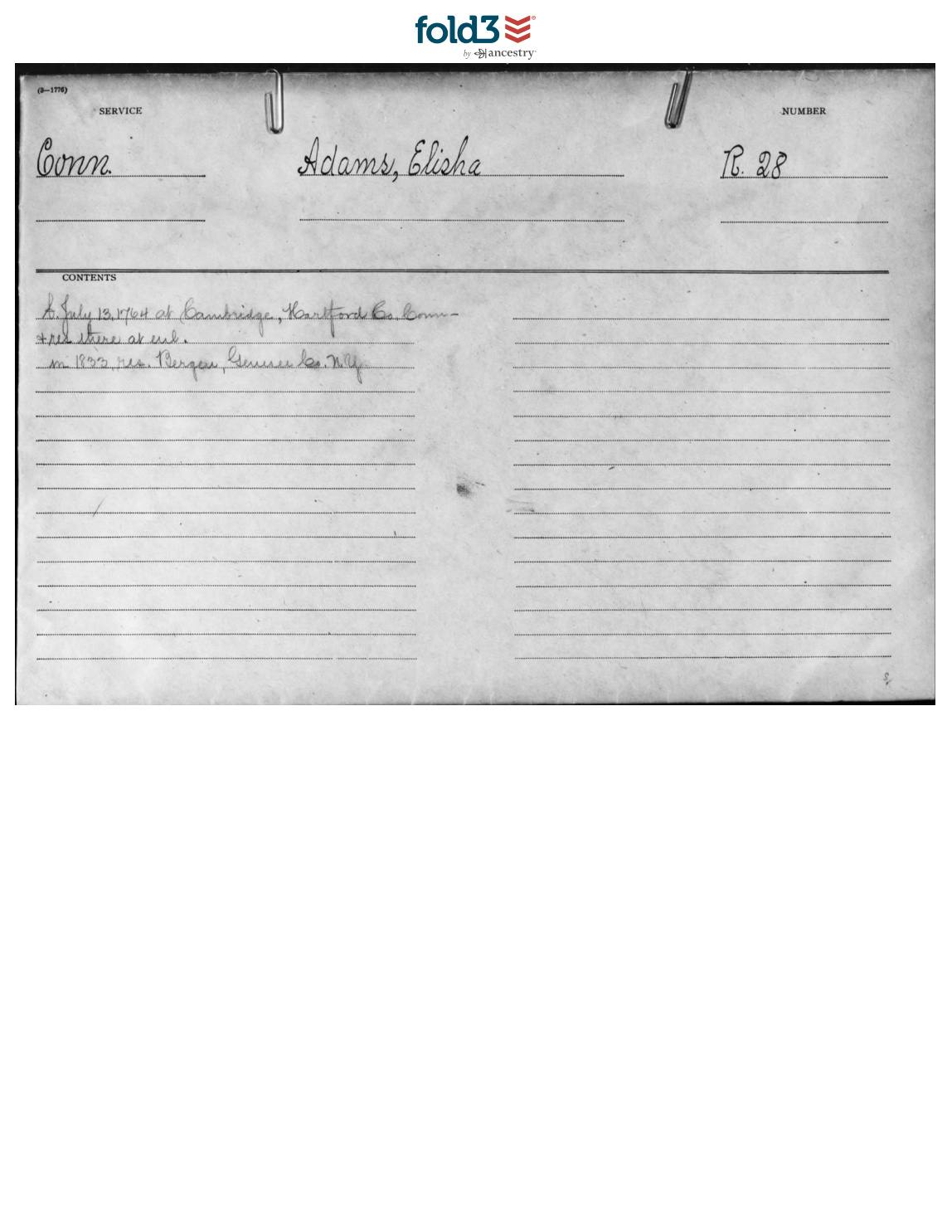
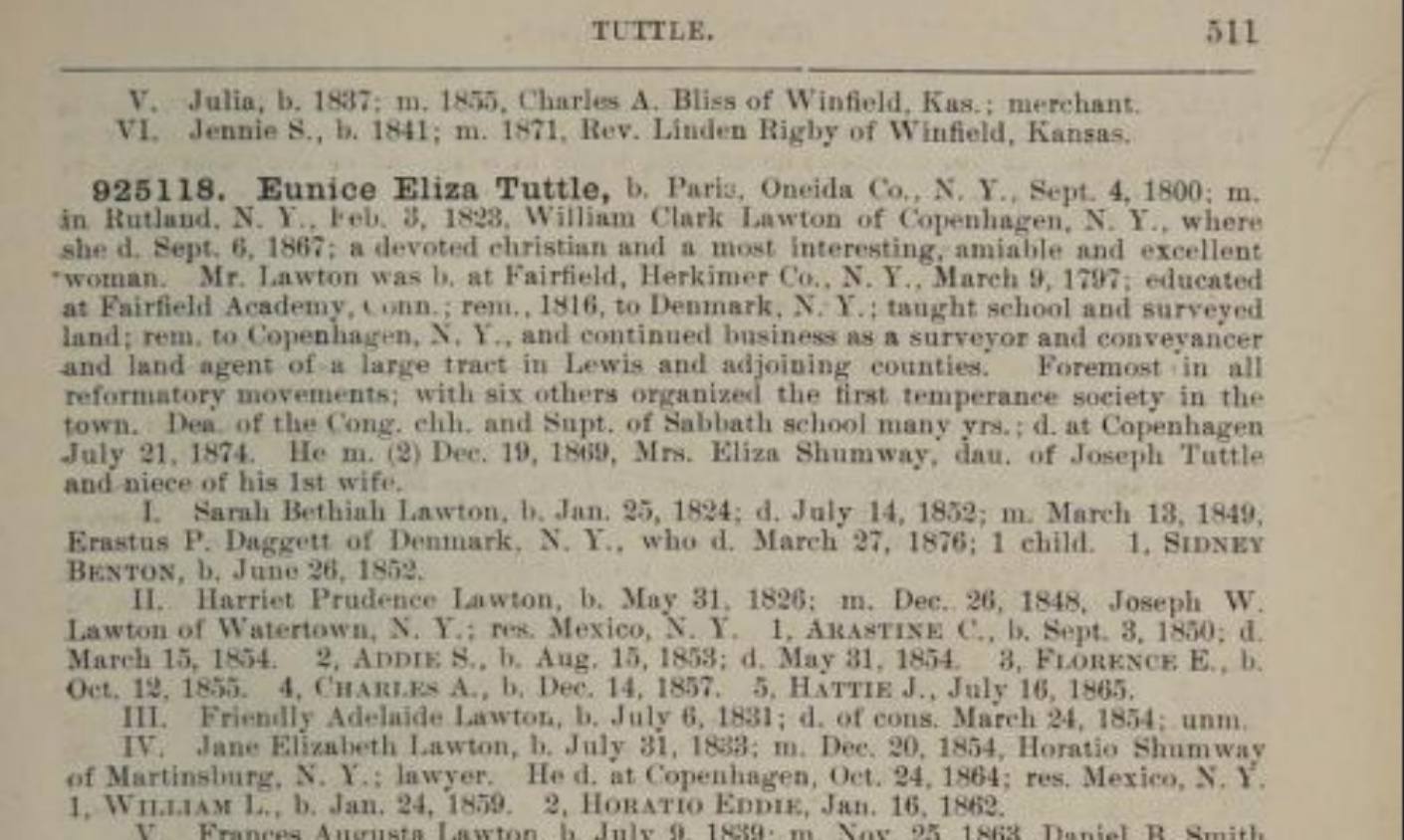
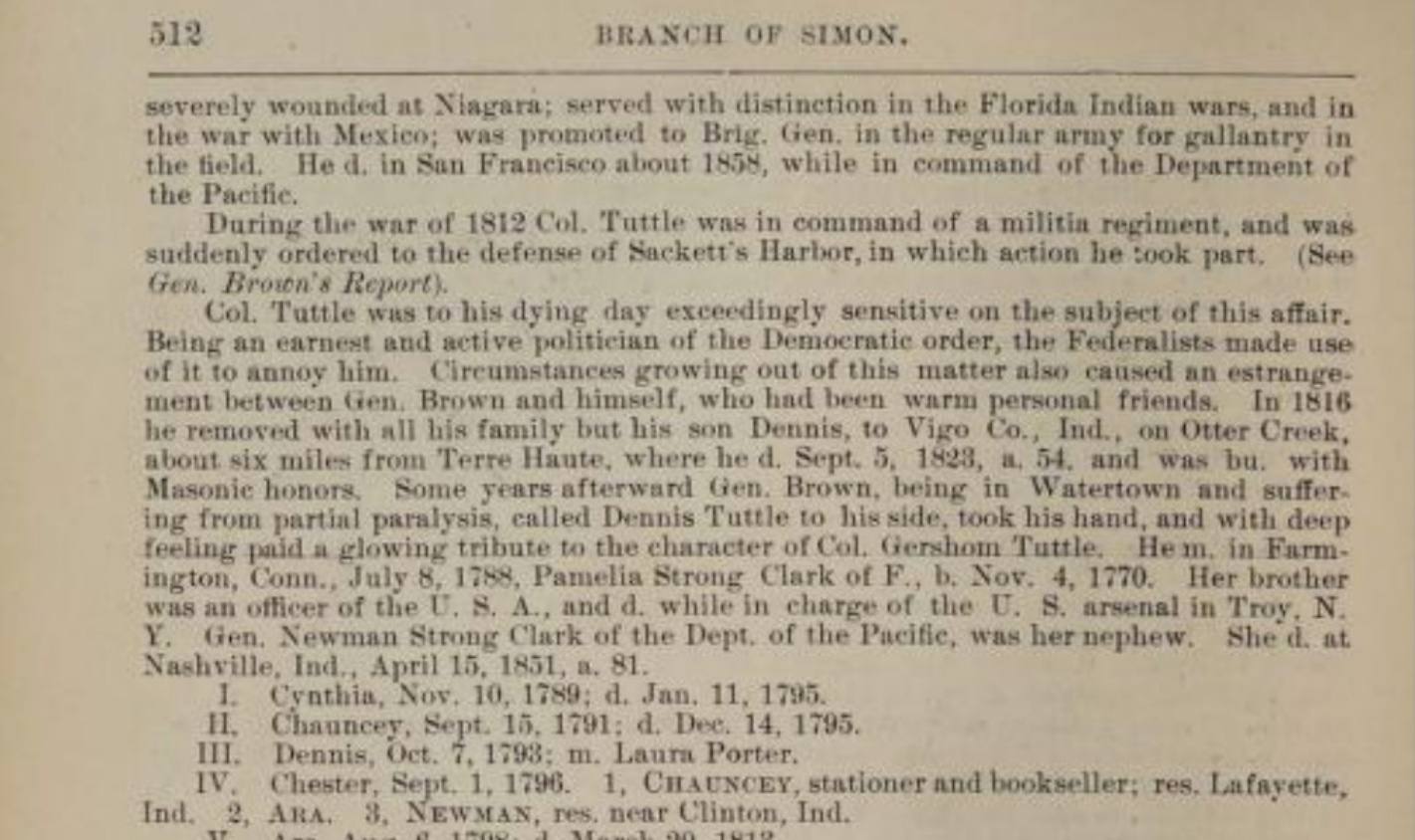
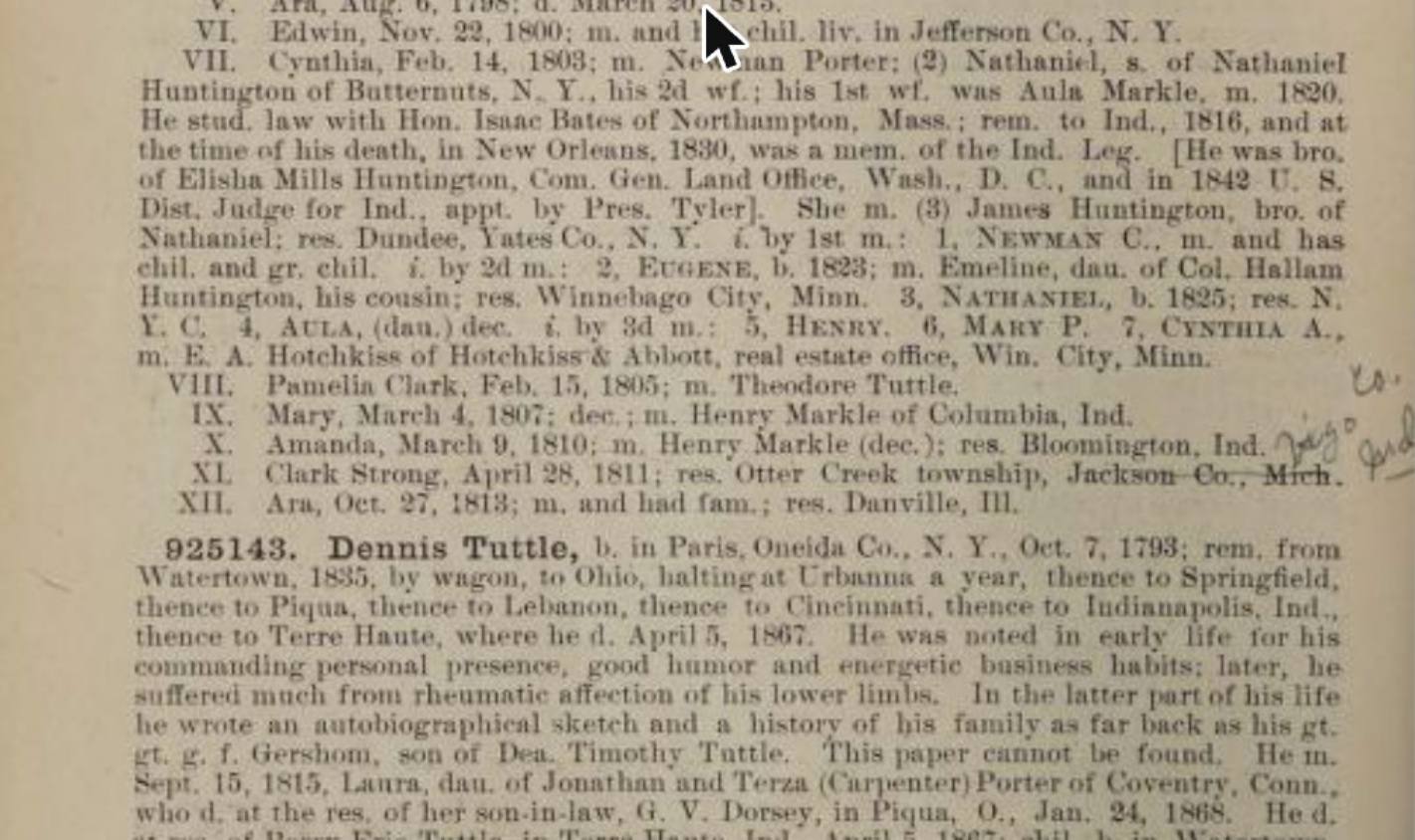
⭐ RENAMED 6 Aug 2026 at Alec’s correction: he was on this chart as “Gershom Tuttle Jr.”, which was wrong once the line ran deeper. There are THREE Gershoms in a row and “Jr.” belongs to none of them:I = Ensign Gershom, b. 1714, d. 1777 (node 768); II = Gershom the patriot, b. 1738, d. 1818 (node 384); III = this man, the Colonel of the War of 1812, b. 1769, d. 1823. ⭐⭐⭐⭐⭐ A LIFE, FROM THE 1883 TUTTLE GENEALOGY p.511 — entry no. 92514 [TUTTLE-29]:“rem. from Bristol, Conn., to Paris, Oneida Co., N.Y., abt. 1790; thence abt. 1800 to Jefferson Co., N.Y., and opened a farm of 275 acres abt. five miles from the site of Watertown, in the town of Rutland.”One of the first commissioners of highways; in 1806, with Seth Bailey, he BUILT THE FIRST GRIST MILL IN THE TOWN; 1808–1816 commissioner for loaning moneys of the state; 1810 a subscriber to the Black River Navigation Co. He traded, made potash, and opened a TAVERN on the great highway to the lake country — “the tavern became famous” in the War of 1812. Described as “a man of excellent character, genial temper, very fond of a joke, a capital story teller.” ⭐⭐⭐ THE MILL DESCENDS: his son Clark Strong Tuttle (node 96) was a MILLER at Otter Creek, Indiana — father builds Rutland’s first grist mill 1806, son is milling in Indiana forty years on. ⭐⭐ And it independently confirms the ONEIDA COUNTY stage that TUTTLE-15 had only from stray deed hits. m. Pamelia Strong Clark 8 Jul 1788 at Farmington, Connecticut; removed the family to Vigo County, Indiana in 1816; county commissioner from 1820; Lieutenant Colonel of the 76th New York Militia in the War of 1812 — the regiment bore his name. ⭐ Buried OTTER CREEK UNION CEMETERY, North Terre Haute, Vigo County (Find a Grave 123311856) — ⚠ no grave photograph exists. ⚠ His wife Pamelia is at Southview Cemetery, Brown County, about ninety miles away: two separate visits.
Outstanding: ⭐⭐⭐⭐⭐ THE ROUTE PAST GERSHOM TUTTLE SR. IS NOW KNOWN [TUTTLE-29]. The 1883 genealogy numbers by descent — each digit is a child’s position. This man is 92514; so 9251 = the patriot (node 384), 925 = GERSHOM TUTTLE SR. (node 768, the wall), 92 = his father (a generation we do not have), 9 = his father, a child of William Tuttle the immigrant of 1635. ✅✅ CONFIRMED THE SAME NIGHT [TUTTLE-30] — ALL FOUR RUNGS EXIST AND ALL FOUR ARE THE RIGHT PEOPLE:9251 = Gershom b. 1738, d. 5 Jan 1818 (image 616); 925 = Gershom Sr., b. 11 Aug 1714, Cheshire → Bristol (image 615); 92 = Dea. Timothy Tuttle of Cheshire (image 574); 9 = Simon Tuttle, bap. New Haven 28 Mar 1647 (image 560), the ninth child of William Tuttle the immigrant. The entry number really was a pedigree. ⭐ Page offset known from the SAR screenshot: printed p.511 = archive.org image 615 of 838; the earlier entries lie BEFORE it. His 29 Aug 1823 Vigo Co. will has been read at the record (Will Record A, p. 21): everything to Parmela for life, no child named [TUTTLE-118]. ⚠⚠ GRADE QUESTION, 12 Sep 2026 [TUTTLE-144]: an adversary reviewing the SAR proof-argument form for this link found that the four Oneida/Jefferson deeds prove which Gershom he is (wife Pamela, Oneida → Rutland, styled junior in the patriot’s county) but that the filiation itself is stated only by the 1883 genealogy and the 1968 DAR record copy, with the 1797 witness “Tabitha Tuttle” probable rather than proven to be the patriot’s wife. [TUTTLE-91 §⑤] (“PROBABLE … must not be graded DOCUMENTED”) and [TUTTLE-139] were never withdrawn; this badge predates both. Under the 11 Sep SAR-standard rubric the question is whether the form’s argument would pass — Derek Brown’s reading of it is the test. Round two the same evening [TUTTLE-145] changed the picture in both directions: the 1800 census of Paris, Oneida County lists “Gershom” (aged 45+, with a woman of his age) and “Gershom Jr.” (26–45, four small boys) on the same page as the patriot’s brothers Oliver and Samuel and his son Solomon, and the 1810 census shows the same pair in Jefferson County — the two-generation structure is now a record fact, not the book’s word; but a rival-genealogy adversary named the alternative no record excludes: a nephew, a son of Oliver or Samuel, also of Paris, named for his grandfather. The records that would exclude it are the Burrville church register (unread, Watertown) and the Jefferson County deeds after the patriot’s 1818 death (unread; tunnel queue). Honest grade tonight: part; the badge stays as set only on the 11 Sep rubric, pending Derek Brown’s reading of the form. ⭐ Otter Creek Township is now independently documented as the family seat — his son Clark was milling there in 1850 and 1860.
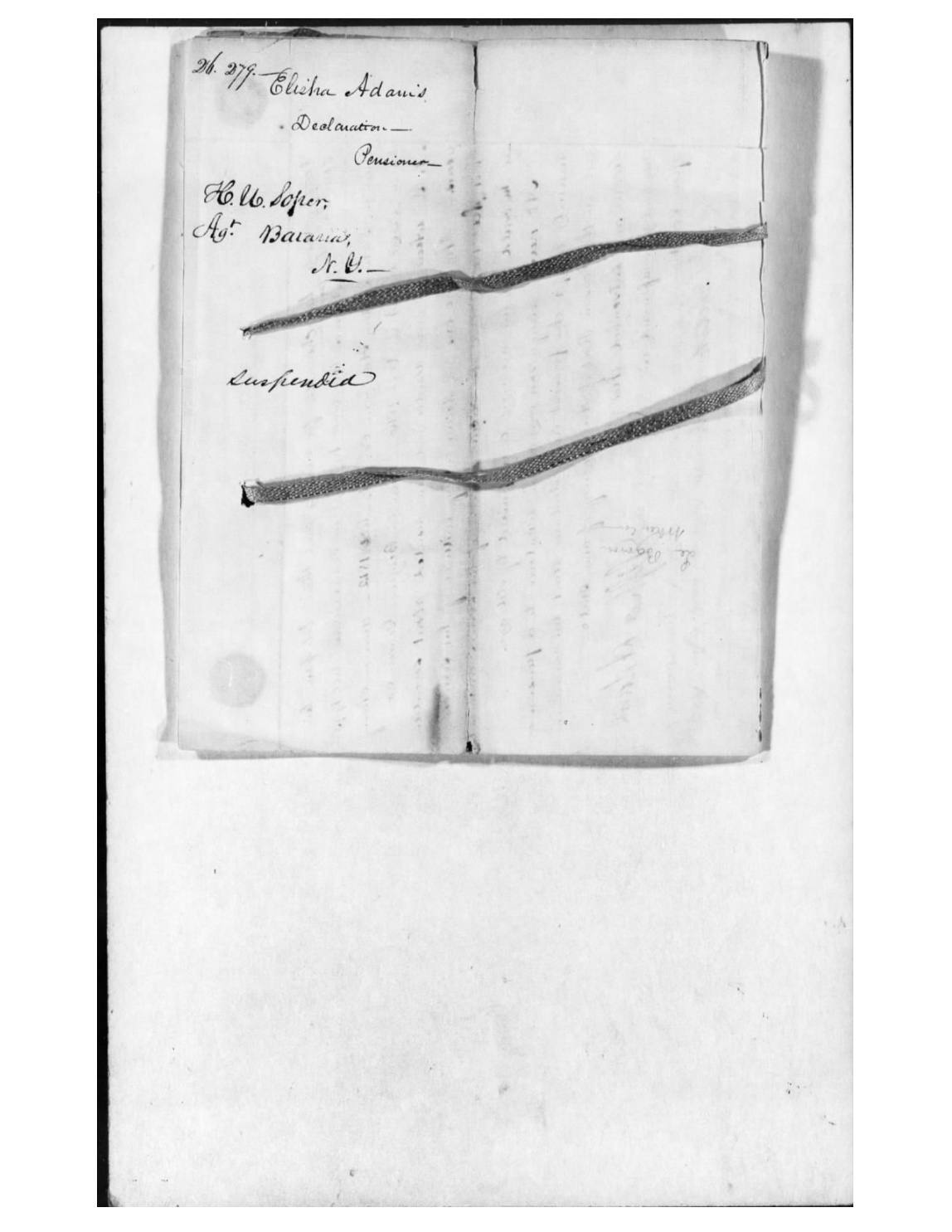
⛔ GRADE MOVED ok → part, 13 Sep 2026 [TUTTLE-147 §⑦]: this field had stated the honest grade as part since 12 Sep. Identity is proven by record (deeds 1797–1817, the 1800 Trenton census sheet with “Gershom Tuttle jun” and “Gershom Tuttle”, the 1810 Jefferson households, the 1806 lodge charter, the 1823 will). Sonship rests on the 1883 genealogy and a 1968 DAR copy, supported by: the patriot’s father’s 1777 will (the patriot’s only brothers were Oliver and Samuel); both of Oliver’s child lists and Samuel’s four named sons, with no Gershom; Joseph Mitchell’s 1792 will (Tabitha alive, so the 1797 witness is probably the patriot’s wife); and Elisha Adams’s 1833 sworn “two of Capt. Tuttle’s sons, Gershom and Joseph” — which the 1779 pay rolls (Theodore, Abner, Joseph) and the Pension Office’s distrust of Adams weaken. What moves it back to ok: Samuel’s or Oliver’s estate listing their children; an Oneida deed naming a son; the Burrville church register (Flower Memorial Library, Watertown).
⭐ “GERSHOM TUTTLE JR.” AT CLAREMONT, N.H., 17 DEC 1789 [TUTTLE-148 §⑤]: he signed next below “Gershom Tuttle”, with Oliver Tuttle and Solomon Tuttle, on a recommendation of Ambrose Cossitt as justice of the peace (N.H. State Papers vol. 11, p. 382, printed transcript). The patriot’s father had been dead since 1777, so this Jr. is a younger man — the colonel was 20 — of that name — but whose family he belonged to, the 76-name petition does not say. The 1800 assessment roll of the town of Paris — so titled and dated on its own first page — pairs the two Gershoms again beside Oliver. It does not by itself tell a son from a nephew. The one other same-name father, Ezra’s son Gershom of Weathersfield, Vt., vanishes from Weathersfield after 1775 and heads no household in 1790, though only his daughter Hannah is named anywhere; Ezra’s estate has since been READ: the will was disapproved in 1793 for want of a third witness and never proved, so the estate went intestate — and the court’s distribution of 6 Apr 1795 sets out a share “To the Heirs of Gershom Tuttle”, as does the 1821 Blakeslee distribution. He documentedly left issue, and neither court names one of them. Grade unchanged: part.
⛪ THE CHURCH [TUTTLE-148 §⑨]: Kimball, Years of Faith (1953), p. 28: “the ball-room in the house of Gershom Tuttle of the town of Rutland” served for worship; “Mr. Tuttle was one of the original members of the church” and later “served with distinction in the War of 1812 as a colonel.” Deacon with William Fellows from 5 May 1808 (p. 31, OCR). Kimball never names two Gershoms or a father, so it neither helps nor harms the link.
⭐⭐ 14 Sep 2026 — round seven, and the grade holds at part for a sharper reason than before. An adversary told to build the affirmative case for a different father refuted the Gen 8 proof argument again, and the count of fathers no record excludes went from three to four: a son of the patriot’s brother Samuel; Thomas Tuttle of the 1800 census; a son of Ezra’s Gershom of Weathersfield, Vt.; and Ebenezer Tuttle of Bristol, the patriot’s first cousin. ⭐⭐ Later the same day EBENEZER WAS EXCLUDED, and not by that book’s silence: Wallingford’s town books register his marriage to Eunice Moss and seven children 1766–75 in an alphabetical run whose G entries are visible and hold only a Gershom of 1714, and in 1769 he was a Cheshire man — enumerated there in 1790, his wife buried at New Haven, his death notice calling him “of Cheshire” — while the Bristol society records that carry the patriot from 1748 never mention him. Three candidates remain.The Weathersfield family is no longer a bare possibility: it settled in 1769, bore children 1769–71, went back to Connecticut to marry, and reached Herkimer and Jefferson Counties on the same road in the same years — so “he moved with the patriot’s family” does not tell the two families apart. Thomas is now the weakest of the four (absent from the 1883 genealogy that did reach this cluster, from the county’s 1851 annals, and from the tax roll) but is excluded by no positive record. ⛔ And the document everyone had nominated as the cure turns out not to exist. Gershom Tuttle Jr. is never a grantee in Oneida County across the index’s whole run, 1792–1849 — because Brothertown title came from commissioners appointed by the Legislature, sold on a purchase-money mortgage to the State, as the neighbouring lots 60, 66 and 115 recite on their face. So no father-to-son deed for lot 62 was ever likely to survive, and its absence says nothing about paternity. The better test that replaces it: whoever signed the State mortgage for lot 62 in the mid-1790s. If that is “Gershom Tuttle Junr” the paternal theory dies; if it is “Gershom Tuttle” plain, father and son stand on one instrument for the land the son later sold as “my own Land.” [TUTTLE-148 §⑮–⑰]
⭐⭐ 14 Sep, later — a new record, and the honest state of play. At Wilmington, Vermont, “Joseph & Gershom Tuttle” of Wardsborough bought a fifty-acre lot in 1791; on 18 January 1797 Zebulon Tuttle quitclaimed his share to Joseph and “Joseph & Gershom Tuttle of Paris in the County of Herkermer” sold it on. Three men the 1883 book calls the patriot’s sons, holding one lot together and moving to one town — the first record-level evidence that they acted as a family group, and a previously unknown Wardsborough, Vermont stage between Bristol and Paris. ⚠ The deeds do not say “brothers,” and they place this Gershom in Vermont in 1791 — the rival’s state — as a married adult forty miles from Weathersfield. ⛔ What would finish it is walled, not lost: the North Haven deeds in which “the heirs of Gershom Tuttle” sold the 12½ Blue Hills acres they inherited are image-restricted across all fourteen FamilySearch reels — readable only at a FamilySearch Centre or affiliate library. Grade unchanged: part. [TUTTLE-148 §⑱–⑳]
Photographs (described)
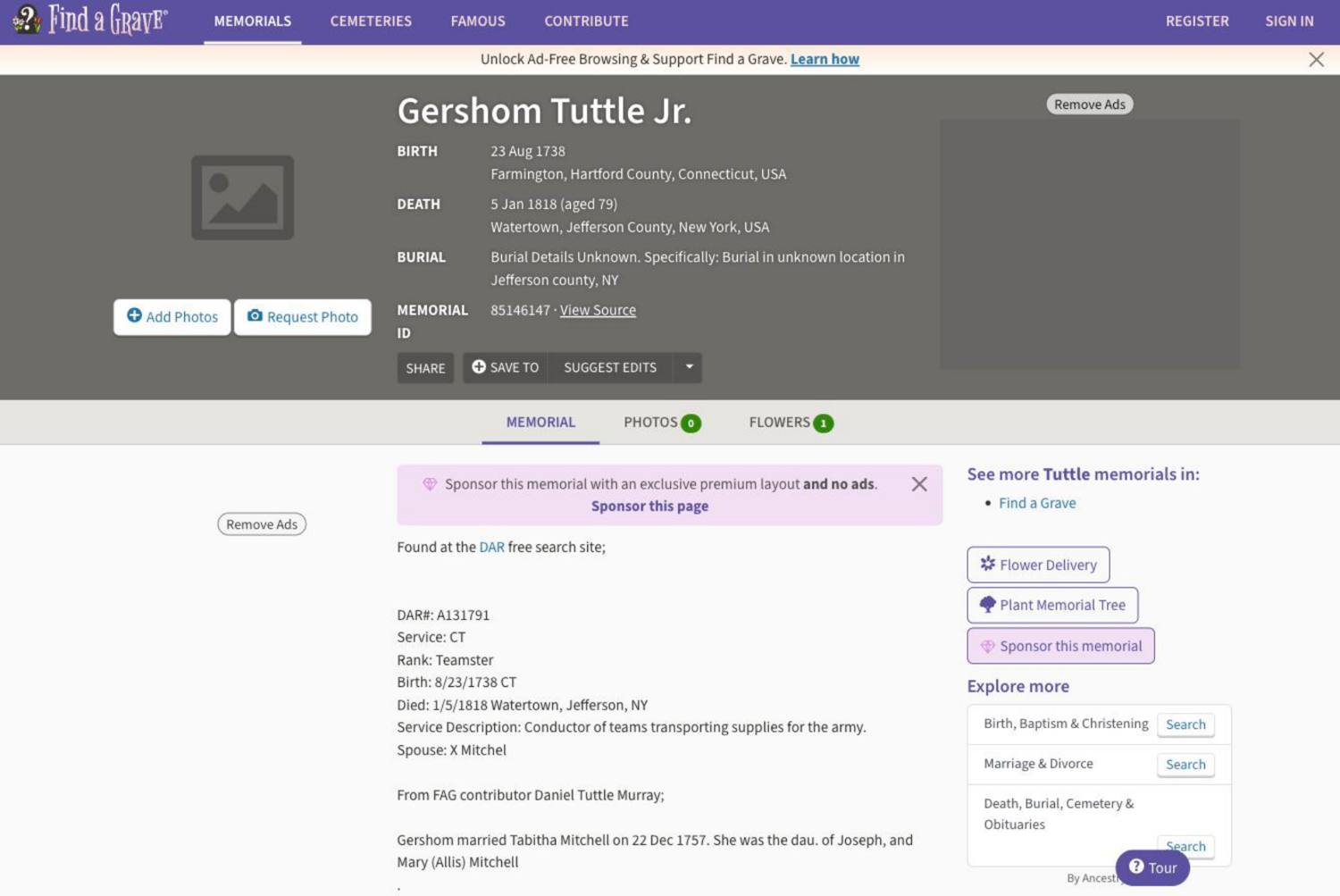
Find a Grave memorial for Colonel Gershom Tuttle — This memorial marks Colonel Gershom Tuttle's grave at Otter Creek Union Cemetery in Indiana, anchoring the family's move west after the War of 1812.Otter Creek cemetery memorials, page one — These Find a Grave memorials from Otter Creek Union Cemetery help sort out a long-standing mix-up between patriot Gershom Tuttle and his son, the colonel, over who is buried there.Otter Creek cemetery memorials, page two — This second page continues sorting out which Otter Creek Union Cemetery burial belongs to patriot Gershom Tuttle and which to his son Colonel Gershom Tuttle.Otter Creek cemetery memorials, page three — This third page completes the Find a Grave documentation resolving where patriot Gershom Tuttle and his son Colonel Gershom Tuttle are actually buried.
Evidence images (described)
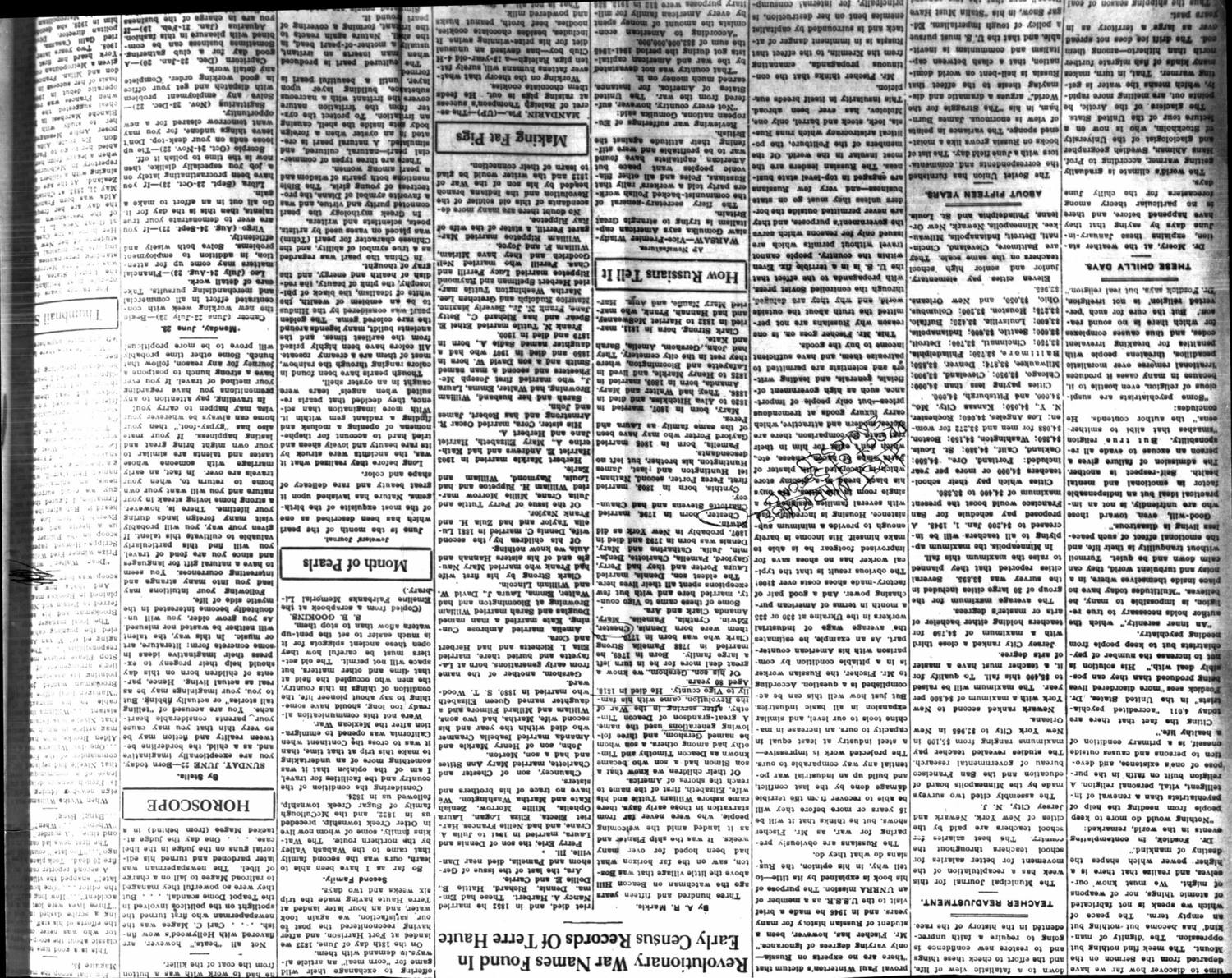
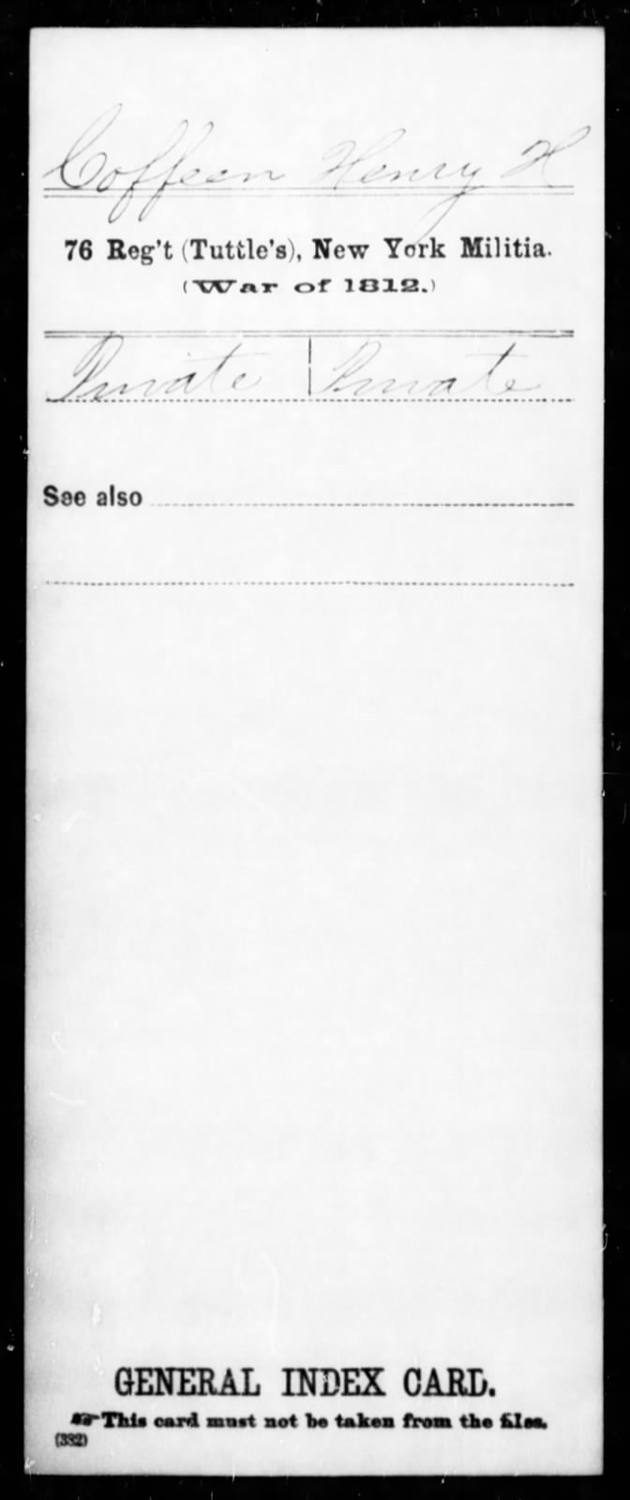
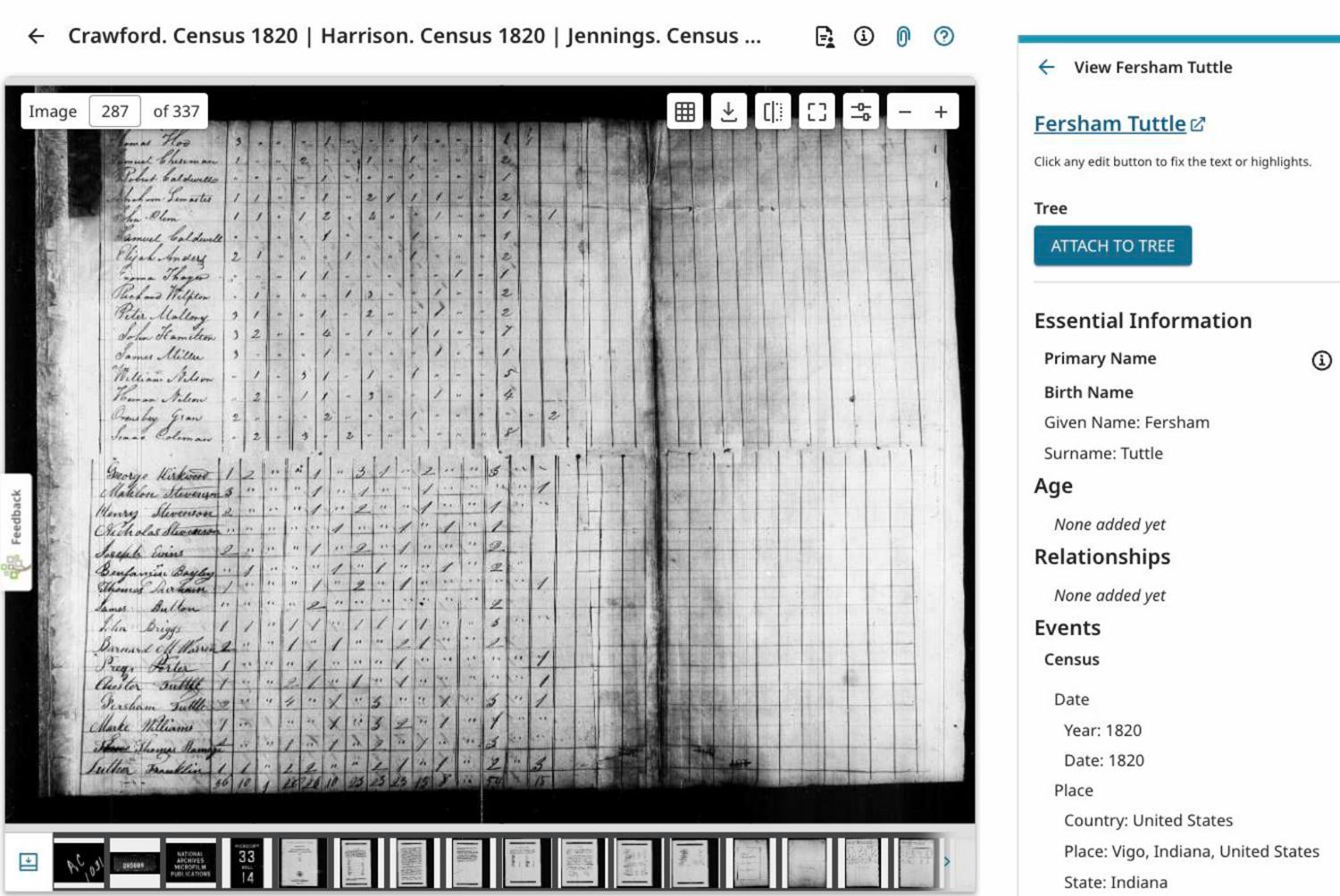
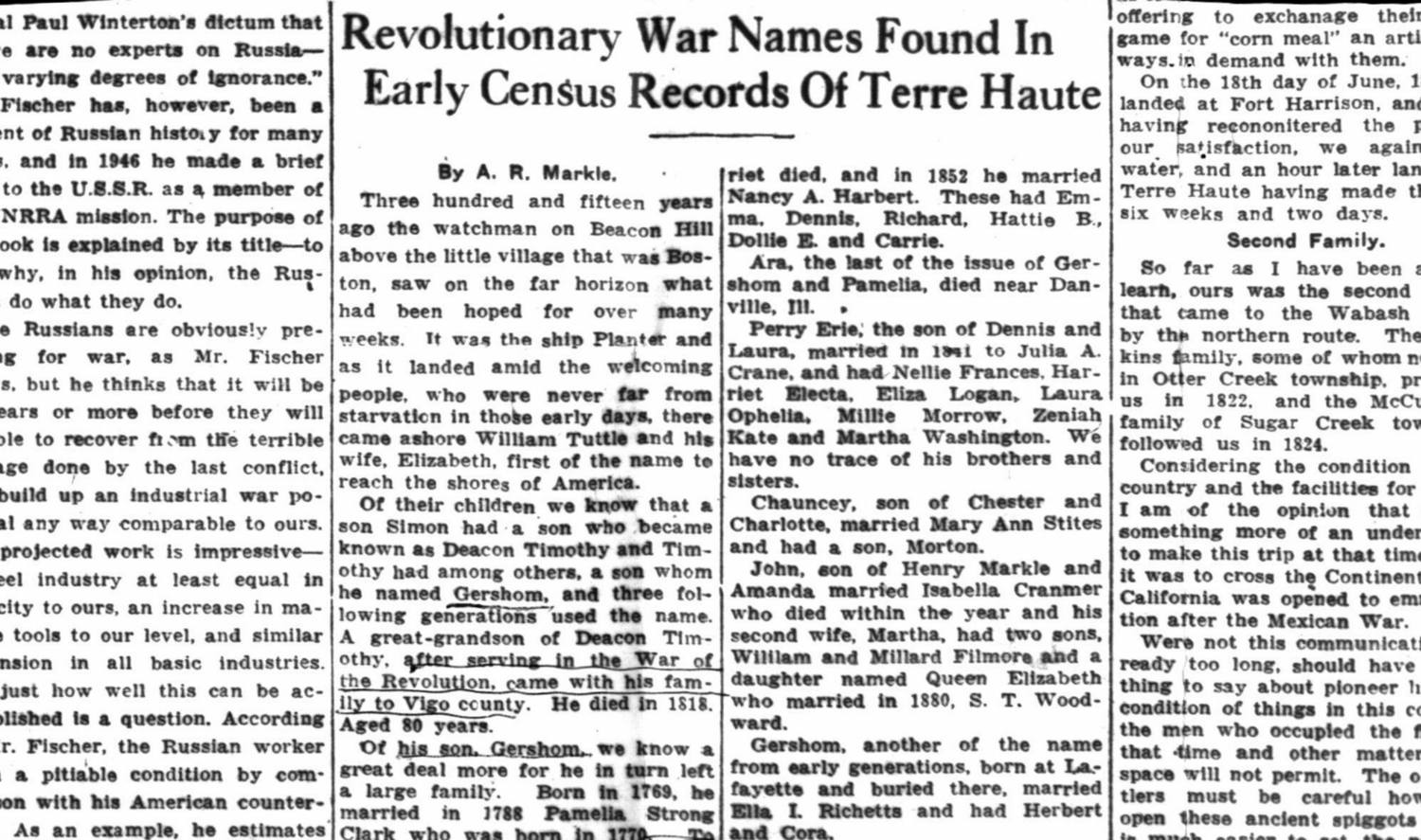
DAR patriot record — Gershom Tuttle and son's marriage to Pamelia Clark — A Daughters of the American Revolution record confirming Gershom Tuttle as a documented Revolutionary War patriot, and his son's marriage to Pamelia Strong Clark.Printed biography of Colonel Gershom Tuttle, 1883 — This 1883 published genealogy tells the story of Colonel Gershom Tuttle's life in Jefferson County, New York, from his tavern and gristmill to his War of 1812 militia command.Colonel Gershom Tuttle's family record, 1883 — This page of the 1883 genealogy records Colonel Gershom Tuttle's death in Indiana, his marriage to Pamelia Strong Clark, and the start of their children's list.County history of Otter Creek Township's Tuttle mill — This 1880s county history credits Gershom Tuttle with settling Otter Creek Township by 1818 and his son Clark Tuttle with building the steam mill there.1820 census, the family's first Indiana record — This 1820 census, indexed under the misspelling Fersham Tuttle, is the family's earliest Indiana record, its household counts matching Colonel Gershom Tuttle, his wife Pamelia, and their young son Clark.1947 newspaper column on the Tuttles — A 1947 Terre Haute newspaper genealogy column traced the Tuttle family from patriot Gershom Tuttle through his son the colonel down to Clark Strong and Richard Tuttle.Veteran names Tuttle's two sons — Elisha Adams's pension file names Captain Tuttle's own sons, Gershom and Joseph, tying the patriot directly to his family.War of 1812 index card for Colonel Tuttle — This military index card records Gershom Tuttle as lieutenant colonel of New York's 76th Regiment, which was named for him.Index card for a private in Tuttle's regiment — This card for Private Henry Coffeen confirms New York's 76th Regiment was known as Tuttle's, after its commander Gershom Tuttle.Another index card for Tuttle's regiment — This card for Private Nathan Coffeen again confirms New York's 76th Regiment was known as Tuttle's, after its commander Gershom Tuttle.County history naming Commissioner Tuttle — This 1891 county history names Gershom Tuttle among the county commissioners elected in Indiana in 1820, confirming his civic standing there.1949 reference book entry on Gershom Tuttle — This 1949 book on Indiana's Revolutionary soldiers has a single entry that mixes up father and son, both named Gershom Tuttle.Second page of Colonel Gershom Tuttle's biography — This continuing page recounts his tavern years and the family's favorite story, a nephew's surprise visit to the Tuttle inn.Second page listing the Tuttle children — This continuing page lists Colonel Gershom and Pamelia Tuttle's children in order, including their son Clark Strong Tuttle, born in 1811.Second page of the Otter Creek Township history — This continuing page confirms Clark Tuttle as proprietor of the steam mill, matching the prosperous milling career shown in the census.Second page of the 1820 Vigo County census — This continuing page shows the age and sex tallies recorded for the Tuttle household in Vigo County in 1820.Newspaper column, continued, second page — This second page continues the 1947 Terre Haute Tribune's account of the Tuttle family's generations, from patriot Gershom Tuttle down to Clark Strong Tuttle.Adams's pension file, continued — This second page continues Elisha Adams's pension testimony naming Captain Gershom Tuttle's sons, Gershom and Joseph.County history, Commissioner Tuttle, continued — This continuation of the county history records Gershom Tuttle signing official county records and serving on the board through 1823.1949 reference book entry, continued — This continuation of the 1949 entry shows the confusion between the Revolutionary soldier Gershom Tuttle and his son, the War of 1812 colonel.Third page of Colonel Gershom Tuttle's biography — This closing page of the biography leads into his move to Indiana and death, setting up the family record on the following page.Third page confirming Clark Strong Tuttle's birth — This closing page of the family record names Clark Strong Tuttle among the children, the link connecting the Revolutionary generation to Indiana.Third page of the 1820 census record — This closing page completes the 1820 household count that places the family on Otter Creek within four years of leaving New York.Newspaper column, continued, third page — This third page finishes the 1947 newspaper's tracing of the Tuttle family from patriot Gershom Tuttle down to Richard B. Tuttle in Vigo County.
Pamelia Strong Clark (1770 Farmington – 1851)
Ahnentafel #193 · his mother’s father’s father’s father’s father’s father’s mother (7 generations back) · Documented — person and parent-link established
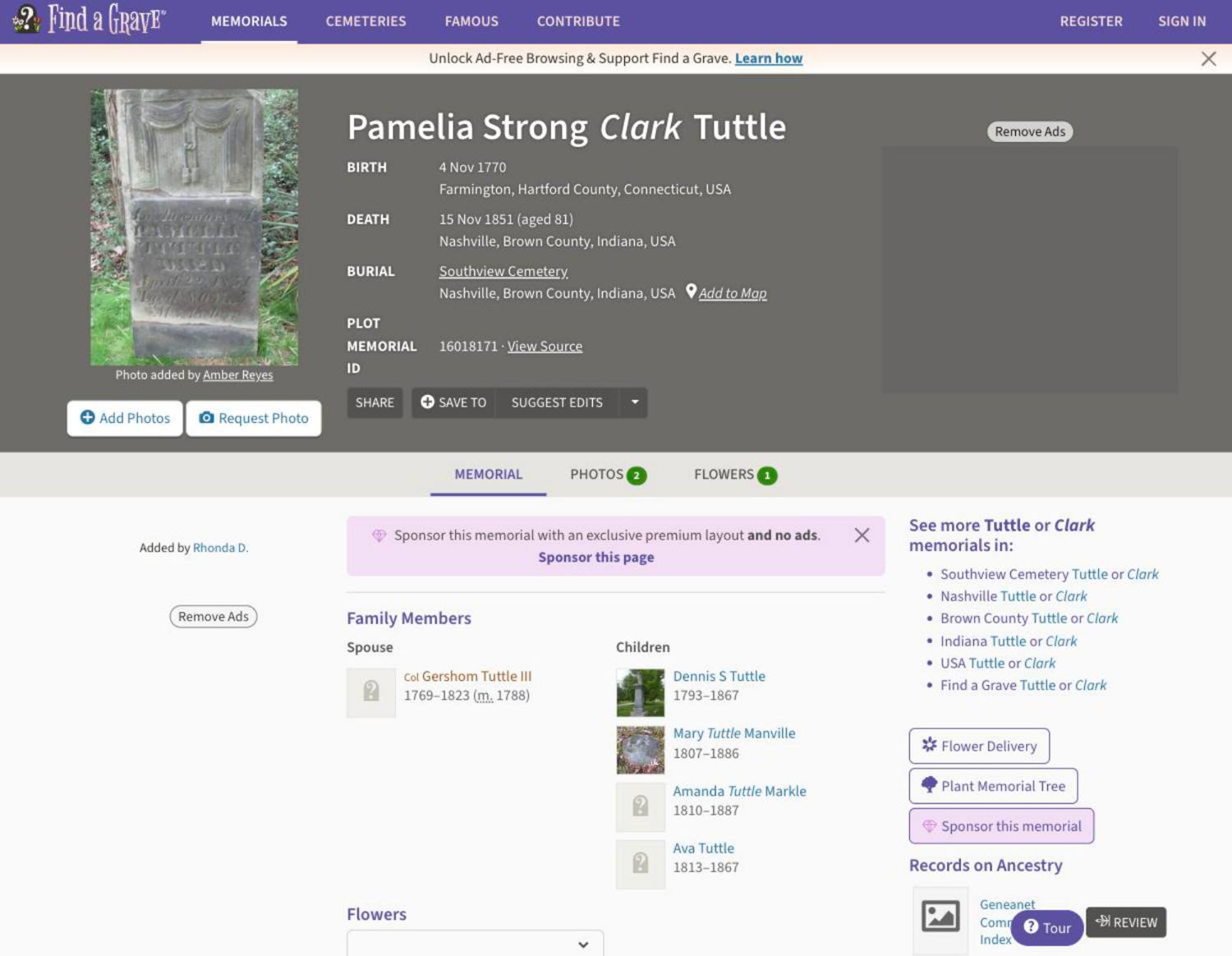
Pamelia Strong Clark was born on 4 November 1770 in Farmington, Connecticut, and died on 15 April 1851, by one account, or 15 November 1851 by another — sources disagree on the exact date — near Nashville, Indiana. She married Gershom Tuttle on 8 July 1788 in Farmington; according to the 1883 Tuttle genealogy, her brother was a United States Army officer who died while commanding the U.S. arsenal at Troy, New York, and her nephew was General Newman Strong Clark of the Department of the Pacific.
She outlived her husband by twenty-eight years, following one of their children south, and is buried at Southview Cemetery in Nashville, Brown County, Indiana, ninety miles from where he lies. Her middle name, Strong, was carried on through her descendants for four generations, though a search of the standard genealogy of the Strong family has so far failed to confirm any direct Strong ancestry for her.
Evidence
Full dates: b. 4 Nov 1770 Farmington, Conn. – 15 Apr 1851 Nashville, Ind.
⭐⭐⭐⭐⭐ HER MAIDEN NAME IS CLARK. “STRONG” IS A MIDDLE NAME [TUTTLE-46, 7 August 2026]. G. F. Tuttle 1883, p. 512, in Col. Gershom’s own sketch: “He m. in Farmington, Conn., July 8, 1788, Pamelia Strong Clark of F., b. Nov. 4, 1770. Her brother was an officer of the U.S.A., and d. while in charge of the U.S. arsenal in Troy, N.Y. Gen. Newman Strong Clark of the Dept. of the Pacific, was her nephew. She d. at Nashville, Ind., April 15, 1851, a. 81.”
⛔⛔ THE STRONG DOOR IS SHUT. Dwight’s Descendants of Elder John Strong (1871) was searched in both volumes — no Pamelia Clark born 1770, no Tuttle marriage, no “Clark of Farmington.” The Elder John Strong descent that this chart has quietly assumed is not established and is now actively unsupported by the standard Strong genealogy. Her mother may still have been a Strong — that is a guess, not a finding.
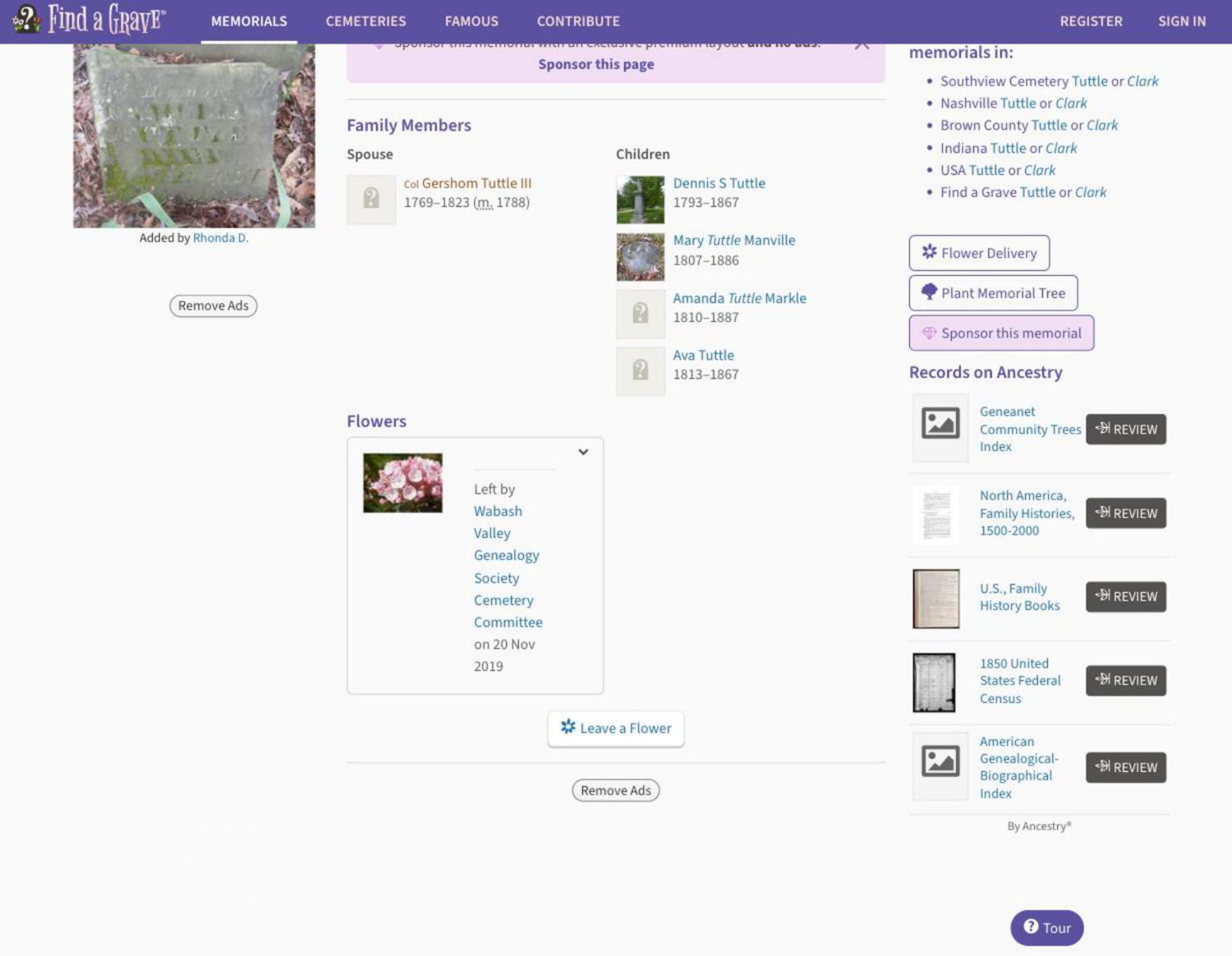
⚠ Her death date is in conflict: Tuttle 1883 says 15 April 1851; Find a Grave memorial 16018171 says 15 November 1851. She is buried at Southview Cemetery, Nashville, Brown County, Indiana — ninety miles from her husband’s grave, because she outlived him by twenty-eight years and followed a child south.
Buried Southview Cemetery, Nashville, Brown Co., Indiana, with a headstone photograph. Her name is the “Strong Clark” carried down through Clark Strong Tuttle to Dennis Clark and Richard Clark — four generations of it.
Photographs (described)
Find a Grave memorial for Pamelia Tuttle — This Find a Grave memorial documents Pamelia Strong Clark Tuttle's burial in Nashville, Indiana, far from her husband's grave in Terre Haute.Pamelia Tuttle's memorial page, continued — This continuation of the memorial page adds further detail on Pamelia Strong Clark Tuttle's burial and headstone.Pamelia Tuttle's memorial page, headstone photo — The final page shows the headstone photograph confirming Pamelia Strong Clark Tuttle's burial at Southview Cemetery.
Evidence images (described)
DAR patriot record — Gershom Tuttle and son's marriage to Pamelia Clark — A Daughters of the American Revolution record confirming Gershom Tuttle as a documented Revolutionary War patriot, and his son's marriage to Pamelia Strong Clark.Colonel Gershom Tuttle's family record, 1883 — This page of the 1883 genealogy records Colonel Gershom Tuttle's death in Indiana, his marriage to Pamelia Strong Clark, and the start of their children's list.1820 census, the family's first Indiana record — This 1820 census, indexed under the misspelling Fersham Tuttle, is the family's earliest Indiana record, its household counts matching Colonel Gershom Tuttle, his wife Pamelia, and their young son Clark.Second page listing the Tuttle children — This continuing page lists Colonel Gershom and Pamelia Tuttle's children in order, including their son Clark Strong Tuttle, born in 1811.Second page of the 1820 Vigo County census — This continuing page shows the age and sex tallies recorded for the Tuttle household in Vigo County in 1820.Third page confirming Clark Strong Tuttle's birth — This closing page of the family record names Clark Strong Tuttle among the children, the link connecting the Revolutionary generation to Indiana.Third page of the 1820 census record — This closing page completes the 1820 household count that places the family on Otter Creek within four years of leaving New York.
Joseph Lamb (~1782 NC – 1855 Wayne Co. IN)
Ahnentafel #216 · his mother’s father’s mother’s mother’s father’s father’s father (7 generations back) · Documented — person and parent-link established
Joseph Lamb was born about 1782 in North Carolina and died in 1855 in Wayne County, Indiana, at the age of 73. Two independent nineteenth-century local histories, written sixteen years apart, agree that he settled on land near Perry, Indiana, in 1829, and name his children, including Ezekiel, Esther, Smith, Elias, Mournen, Joseph, and Ithamar. According to one of those accounts, his own parents were Joseph and Lydia Adamson Lamb, and the family were members of the Society of Friends before leaving North Carolina; the particular county of North Carolina they came from is not recorded by either source.
Evidence
⭐⭐ ADDED at DOCUMENTED, 10 Aug 2026, adversary-confirmed [KNOTT-13/-VERDICT]: two genuinely independent histories 16 years apart — Young 1872 (“Joseph Lamb, from North Carolina, settled, in 1829, on land adjoining Perry, where he died in 1855, at the age of 73. His children were, Ezekiel, deceased; Esther, Smith, deceased; Elias, Mournen, Joseph, Ithamar”) and the 1888 Elias-informed sketch (“his parents, Joseph and Lydia (Adamson) Lamb, left North Carolina… members of the Society of Friends”) — different informants, different details (Young names the deceased children), converging. County of NC origin NOT stated by either source [self-correction #25].
Outstanding: the 1855 estate file (heirs list; NC county); a Quaker certificate of removal.
10 Aug 2026 [KNOTT-14]: candidate parents lead-grade: Henry (M.) Lamb × Ann Dennis; b. 25 Mar 1782; the 1806 “Lidya Addison” bond (bondsman her brother Samuel) and the 1829 Center MM certificate — all one compiled source pending the minute books.
Lydia (Adamson) Lamb (d. 1844 Wayne Co. IN)
Ahnentafel #217 · his mother’s father’s mother’s mother’s father’s father’s mother (7 generations back) · Probable — the IDENTIFICATION or the LINK rests on one source, or is in conflict
Lydia Adamson Lamb died in 1844, or possibly in 1837, in Wayne County, Indiana — the records disagree on the year. She is named as Joseph Lamb's wife in an 1888 biographical sketch of their son Elias, though an earlier 1872 history of the same family never mentions her by name. The family were Quakers, and her own Adamson family in the area has not yet been traced.
Evidence
ADDED at PROBABLE, 10 Aug 2026 [KNOTT-13/-VERDICT]. Named only by the 1888 sketch (Young 1872 never names Joseph’s wife). Quaker.
Outstanding: a monthly-meeting record; her Adamson family (a Samuel Adamson bought in the same 1832 land list — unexplored).
⚠ 10 Aug 2026 [KNOTT-14]: death-date CONFLICT — 11 Nov 1837, Economy (compiled KaysAncestry) vs 1844 (the 1888 sketch, this node’s source). Unadjudicated. Candidate parents named lead-grade: Enos Adamson × Mary Love (single compiled source; the Center MM minutes are the primary test).
John Bish (Fairfield Co. OH → Wayne Co. IN)
Ahnentafel #218 · his mother’s father’s mother’s mother’s father’s mother’s father (7 generations back) · Probable — the IDENTIFICATION or the LINK rests on one source, or is in conflict
John Bish lived in Fairfield County, Ohio, before moving to Wayne County, Indiana, in 1836, and later removed to Miami County before returning to what is described as "the old homestead," where he died. He and his wife raised ten children. This identification currently rests on a single biographical sketch.
Evidence
Also recorded: of Fairfield Co., OH → Wayne Co., IN 1836; d. “on the old homestead”
ADDED at PROBABLE, 10 Aug 2026 [KNOTT-13/-VERDICT] (251-Rickard precedent — a genuine single-source identification with dates/places, not a bare candidate). Ten children; removed to Miami Co. and back.
Outstanding: everything record-side.
Ann Elizabeth Bish (d. Miami Co., Indiana)
Ahnentafel #219 · his mother’s father’s mother’s mother’s father’s mother’s mother (7 generations back) · Probable — the IDENTIFICATION or the LINK rests on one source, or is in conflict
Ann Elizabeth Bish, whose maiden name is not known, died in Miami County, Indiana. She was John Bish's wife, named alongside him in the same single biographical sketch that records their family.
Evidence
ADDED at PROBABLE, 10 Aug 2026 [KNOTT-13/-VERDICT]. Same single sketch; maiden name unknown.
John Roush (1785 – 1861 Meigs Co. OH)
Ahnentafel #240 · his mother’s mother’s mother’s father’s father’s father’s father (7 generations back) · Probable — the IDENTIFICATION or the LINK rests on one source, or is in conflict
John Roush was born on 22 November 1785 and died on 21 January 1861 in Meigs County, Ohio. He was the son of George Roush and Catharine Zerkel, and on 18 May 1808 he married his own cousin, Regina Roush, with Justice of the Peace Francis Watkins presiding. The couple settled in the Nease Settlement of Sutton Township, Meigs County, Ohio, moving there from Graham Station, Mason County, Virginia, sometime between the births of their children Benjamin, born in Virginia in August 1816, and Hannah, born in the Nease Settlement in May 1820.
They are buried in a family plot beside Regina's father, Jonas, though their graves are unmarked. Their son Benjamin's place in the family is recorded in a 1928 genealogy, though this last link has not yet been confirmed by an original record.
Evidence
Full dates: 22 Nov 1785 – 21 Jan 1861, Meigs Co., Ohio
⭐⭐⭐⭐⭐ NEW NODE, 7 August 2026 [ROUSH-54]. This is the rung that opens two Revolutionary patriots.
Son of George Roush and Catharine Zerkel. Married 18 May 1808 — “Francis Watkins, Justice of the Peace, pronounced the words that made them one” — his own cousin Regina Roush. A baptismal register printed in the 1928 genealogy records “John, Nov. 22, 1785. Bap. Wit. John Roush, wife Susannah, Jan. 5, 1786.”
He and Regina settled in the Nease Settlement, Sutton Township, Meigs County, Ohio — ⭐ the same few square miles where their great-great-grandson John G. Roush was born in 1877, and where the Roush and Nease families that later intermarried were founding neighbours. They lie in a family plot beside Regina’s father Jonas, with no stone marking their graves.
The move is dated by their children. Benjamin was born at Graham Station, Mason County, Virginia in August 1816; his sister Hannah was born in the Nease Settlement in May 1820. So John and Regina crossed from Virginia into Ohio between those two dates — which is exactly why Benjamin’s birthplace is Virginian and his siblings’ are not.
⚠⚠ GRADED PROBABLE ON PURPOSE. Everything above this couple is DAR-verified; everything below Benjamin is ours from records. The one link still resting on a single source is Benjamin as their son — the 1928 genealogy, p. 464: “5. BENJAMIN ROUSH, fifth child of John and Regina Roush, was born August 30, 1816.”
Outstanding — and this is the single most valuable document left on the Roush line: the Meigs County, Ohio probate death record for Benjamin Roush, 1897, or John Roush’s 1861 Meigs County estate file naming son Benjamin. Either one converts this node to Documented and the whole patriot descent with it. ⛔ Benjamin is not in the West Virginia death index — searched Mason Co. 1897 and Benjamin Roush statewide, all years. He died in Ohio.
Regina Roush (b. 1788)
Ahnentafel #241 · his mother’s mother’s mother’s father’s father’s father’s mother (7 generations back) · Probable — the IDENTIFICATION or the LINK rests on one source, or is in conflict
Regina Roush was born on 30 November 1788, the daughter of the Revolutionary War patriot Jonas Roush and his wife Barbara Fox. She married her cousin John Roush on 18 May 1808. In her later years her father lived in her household in the Nease Settlement, a detail recorded independently both in a 1928 family genealogy and in Jonas's own Revolutionary War pension file. Her date of death was not known even to the compilers of that genealogy and remains unrecorded today.
Evidence
Full dates: 30 Nov 1788 – death not established
⭐⭐⭐⭐ NEW NODE, 7 August 2026 [ROUSH-54]. Daughter of the patriot Jonas Roush and Barbara Fox; married her cousin John Roush on 18 May 1808. A Roush married a Roush — both of them grandchildren of the same Shenandoah Valley family, which is a pedigree collapse waiting to be drawn once the generation above is proved.
⭐⭐ The DAR has approved this exact person twice — on Jonas Roush’s ancestor record the approved lineages include “child REGINA — spouse JOHN ROUSH” (National Nos. 569934 and 1076887).
⭐ Her father spent his last years in her house. The 1928 genealogy says Jonas Roush “spent his last years in her home in the Nease Settlement” — and Jonas’s own Revolutionary pension file, independently, records that he removed to Meigs County, Ohio to live with a daughter. Two sources that never met, agreeing.
Outstanding: her death date. The 1928 book says plainly that it “has not been ascertained,” and the grave is unmarked.
David Altman (~1788 Pennsylvania – 1850/70)
Ahnentafel #242 · his mother’s mother’s mother’s father’s father’s mother’s father (7 generations back) · Hypothesis — a candidate, not tied in
David Altman is believed to have been born about 1788 in Pennsylvania and to have died sometime between 1850 and 1870. He farmed in Sutton Township, Meigs County, Ohio — the same township where the Roush family lived — and is recorded there in both the 1840 and 1850 census with a household that includes children named Jacob, Solomon, Mary, and Samuel. He is a leading candidate to be the father of Sophia Altman, whose birth year fits neatly into a gap between two of his other children, but no document has yet been found that states this connection directly.
Evidence
Full dates: b. about 1788 in Pennsylvania – d. between 1850 and 1870
LEADING CANDIDATE, NOT ESTABLISHED. Farmer of Sutton Township, Meigs County, Ohio — the Roushes’ own township — with $1000 in land in 1850; also there in 1840, indexed “ATTMAN.” Household 1211: David 62, Margaret 56, Jacob 23, Solomon 19, Mary 14, Samuel 12. Sophia b. 1823 drops exactly into the gap between John (b. c.1819, his own household nearby) and Jacob (1827) [ROUSH-37].
Outstanding: ⚠⚠ No document connects Sophia to him. Surname + township + generation + a gap — the same shape of reasoning that failed at TRUETT-15/16. Proof or kill: his Meigs County probate; an heirs list would name Sophia Roush outright.
Evidence images (described)
1850 census, Meigs County — David and Margaret Altman — The 1850 census entry for David and Margaret Altman, a Pennsylvania-born farming family in Meigs County, Ohio, believed to be Sophia Altman Roush's parents.
Margaret Altman (b. ~1794 Pennsylvania)
Ahnentafel #243 · his mother’s mother’s mother’s father’s father’s mother’s mother (7 generations back) · Hypothesis — a candidate, not tied in
Margaret Altman is believed to have been born about 1794 in Pennsylvania. She appears in the same 1850 census household as David Altman, presumably as his wife, with several Ohio-born children. Her maiden name is not known.
Evidence
Same household, same status. Both she and David were Pennsylvania-born; every child in both Altman households is Ohio-born from c.1819 on [ROUSH-37].
Outstanding: Her maiden name is unknown and would be a Gen 9 name. Best route: the post-1908 Ohio death certificates of her children Jacob, Solomon, Mary and Samuel — each names both parents.
Evidence images (described)
1850 census, Meigs County — David and Margaret Altman — The 1850 census entry for David and Margaret Altman, a Pennsylvania-born farming family in Meigs County, Ohio, believed to be Sophia Altman Roush's parents.
George Duckworth (Bury district, Lancashire)
Ahnentafel #244 · his mother’s mother’s mother’s father’s mother’s father’s father (7 generations back) · Documented — person and parent-link established
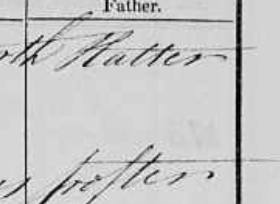
George Duckworth worked as a hatter in the Bury district of Lancashire, England. He is named in the marriage register at his son James's wedding on 21 January 1839, in the column recording the father's rank or profession, as "Hatter." His own marriage and details of his life have not yet been traced.
Evidence
Also recorded: a hatter of the Bury district, Lancashire
Named in the register at his son’s marriage, 21 January 1839, in the column “Rank or Profession of Father” — Hatter. A wholly new generation, opened 6 Aug 2026 [ROUSH-34].
Outstanding: His own marriage, Bury district c.1805–12, and his son James’s baptism c.1810–18. Both are named searches now.
Evidence images (described)
A document from the research fileA document from the research fileA document from the research file
Adam Collins (Freetown, Bury, Lancashire)
Ahnentafel #246 · his mother’s mother’s mother’s father’s mother’s mother’s father (7 generations back) · Documented — person and parent-link established
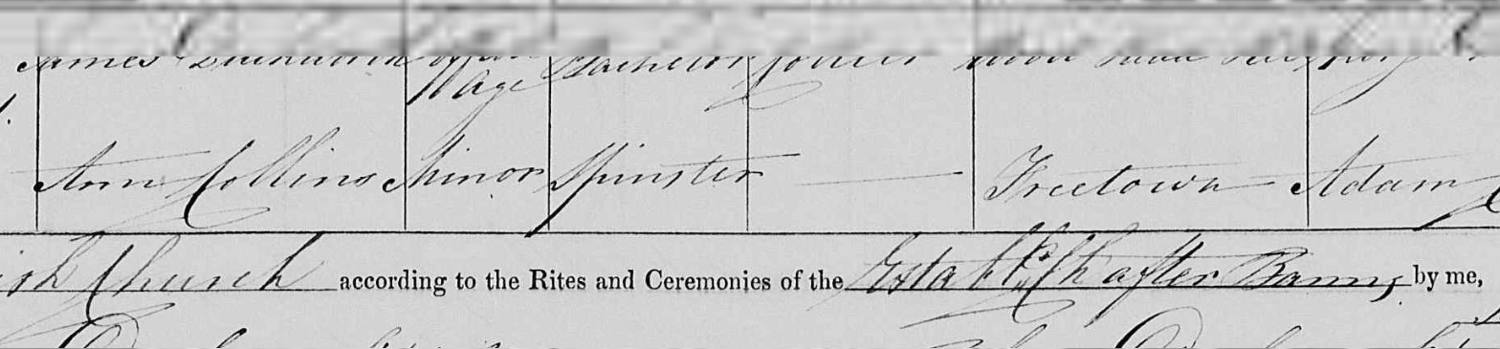
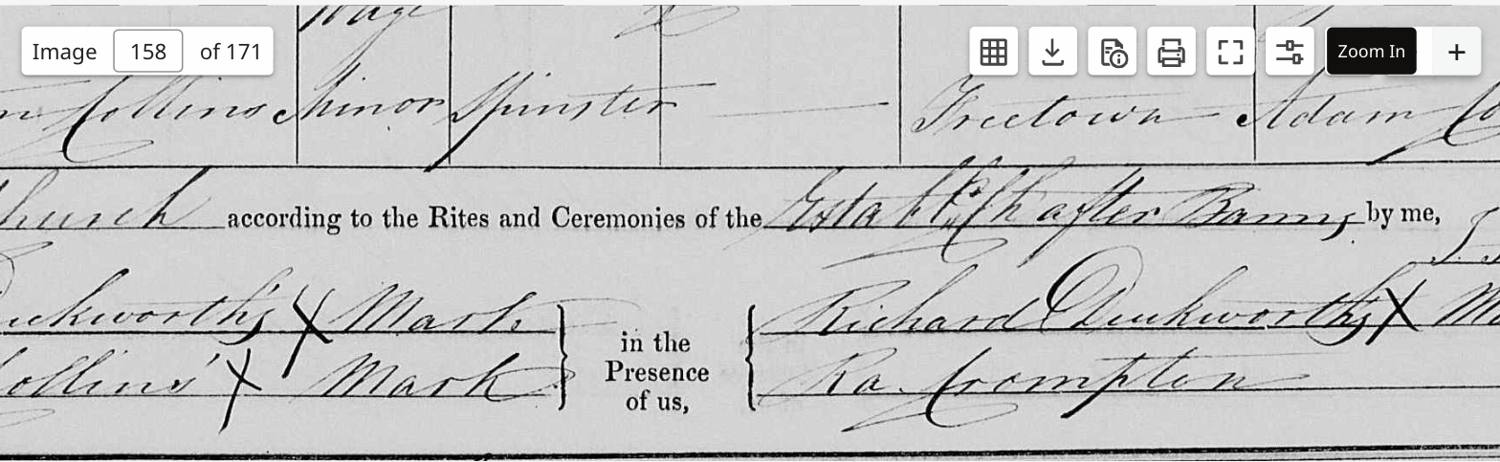
Adam Collins lived at Freetown, in Bury, Lancashire, England. He is named in the marriage register at his daughter Ann's wedding in 1839, because she was a minor and his consent to the marriage was required. The Ohio branch of the family later named a son Adam, born 14 March 1847, in what appears to be a tribute to him.
Evidence
Named in the register because his daughter was a minor and his consent was required — the same mechanism that gave us Wm. H. Ward on the Truett side. ⭐ The Ohio family named a son ADAM (b. 14 Mar 1847) after him, an independent corroboration of the whole identification [ROUSH-34].
Outstanding: ⚠ His occupation is written in the last column but is not securely read — recorded as unread rather than guessed. Second pair of eyes wanted on image ROUSH-34b.
Evidence images (described)
A document from the research fileA document from the research fileA document from the research file
George Nease's father
Ahnentafel #248 · his mother’s mother’s mother’s mother’s father’s father’s father (7 generations back) · Known unknown — the person existed; the name does not survive
The identity of George Nease's father is not settled; two records disagree on his name, one giving Samuel and another Emanuel Nease. A documented Nease couple in the 1850 census of Mason County, Virginia — Emanuel, born about 1792, and Catharine, born about 1797, both in Virginia — is recorded elsewhere as the parents of George Nease, born 21 November 1820, but which record is correct has not yet been determined.
Evidence
Also recorded: recorded as Samuel, and as Emanuel — the records conflict
KNOWN UNKNOWN. Lewis J. Nease’s 1917 death register entry leaves both parent columns as ditto marks running down from “not given.”
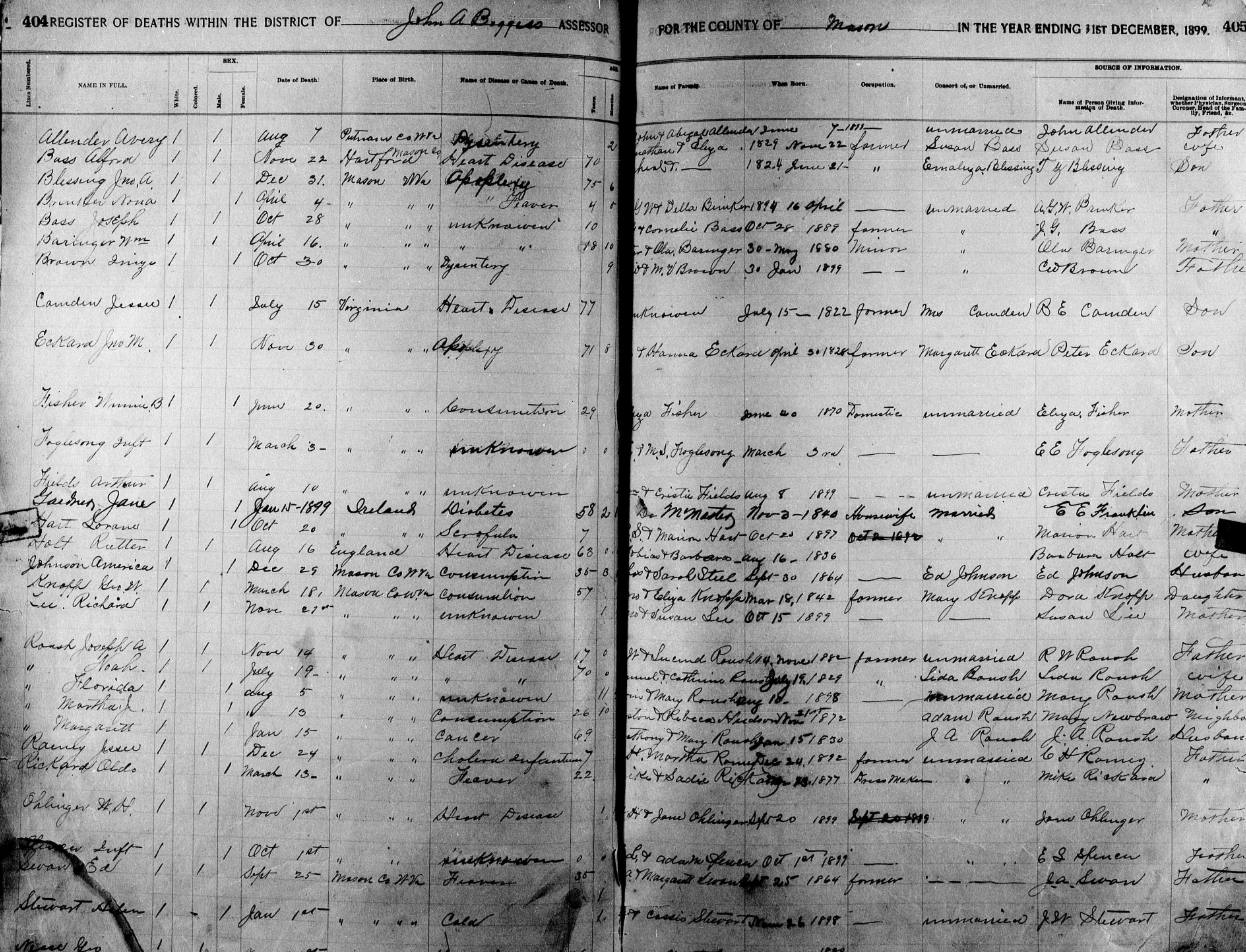
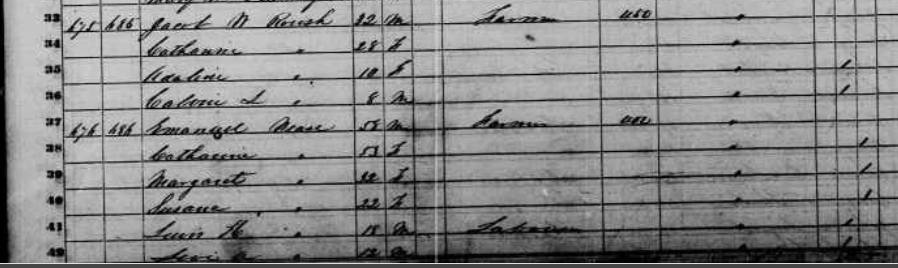
⭐ There is a documented candidate pool, not a blank. The 1850 census of Mason County has EMANUEL NEASE (b. c.1792, Virginia), farmer, and CATHARINE (b. c.1797, Virginia), and the 1899 county death register names “Emanuel & Catharine Nease” as the parents of George Nease (b. 21 Nov 1820) [ROUSH-45/46/48]. Their sons George and Levi A. are documented brothers. Lewis belongs somewhere in that family; which man was his father is not established.
Outstanding: Emanuel Nease’s estate, Mason Co., 1850s. A Nease marriage return of c.1853 — Mason County returns of that period do name both parties’ parents.
RELOCATED from mislabeled node 126, 8 Aug 2026 (self-correction #22) — these are GEORGE’s parents (Lewis’s grandparents). ⚠ George’s 1899 death-register zoom reads parents “SAMUEL and CATHERINE NEASE” [ROUSH-43b]; the 1850 candidate household is EMANUEL Nease 58 & Catharine 53, next door to Jacob M. Roush [ROUSH-46]. Samuel-vs-Emanuel unresolved.
Evidence images (described)
1899 Mason County death register with parents' names — A full spread of the 1899 Mason County death register, from the rare years when West Virginia's death books actually wrote down a dead person's parents.George Nease's 1899 death record, parents named — George Nease's 1899 death record names his parents as Samuel and Catherine Nease and gives his birth date as 21 November 1820, opening up another generation of the family.1850 census — Emanuel and Catharine Nease's household — The 1850 census shows Emanuel and Catharine Nease living right next door to a Roush family in Mason County, Virginia, neighbors who would later become in-laws.
Catharine Nease (b. ~1793/97 Virginia)
Ahnentafel #249 · his mother’s mother’s mother’s mother’s father’s father’s mother (7 generations back) · Known unknown — the person existed; the name does not survive
Catharine Nease was born about 1793 to 1797 in Virginia. She is named as George Nease's mother in more than one record, alongside a father recorded inconsistently as either Samuel or Emanuel Nease, but her own maiden name and identity have not been established.
Evidence
RELOCATED from mislabeled node 127, 8 Aug 2026 (self-correction #22). “Catherine/Catharine” agrees across George’s 1899 register [ROUSH-43b] and the 1850 census [ROUSH-46]; surname and identity not established; the 1870 “Catharine Neas, 74” of Graham District [ROUSH-50] is the same candidate pool.
Evidence images (described)
1899 Mason County death register with parents' names — A full spread of the 1899 Mason County death register, from the rare years when West Virginia's death books actually wrote down a dead person's parents.George Nease's 1899 death record, parents named — George Nease's 1899 death record names his parents as Samuel and Catherine Nease and gives his birth date as 21 November 1820, opening up another generation of the family.1850 census — Emanuel and Catharine Nease's household — The 1850 census shows Emanuel and Catharine Nease living right next door to a Roush family in Mason County, Virginia, neighbors who would later become in-laws.1870 census, Graham District — Catharine Nease's household — The 1870 census finds eighteen-year-old James Nease still working the family farm beside seventy-four-year-old Catharine Nease, likely his own grandmother.
Anthony Roush (b. 1792 Shenandoah Co. VA)
Ahnentafel #250 · his mother’s mother’s mother’s mother’s father’s mother’s father (7 generations back) · Probable — the IDENTIFICATION or the LINK rests on one source, or is in conflict
Anthony Roush was born on 23 January 1792 near Solomon's Church in Shenandoah County, Virginia, and is buried at Rickard Cemetery in White Church, Mason County, West Virginia. According to a 1928 family genealogy, he was the seventh child of Henry Roush and his wife Dorothy, and he married first Elizabeth Rickard around 1810 and later Catherine Hoffman. He was an heir to a portion of the family's 6,000-acre Graham District estate, and his daughter Nancy, from his first marriage, was the eleventh of his numbered children.
Evidence
Full dates: 23 Jan 1792 Shenandoah Co., VA – bur. Rickard Cem., White Church, Mason Co., WV
⭐ ADDED at PROBABLE, 8 Aug 2026, adversary-confirmed [ROUSH-64/-VERDICT]. The 1928 Roush genealogy, two internal threads agreeing: his own entry (printed p.365 — “seventh child of Henry Roush and wife, Dorothy… born… near Solomon’s Church, Jan. 23, 1792, baptized Mar. 18, 1792”) and the minute-book sons table (printed p.61), both carrying sponsor Michael Levermore. Nancy (node 125) is child 11 of his numbered sequence. m.(1) Elizabeth Rickard ~1810, (2) Catherine Hoffman. Heir to a portion of the 6,000-acre Graham District estate. ⚠ The 1812 Gallia deed proves co-location only — its Anthony clause lacks “his son” (verdict-ordered caveat).
Outstanding: Nancy’s 1848 marriage record (father named?); the 1840 household tally; an independent Solomon’s Church register transcription.
Elizabeth (Rickard) Roush (m. ~1810 Mason Co. WV)
Ahnentafel #251 · his mother’s mother’s mother’s mother’s father’s mother’s mother (7 generations back) · Probable — the IDENTIFICATION or the LINK rests on one source, or is in conflict
Elizabeth Rickard Roush married Anthony Roush around 1810 and was, by family tradition, a sister to the Rickard brothers of the same area. She was the mother of his numbered children, including Nancy, the eleventh, born in 1832. No dates or gravestone for her have yet been found, and her identity currently rests on the family genealogy alone.
Evidence
Full dates: m. c.1810; “a sister to the Rickard brothers”
⭐ ADDED at PROBABLE, 8 Aug 2026 [ROUSH-64/-VERDICT]. First wife of Anthony; mother of the numbered children incl. Nancy (11th, b. 1832). Identity rests on the book alone — no dates, no stone found yet; the Rickard Cemetery at White Church carries the family name.
Outstanding: her vitals; the Rickard family of Mason Co. (a Gen-9 opening).