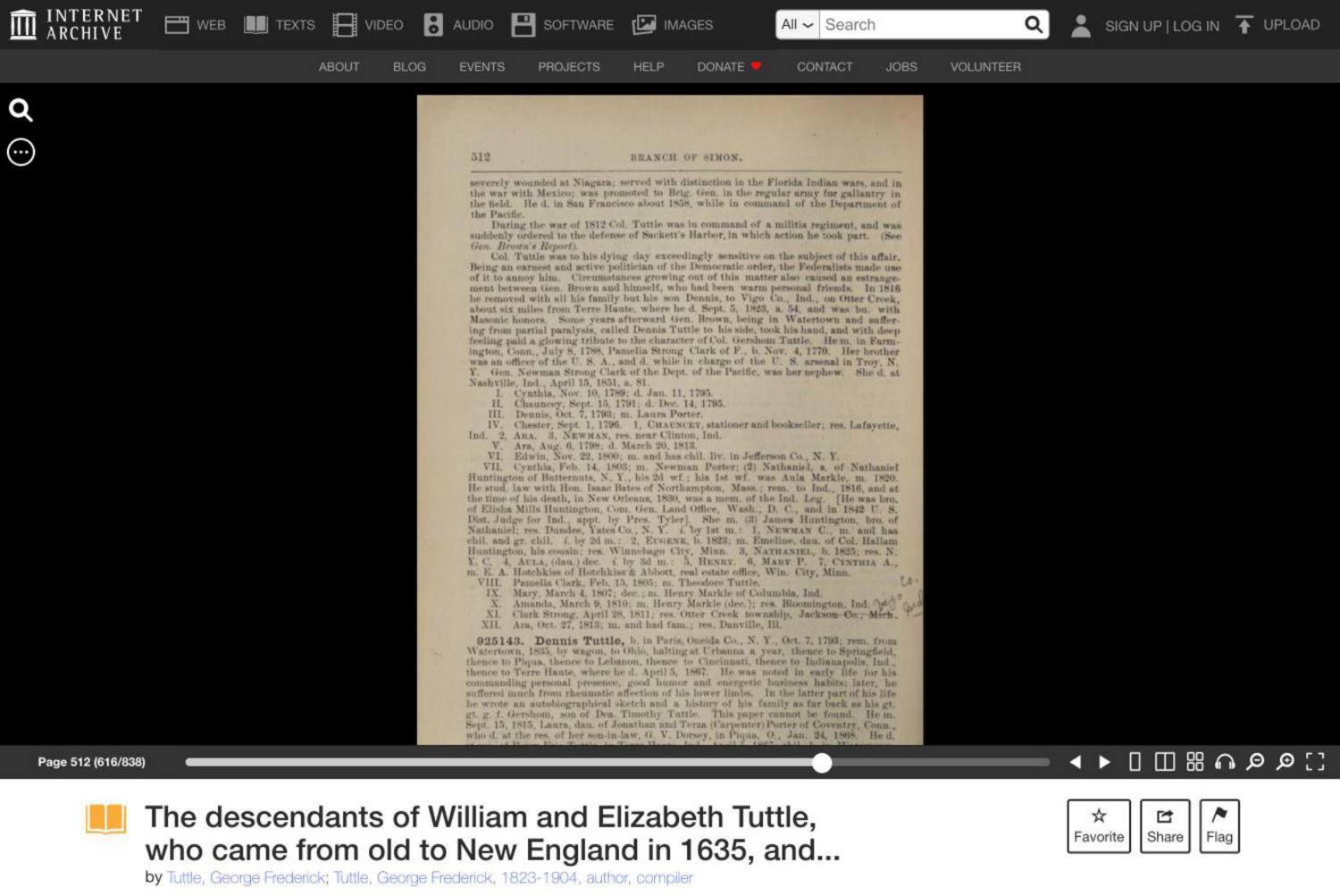
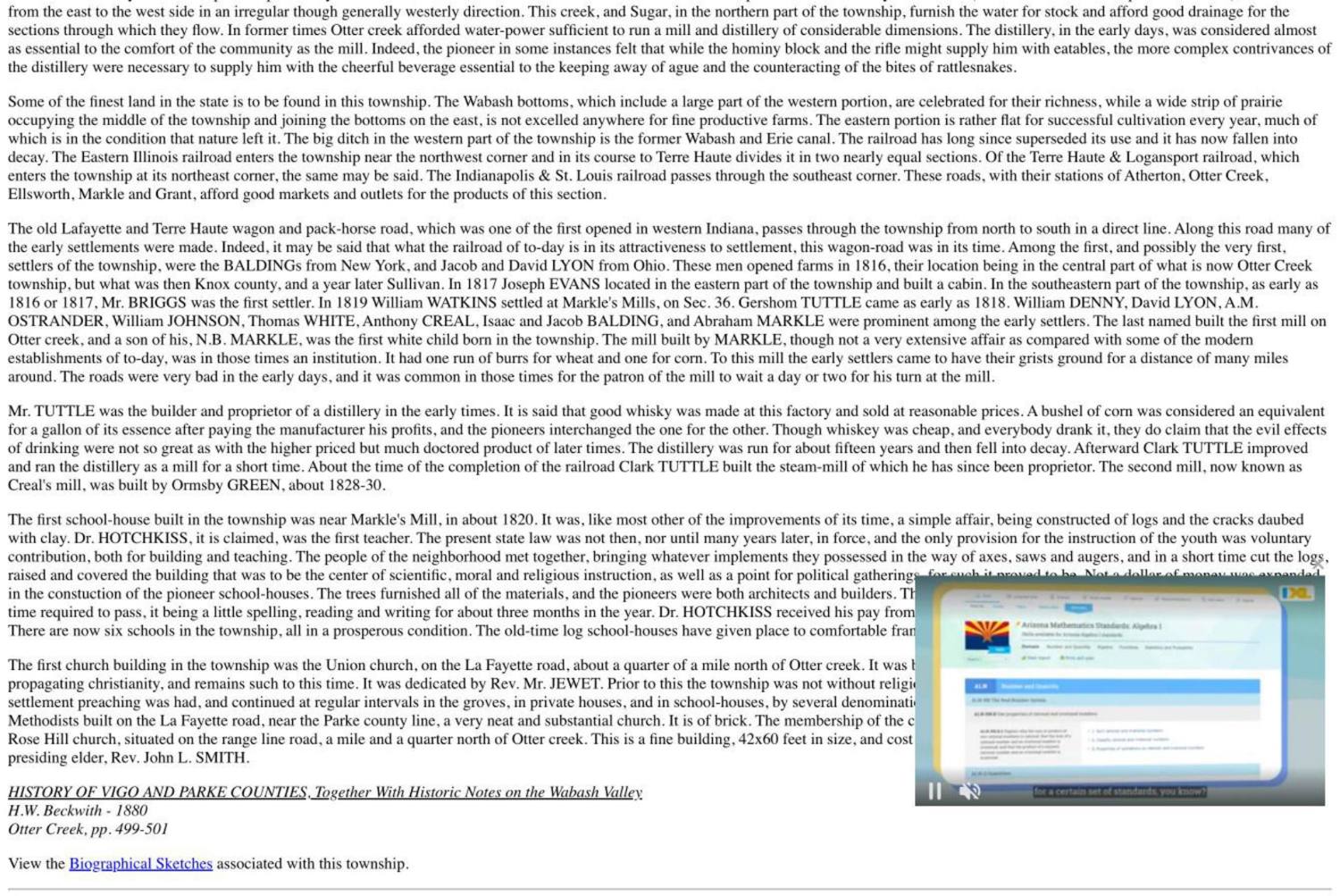
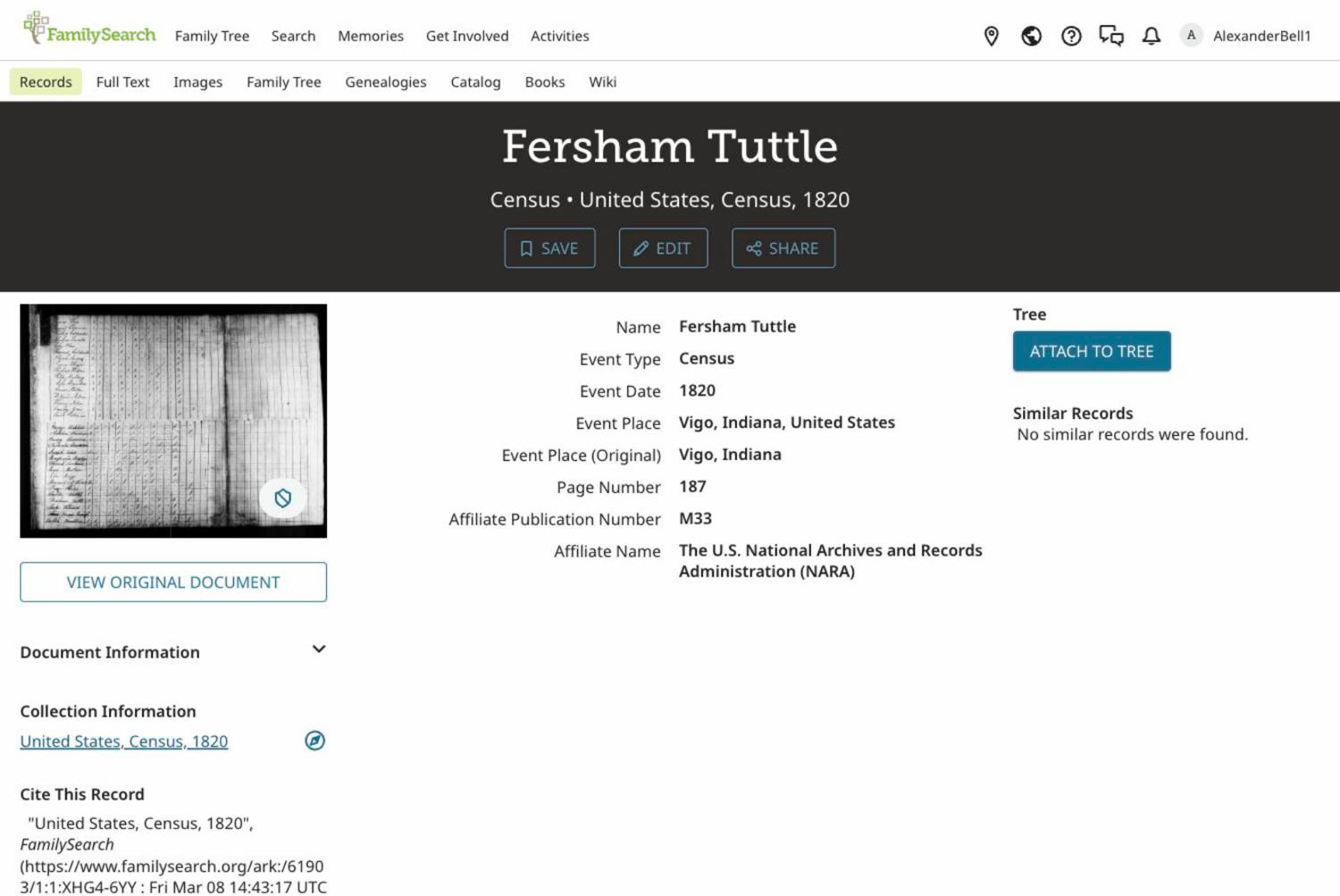
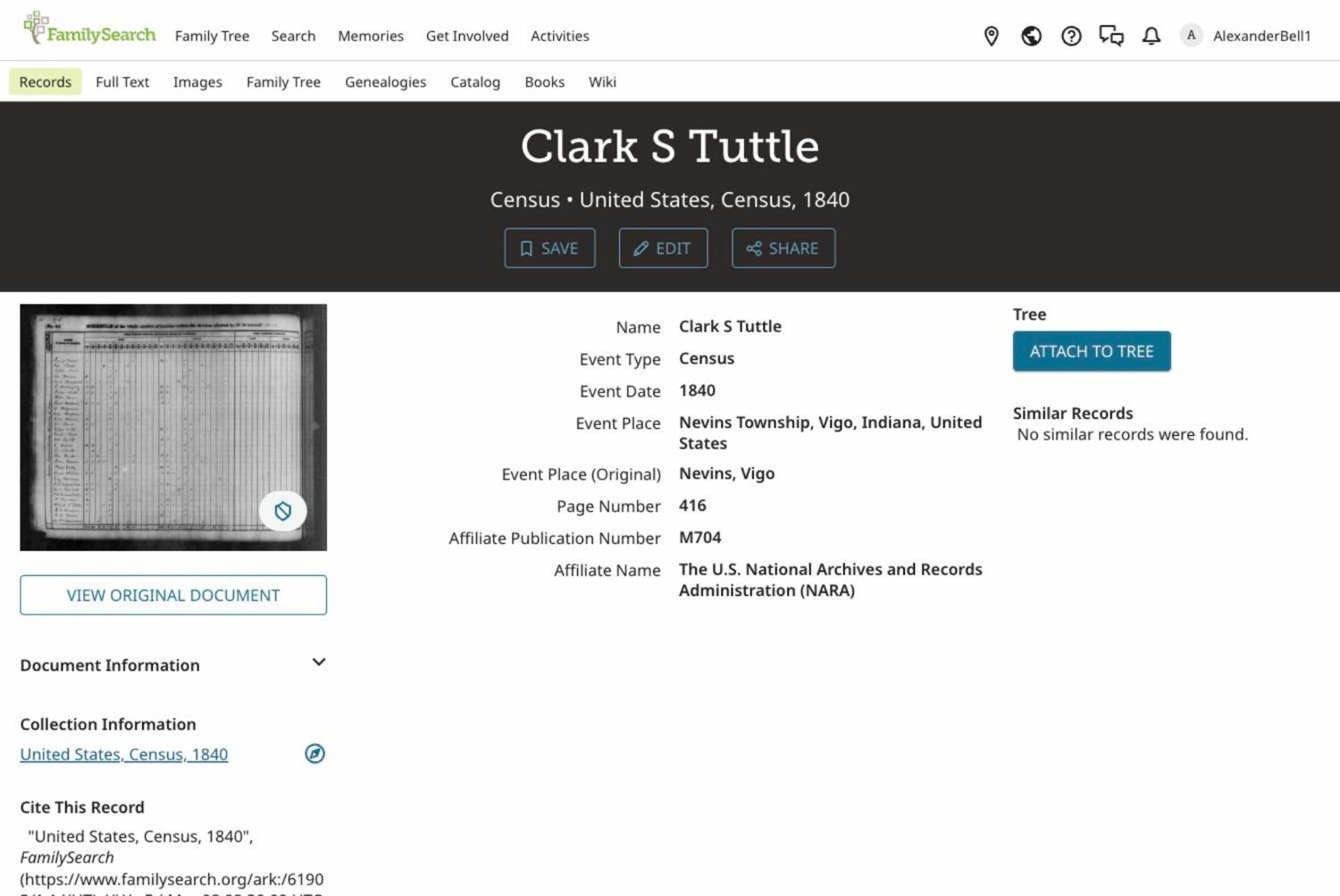
194 people, numbered by ahnentafel: #1 is me, each person’s father is double their number, each mother is double plus one. Every entry carries its dates, relationship, evidence grade, story, evidence notes, and text descriptions of every photograph and evidence scan.
Ahnentafel #81 · his father’s mother’s father’s father’s father’s mother (6 generations back) · Documented — person and parent-link established
Sarah Ann Jones was born about 1833 in North Carolina and married Henry H. Stephens on 4 June 1846 in Sumter County, Alabama, when she was only about thirteen. She was the mother of Caswell Stephens, born in January 1852, and possibly of his brothers Calvin and John as well. A Daniel Jones, who died around 1869 in Sumter County, is a promising but not yet confirmed candidate for her father; her own sons were bonded as his minor heirs after her death.
Evidence
Full dates: b. about 1833 in North Carolina; m. 4 June 1846, Sumter Co., Alabama
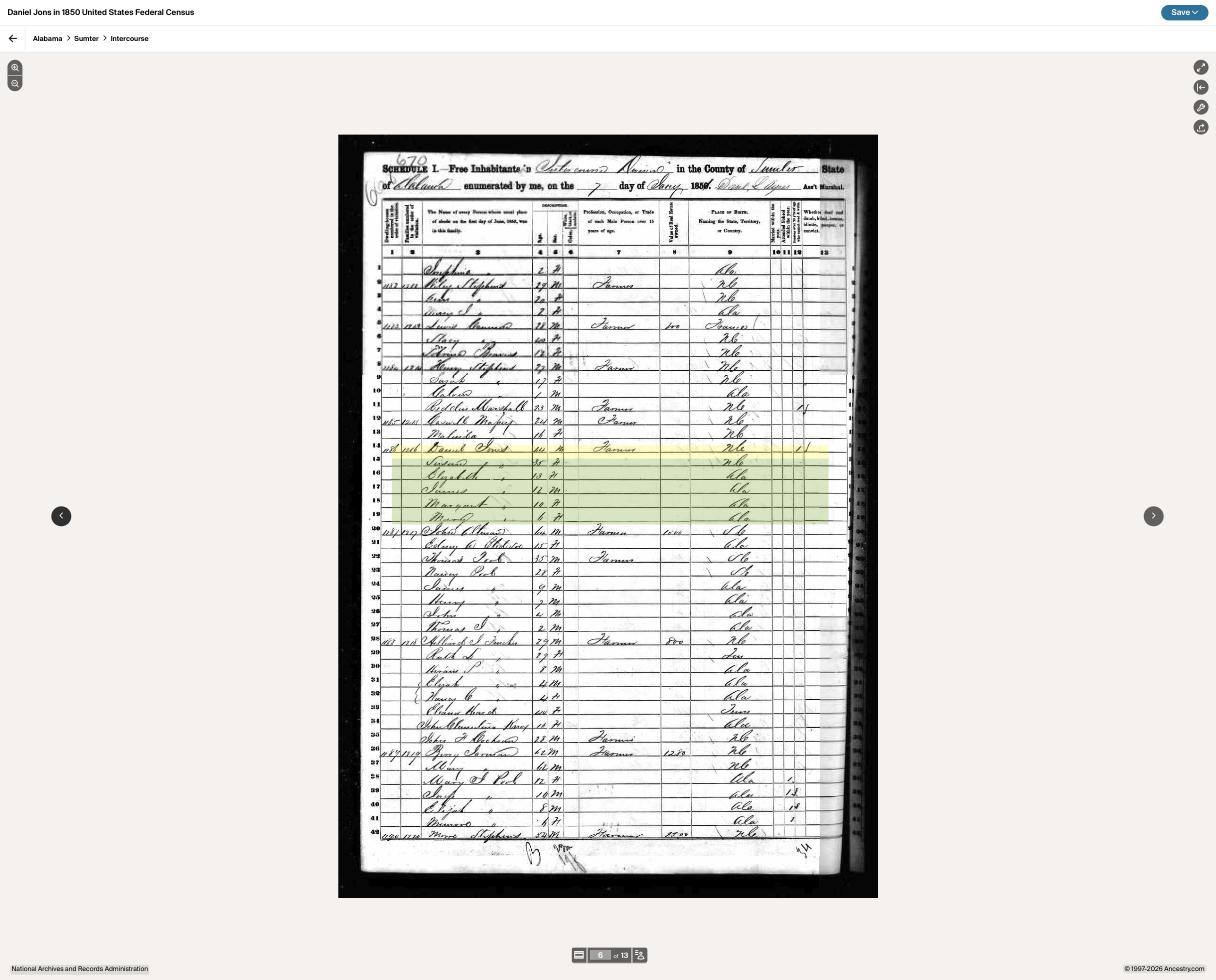
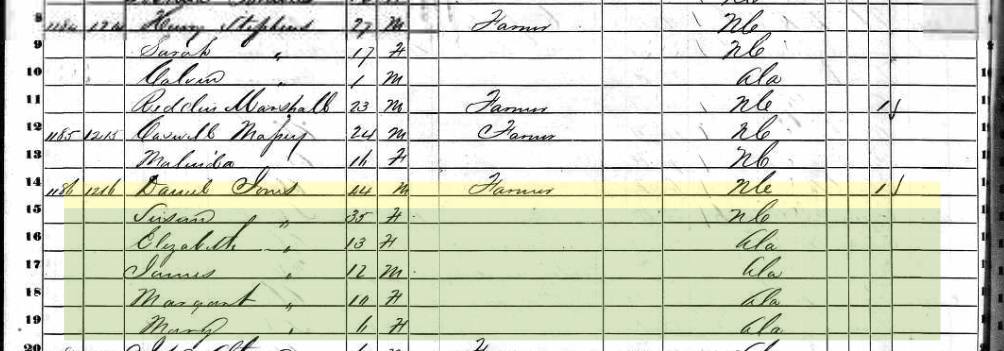
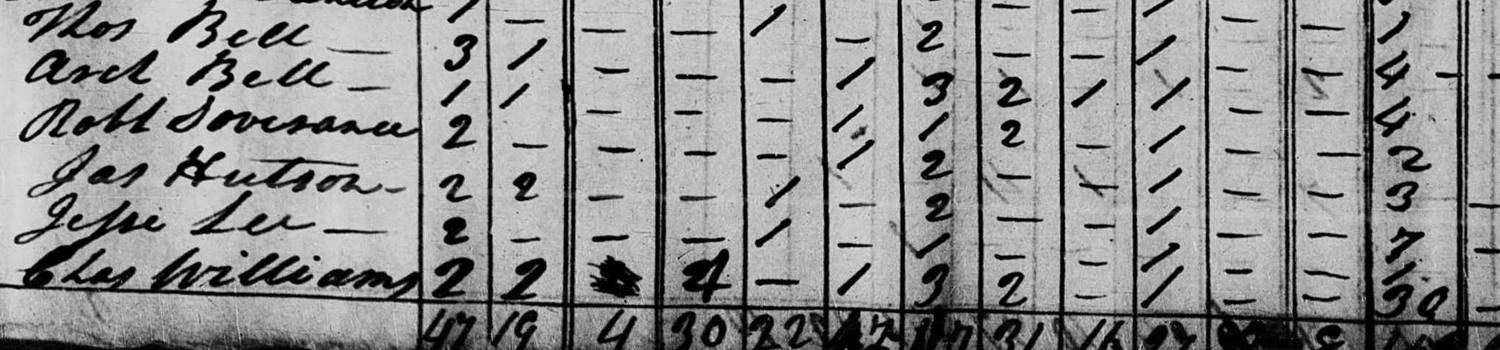
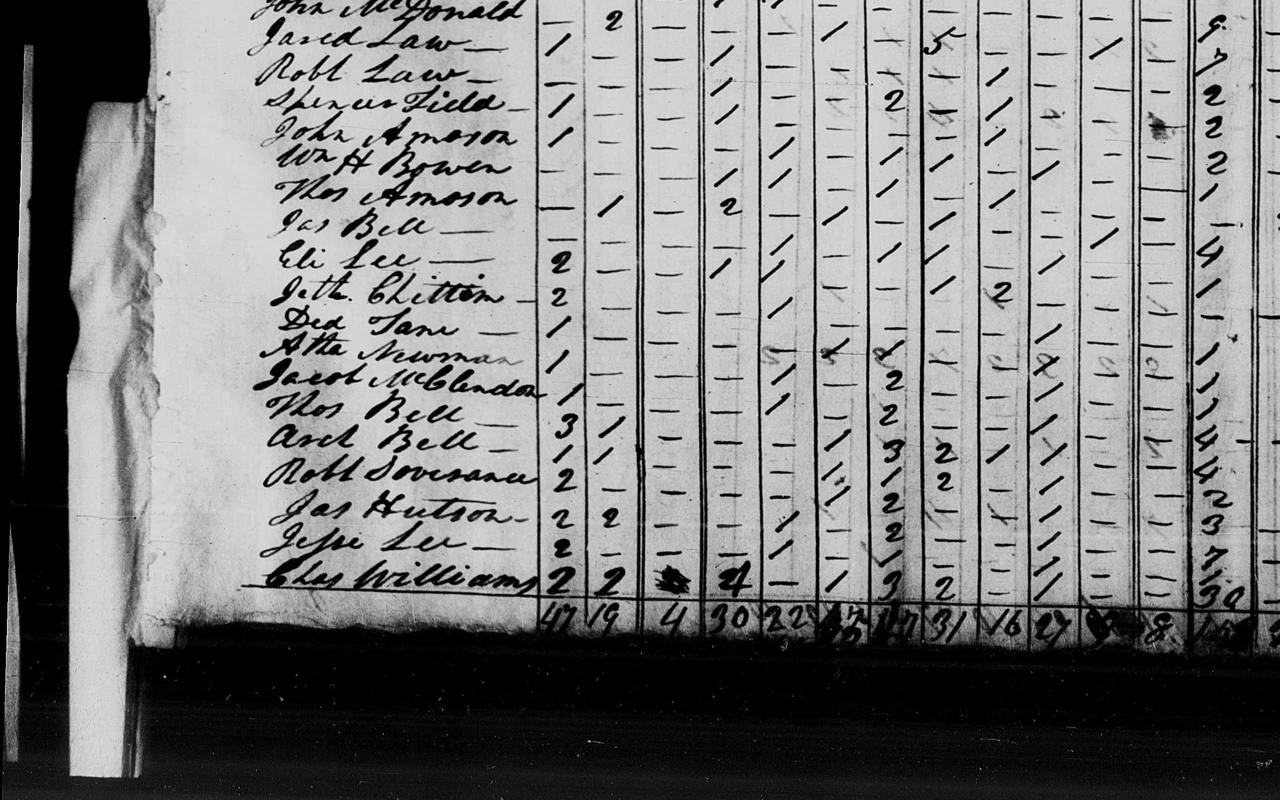
m. 4 Jun 1846, Sumter Co.; mother of Caswell (b. Jan 1852). Henry’s second wife was Elizabeth Jones, m. 1854. ⭐⭐⭐ 6 Aug 2026: the 1850 census gives “Sarah Stephens, 17” — born NORTH CAROLINA, which matches her recorded 1833 birth exactly and adds a birthplace that was not previously recorded. She married at about thirteen and had Calvin at about sixteen [STEPHENS-16].
Outstanding: ⭐⭐ Her North Carolina birth opens the JONES line. Look for a Jones household of North Carolina origin in Sumter Co., Alabama, 1850 — that is her parents, and a whole unopened generation. Also: boarder Redden Marshall, 23, b. N.C., in her house — possibly kin.
10 Aug 2026 [STEPHENS-33/-VERDICT]: a Daniel Jones, d. ~1869 Sumter Co., is a named, well-evidenced LEAD for her father — her sons Caswell, Calvin, and John were bonded 31 Dec 1869 as his “minor heirs” (per-stirpes through their dead mother) — but the record is generation-blind (father vs. childless brother), so the adversary refused a node. The decider: Daniel’s own 1869 administration/distribution (same volumes) — a “daughter Sarah” recital confirms slot 162 at part; a sibling-heir recital kills it.
Evidence images (described)
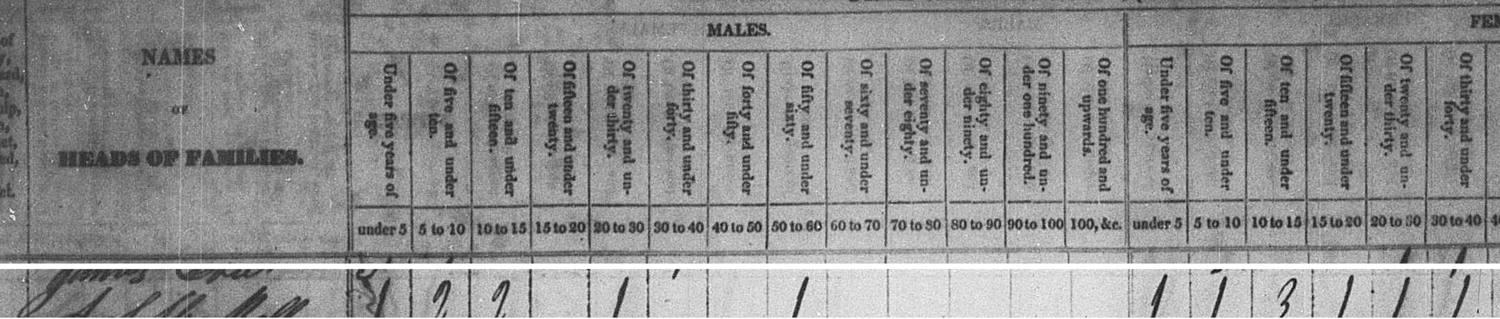
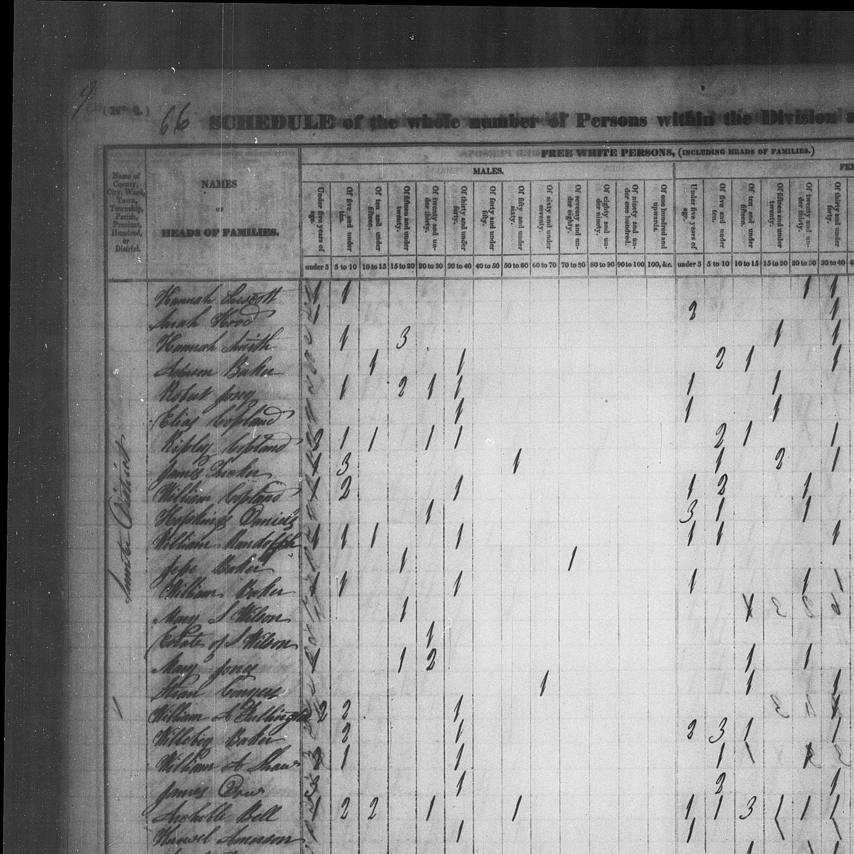
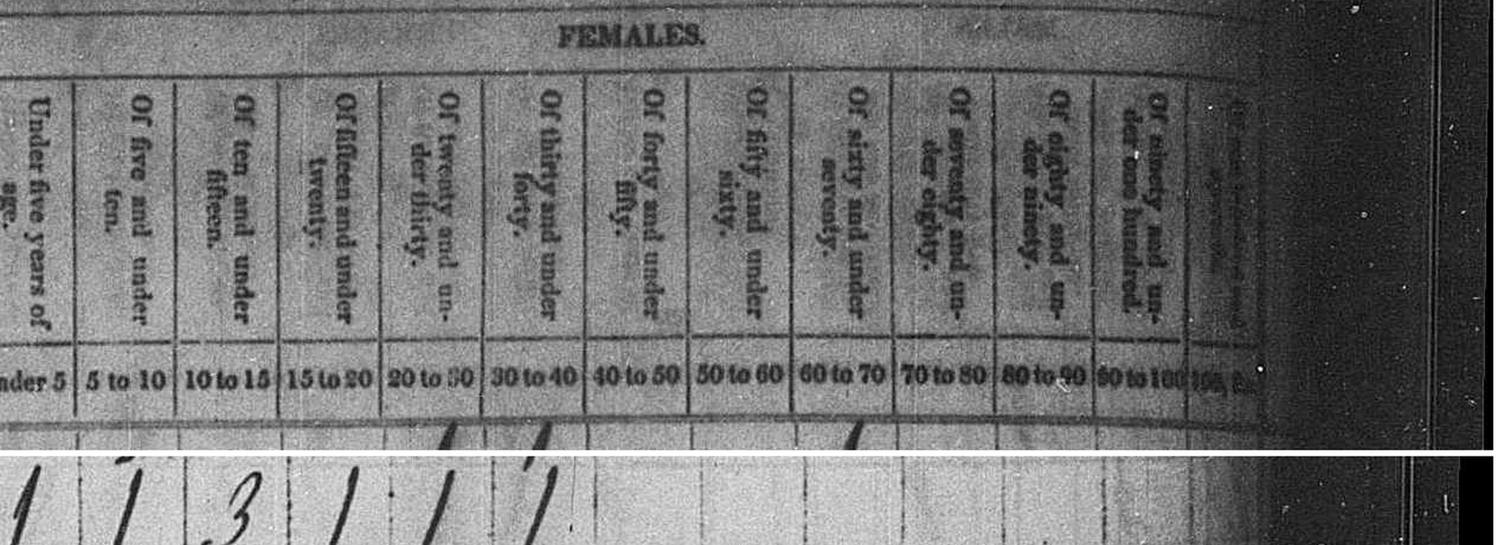
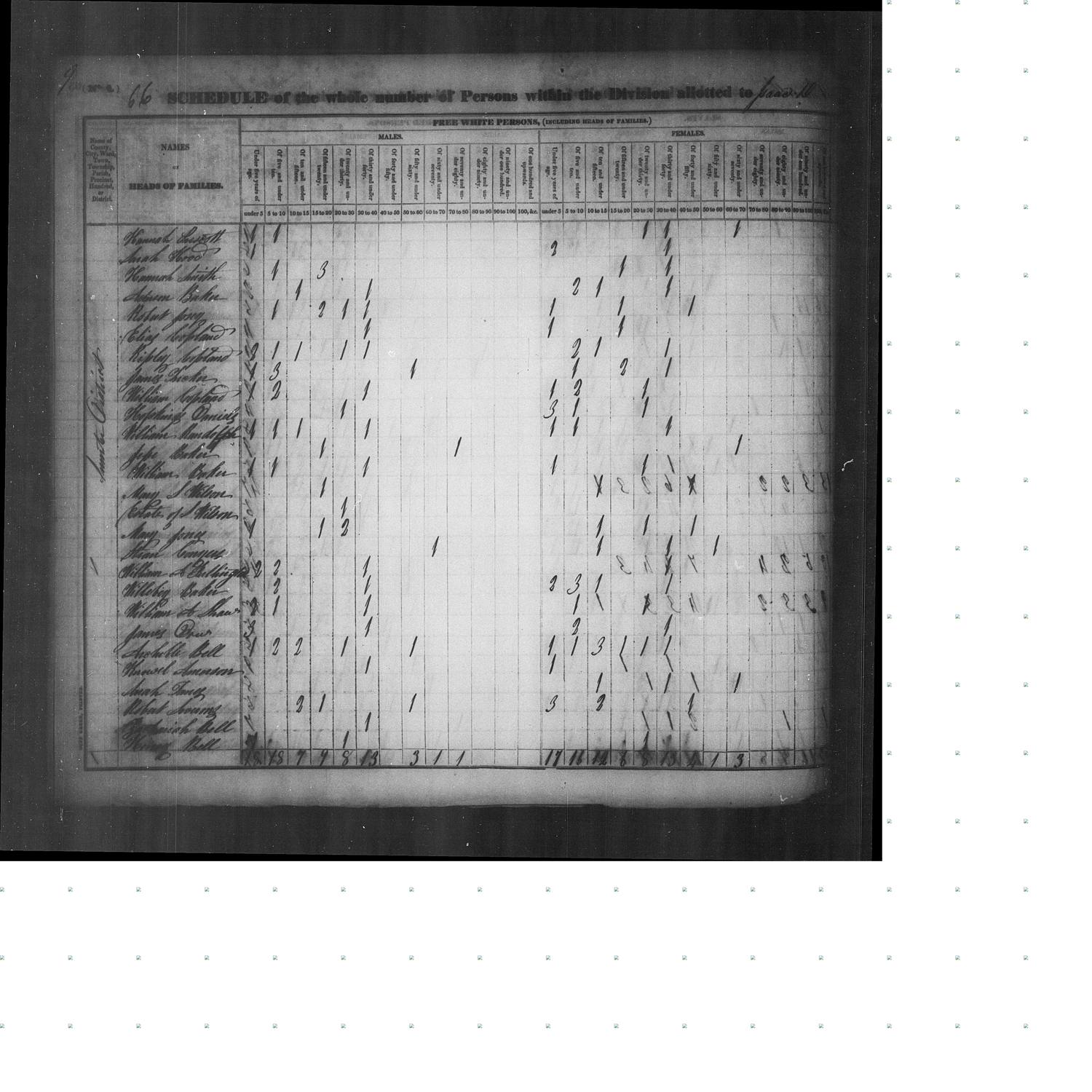
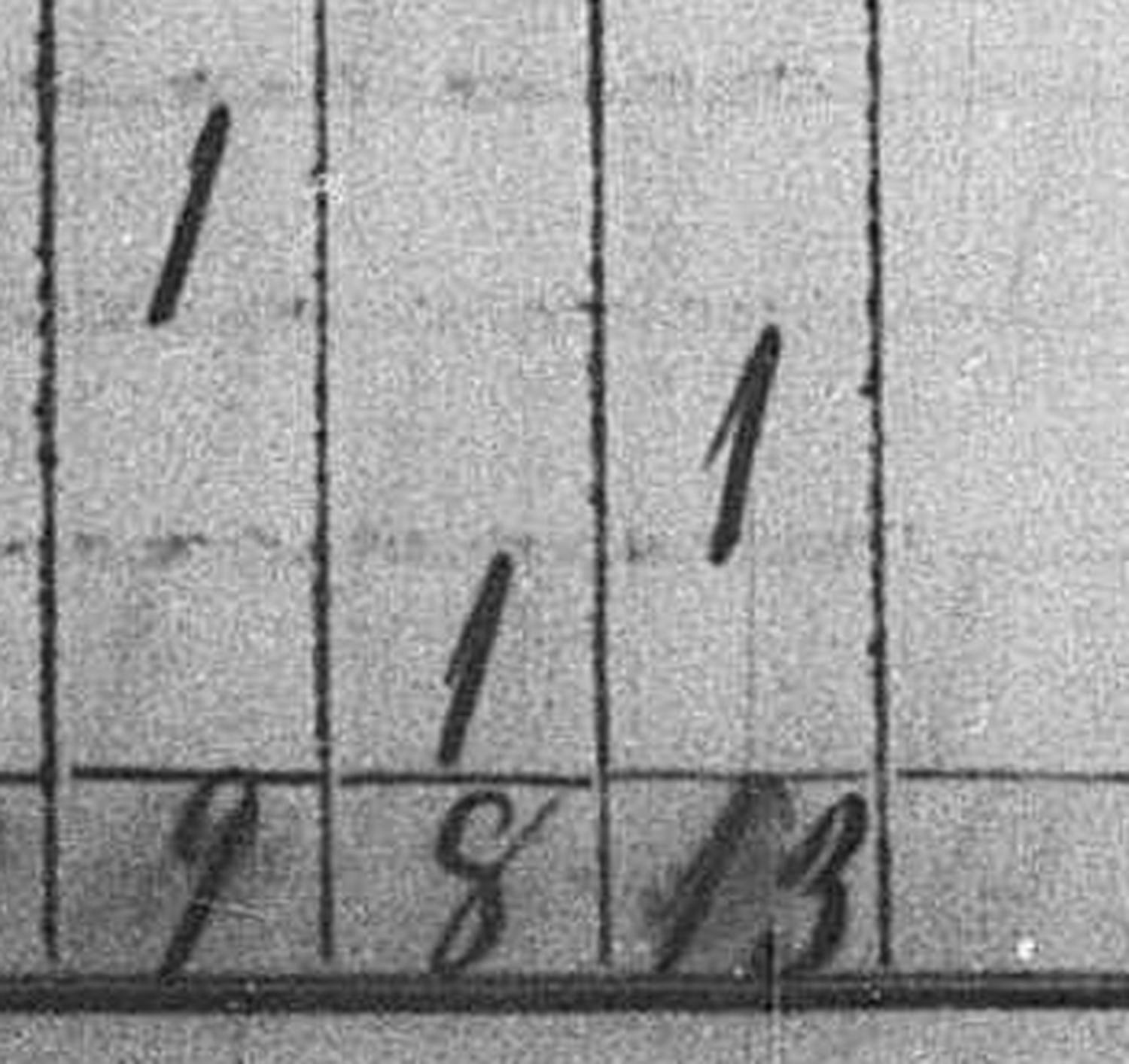
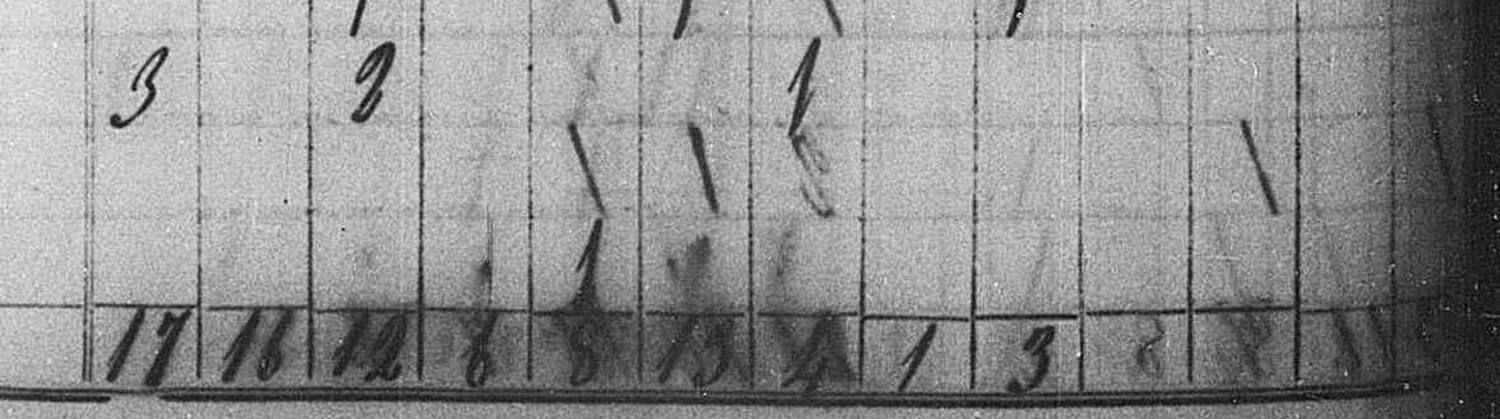
1850 census page — the Stephens and Jones neighbors — A single 1850 census page from Sumter County, Alabama, where the Stephens and Jones families lived just a few doors apart, neighbors who later became family through marriage.1850 census detail — Henry Stephens and Daniel Jones — A close-up of three neighboring 1850 census households: Henry Stephens, a farmer named Caswell Massey, and Daniel Jones, whose name resurfaced two years later as a Stephens baby's own.
John Wesley Truett (1833 – 1914)
Ahnentafel #88 · his father’s mother’s mother’s father’s father’s father (6 generations back) · Documented — person and parent-link established
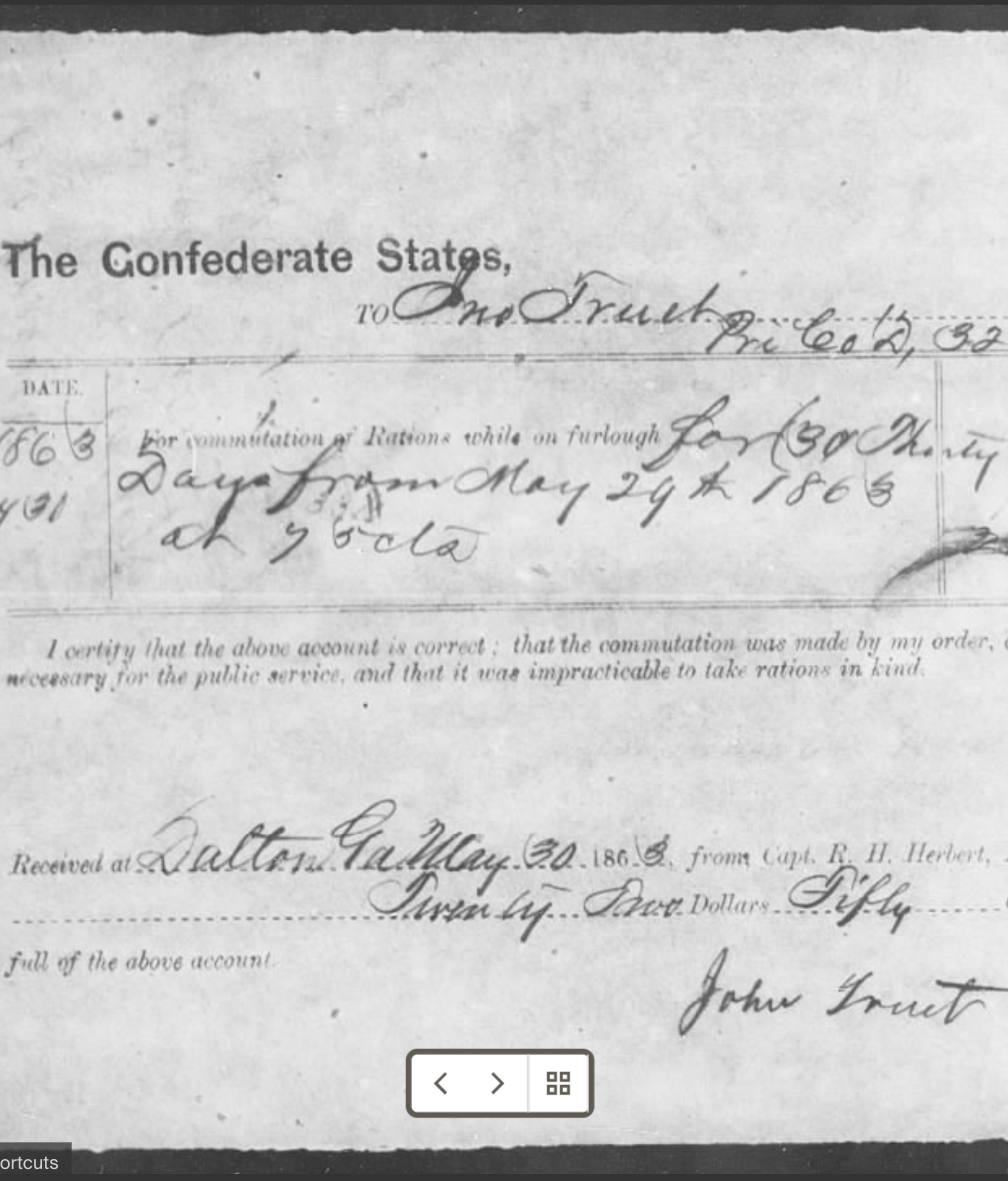
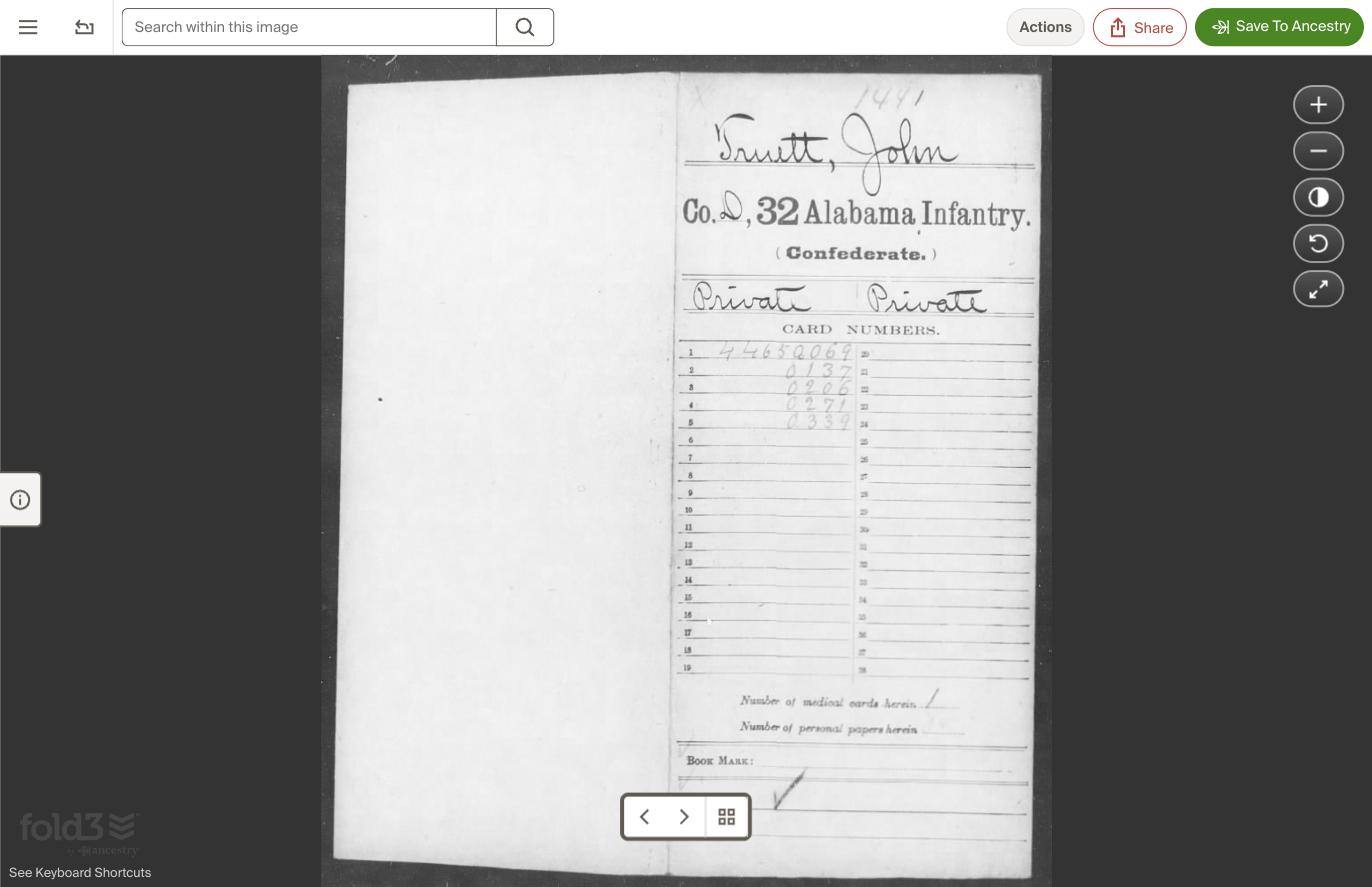
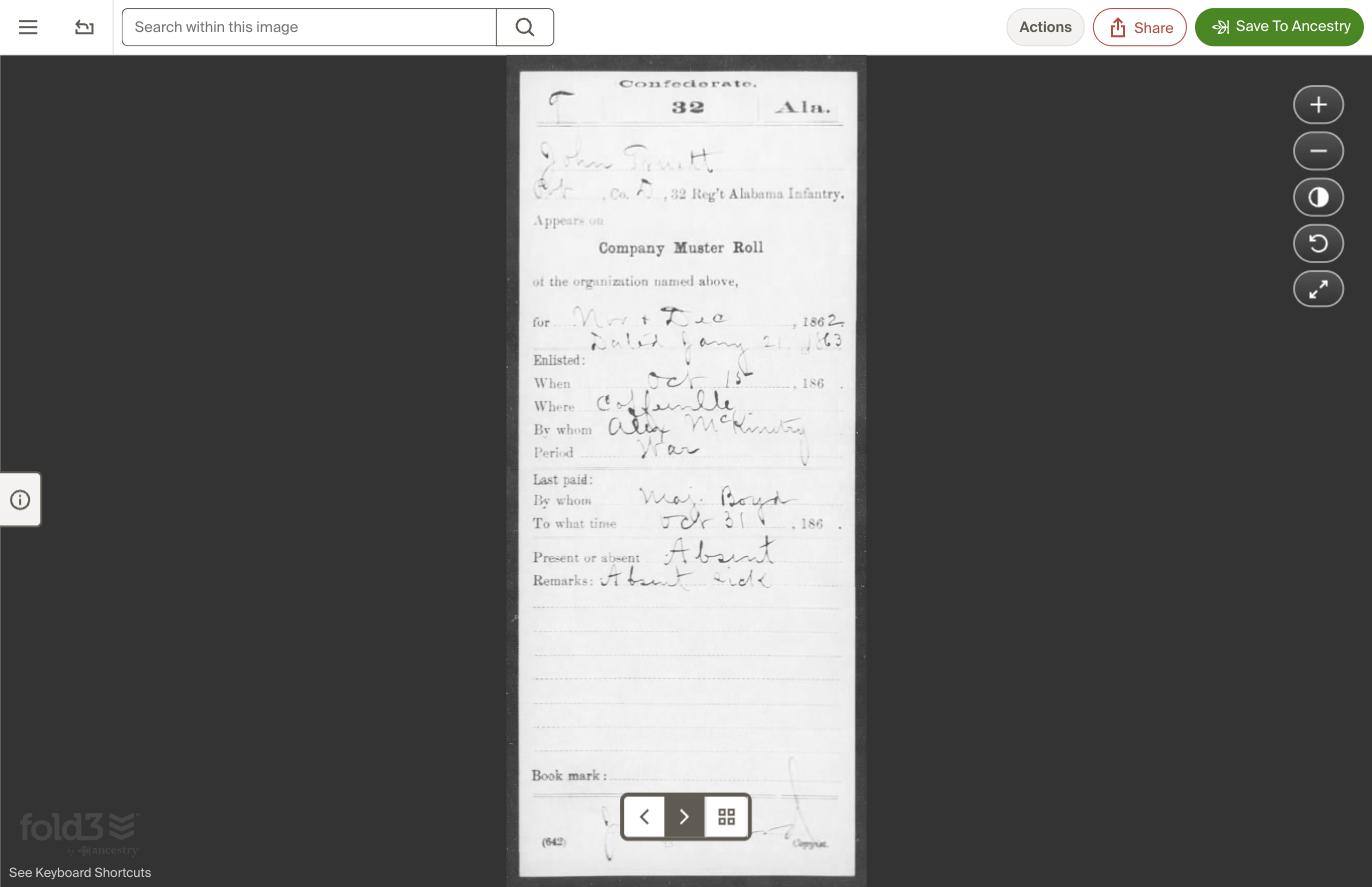
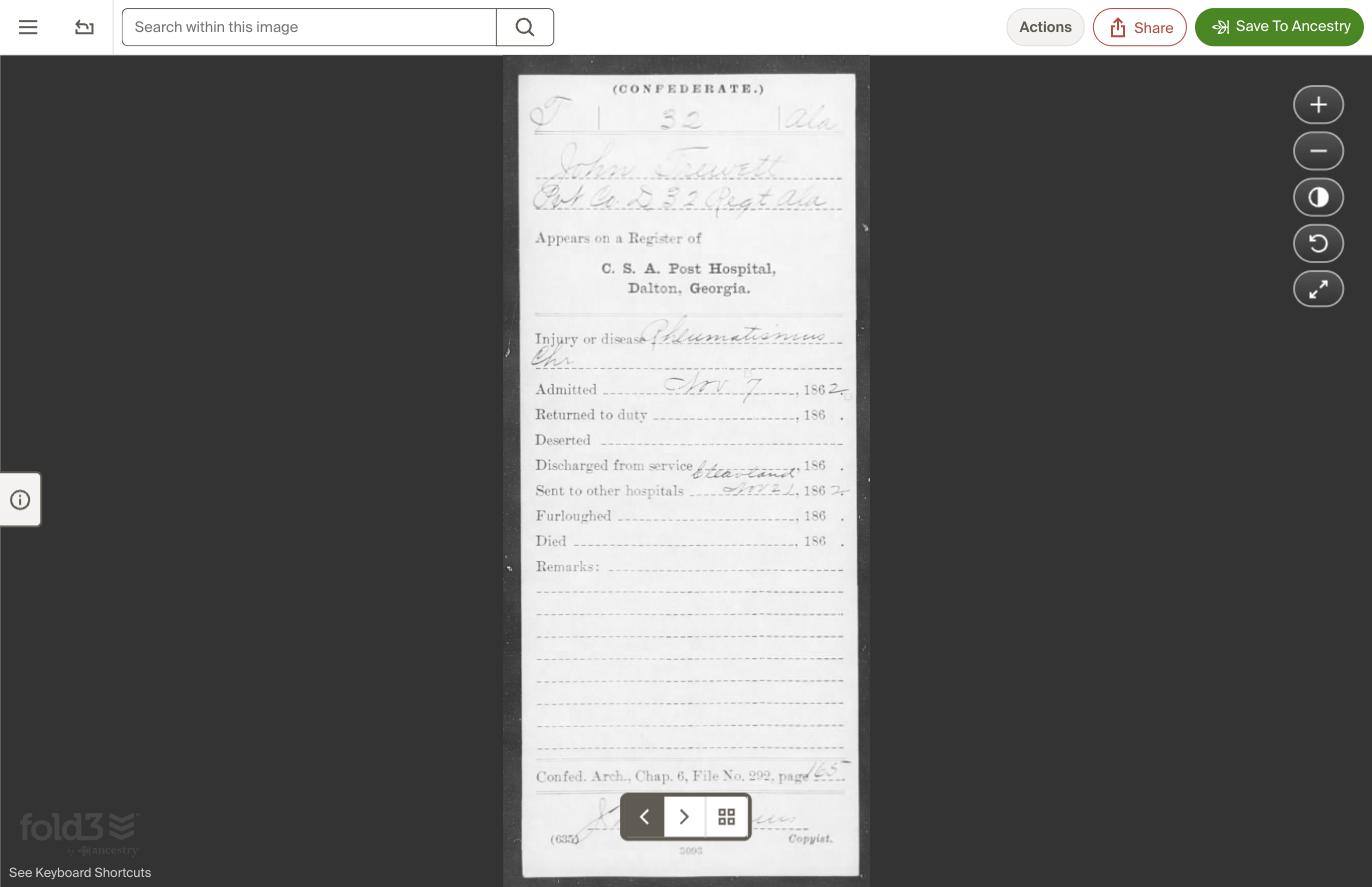
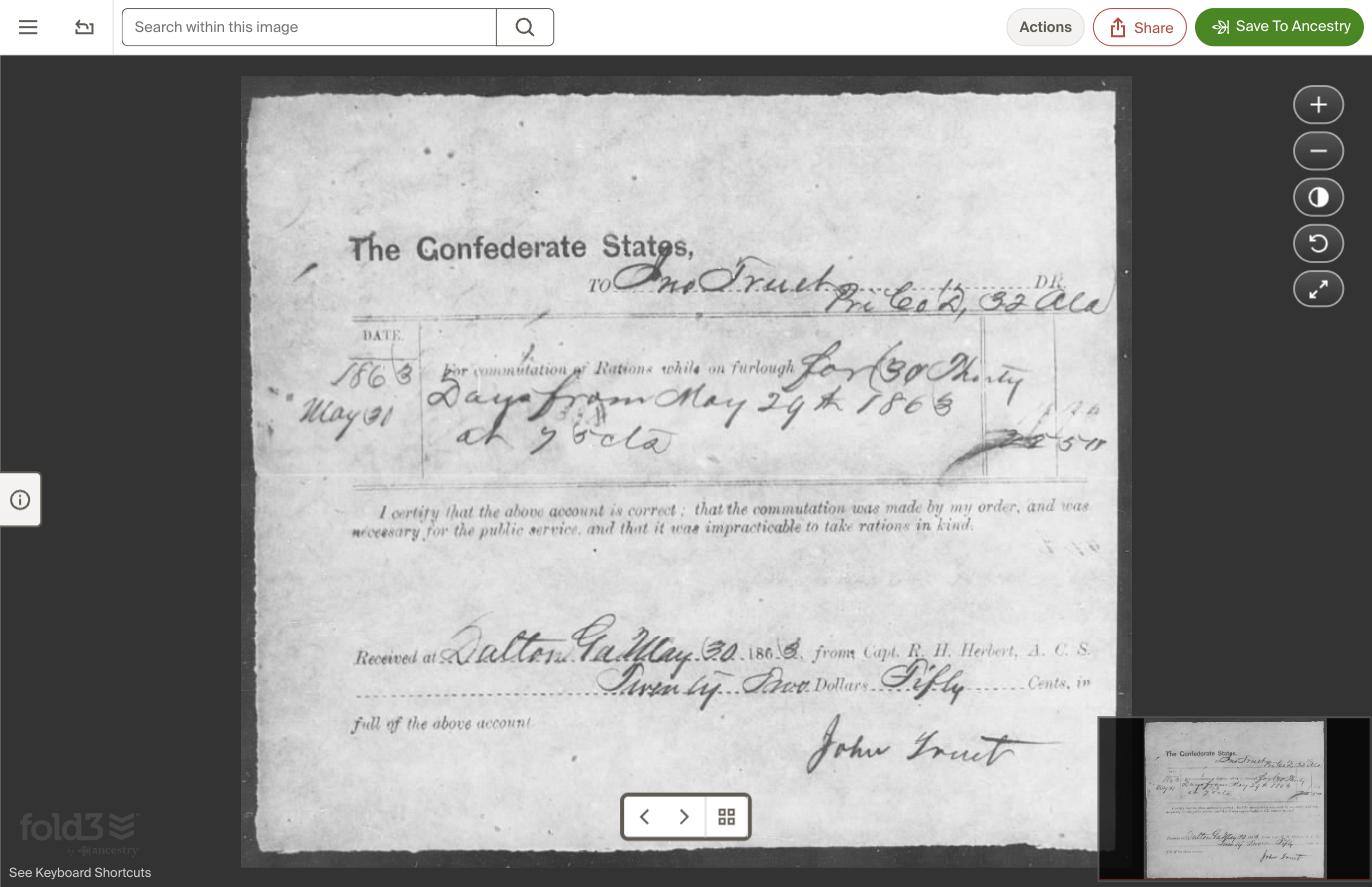
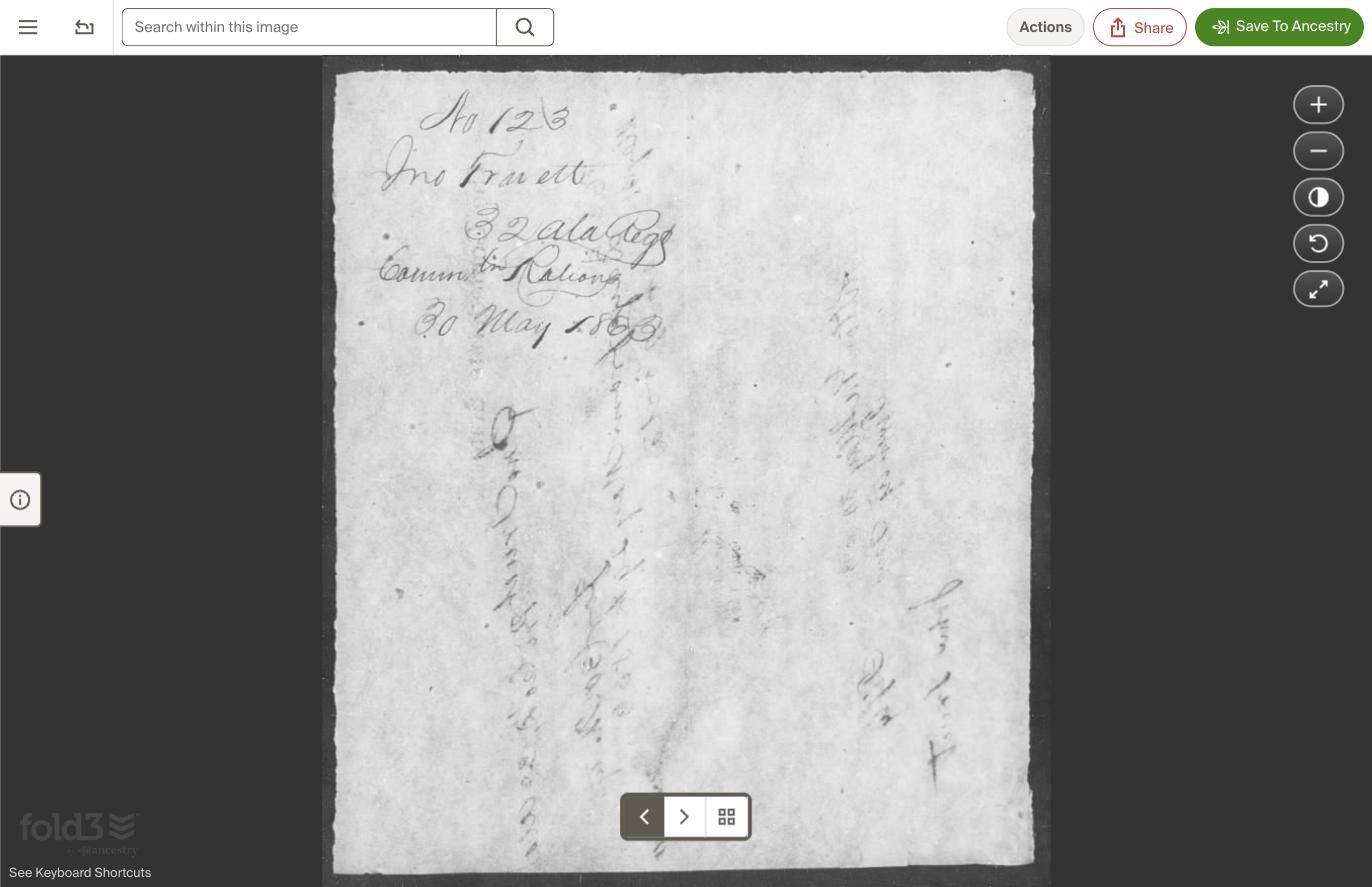
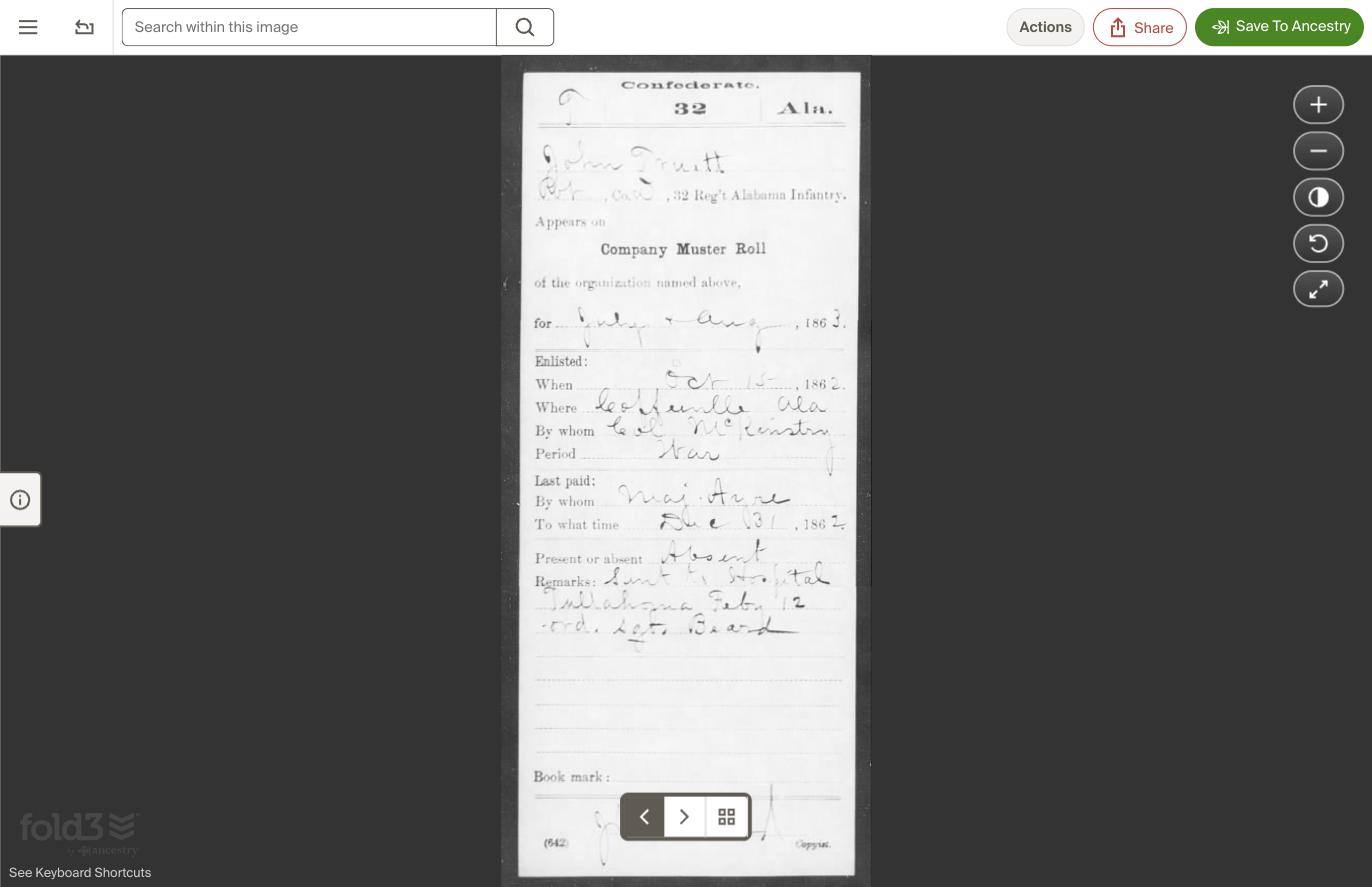
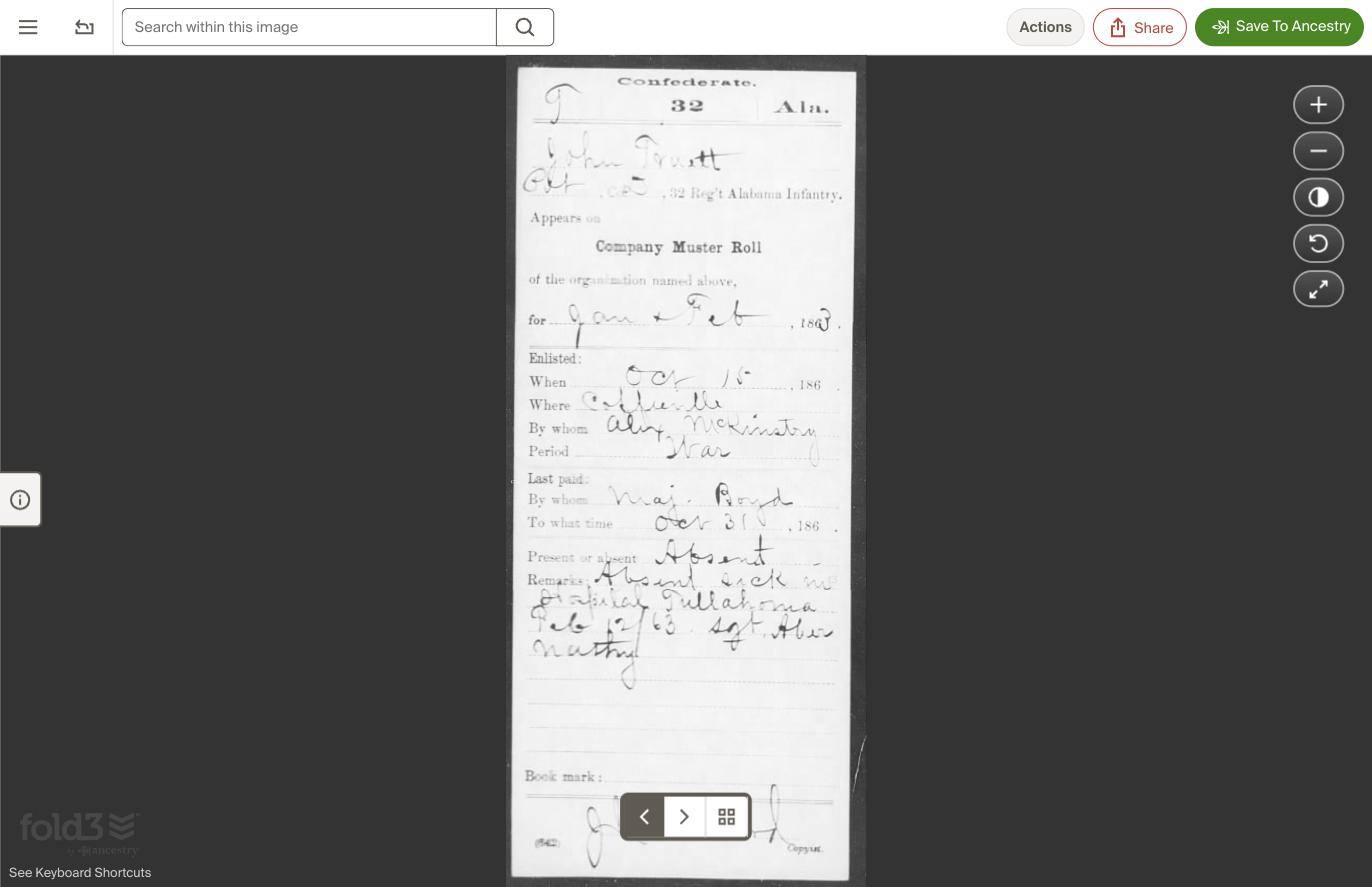
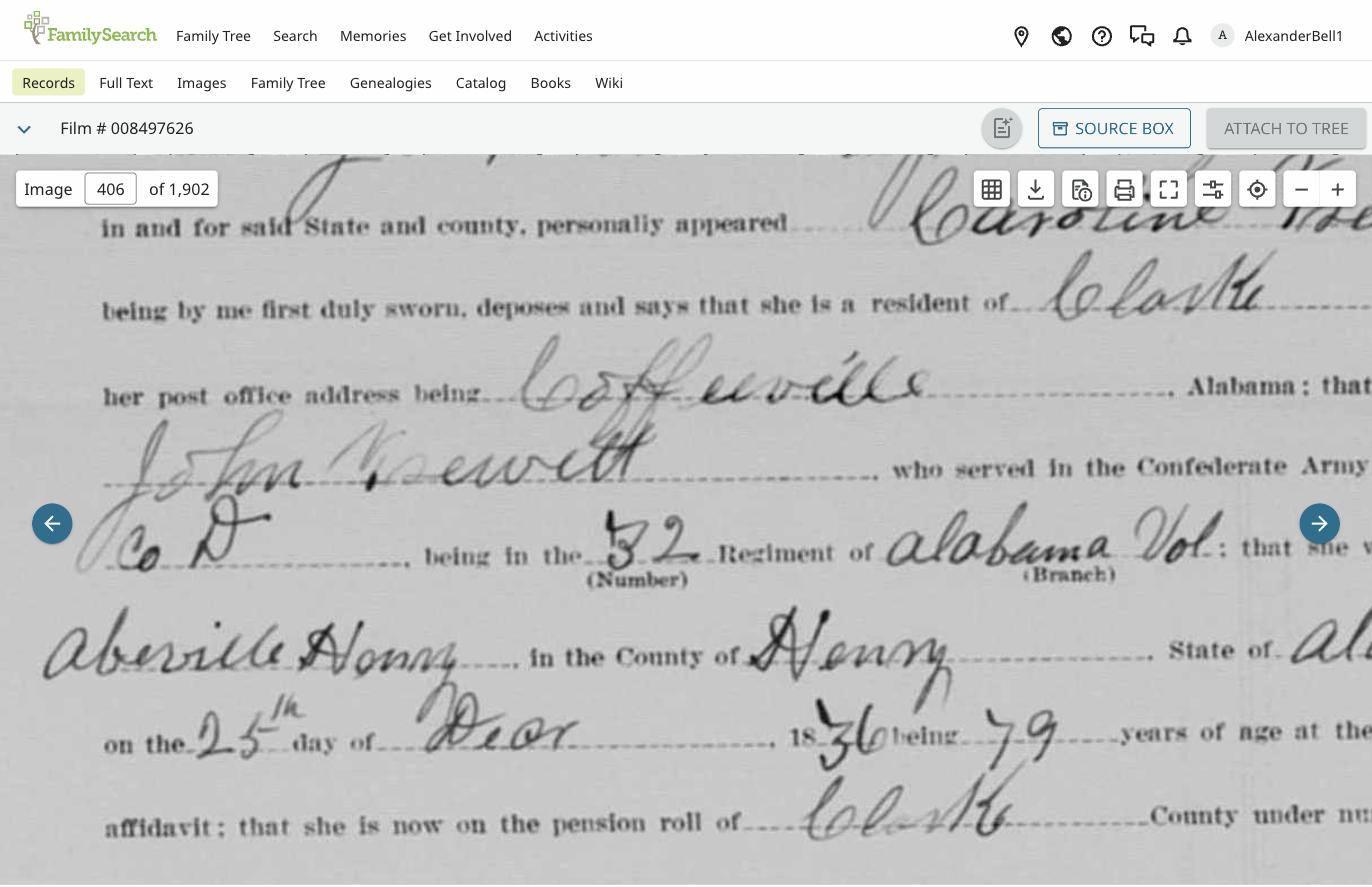
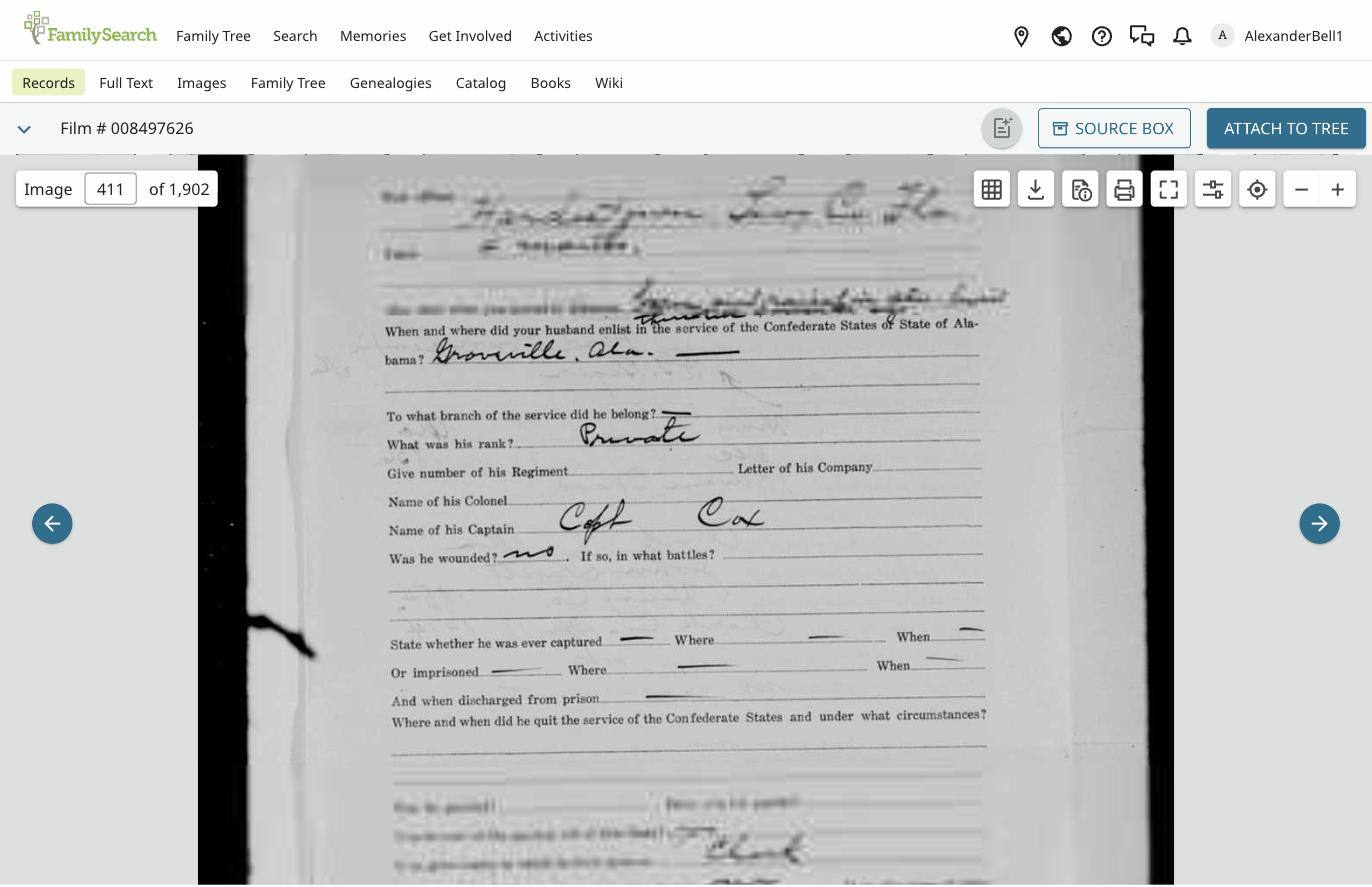
John Wesley Truett was born on 20 October 1833 and died on 17 April 1914. He served as a private in Company D of the 32nd Alabama Infantry during the Civil War, enlisting on 15 October 1862 at Coffeeville, and was hospitalized within weeks with chronic rheumatism that kept him listed as absent for the rest of the war. A voucher he signed himself at Dalton, Georgia, on 30 May 1863 is the oldest surviving signature of a direct ancestor in this family's records, and he was later enumerated, at age 73, in the 1907 Alabama Census of Confederate Veterans.
Evidence
Full dates: 20 Oct 1833 – 17 Apr 1914
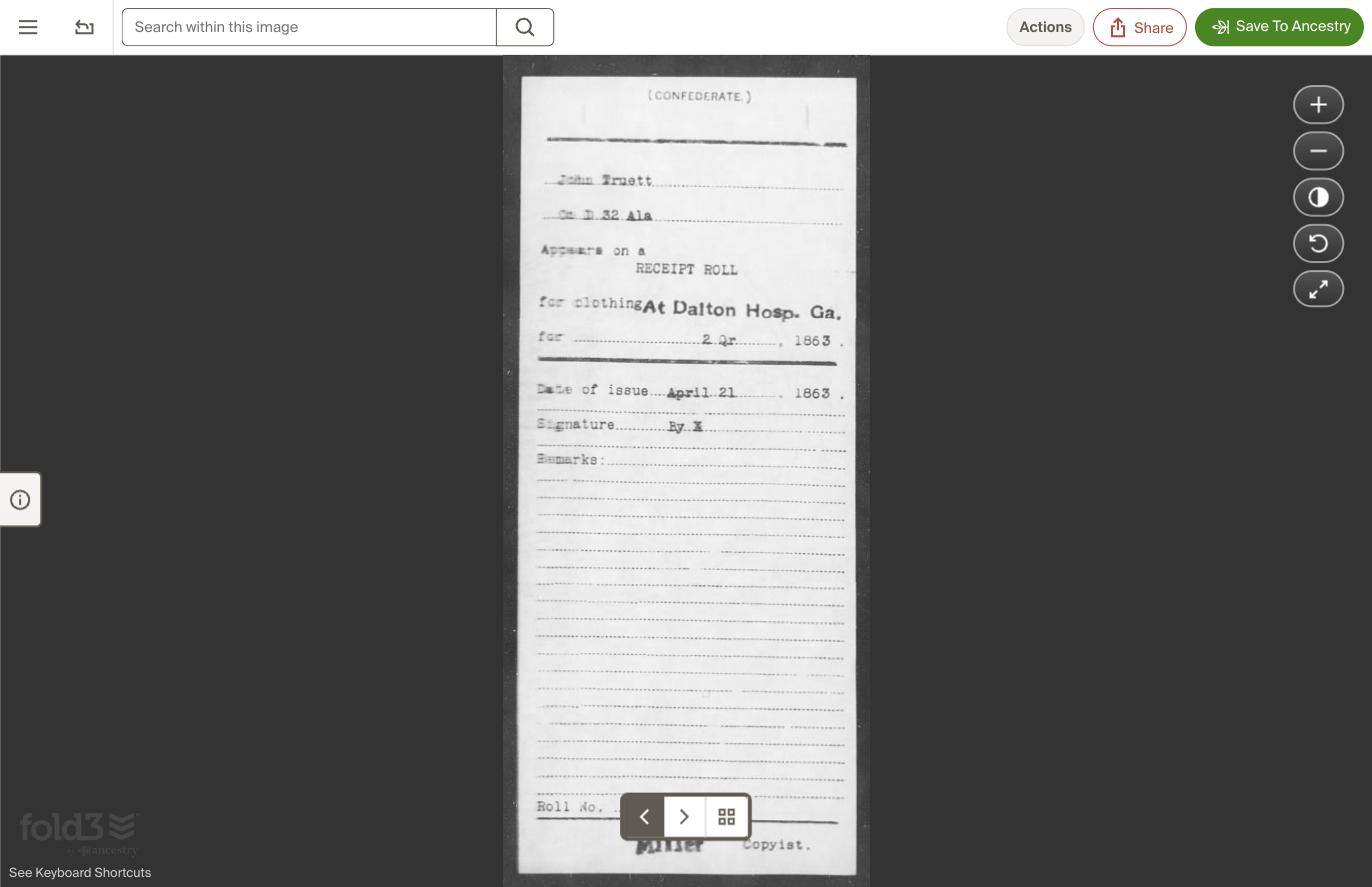
Private, Co. D, 32nd Alabama Infantry (CSA). Enlisted 15 Oct 1862 at Coffeeville — not May 1862 at Mobile — was in hospital at Dalton, Georgia within 23 days with chronic rheumatism, and is marked absent on every muster roll in the file. Page 11 is a voucher he signed himself at Dalton on 30 May 1863: the oldest signature of a direct ancestor recovered in this project. Enumerated in the 1907 Alabama Census of Confederate Veterans, aged 73.
Outstanding: His 1907 Confederate pension application at ADAH would add unit detail and a physical description.
Photographs (described)
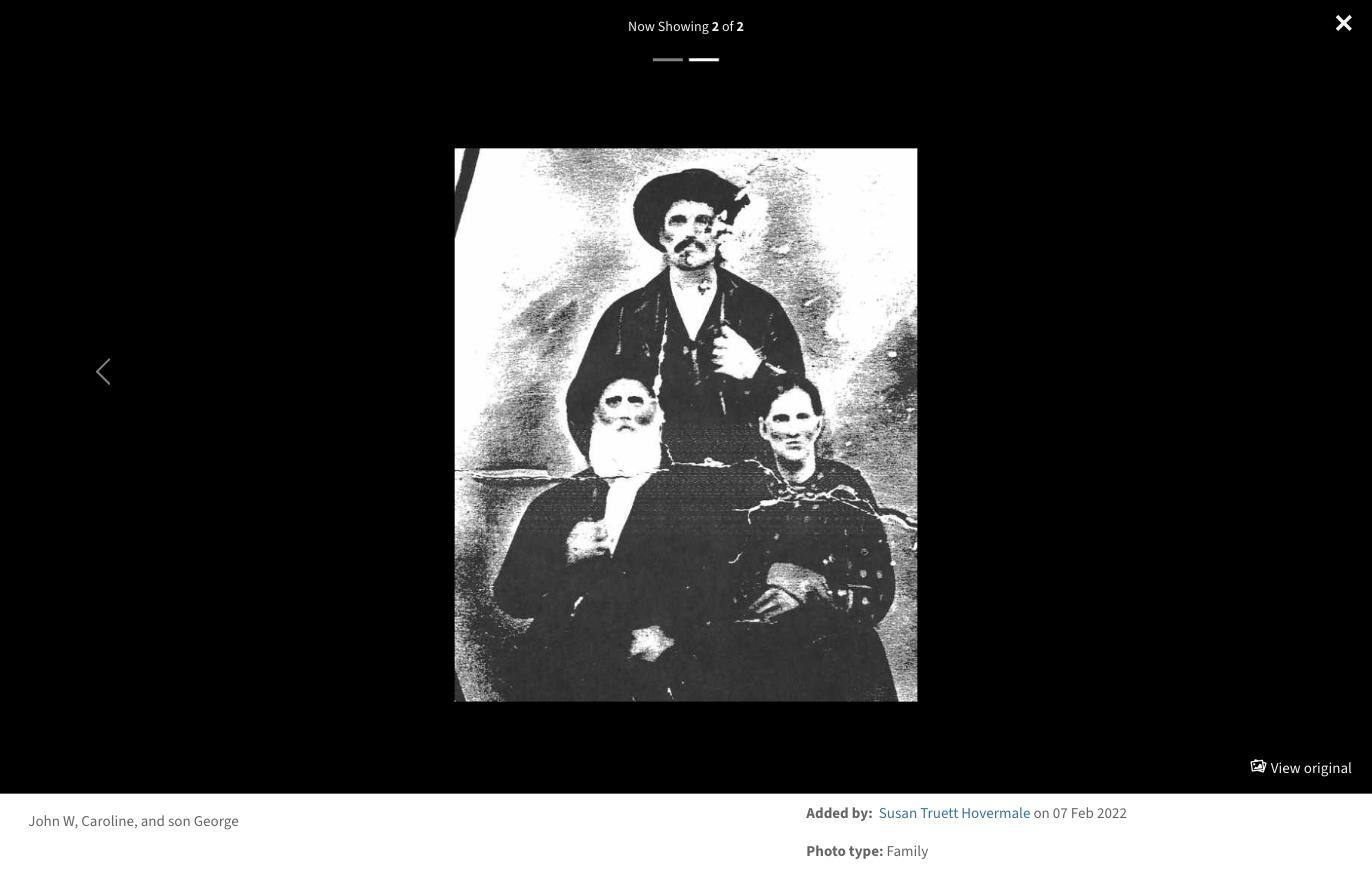
Studio portrait of John Wesley and Emily Caroline Truett
Evidence images (described)
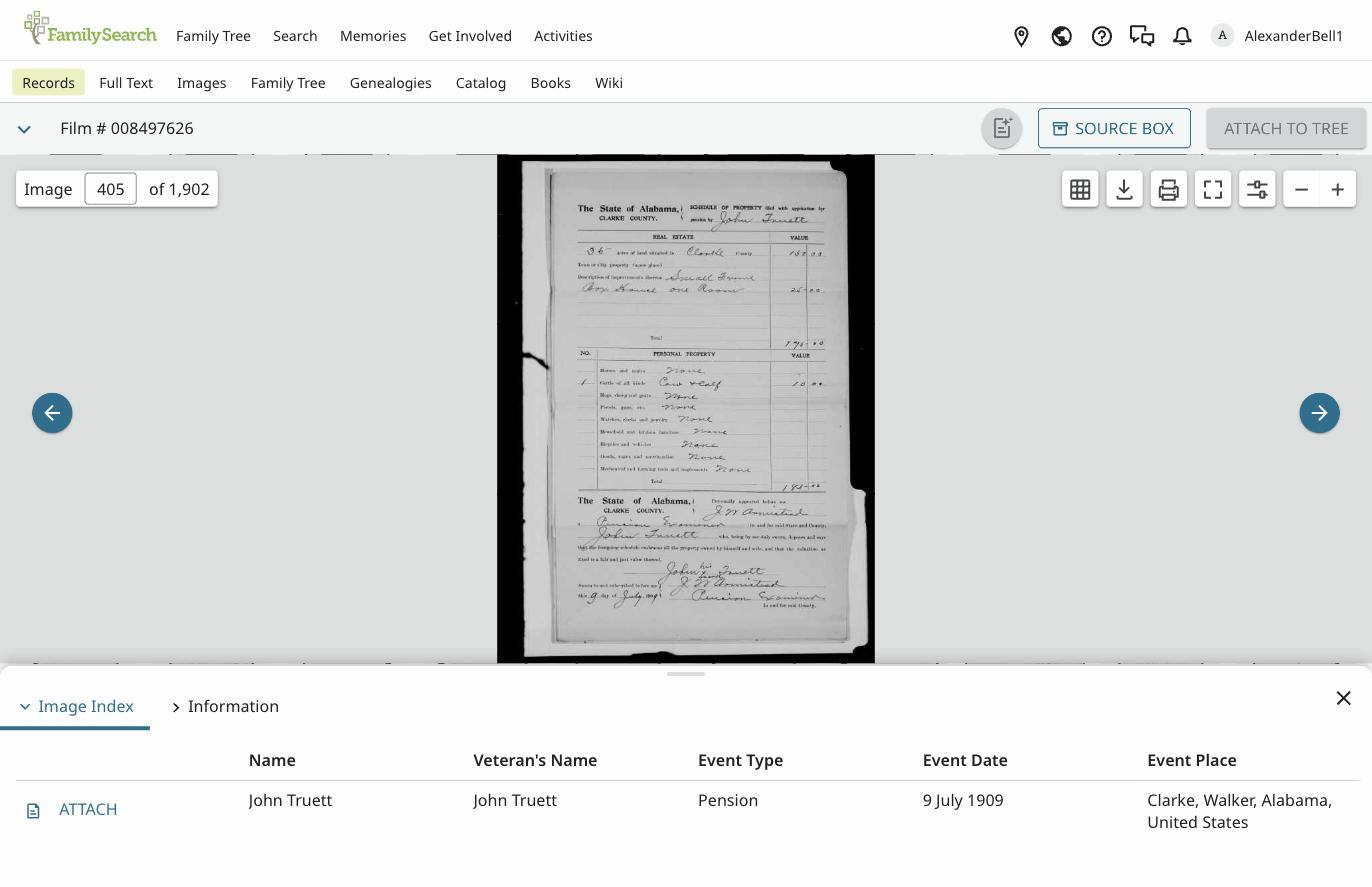
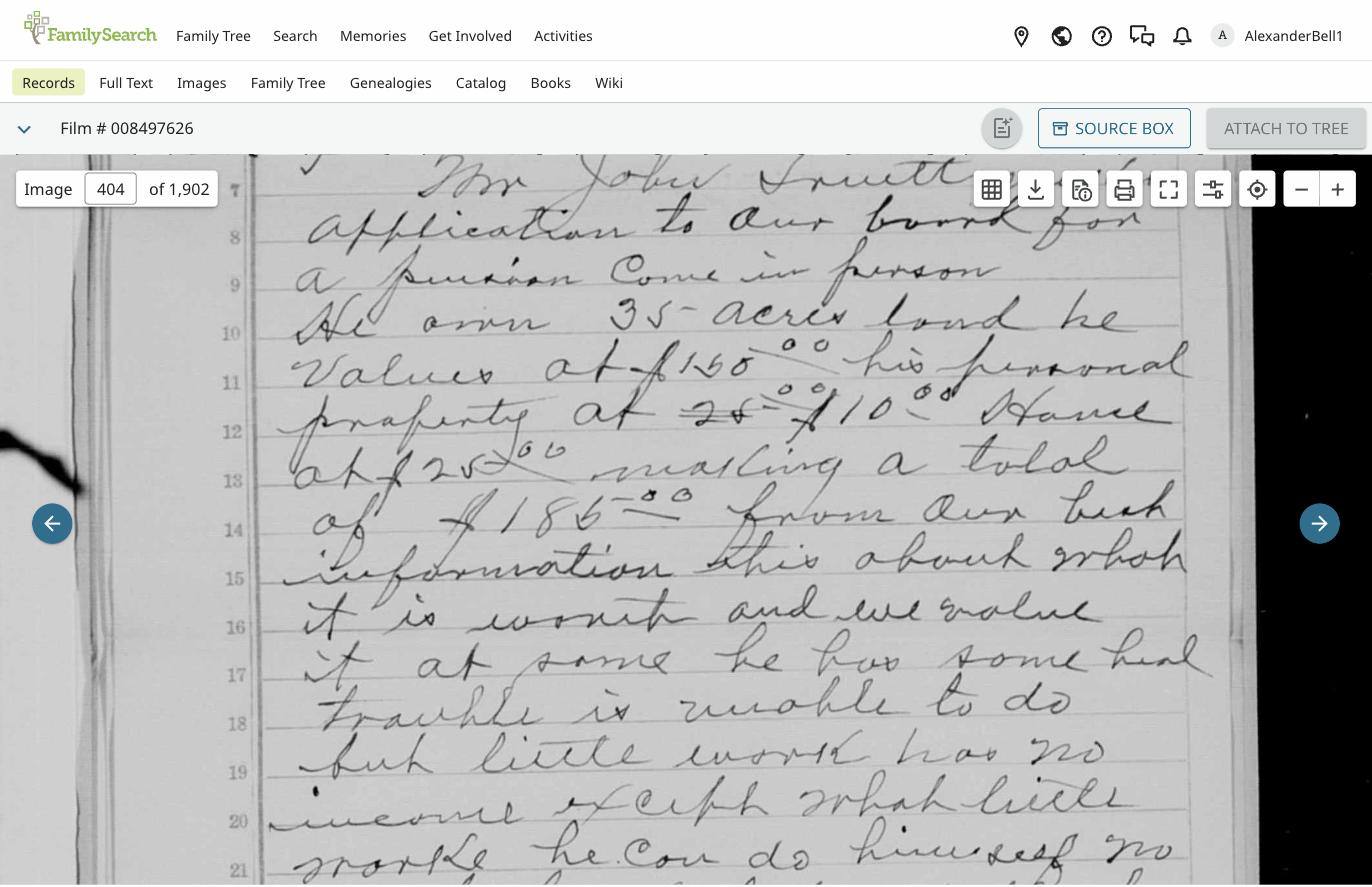
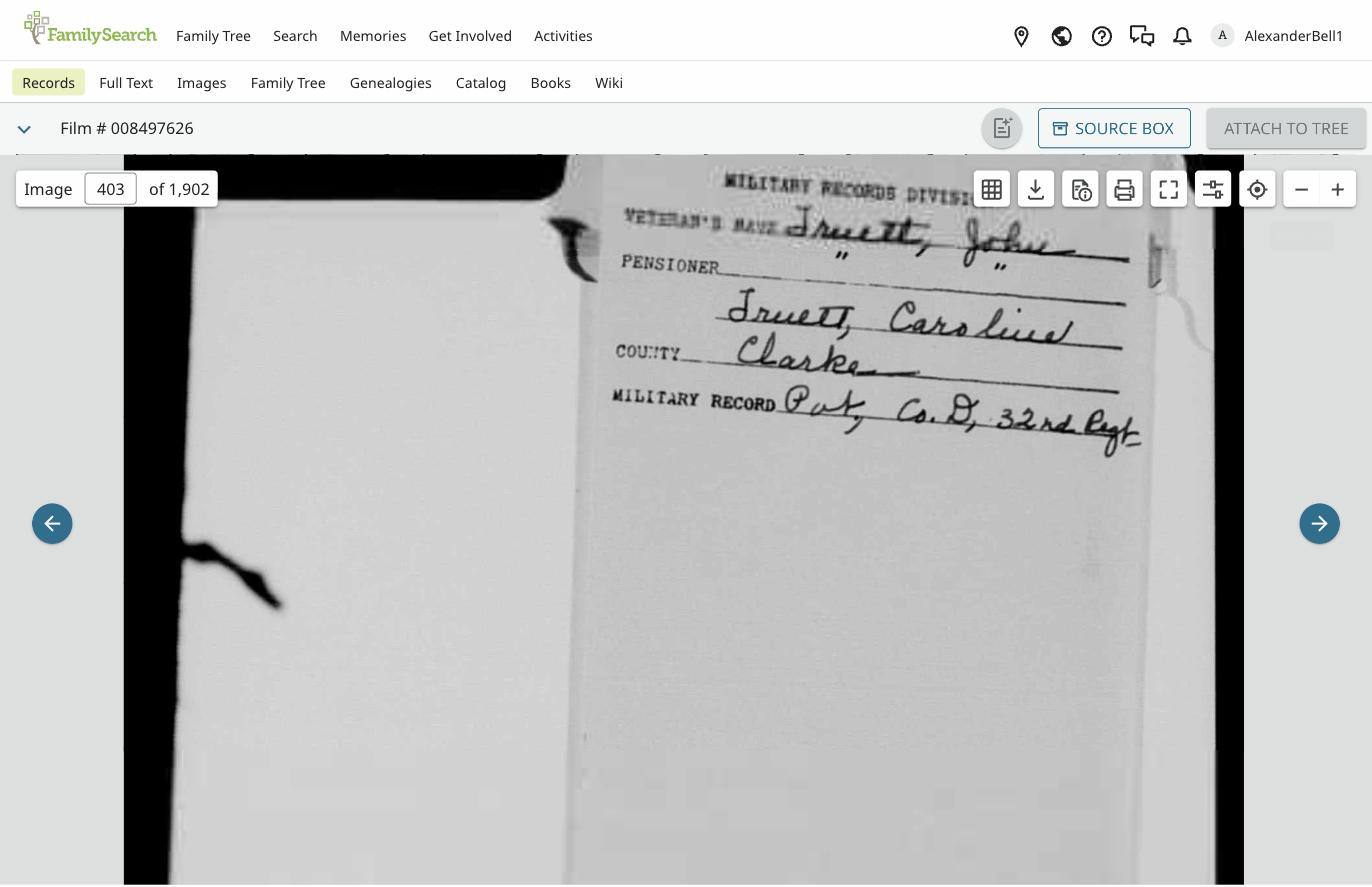
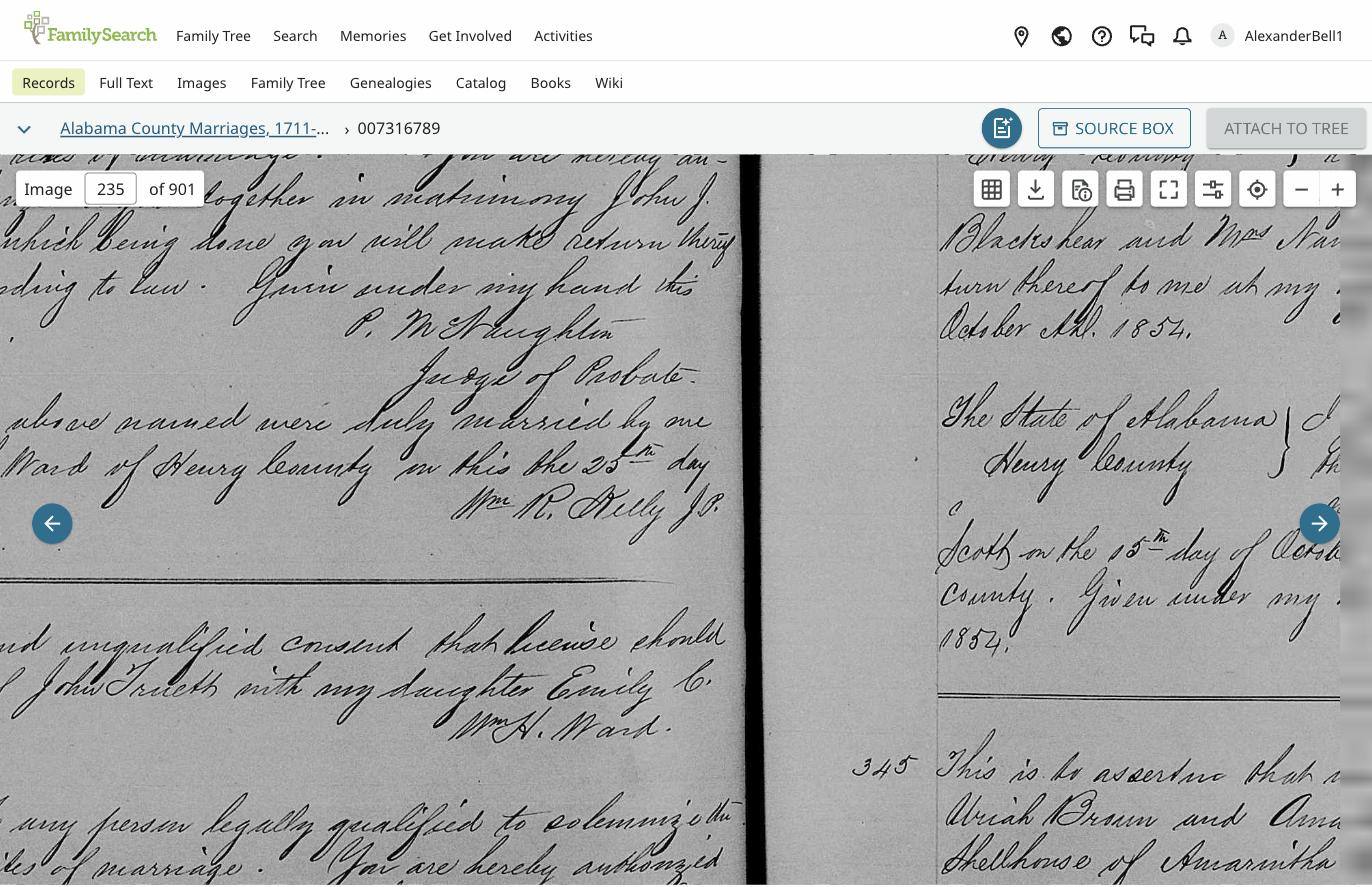
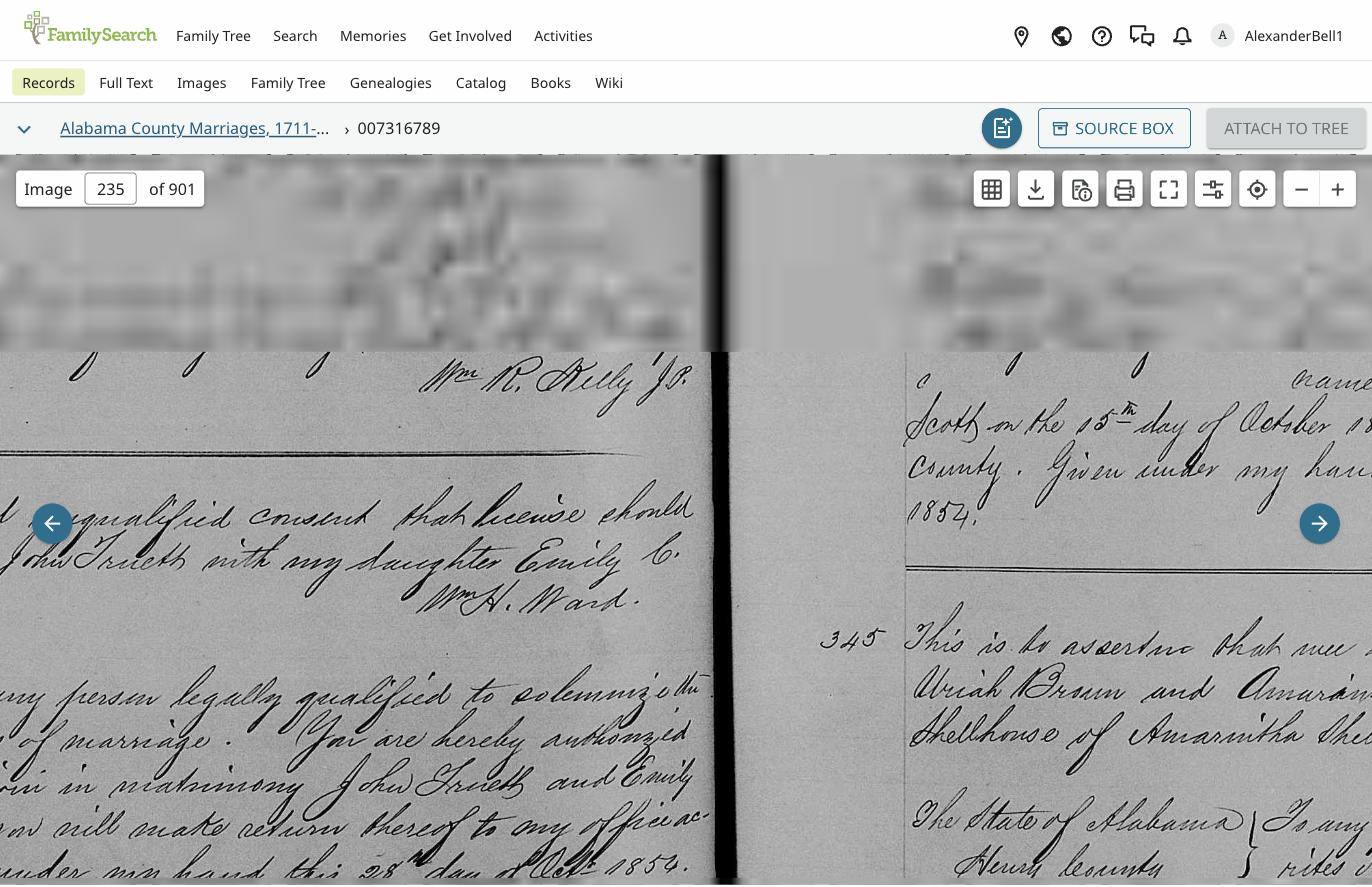
Signed voucher from John Truett's Confederate service file — A wartime pay voucher bearing John Wesley Truett's name from a Confederate hospital in Georgia in 1863, though the tidy handwriting turned out to be a clerk's, not his own.Confederate service record jacket, John Wesley Truett — The folder holding John Wesley Truett's whole surviving Confederate service record, the paper trail of a war spent mostly too sick to fight.Muster roll showing John Truett's enlistment at Coffeeville — The muster roll recording John Wesley Truett's enlistment at Coffeeville, Alabama, the same small town where his family lived for generations.Hospital record: John Truett's chronic rheumatism, 1862 — A Confederate hospital register showing John Wesley Truett was admitted with chronic rheumatism just weeks after he enlisted in 1862.Signed receipt, Dalton, Georgia, 1863 — A receipt bearing John Wesley Truett's name for a month's furlough pay in 1863, though it was later realized a clerk likely wrote it for him.Voucher docket for John Truett, 1863 — The docket recording the same 1863 furlough payment made to John Wesley Truett while he recovered in Georgia.Clothing receipt roll, Dalton hospital, signed by his mark — A clothing roll from the Dalton hospital where John Wesley Truett was recovering, signed with his own mark rather than a written name.Muster roll: sent to hospital at Tullahoma, 1863 — A muster roll from the summer of 1863 still marking John Wesley Truett absent, sent away to a hospital in Tullahoma, Tennessee.Muster roll: absent sick at Tullahoma, 1863 — An earlier 1863 muster roll listing John Wesley Truett absent sick at the hospital in Tullahoma, Tennessee.Pension schedule of property, Clarke County, 1909 — John Wesley Truett's 1909 pension application, in which he listed everything he owned in his old age in Clarke County, Alabama.Pension board letter describing John Truett's poverty — A letter from the county pension board describing John Wesley Truett's poverty in his final years, with only thirty-five acres and no one to support him.Alabama pension file jacket for John and Caroline Truett — The outer folder of the Alabama pension file shared by John Wesley Truett and his widow Caroline, gathering both their claims together.William H. Ward's consent to his daughter's marriage — William H. Ward's own written consent for his daughter Emily's marriage in 1854, the clearest proof yet of who her father was.Marriage license, John Truett and Emily C. Ward, 1854 — The marriage license for John Wesley Truett and Emily Caroline Ward, issued in Henry County, Alabama, the same day her father gave his consent.
Emily Caroline Ward (1836 Henry AL – 1922 Levy FL)
Ahnentafel #89 · his father’s mother’s mother’s father’s father’s mother (6 generations back) · Documented — person and parent-link established
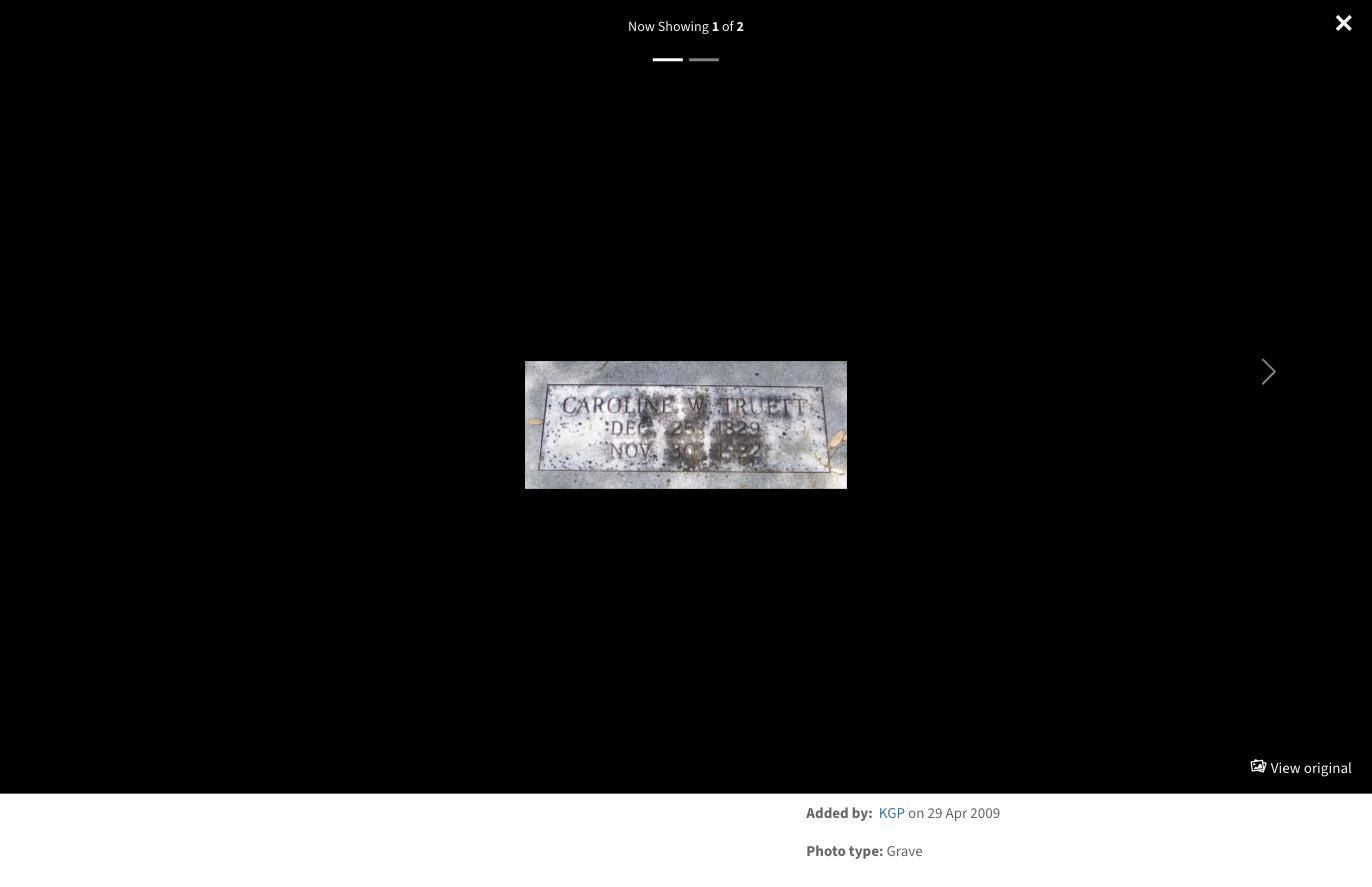
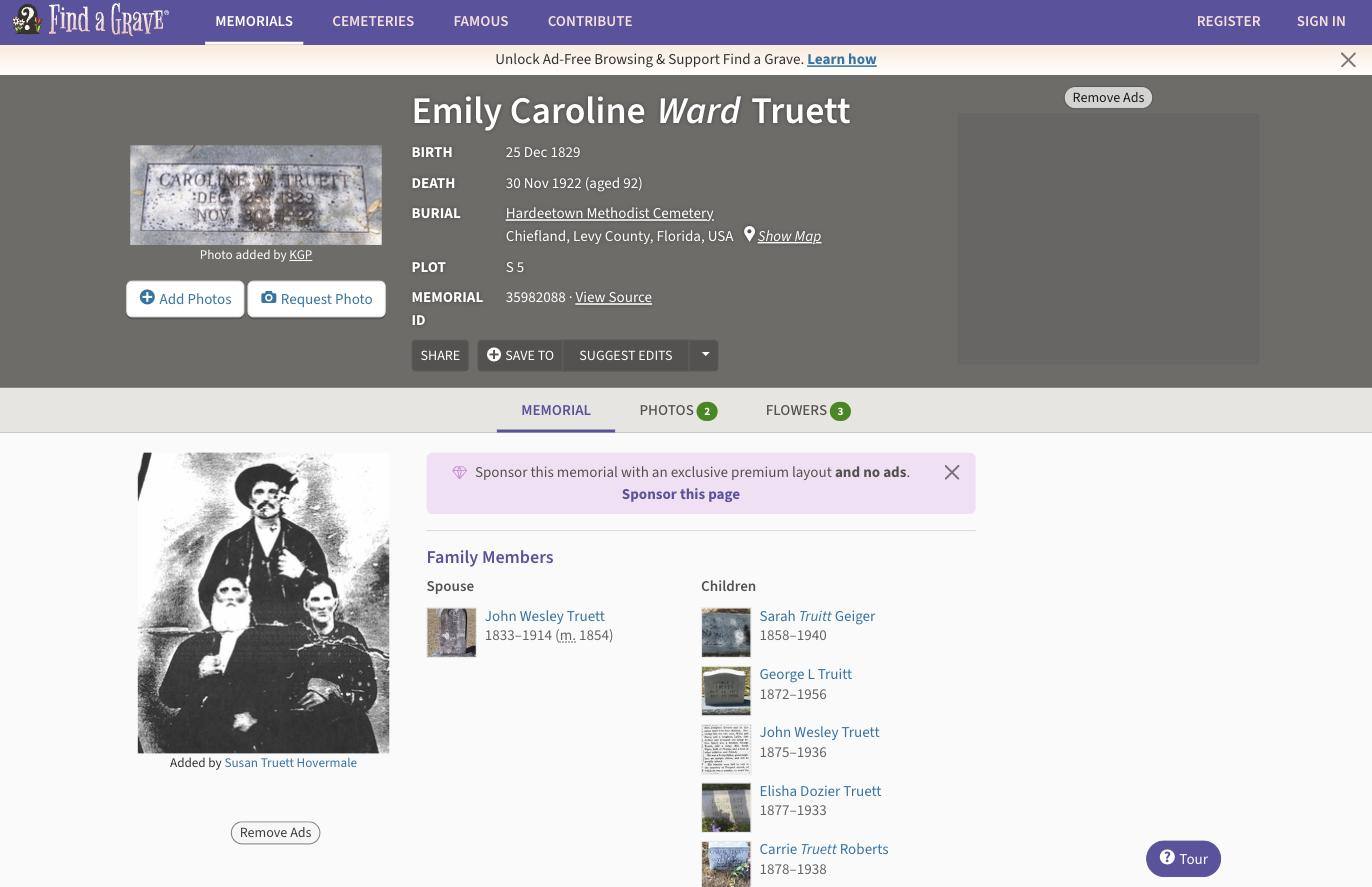
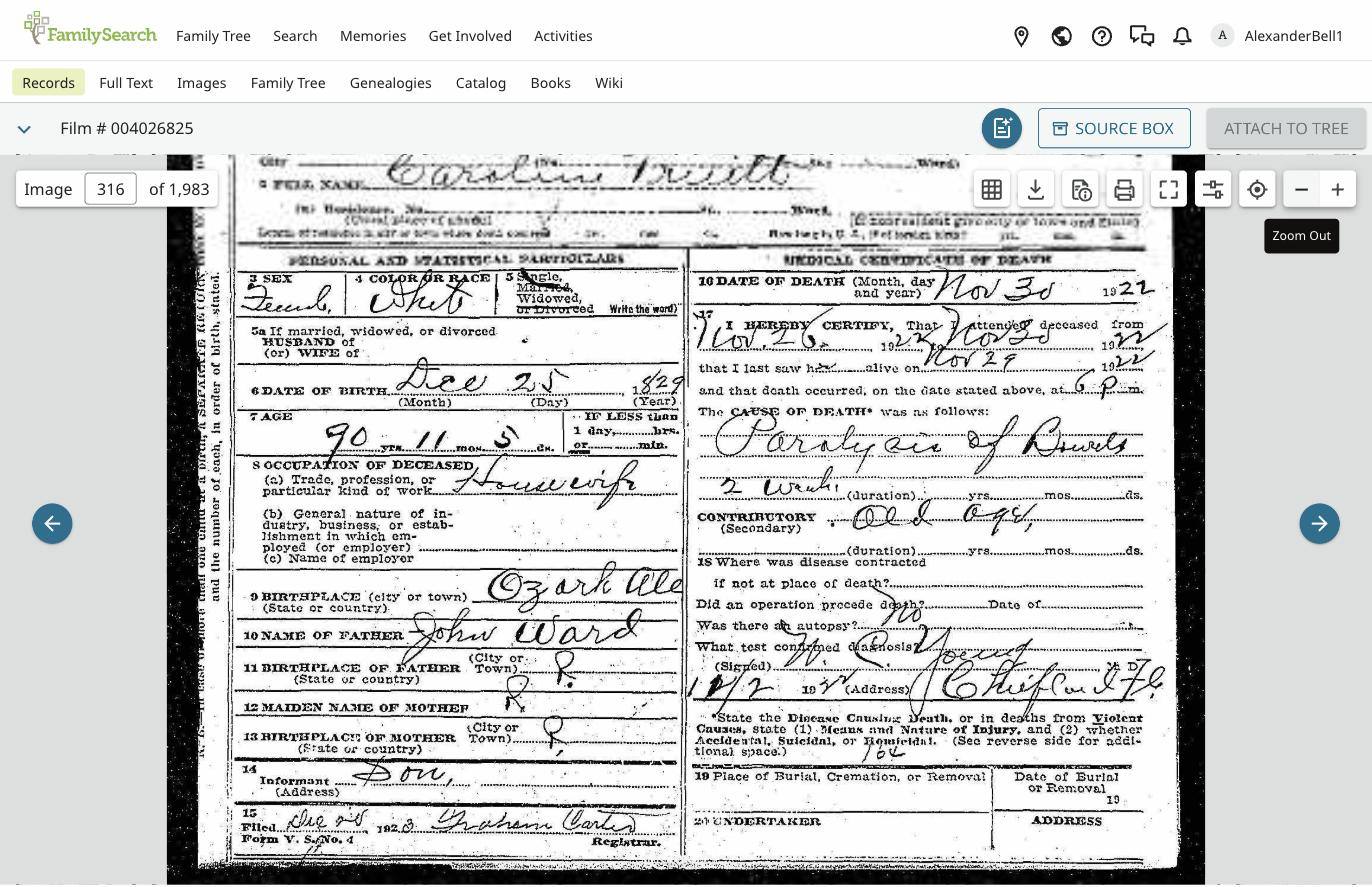
Emily Caroline Ward was born on 25 December 1836 in Henry County, Alabama, and died on 30 November 1922 in Levy County, Florida. She married John Wesley Truett on 2 November 1854 in Henry County, with her father's written consent, and was later named as an heir in her father's estate. In 1917, at the age of 80, she moved with the family to Hardeetown in Levy County, Florida, where she died at Chiefland and was buried in Hardeetown Methodist Cemetery. A photograph of her survives, captioned with her husband's and son's names.
Evidence
Full dates: 25 Dec 1836, Henry Co., Alabama – 30 Nov 1922, Levy Co., Florida
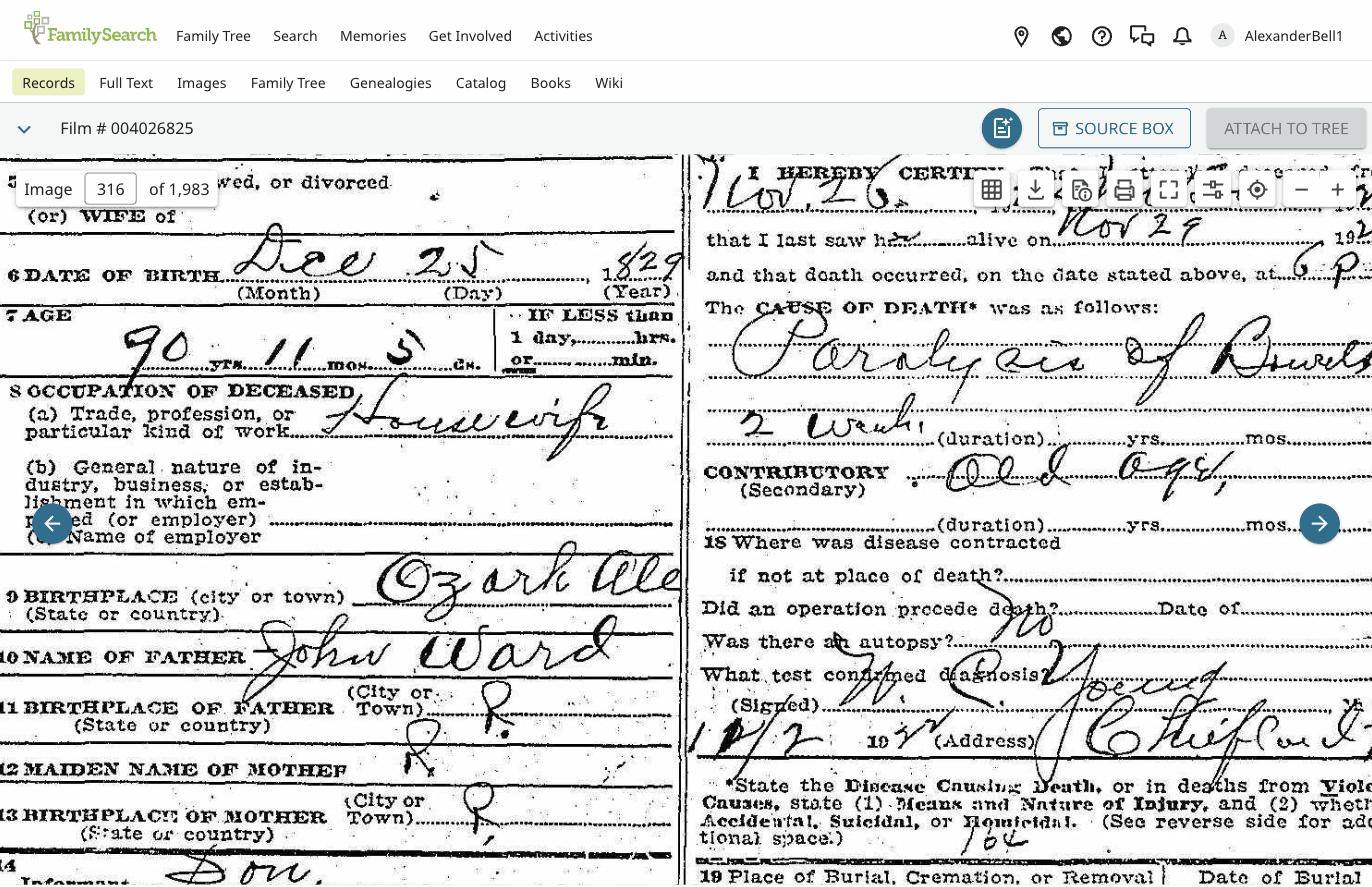
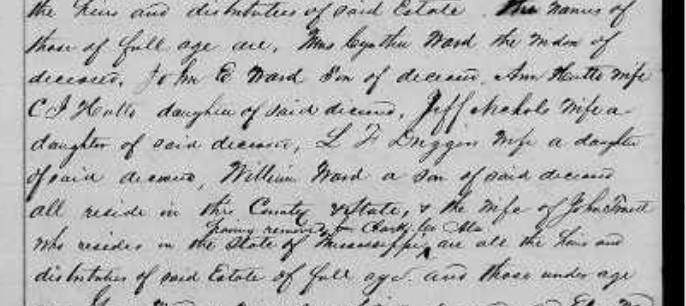
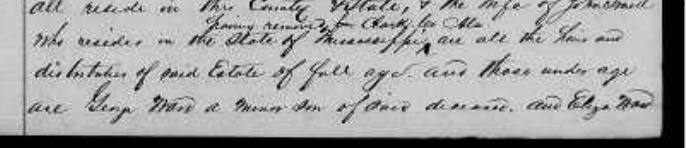
m. John Wesley Truett 2 Nov 1854, Henry Co., with her father’s written consent. ⭐ Named as an heir of her father’s estate, 6 Aug 2026 — Abijah Wiggins’s deposition of 11 Nov 1870 lists among the heirs of full age “the wife of JOHN TRUETT” [TRUETT-22], and the 1870 petition names her siblings outright [TRUETT-23]. Moved to Hardeetown, Levy County, Florida in 1917, aged 80. Died at Chiefland; buried Hardeetown Methodist Cemetery. Her photograph survives, captioned “John W, Caroline, and son George.”
Outstanding: The Florida death certificate would name her parents in her own family’s words.
Photographs (described)
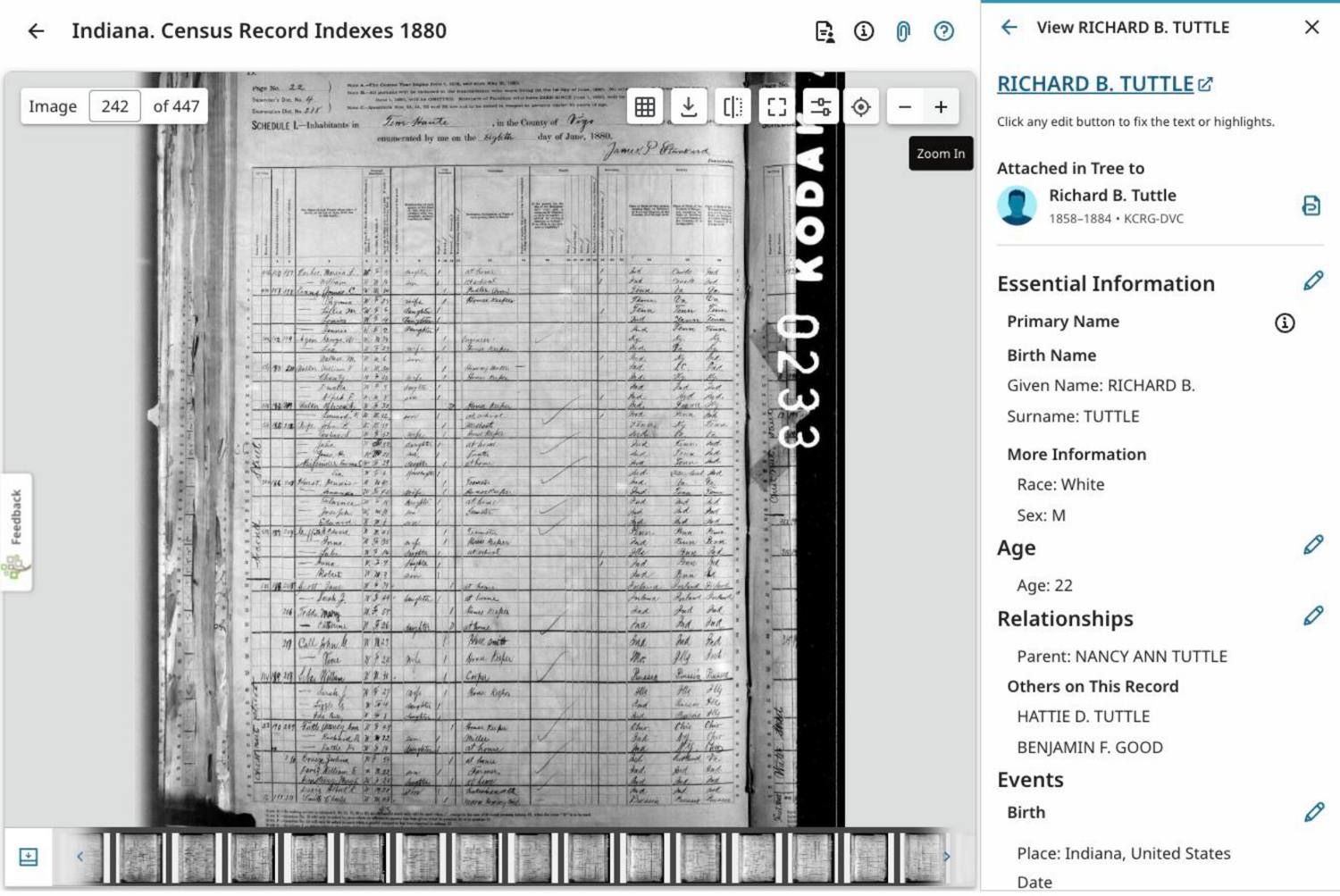
Studio portrait of John Wesley and Emily Caroline TruettGravestone of Caroline W. Truett, Hardeetown CemeteryFind a Grave memorial for Emily Caroline Ward Truett
Evidence images (described)
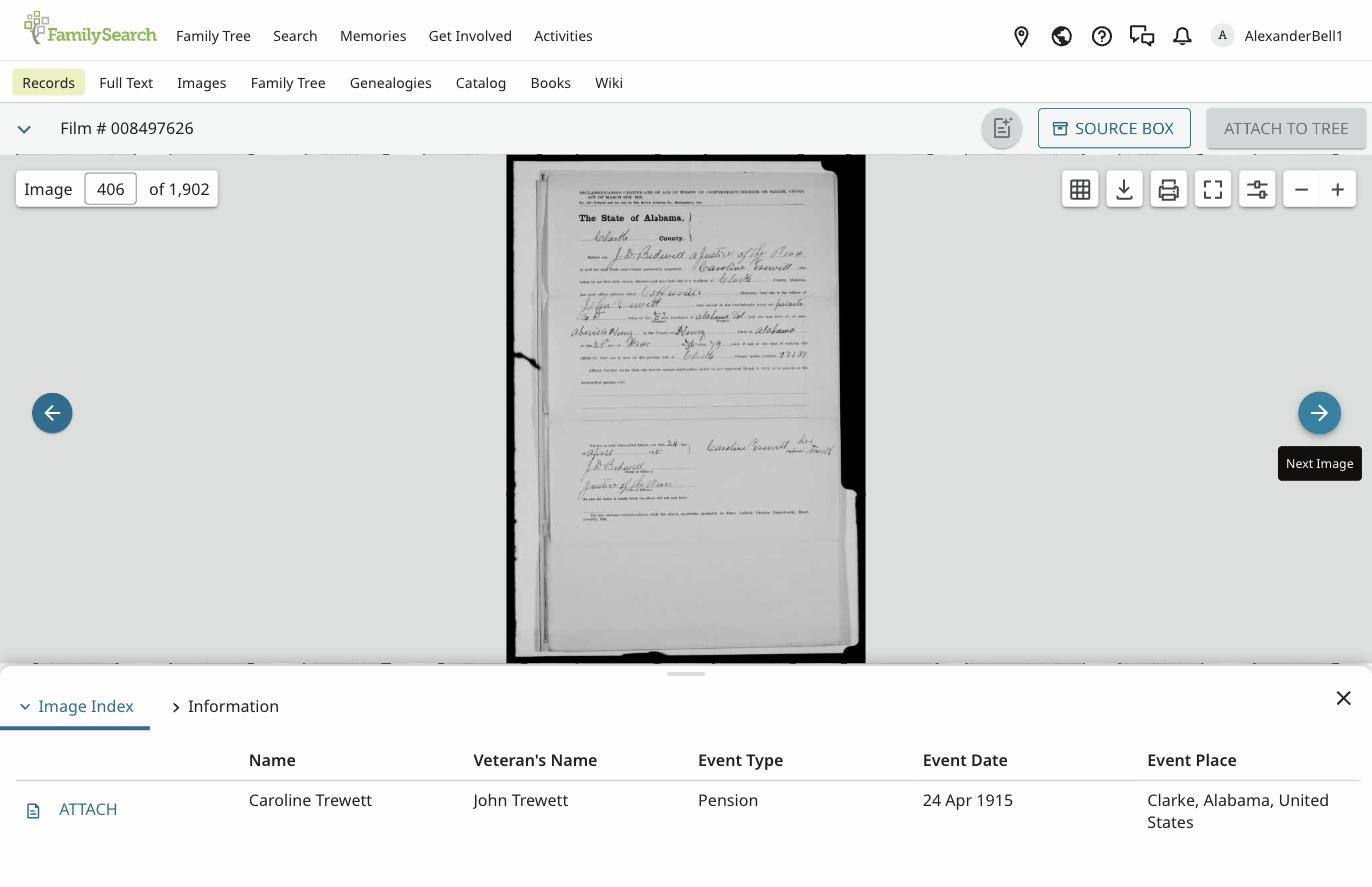
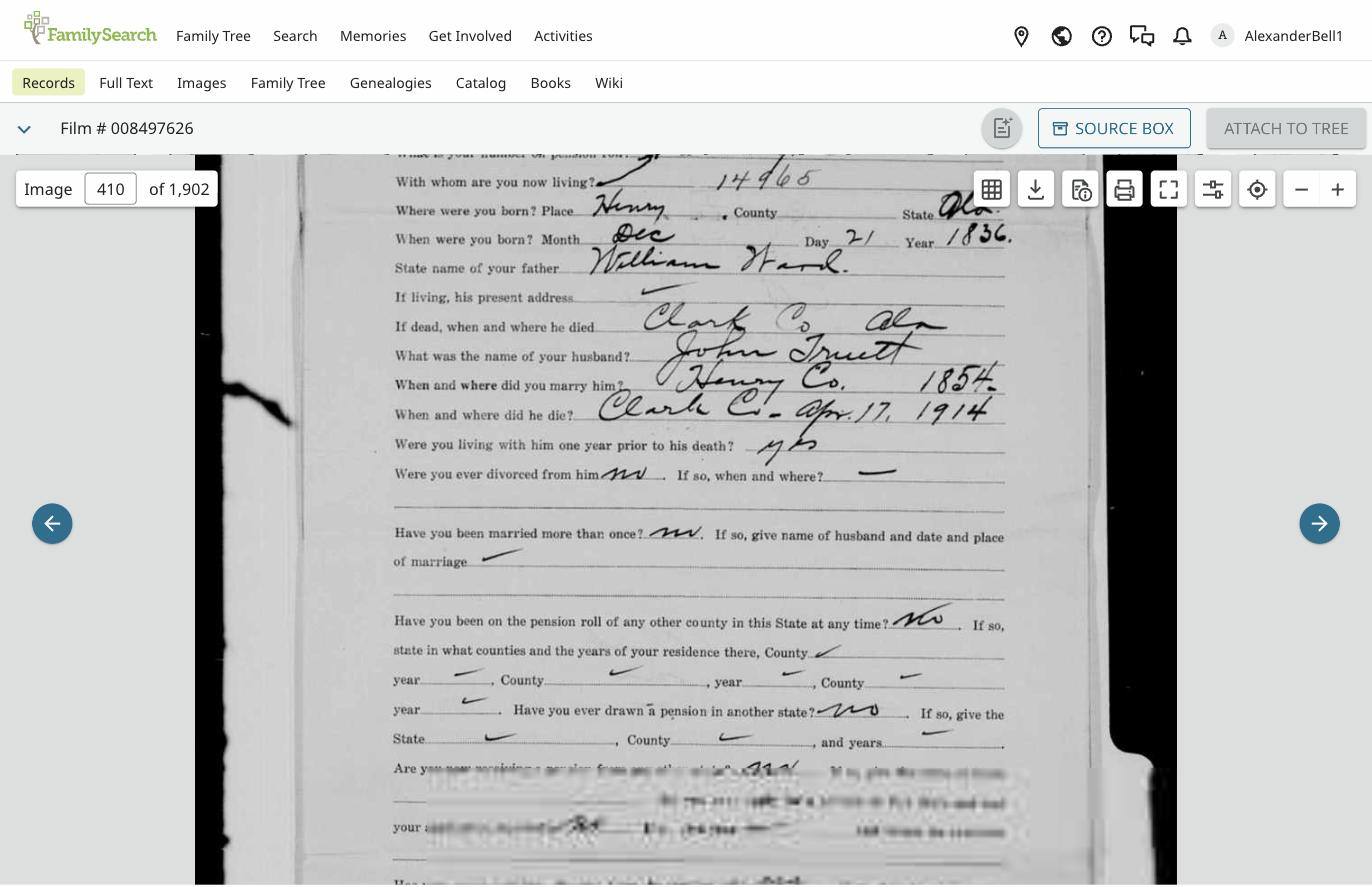
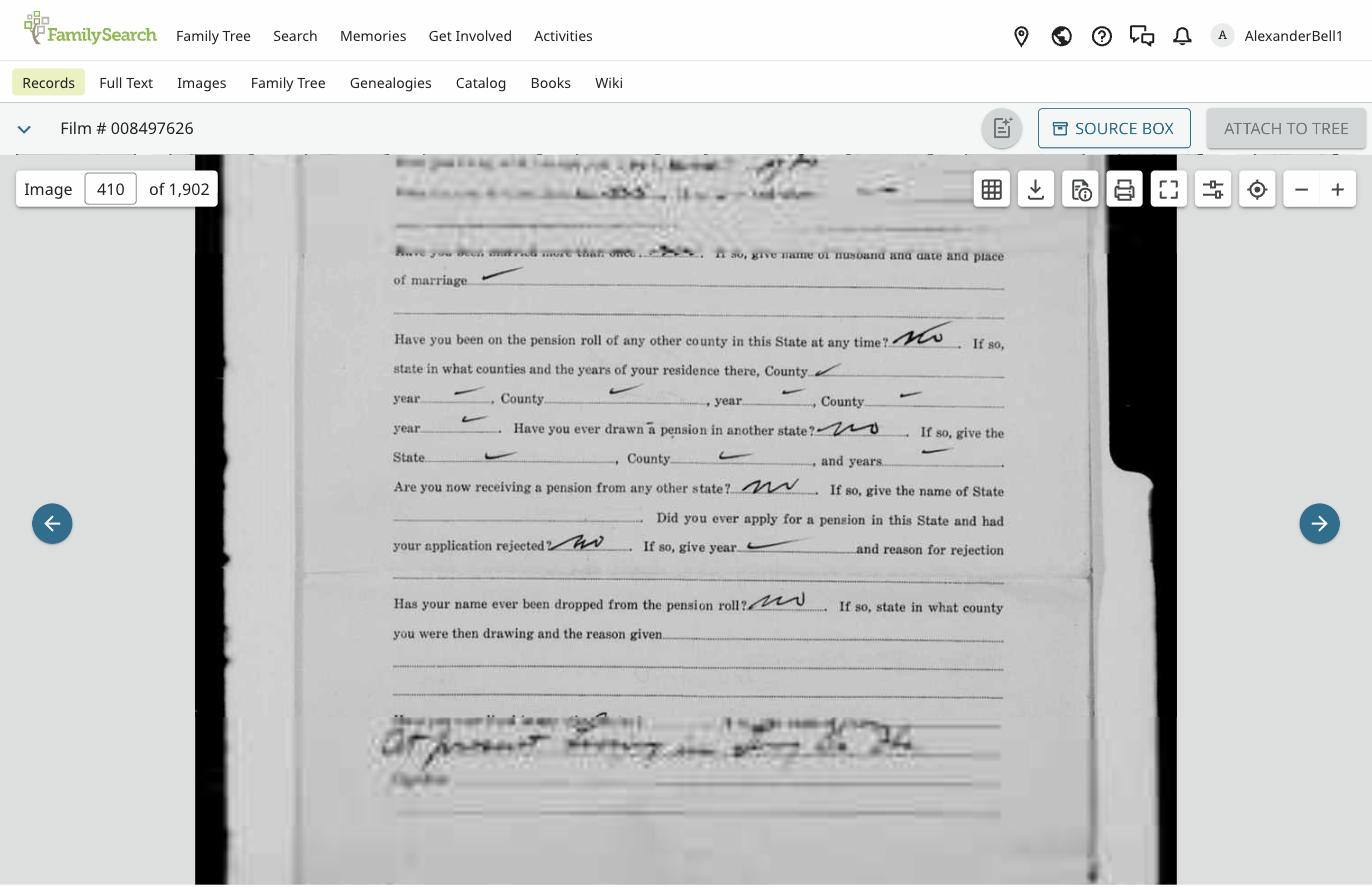
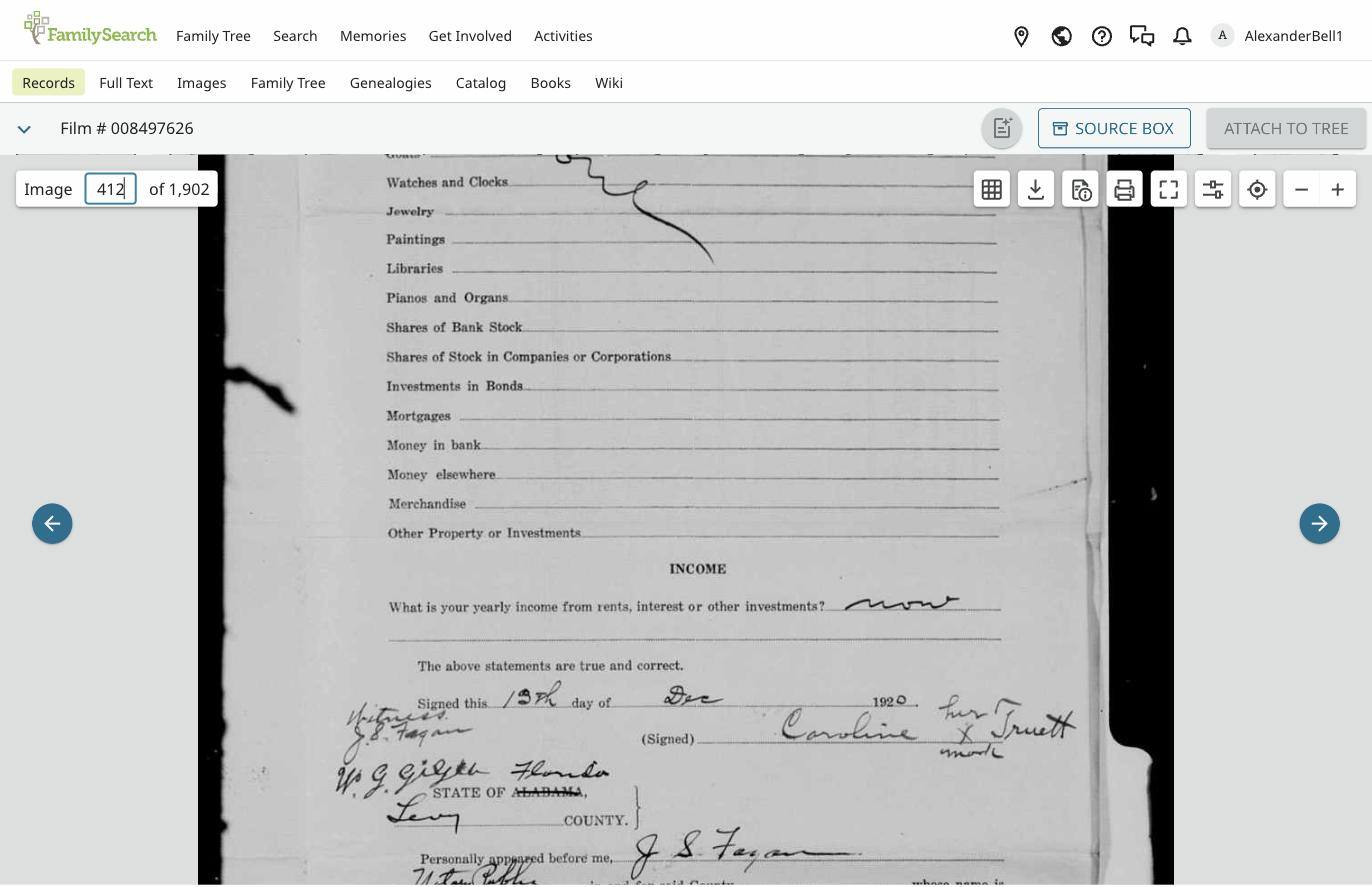
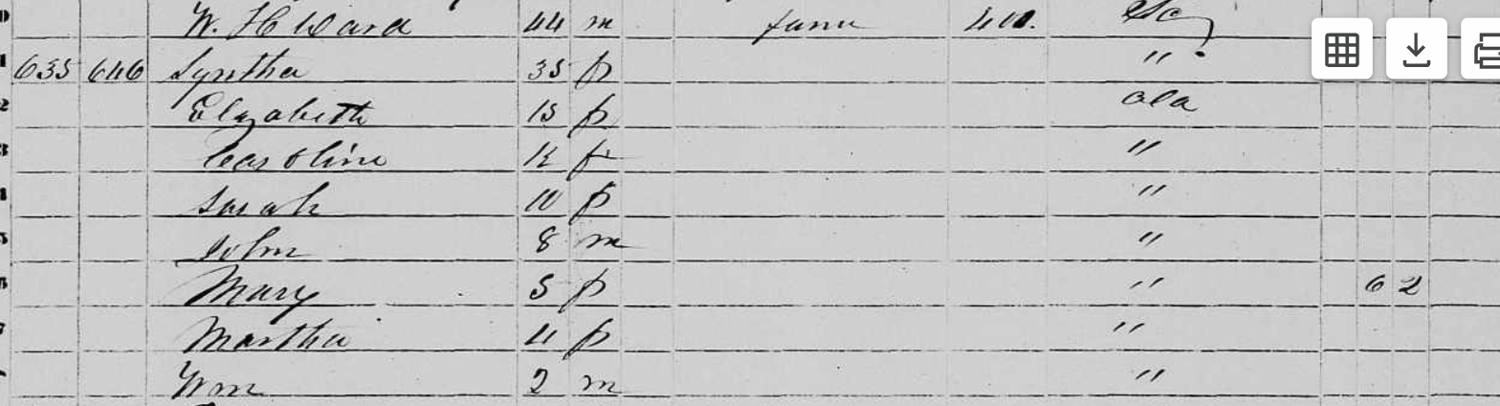
Widow's pension reclassification certificate, 1915 — A 1915 certificate reclassifying Caroline Truett as a Confederate widow, the year after her husband John's death.Widow's affidavit detail: her birth, 25 Dec 1836 — Caroline Truett's own sworn statement about her husband's Confederate service, which also records her own birth as Christmas Day 1836.Alabama pension file jacket for John and Caroline Truett — The outer folder of the Alabama pension file shared by John Wesley Truett and his widow Caroline, gathering both their claims together.Widow's pension blank naming her father, William Ward — Caroline Truett's 1920 pension form naming her own father, William Ward, and the year she married John in Henry County, Alabama.Widow's pension blank, now living in Levy County, Florida — The same 1920 pension form, showing that by then Caroline Truett had moved far from Alabama, to Levy County, Florida.Widow's account of her husband's Confederate service — Caroline Truett's own account of her husband's Confederate service, recalled from memory nearly six decades after the war.Caroline Truett's signed X mark, December 1920 — Caroline Truett's own signature, an X she made in December 1920 in Levy County, Florida, at the bottom of her pension papers.William H. Ward's consent to his daughter's marriage — William H. Ward's own written consent for his daughter Emily's marriage in 1854, the clearest proof yet of who her father was.Marriage license, John Truett and Emily C. Ward, 1854 — The marriage license for John Wesley Truett and Emily Caroline Ward, issued in Henry County, Alabama, the same day her father gave his consent.Florida death certificate, Caroline Truitt, 1922 — The Florida death certificate for Caroline Truett, who died in 1922 in Chiefland, closing out a long life that began in Alabama.Death certificate detail, parentage as the informant recalled it — A close-up of Caroline Truett's death certificate, where her grieving son, the informant, got his grandfather's name wrong and left his grandmother blank.1850 census, Henry County — the William H. Ward household — The 1850 census finally located William H. Ward's household in Henry County, Alabama, with his wife Syntha and young daughter Caroline.Estate deposition naming William H. Ward's heirs — An 1870 court deposition naming William H. Ward's heirs, including the daughter who by then was the wife of John Truett.Estate deposition: Caroline's move and the minor heirs — The same 1870 estate record notes that William H. Ward's widow had moved to Clarke County, Alabama, with two still-underage children.
Clark Strong Tuttle (1811 Jefferson Co. NY – 1876/80)
Ahnentafel #96 · his mother’s father’s father’s father’s father’s father (6 generations back) · Documented — person and parent-link established
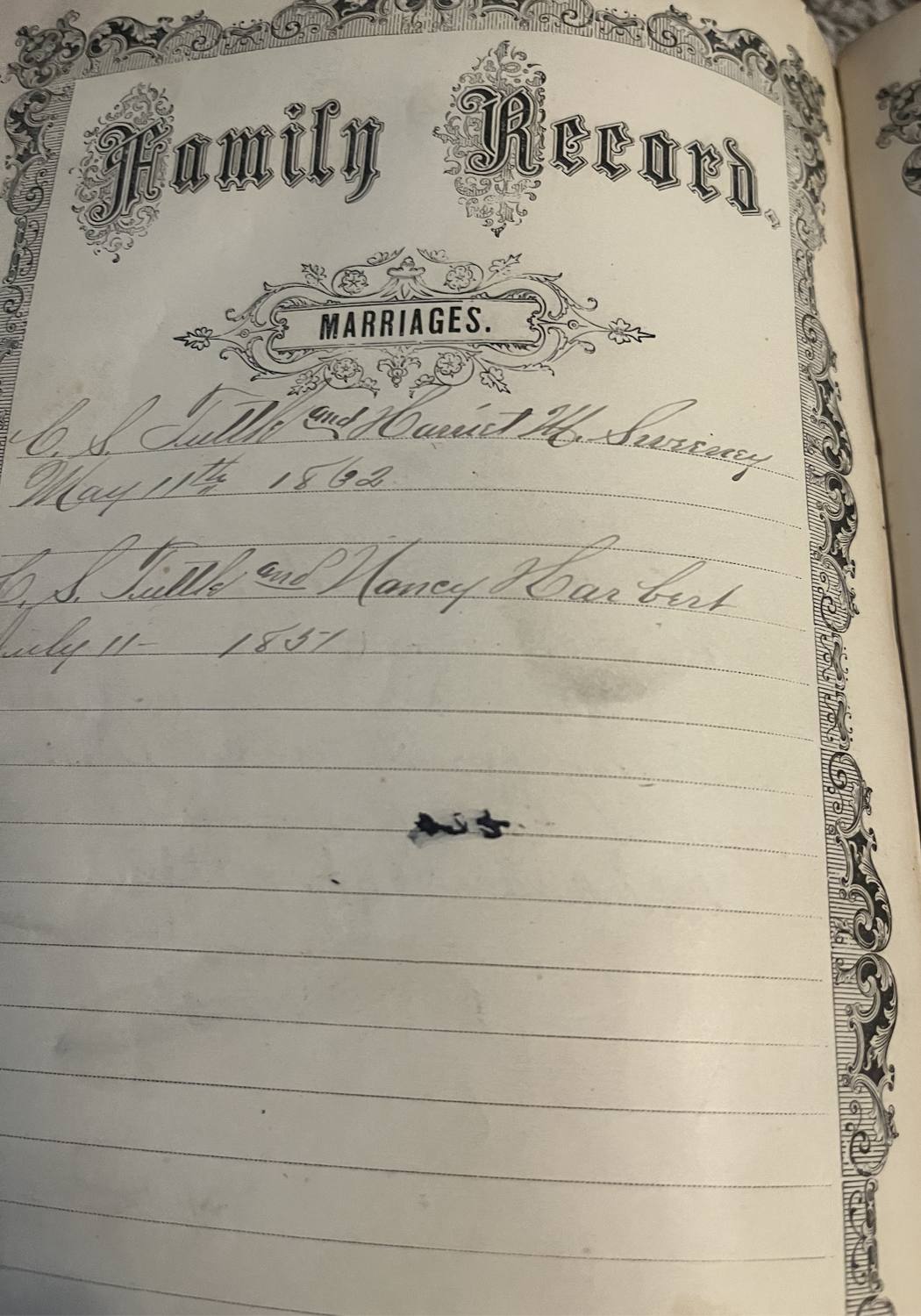
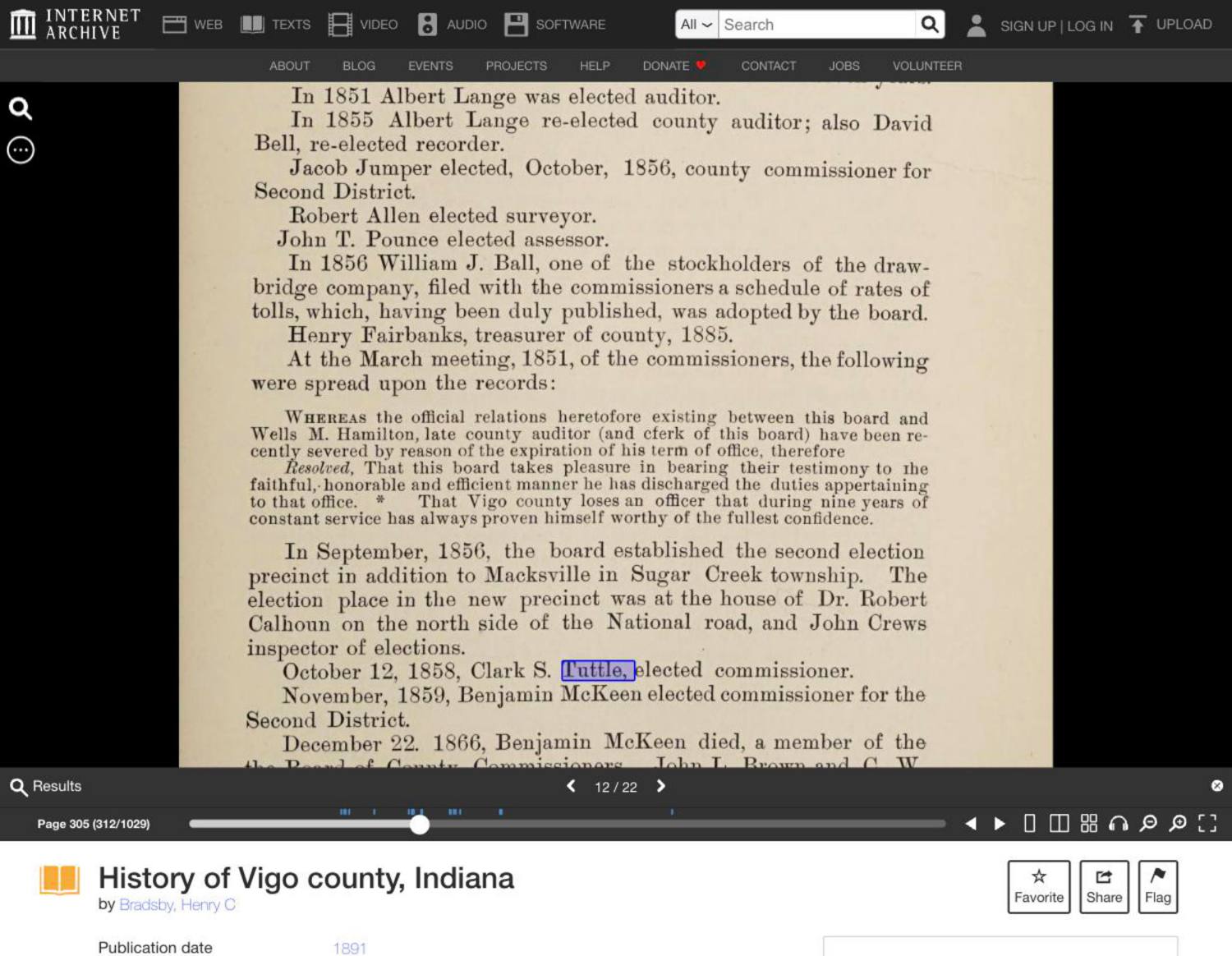
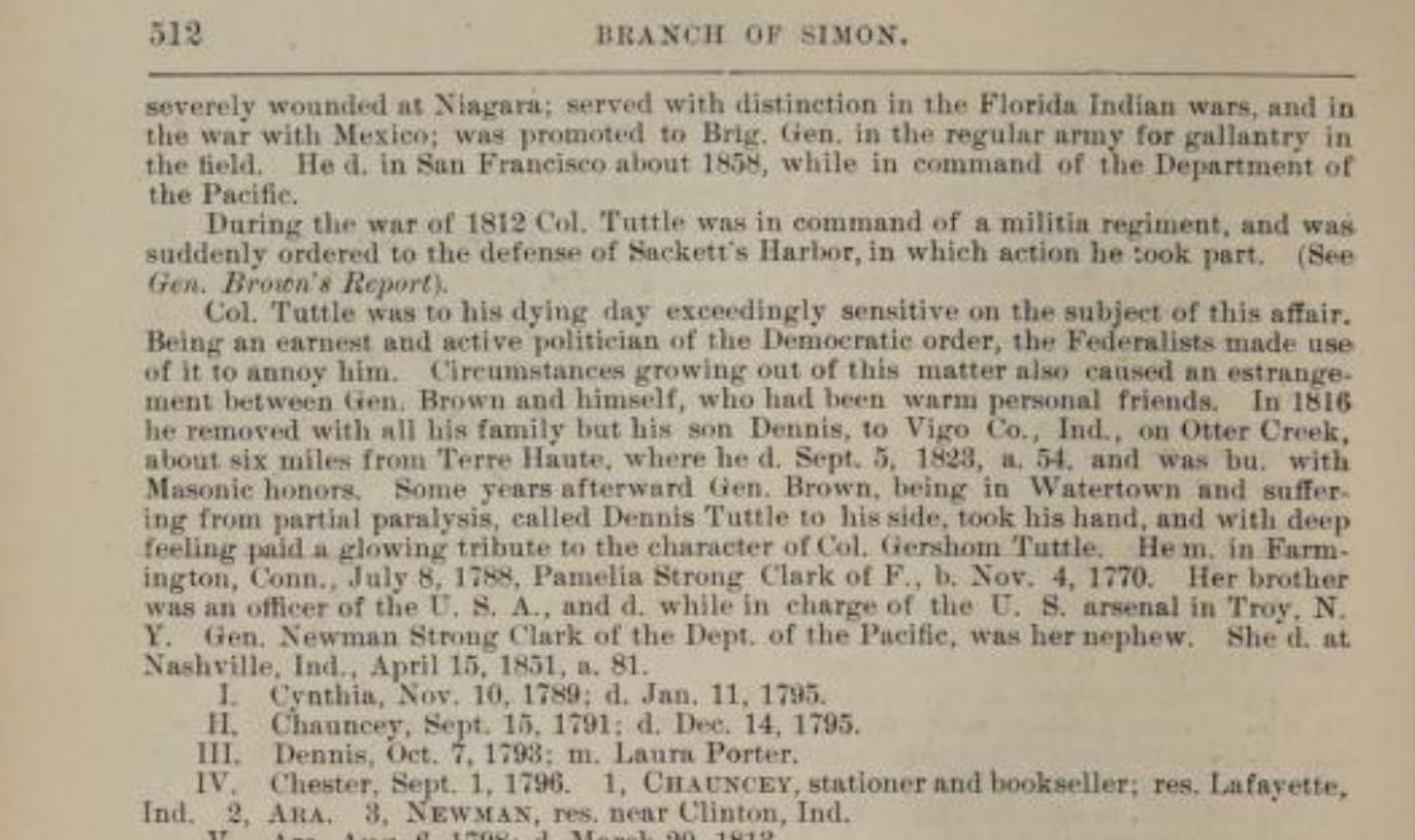
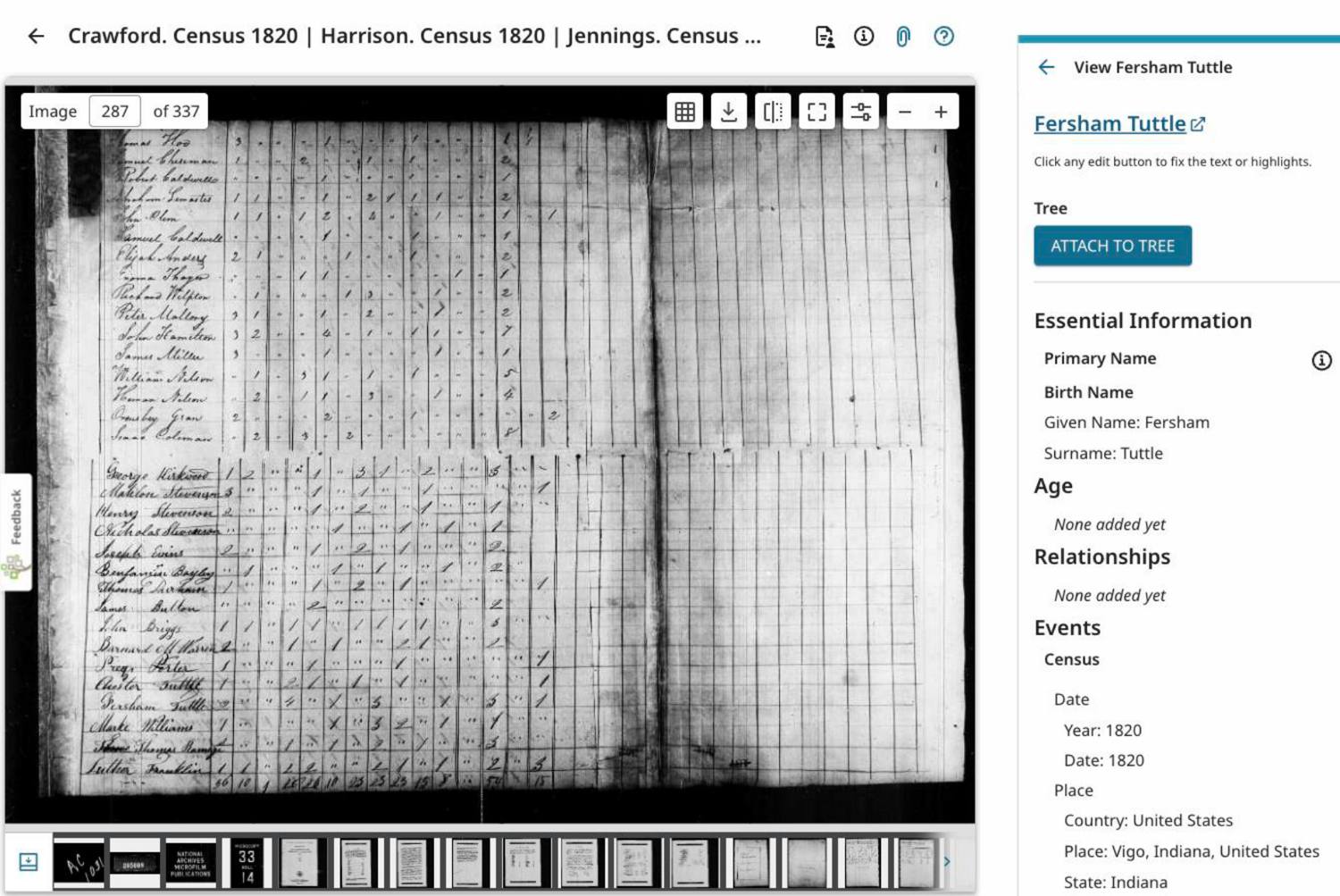
Clark Strong Tuttle was born in April 1811 in Jefferson County, New York, and died in Vigo County, Indiana, between June 1876 and May 1880. He was a prosperous miller at Otter Creek Township — Tuttle’s Mills was the town of Ellsworth, and he was its postmaster — a county commissioner from 1858, worth $14,000 in land by 1860. Orphaned of his father at twelve, he was counted at nineteen in the household of his sister’s husband Henry Markle, married Harriet M. Sweany two weeks after coming of age in 1832, and named his first recorded son Gersham and a later son Chester. Four of his and Harriet’s children died young and lie at Otter Creek Union Cemetery; Harriet died in June 1851 and he married Nancy A. Herbert that July.
Evidence
Full dates: b. 27/28 Apr 1811 Jefferson Co. NY – between Jun 1876 and May 1880
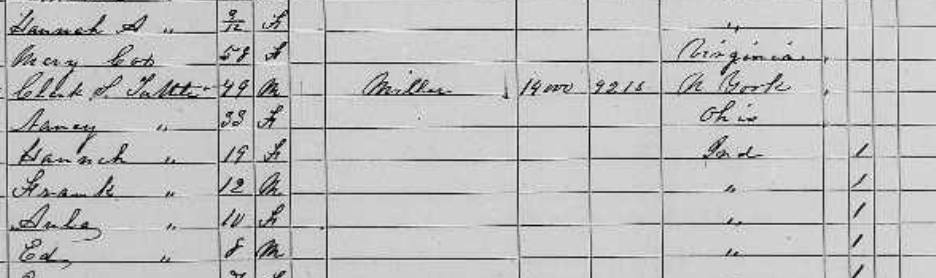
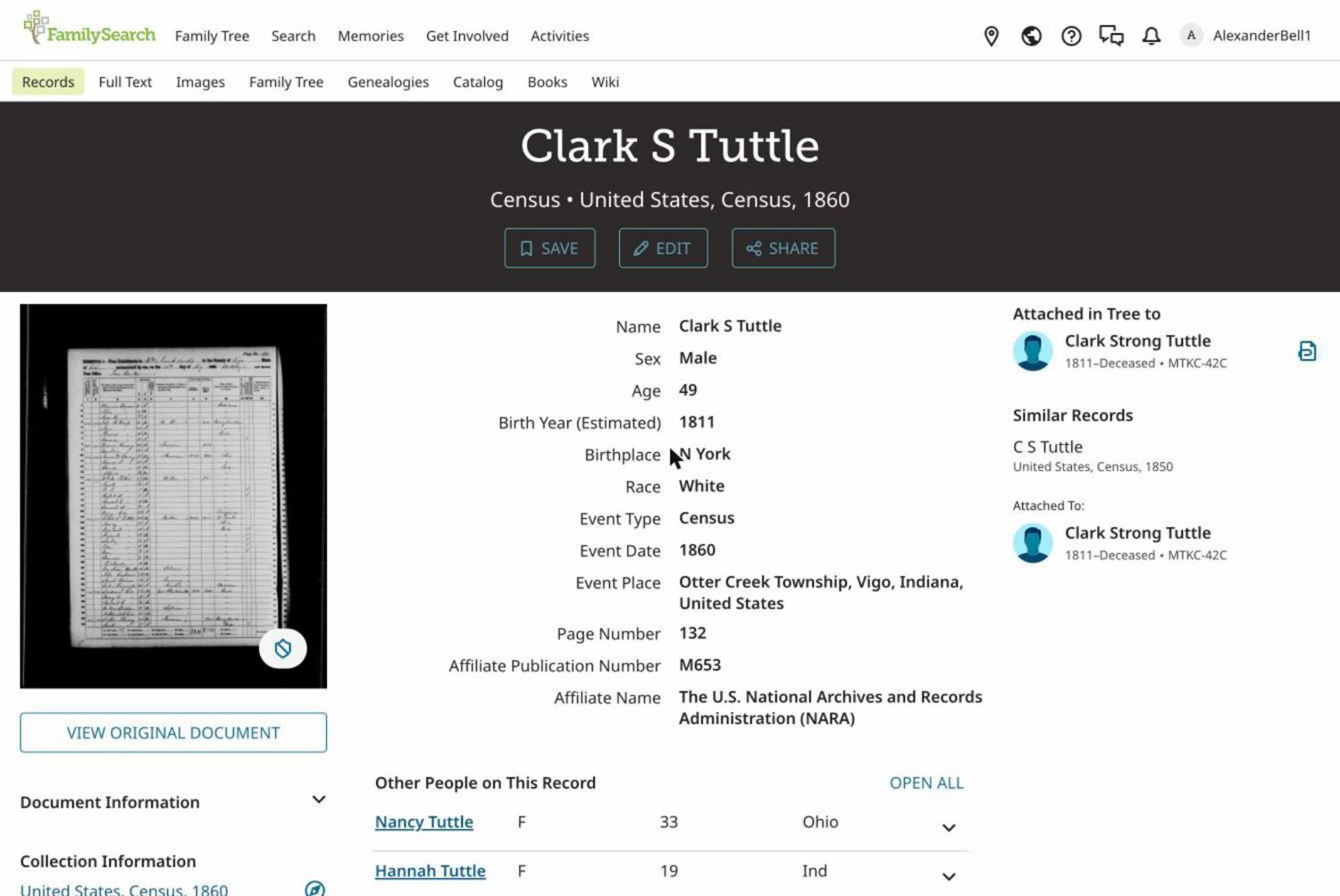
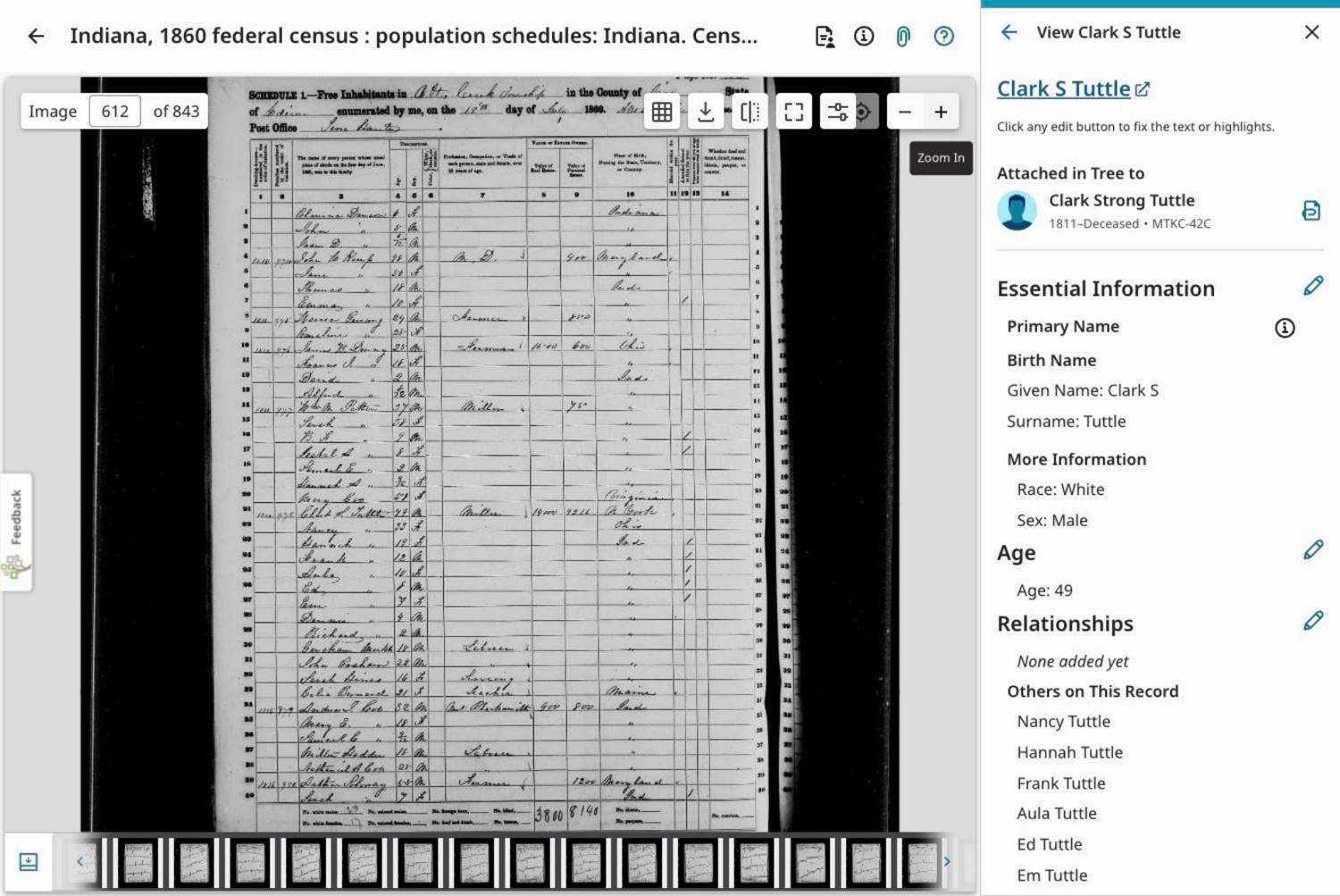
A MILLER, and a well-off one — read from two census images 6 Aug 2026. Otter Creek Township, Vigo County: 1850, miller, $9,500 real estate; 1860, miller, $14,000 real estate and $9,215 personal, with three hired hands and a servant living in and every school-age child at school [TUTTLE-13, TUTTLE-14]. Vigo County commissioner from October 1858; postmaster at Ellsworth — the post office at his own Tuttle’s Mills [TUTTLE-113]. In 1830, aged 19, he appears as one of two males 15–19 tallied in the household of Henry Markle — his sister Amanda’s husband, and his brother Asa’s court-appointed guardian; no Tuttle headed a Vigo household that year [TUTTLE-129].
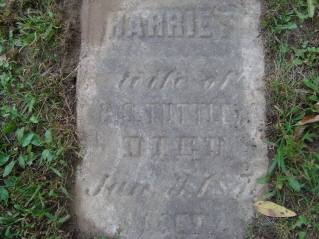
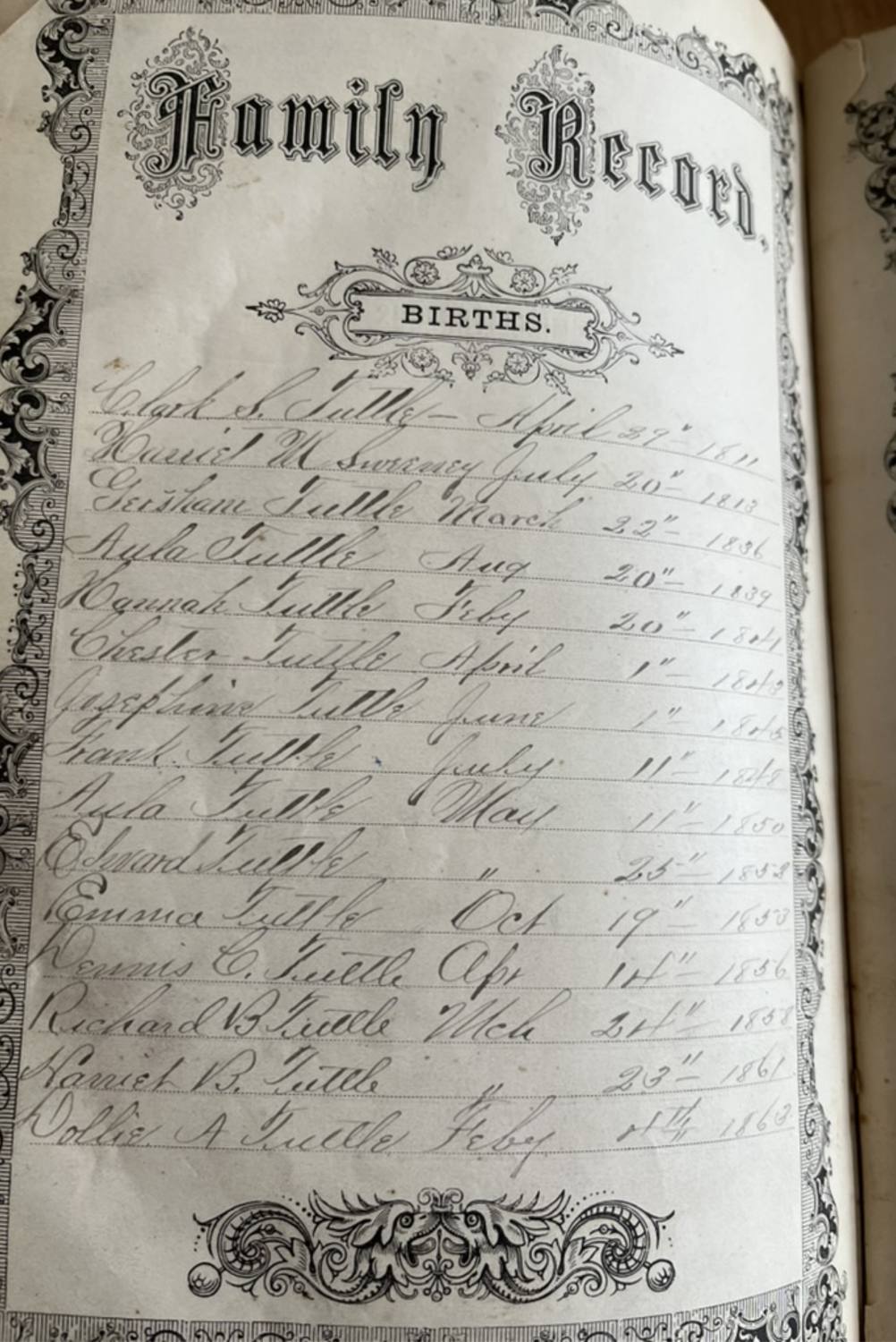
⚠⚠ HE MARRIED TWICE: Harriet M. Sweany (b. 20 Jul 1813, New Jersey — the family Bible) on 11 May 1832, about two weeks after his own majority [TUTTLE-123]; and, after Harriet died (3 Jun 1851, aged 37 — the 1979 cemetery transcription; five weeks before he remarried), Nancy A. Herbert/Harbert on 10 Jul 1851 [TUTTLE-67]. The Bible’s “1862” marriage year is a scribal slip — there was no third marriage [TUTTLE-124 §④].
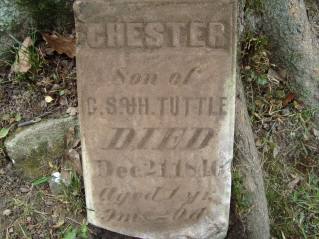
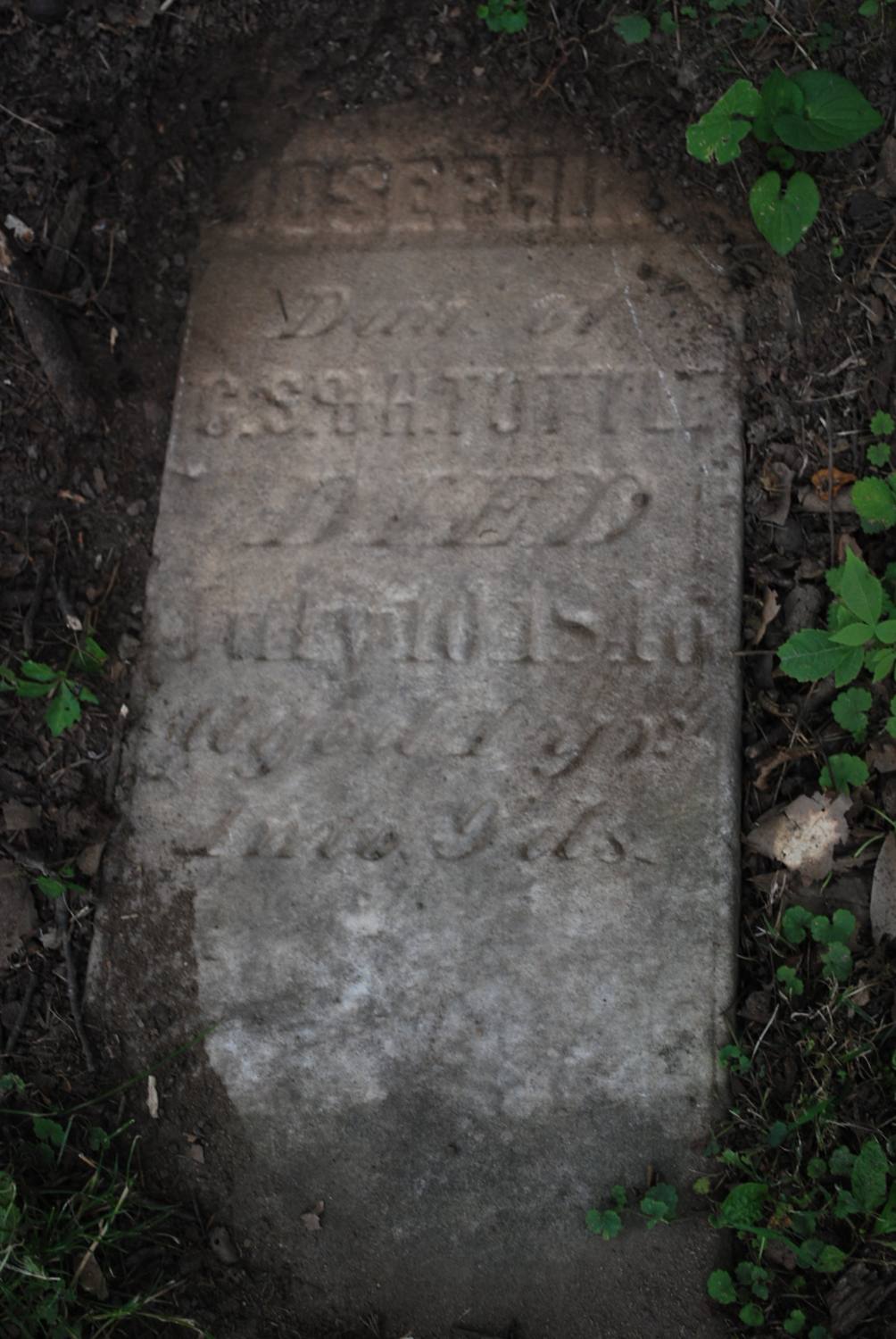
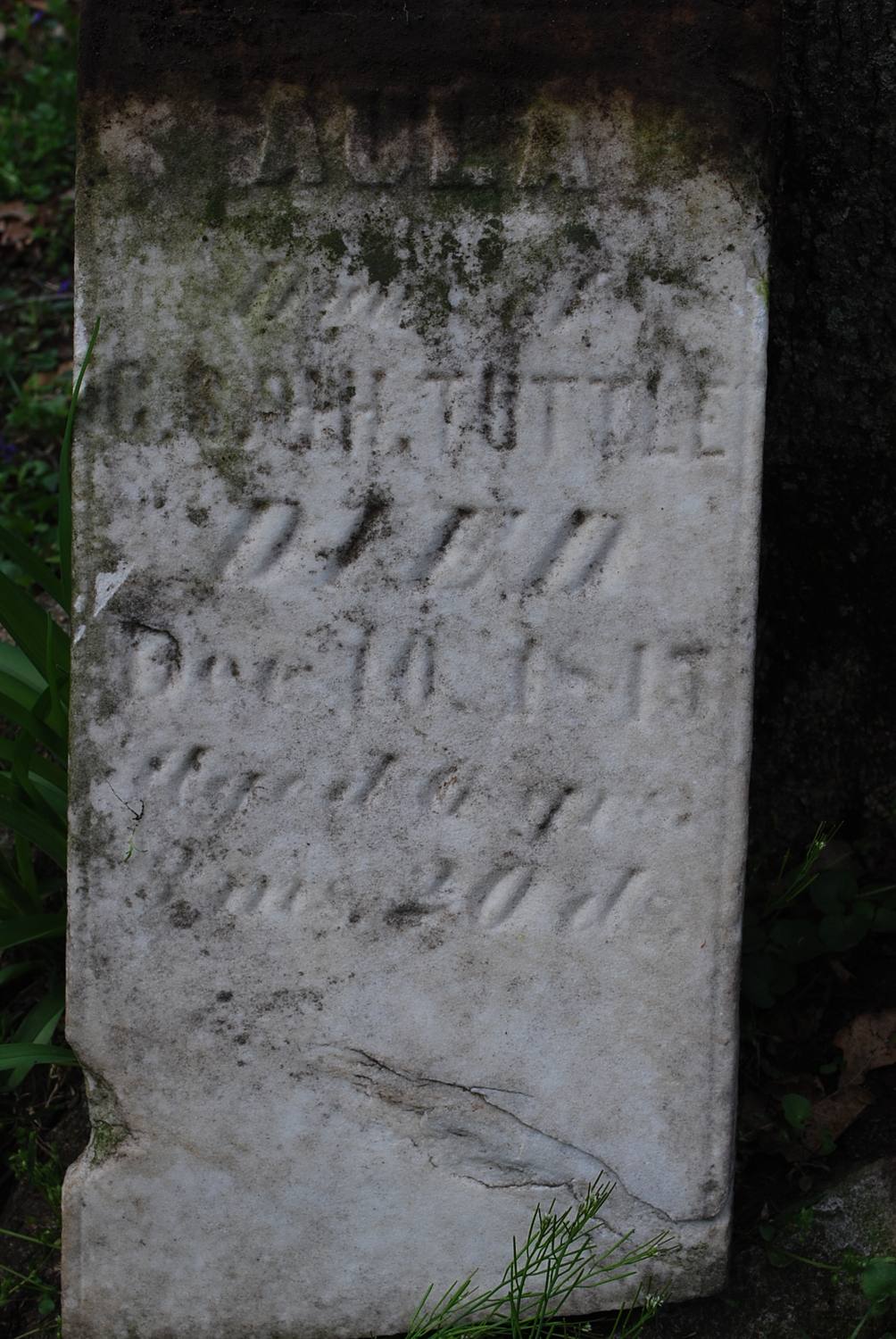
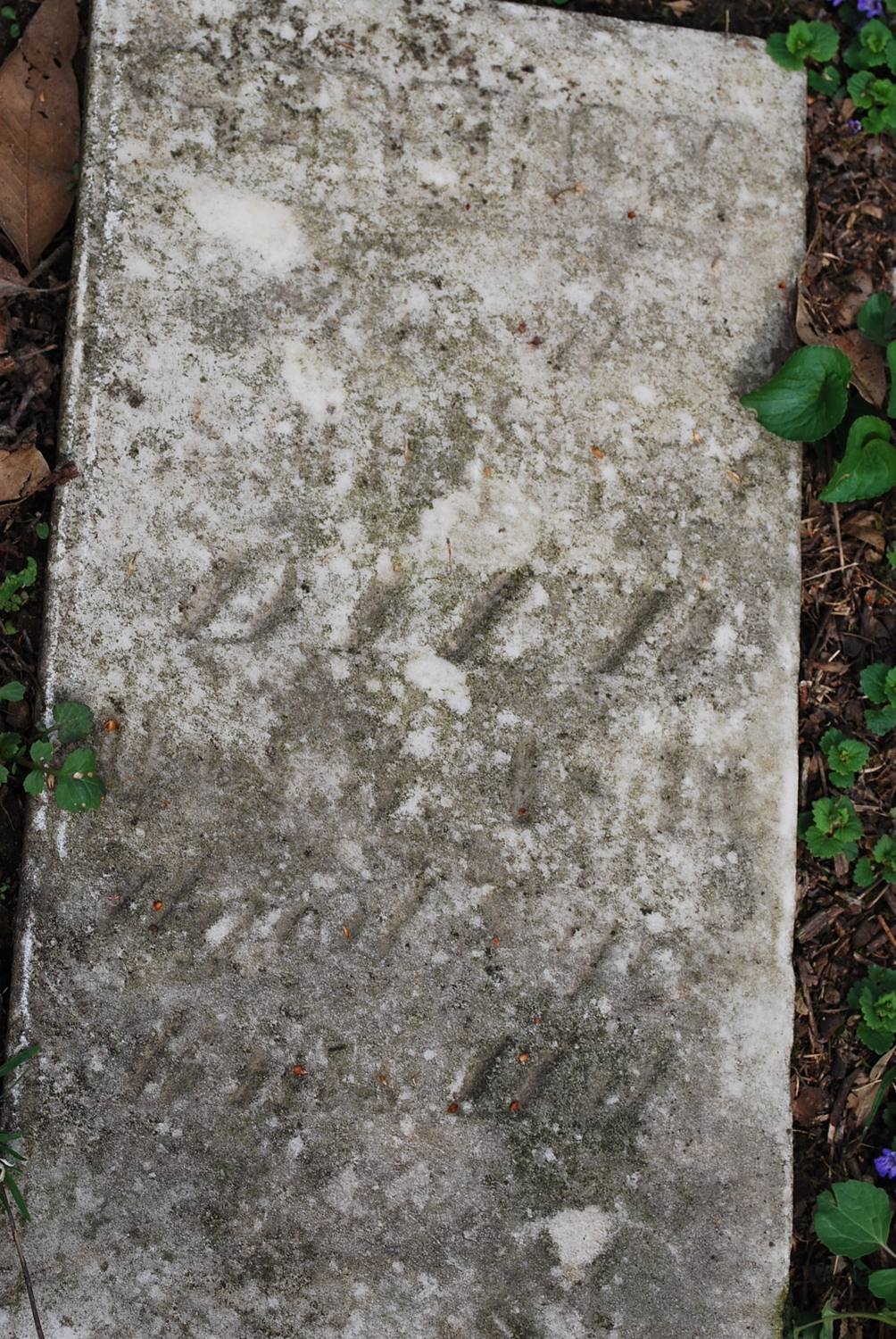
⭐⭐ HIS FIRST RECORDED SON WAS NAMED GERSHAM (b. 22 Mar 1833 or 1836 — stone vs Bible, in conflict; d. 3 Oct 1841); A LATER SON, CHESTER (1843–1846) — the name of the father this line seeks to prove, and of that father’s documented son. Four children of Clark & Harriet — Gersham, Aula (1839–45), Chester and Josephine (1845–46) — lie under “C.S. & H. TUTTLE” stones at Otter Creek Union Cemetery, proven to this family by the Bible’s Births page, which matches two stones’ age-arithmetic to the day [TUTTLE-124].
Outstanding: ⚠ The family is NOT in Vigo Co. in 1870 (three searches); Dennis C. Tuttle was born at PEORIA, ILLINOIS, so look there. ⚠ Bible says born April 27, the 1883 genealogy April 28 — unresolved. ⚠ Little Gersham’s birth year: two stone transcriptions say 1833, the Bible 1836 — unresolved [TUTTLE-130].
Evidence images (described)
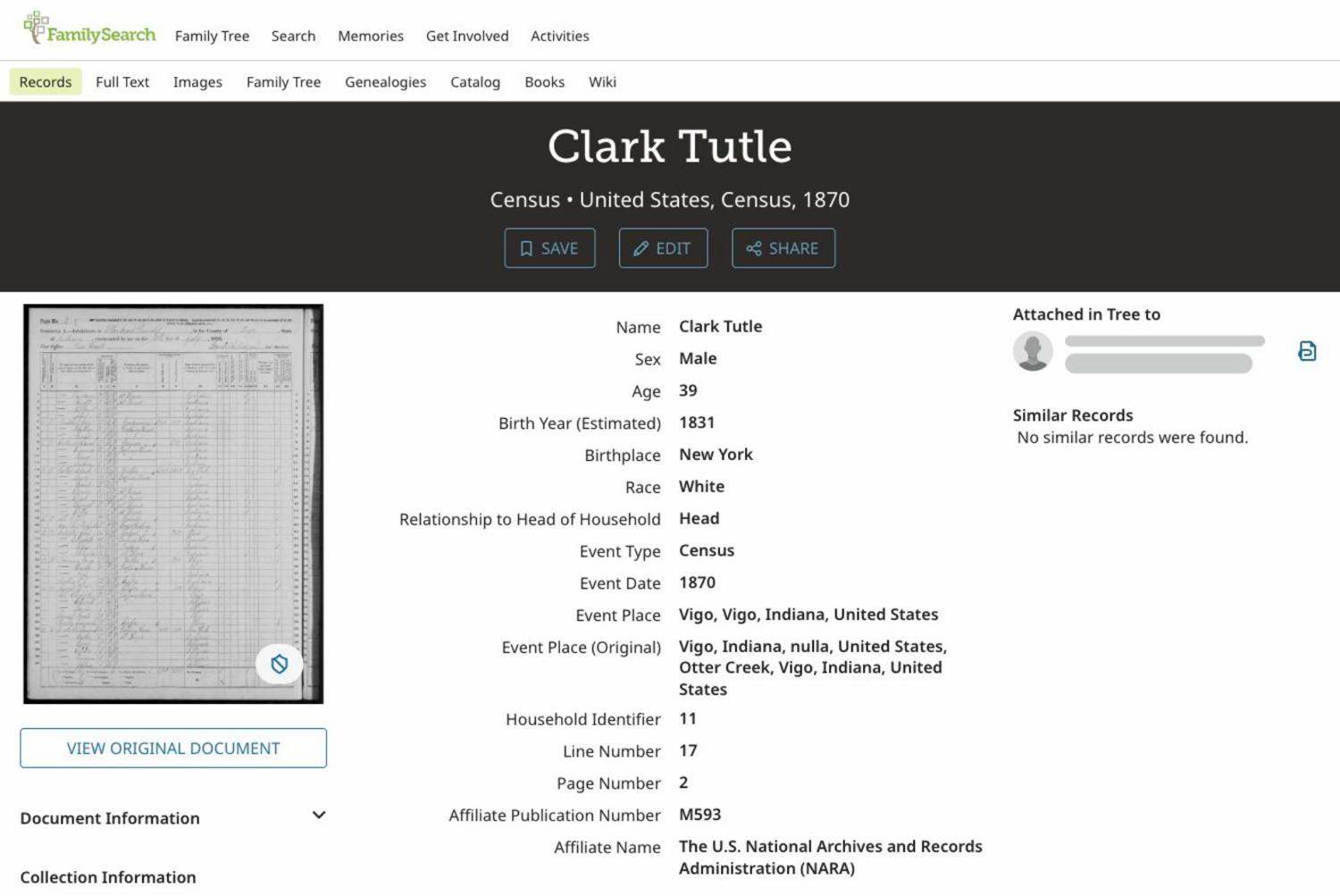
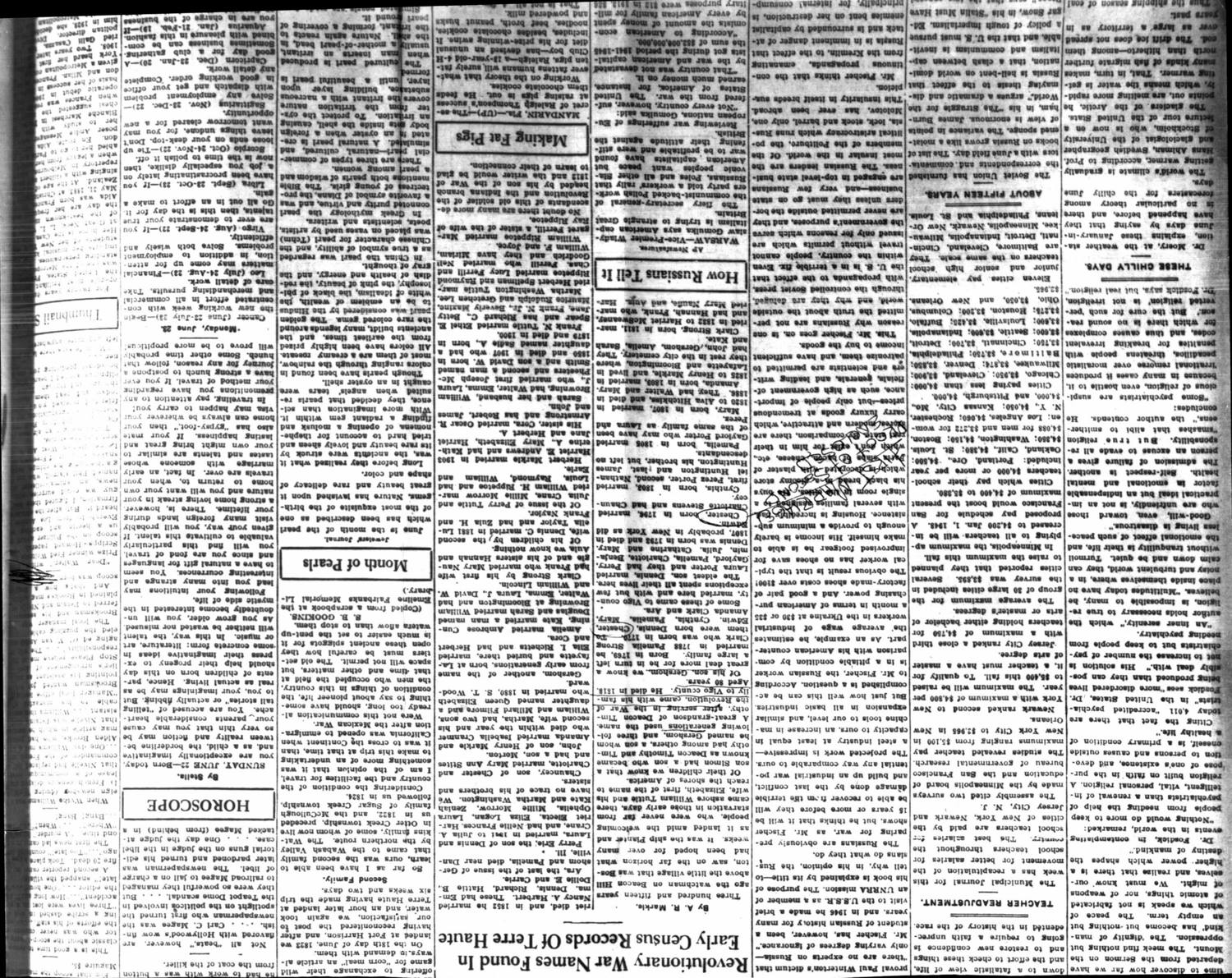
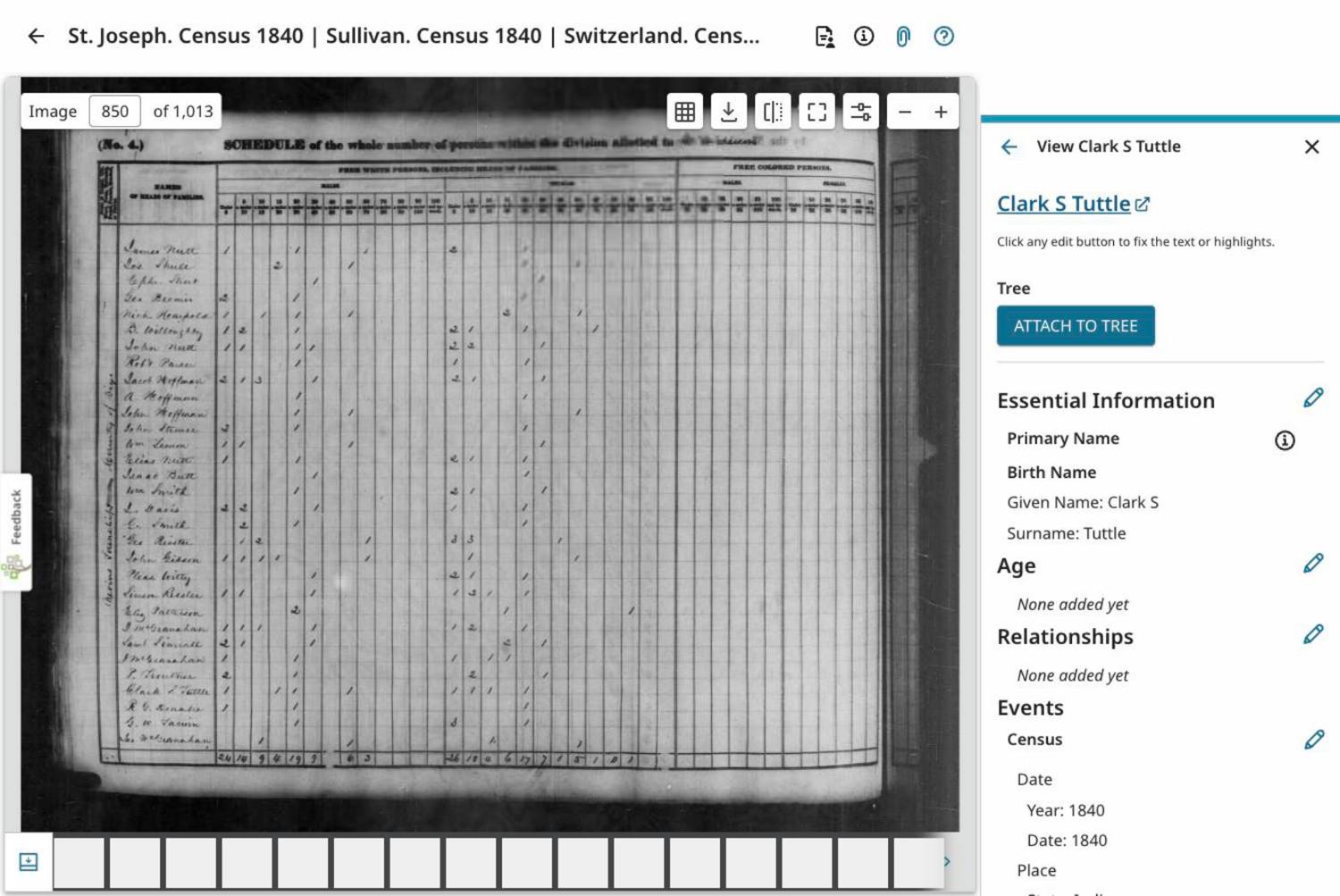
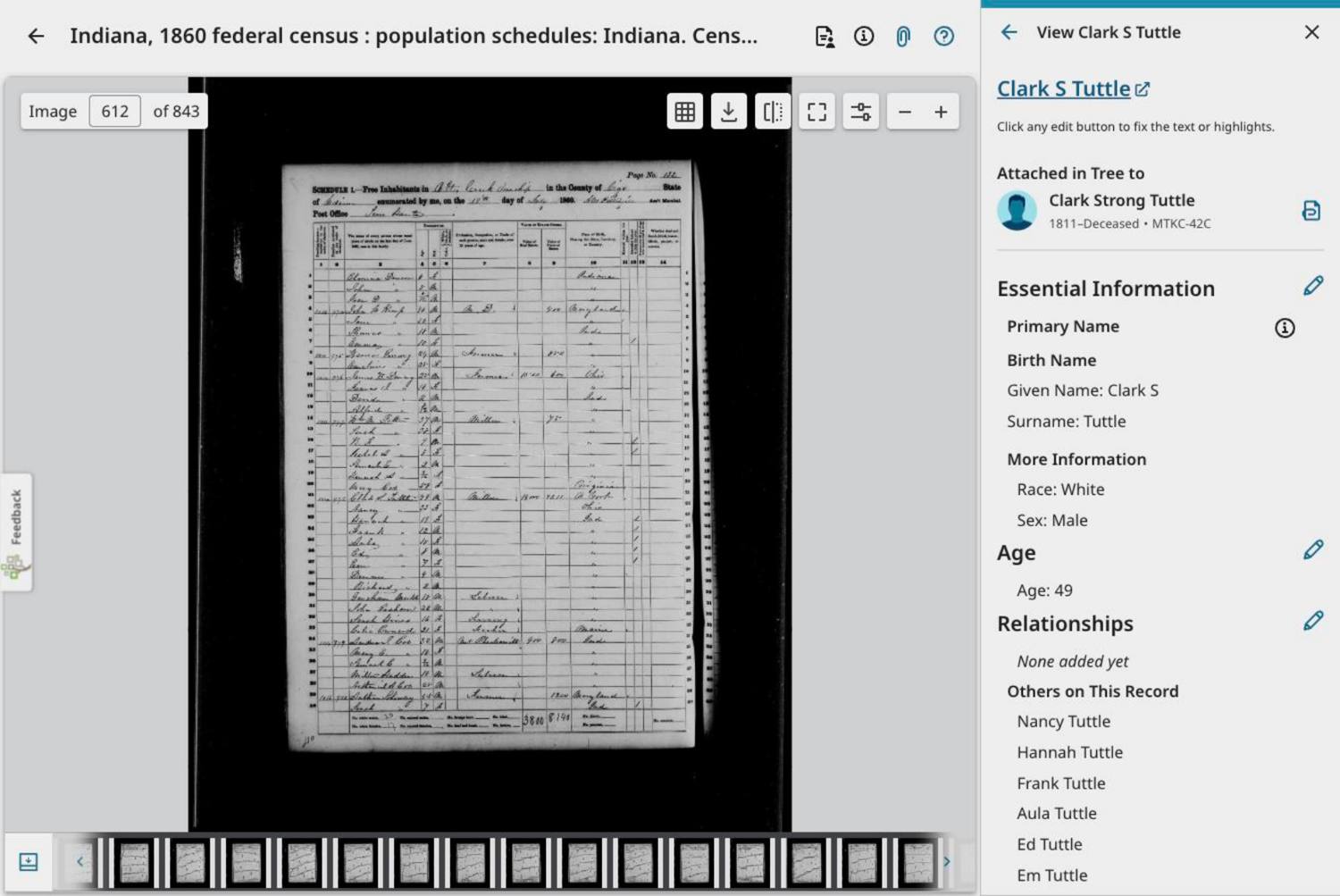
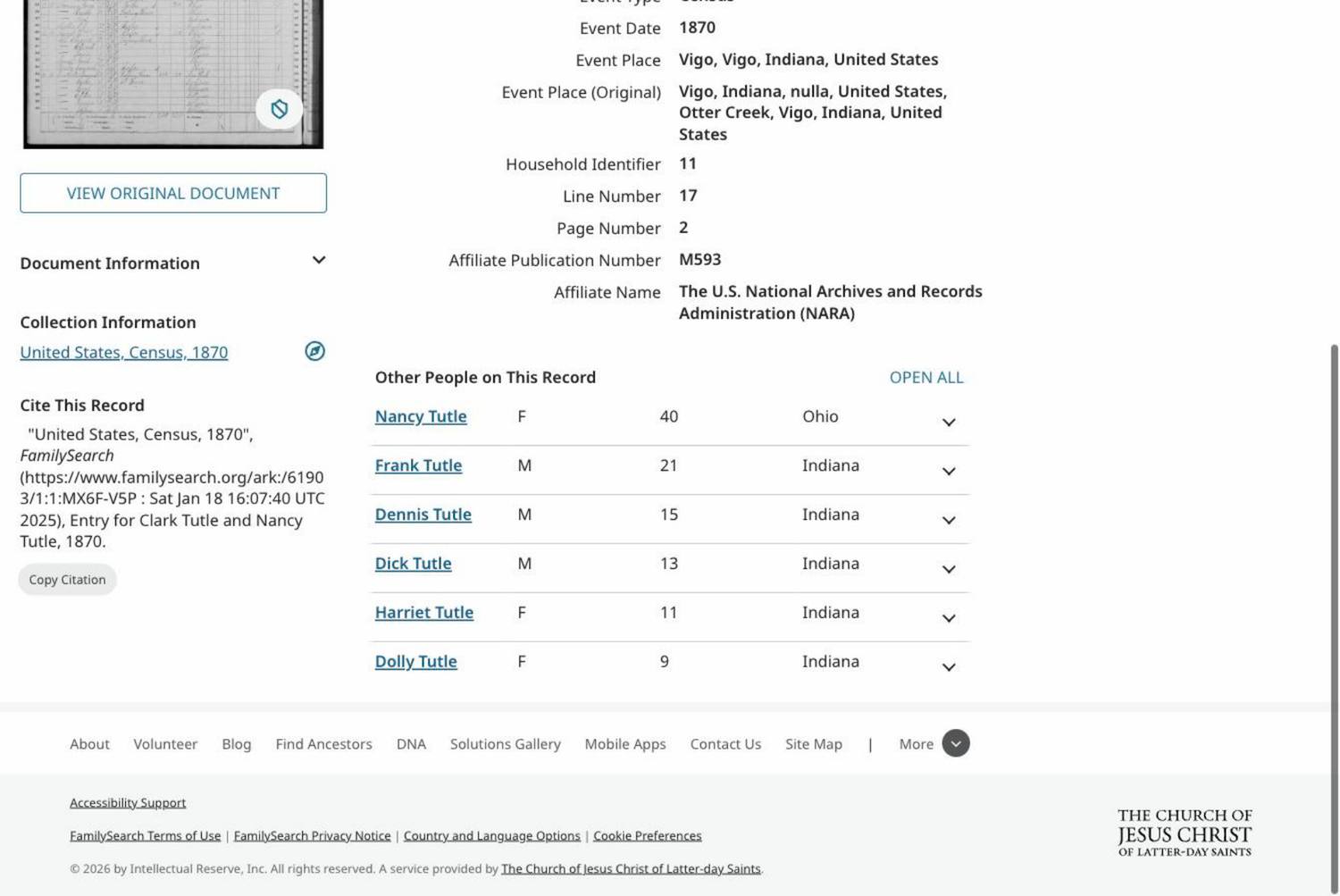
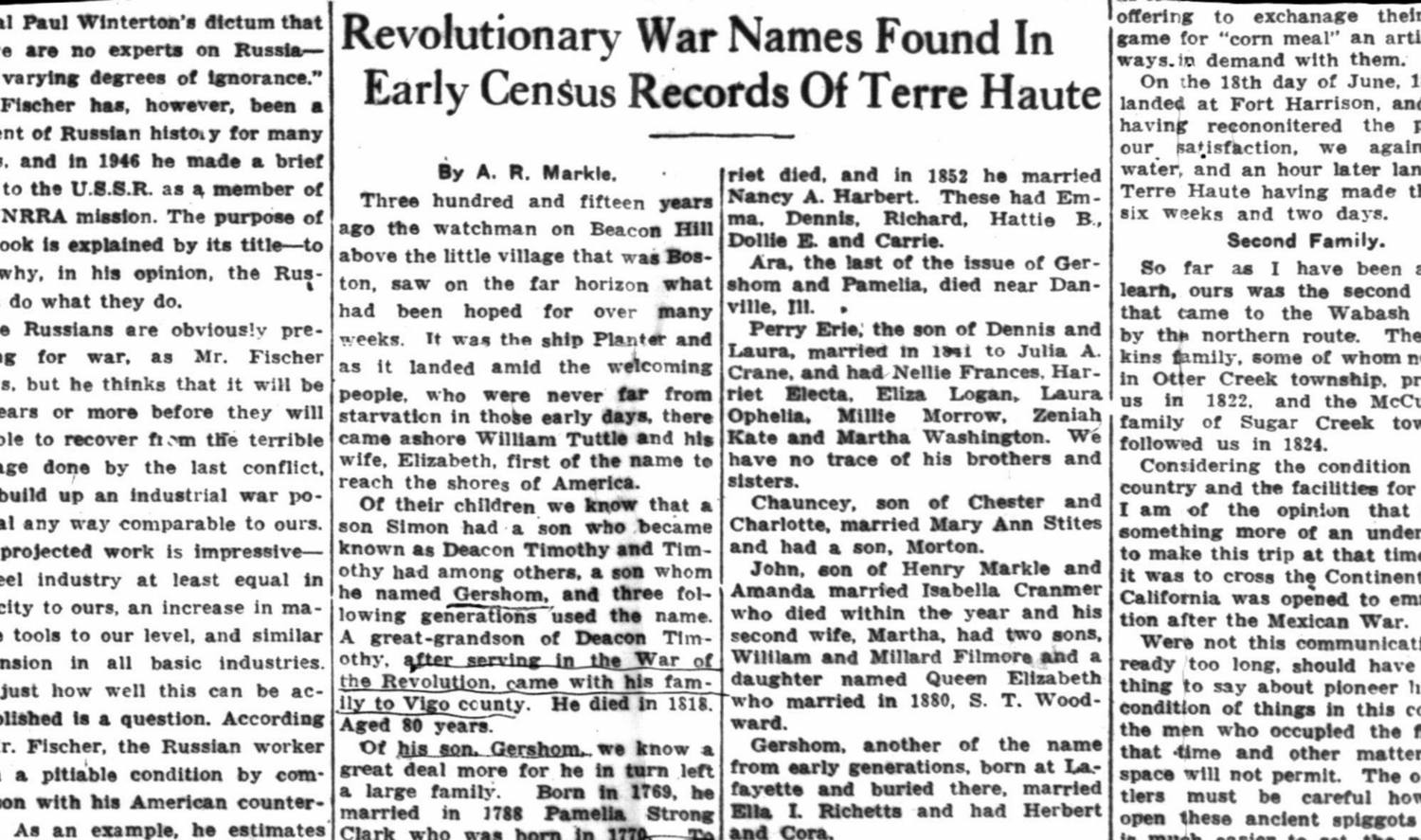
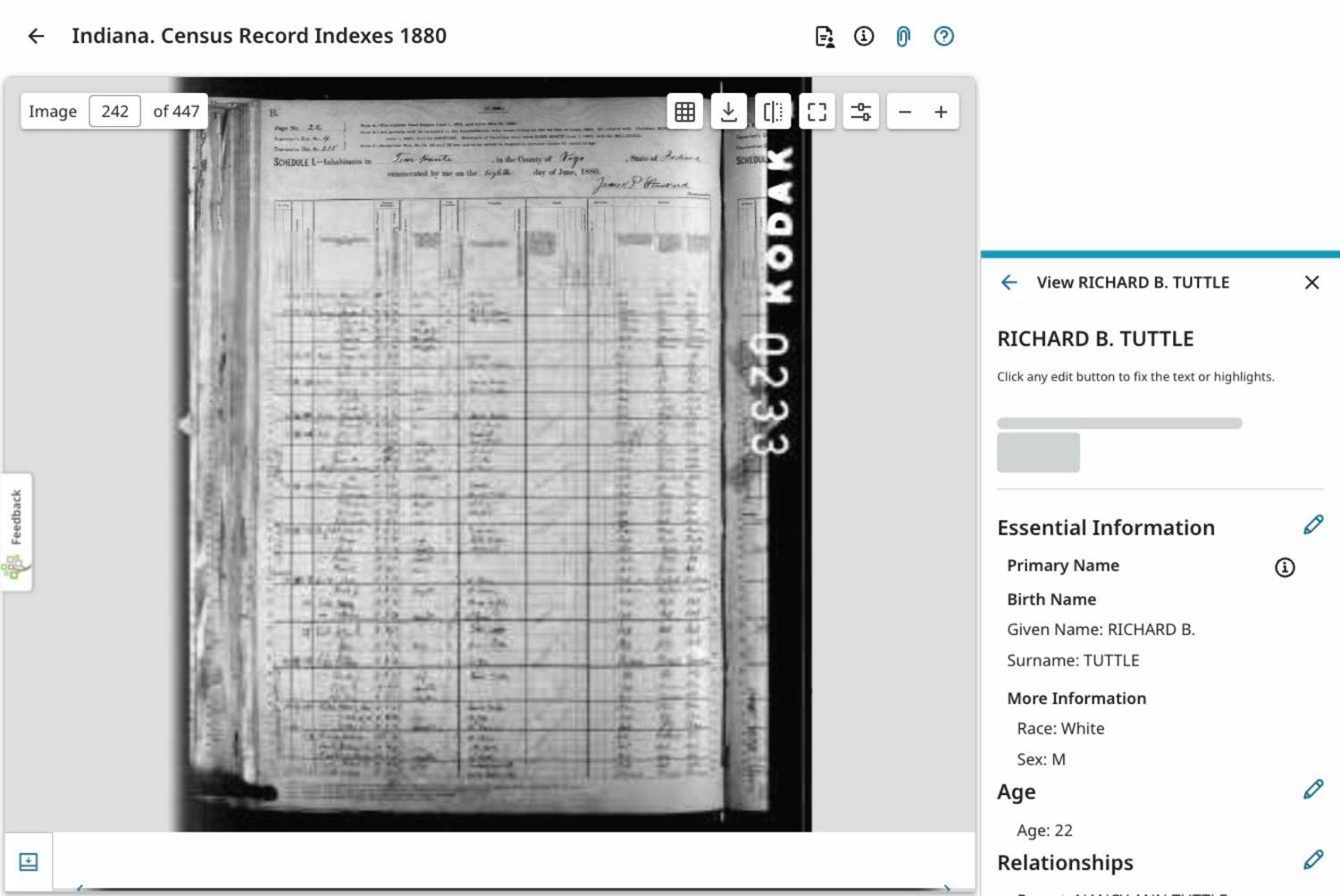
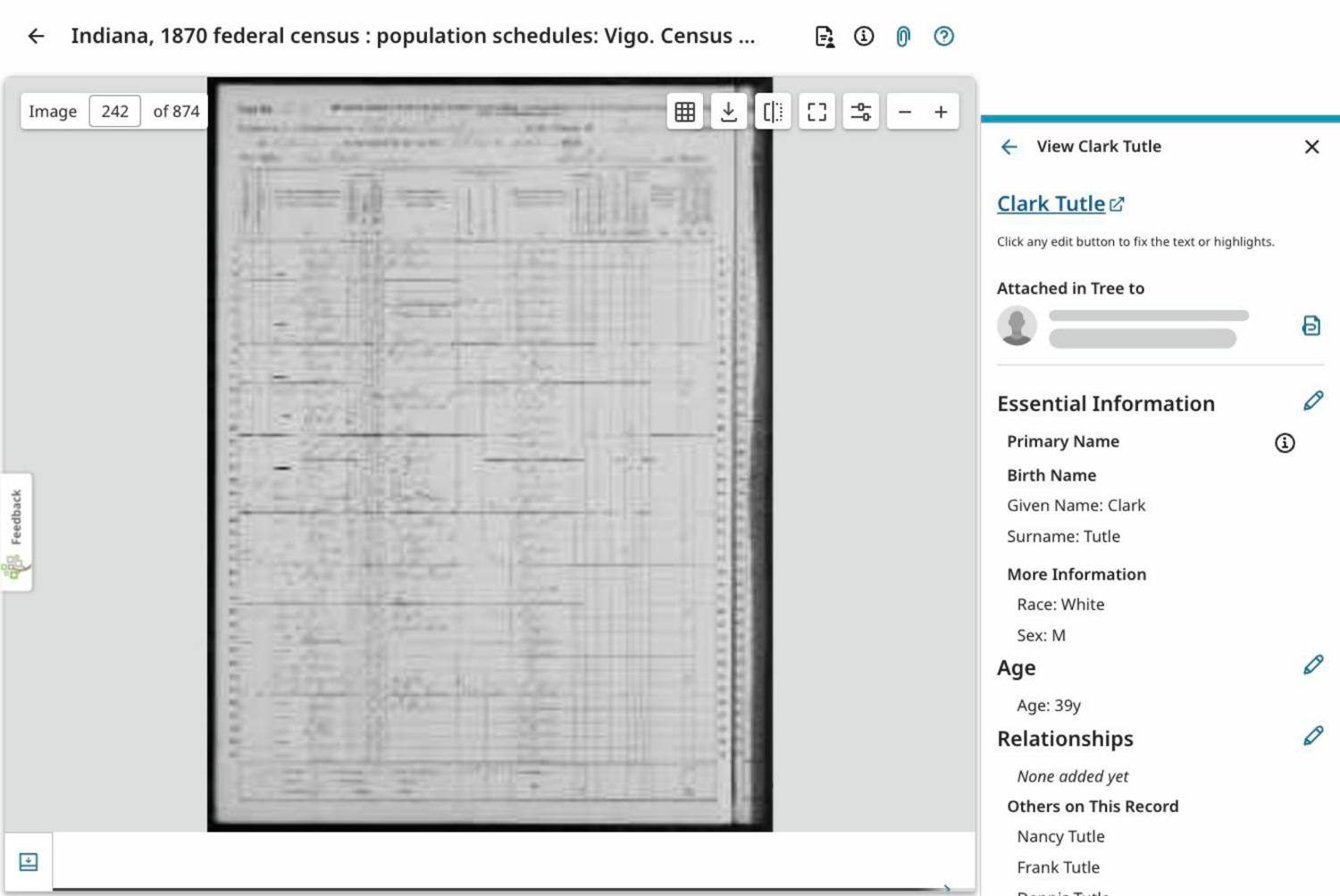
Headstone: “CHESTER, Son of C.S. & H. TUTTLE, died Dec. 21, 1846” — Otter Creek Union Cemetery — Clark S. Tuttle named a son CHESTER — his brother's name. The stone, read at the photograph, names the parents as C.S. & H. Tuttle: Clark and his first wife Harriet.Headstone: “JOSEPHINE, Dau of C.S. & H. TUTTLE, died July 10, 1846” — Otter Creek Union Cemetery — A daughter of Clark and Harriet who died in infancy; one of four children's stones standing together in the family cemetery.Headstone: “AULA, Dau of C.S. & H. TUTTLE, died Dec. 10, 1845, aged 6y 3m 20d” — The rare name Aula was given again to a daughter born 11 May 1850 (family Bible) — necronym reuse that ties the stones, the Bible and Clark's 1850 census household into one family. Her Bible birth date, 20 Aug 1839, matches this stone's age-arithmetic to the day.Headstone (weathered): Gershom Tuttle, d. 3 Oct 1841, “son of [C].S. & H” per the WVGS transcription — Clark's first recorded son was named GERSHAM — for the father this application is trying to prove. Born 22 Mar 1833 (two stone transcriptions, 1979 and 2012) or 22 Mar 1836 (family Bible) — an unresolved conflict; the stone is now too weathered to re-read.Headstone: “HARRIET, wife of C.S. TUTTLE” — d. 3 June 1851, aged 37 (1979 transcription; the worn date line misread as “Jan 9” and “1871” by later readers) — Clark's first wife, dead at 37 five weeks before he remarried — the age matches the 1850 census and the family Bible exactly. Find a Grave's “1871” is a misreading.1860 census, Otter Creek Twp IN — Clark Strong Tuttle and wife Nancy — The 1860 census caught Clark Strong Tuttle as a prosperous miller worth thousands of dollars, alongside his second wife Nancy, a woman from Ohio previously unknown to the family.1850 census, Otter Creek Twp — Clark Strong Tuttle and his unnamed first wife — This 1850 census names Clark Strong Tuttle's forgotten first wife only by her initials, H.M., a New Jersey woman dead within the year, before Nancy became his second wife.Colonel Gershom Tuttle's family record, 1883 — This page of the 1883 genealogy records Colonel Gershom Tuttle's death in Indiana, his marriage to Pamelia Strong Clark, and the start of their children's list.County history of Otter Creek Township's Tuttle mill — This 1880s county history credits Gershom Tuttle with settling Otter Creek Township by 1818 and his son Clark Tuttle with building the steam mill there.1820 census, the family's first Indiana record — This 1820 census, indexed under the misspelling Fersham Tuttle, is the family's earliest Indiana record, its household counts matching Colonel Gershom Tuttle, his wife Pamelia, and their young son Clark.1840 census, Clark Tuttle's own household — This 1840 census is the first record of Clark Strong Tuttle heading his own household in Vigo County, a decade before he appears as a prosperous miller.1860 census, Clark Tuttle the prosperous miller — This 1860 census records Clark Strong Tuttle as a well-off miller with his wife Nancy and young son Richard, Alec's third-great-grandfather, listed at age two.1870 census, the family under a misspelled name — This 1870 census, indexed as Clark Tutle rather than Tuttle, lists wife Nancy and sons Frank, Dennis, and Dick, the last being Richard B. Tuttle at age thirteen.1947 newspaper column on the Tuttles — A 1947 Terre Haute newspaper genealogy column traced the Tuttle family from patriot Gershom Tuttle through his son the colonel down to Clark Strong and Richard Tuttle.Family Bible page recording births — The Tuttle family Bible's births page records Clark Strong Tuttle's own 1811 birth and lists his son Richard B. Tuttle's 1858 birth among the children.Family Bible page recording marriages — The family Bible's marriage page records Clark Strong Tuttle's wedding to Nancy Harbert, the couple whose children carried the family line forward.County history naming Commissioner Clark Tuttle — This 1891 county history names Clark S. Tuttle among the commissioners elected in Vigo County, Indiana, in 1858.Second page listing the Tuttle children — This continuing page lists Colonel Gershom and Pamelia Tuttle's children in order, including their son Clark Strong Tuttle, born in 1811.Second page of the Otter Creek Township history — This continuing page confirms Clark Tuttle as proprietor of the steam mill, matching the prosperous milling career shown in the census.Second page of the 1820 Vigo County census — This continuing page shows the age and sex tallies recorded for the Tuttle household in Vigo County in 1820.Second page of the 1840 census tally sheet — This continuing image shows the handwritten tally sheet on which Clark S. Tuttle's household was counted in 1840.Second page of the 1860 census, the Tuttle children — This continuing page lists the Tuttle children by name and age, including two-year-old Richard and his older half-siblings.Second page listing the rest of the household — This continuing page names the rest of the 1870 household, Harriet and Dolly Tuttle, alongside Dick, the census taker's version of Richard's name.Newspaper column, continued, second page — This second page continues the 1947 Terre Haute Tribune's account of the Tuttle family's generations, from patriot Gershom Tuttle down to Clark Strong Tuttle.
Nancy A. Harbert / Herbert (b. ~1826 Ohio)
Ahnentafel #97 · his mother’s father’s father’s father’s father’s mother (6 generations back) · Documented — person and parent-link established
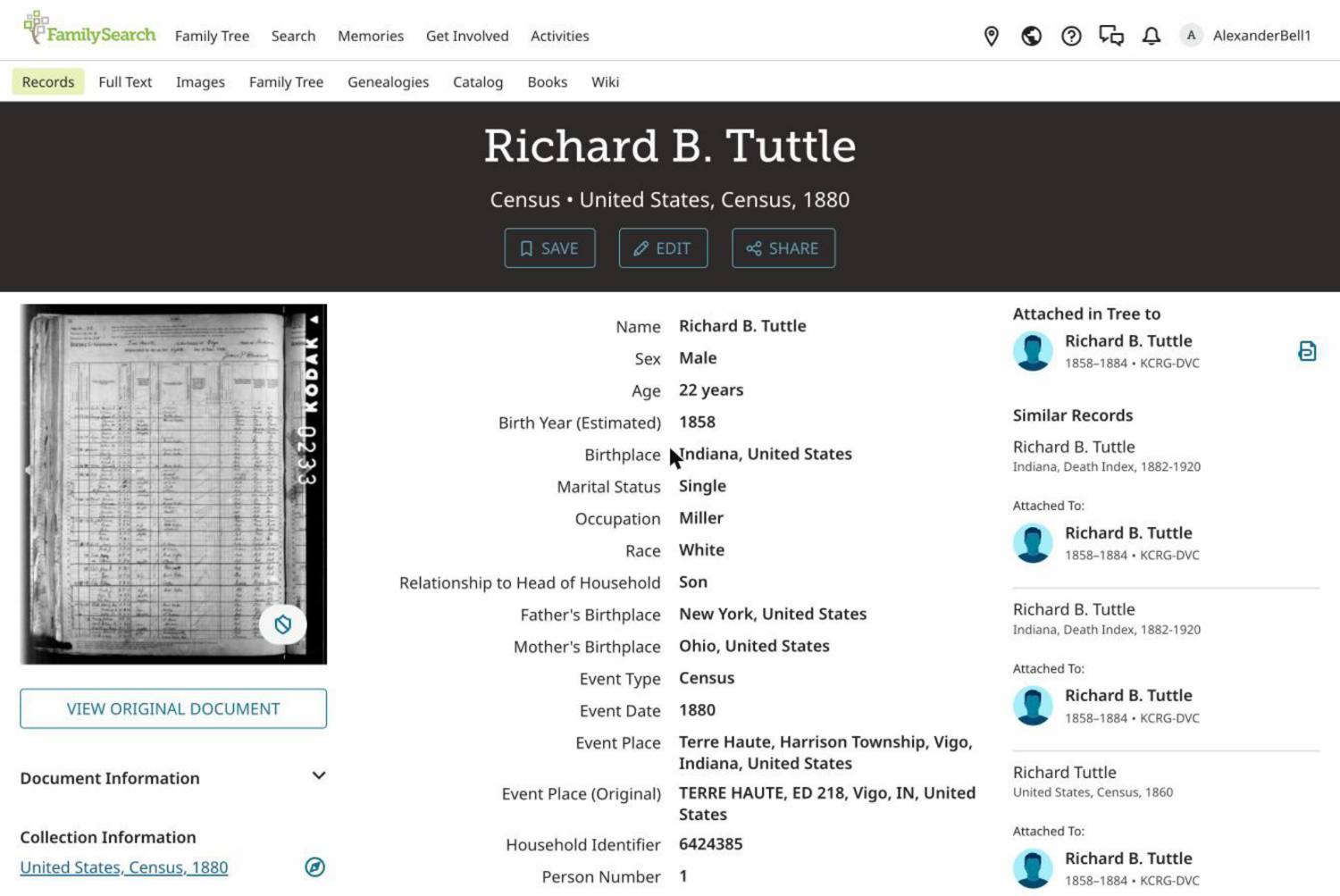
Nancy A. Harbert, sometimes recorded as Herbert, was born about 1826-27 in Ohio. She became Clark Strong Tuttle's second wife, marrying him in Vigo County, Indiana, after his first wife's death in 1850 or 1851, and was the mother of his children Richard, Ed, Em, and Dennis. Her own parents have not yet been identified.
Evidence
⭐ The Harbert line opened 6 Aug 2026 — her first recorded fact of any kind. The 1860 census of Otter Creek Township gives her aged 33, born OHIO [TUTTLE-13]. The marriage is indexed in Indiana, Marriages 1811–2019 as Clark S. Tuttle × Nancy A. HERBERT, Vigo County, page 218 — no date, no image, a third name Harvey W. Allen. ⚠ She was Clark’s SECOND wife, but our line is on the right side of the break: Richard, born about 1858, is hers, as are Ed (1852), Em (1853) and Dennis (1856).
Outstanding: Her parents are unknown — an Ohio-born family. Candidates in Vigo County: Benjamin H. Harbert (m. 1855) and Daniel Harbert. ⚠ No Nancy Harbert/Herbert born Ohio c.1826–27 appears in the indexed 1850 census of Indiana (three query shapes).
Evidence images (described)
1860 census, Otter Creek Twp IN — Clark Strong Tuttle and wife Nancy — The 1860 census caught Clark Strong Tuttle as a prosperous miller worth thousands of dollars, alongside his second wife Nancy, a woman from Ohio previously unknown to the family.1860 census, Clark Tuttle the prosperous miller — This 1860 census records Clark Strong Tuttle as a well-off miller with his wife Nancy and young son Richard, Alec's third-great-grandfather, listed at age two.1870 census, the family under a misspelled name — This 1870 census, indexed as Clark Tutle rather than Tuttle, lists wife Nancy and sons Frank, Dennis, and Dick, the last being Richard B. Tuttle at age thirteen.1880 census, Richard Tuttle as a young miller — This 1880 census shows Richard B. Tuttle, age twenty-two and already a miller like his father, living in his widowed mother Nancy's Terre Haute household.Family Bible page recording marriages — The family Bible's marriage page records Clark Strong Tuttle's wedding to Nancy Harbert, the couple whose children carried the family line forward.Second page of the 1860 census, the Tuttle children — This continuing page lists the Tuttle children by name and age, including two-year-old Richard and his older half-siblings.Second page listing the rest of the household — This continuing page names the rest of the 1870 household, Harriet and Dolly Tuttle, alongside Dick, the census taker's version of Richard's name.Second page of the 1880 Terre Haute census — This continuing page confirms Richard B. Tuttle's birthplace and his mother Nancy's household in Terre Haute in 1880.Third page of the 1860 Otter Creek census — This closing page completes the household count, showing the hired hands and servant that came with Clark Tuttle's milling fortune.Third page of the 1870 Otter Creek census — This closing page completes the 1870 census record that keeps the family in Vigo County between the 1860 and 1880 counts.Third page of the 1880 census record — This closing page completes the 1880 household record, the last census before Richard's marriage the following year.
Francis “Frank” Fuerstenberger (~1826 Bavaria – 1894)
Ahnentafel #98 · his mother’s father’s father’s father’s mother’s father (6 generations back) · Documented — person and parent-link established · Immigrant
Francis "Frank" Fuerstenberger was born in Bavaria in 1826 or 1827 and died in 1894. He immigrated to the United States and was recorded in the Terre Haute, Indiana census of 1870 and 1880. He married Sophia Snyder on 26 February 1852 in Clark County, Illinois, and together they had eight children, five of whose branches later appeared as heirs in a 1934 family probate case.
Evidence
The immigrant. 1870 Terre Haute census (indexed “Fersenburger”), 1880 (“Fuerstebuger”). m. Sophia Snyder 26 Feb 1852, Clark Co., Illinois. Eight children, five of whose branches reappear as heirs in the 1934 Andrews probate.
Outstanding: His German town, naturalisation and passenger list — all unworked. Probably buried at Highland Lawn with the Tuttles.
Sophia Snyder (1828 PA – 1889)
Ahnentafel #99 · his mother’s father’s father’s father’s mother’s mother (6 generations back) · Documented — person and parent-link established
Sophia Snyder was born in Pennsylvania in 1828 and died in 1889. She married Francis Fuerstenberger in Clark County, Illinois, in 1852, and the couple raised eight children together.
Evidence
Full dates: b. 1828 Pennsylvania – 1889
Outstanding: A “Snyder Family: Clark, Illinois — Family Histories 1731–1938” manuscript surfaced in the same full-text search and likely covers her ancestry.
John Fletcher (b. Pennsylvania or Indiana)
Ahnentafel #102 · his mother’s father’s father’s mother’s mother’s father (6 generations back) · Probable — the IDENTIFICATION or the LINK rests on one source, or is in conflict
John Fletcher was probably born either in Pennsylvania or in Indiana — his daughter Mary Elizabeth's census records over the years disagree on which. He was named as her father on her 1934 Indiana death certificate, which is presently the only document connecting the two.
Evidence
Full dates: b. Pennsylvania (1880) or Indiana (1900) — in conflict
ADDED at PROBABLE, 10 Aug 2026, adversary-confirmed [ALEX-04/07/-VERDICT]. Named as Mary Elizabeth Fletcher’s father on her 1934 Indiana death certificate (informant unidentified — the certificate IMAGE’s informant line is the named next check). One document names the pair; the birthplace conflict (PA vs IN, both Mary’s own census reports) is carried, not resolved.
Outstanding: the certificate image’s informant; a Fletcher × Wallace marriage ~1850–58; no Fletcher marriage exists in Vermillion’s own 1844–61 register (elsewhere-origin reading).
Sarah (Wallace) Fletcher (b. Indiana)
Ahnentafel #103 · his mother’s father’s father’s mother’s mother’s mother (6 generations back) · Probable — the IDENTIFICATION or the LINK rests on one source, or is in conflict
Sarah Fletcher, born Wallace, was recorded as being born in Indiana. She was probably the wife of John Fletcher and the mother of Mary Elizabeth Fletcher, named alongside him on Mary Elizabeth's 1934 death certificate. A cluster of pioneer Wallace families in Vermillion County, Indiana, may be connected to her, though this remains an unproven lead.
Evidence
Full dates: b. Indiana (both censuses)
ADDED at PROBABLE, 10 Aug 2026 [ALEX-04/07/-VERDICT]. Same single certificate. The Vermillion “Wallace pioneer cluster” remains a surname-only lead — hers, not William Alexander’s (the earlier mix-up corrected in ALEX-07).
Elias Lamb (1814 NC – 1890 Vermillion Co. IN)
Ahnentafel #108 · his mother’s father’s mother’s mother’s father’s father (6 generations back) · Probable — the IDENTIFICATION or the LINK rests on one source, or is in conflict
Elias Lamb was born on 24 September 1814 in North Carolina and died on 31 August 1890 in Vermillion County, Indiana. According to an 1888 county history, he was the son of Joseph and Lydia Lamb, married Susannah Bish on 23 March 1837, and celebrated his golden wedding anniversary in 1887. He left the Society of Friends for the United Brethren church in 1841, and his son Erwin's own biographical sketch, printed in the same volume, confirms him as Erwin's father.
Evidence
⭐ ADDED at PROBABLE, 10 Aug 2026, adversary-confirmed (ok refused — the Elias→Erwin link lives in one publication) [KNOTT-13/-VERDICT]. The 1888 Vermillion mug-book, two entries: his own sketch (b. 24 Sep 1814; parents Joseph & Lydia; m. Susannah Bish 23 Mar 1837; golden wedding 1887) and the children list naming “Azel E., Irvin R.…” — with Erwin’s own sketch (“a son of Elias Lamb”) in the same volume. Left the Friends for the United Brethren by letter, 1841. Death: genealogytrails index, 31 Aug 1890.
Outstanding: the 1870 Wayne Co. household read (the ruled test); his estate file.
Ahnentafel #109 · his mother’s father’s mother’s mother’s father’s mother (6 generations back) · Probable — the IDENTIFICATION or the LINK rests on one source, or is in conflict
Susannah Lamb, born Bish, was born on 17 November 1818 in Fairfield County, Ohio, and was still living after 1888. According to the same 1888 county history that names her husband Elias, she was the daughter of John and Ann Elizabeth Bish, moved to Wayne County in 1836, married Elias Lamb on 23 March 1837, and had ten children. The couple's golden wedding anniversary in 1887 was, by that same account, attended by a large gathering of old settlers.
Evidence
Full dates: 17 Nov 1818 Fairfield Co., OH – aft. 1888; m. 23 Mar 1837
ADDED at PROBABLE, 10 Aug 2026 [KNOTT-13/-VERDICT]. The 1888 sketch: daughter of John & Ann Elizabeth Bish, to Wayne Co. 1836; ten children; the 1887 golden wedding “with a large attendance of the old settlers.” Single source.
Outstanding: the 1837 marriage record; her death.
Milo Bailey (Clay Twp., Wayne Co. IN)
Ahnentafel #110 · his mother’s father’s mother’s mother’s mother’s father (6 generations back) · Hypothesis — a candidate, not tied in
Milo Bailey is believed to have lived in Clay Township, Wayne County, Indiana, as the son of John Bailey, who died in 1863 at the age of 72. He appears alongside the Lamb family in an 1872 local history, and two Lamb brothers are known to have married two Bailey women in the same year, 1859 or 1860 — a pattern that makes him a plausible candidate for the father of Melissa J. Bailey. No record has yet been found that names his daughters, so the connection remains unproven.
Evidence
Also recorded: of Clay Twp., Wayne Co., Indiana; son of John Bailey, d. 1863 aged 72
ADDED at HYPOTHESIS, 10 Aug 2026 [KNOTT-13/-VERDICT]. The candidate father of Melissa J. Bailey: real and clustered (Young 1872: “Ithamar Lamb, Milo Bailey, and Lewis Strickler live on it”; “his son Milo resides [Clay, 1859]”), and two Lamb brothers married two Bailey women in one 1859–60 season — but NO record names his daughters. ⚠ TRAP: an unrelated Milo LAMB (Thomas Lamb’s NC family) sits in the same county — discriminate in every pull.
Outstanding: the 1850/1860 census household (Melissa in it = tied in; absent = candidacy dies); his own marriage (names node 111).
Melissa Bailey's mother
Ahnentafel #111 · his mother’s father’s mother’s mother’s mother’s mother (6 generations back) · Known unknown — the person existed; the name does not survive
The name of Melissa J. Bailey's mother has not survived in any record found so far. If Milo Bailey's candidacy as her father is ever confirmed, his own marriage record would be the most likely place to recover her mother's identity.
Evidence
Also recorded: name not recorded
KNOWN UNKNOWN [KNOTT-13-VERDICT]. Melissa’s mother existed; no record names her under any candidacy. Milo Bailey’s own marriage record is the recovery path if his candidacy holds.
Benjamin “Bennie” Roush (1816 – 1897)
Ahnentafel #120 · his mother’s mother’s mother’s father’s father’s father (6 generations back) · Documented — person and parent-link established
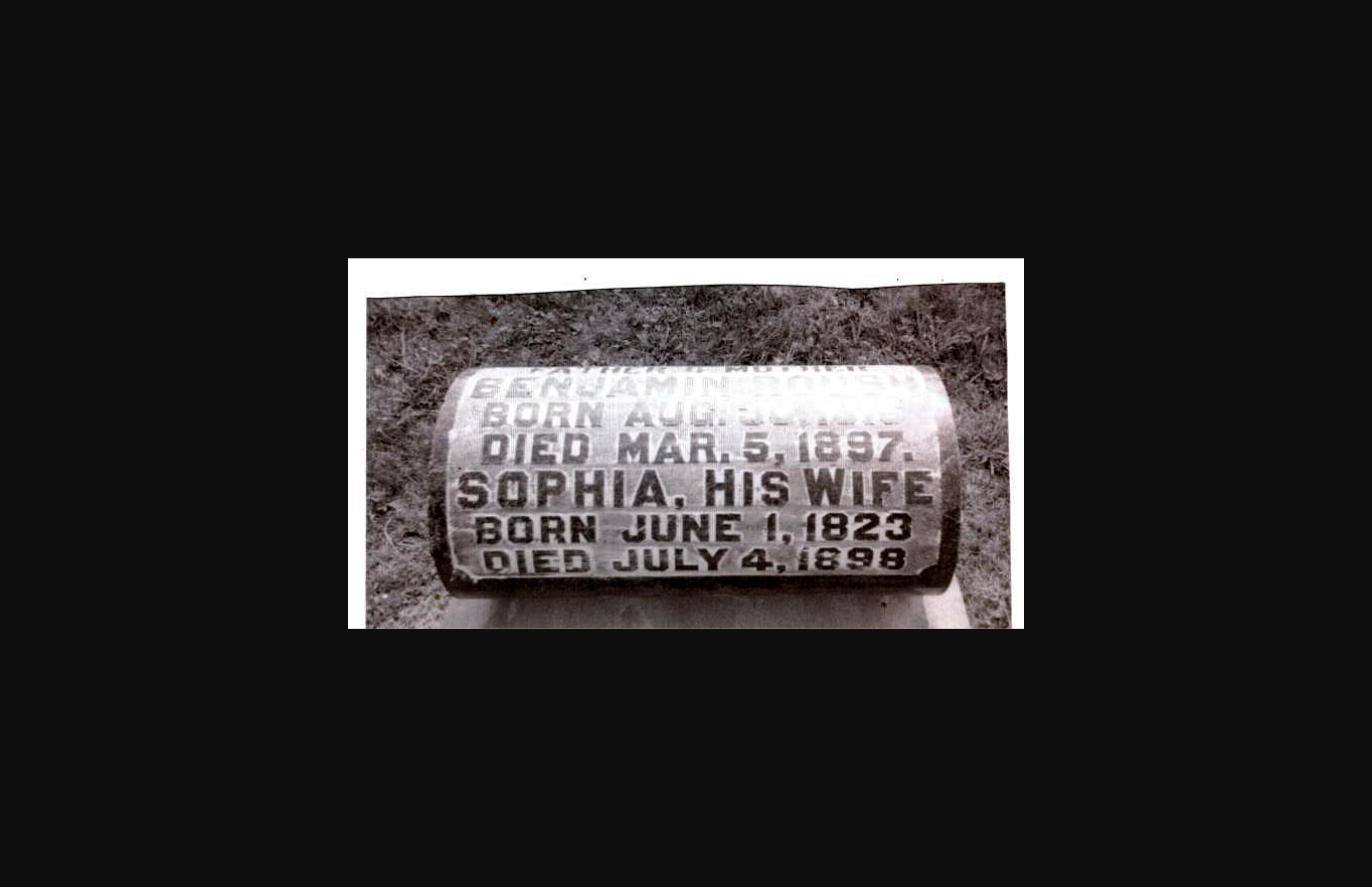
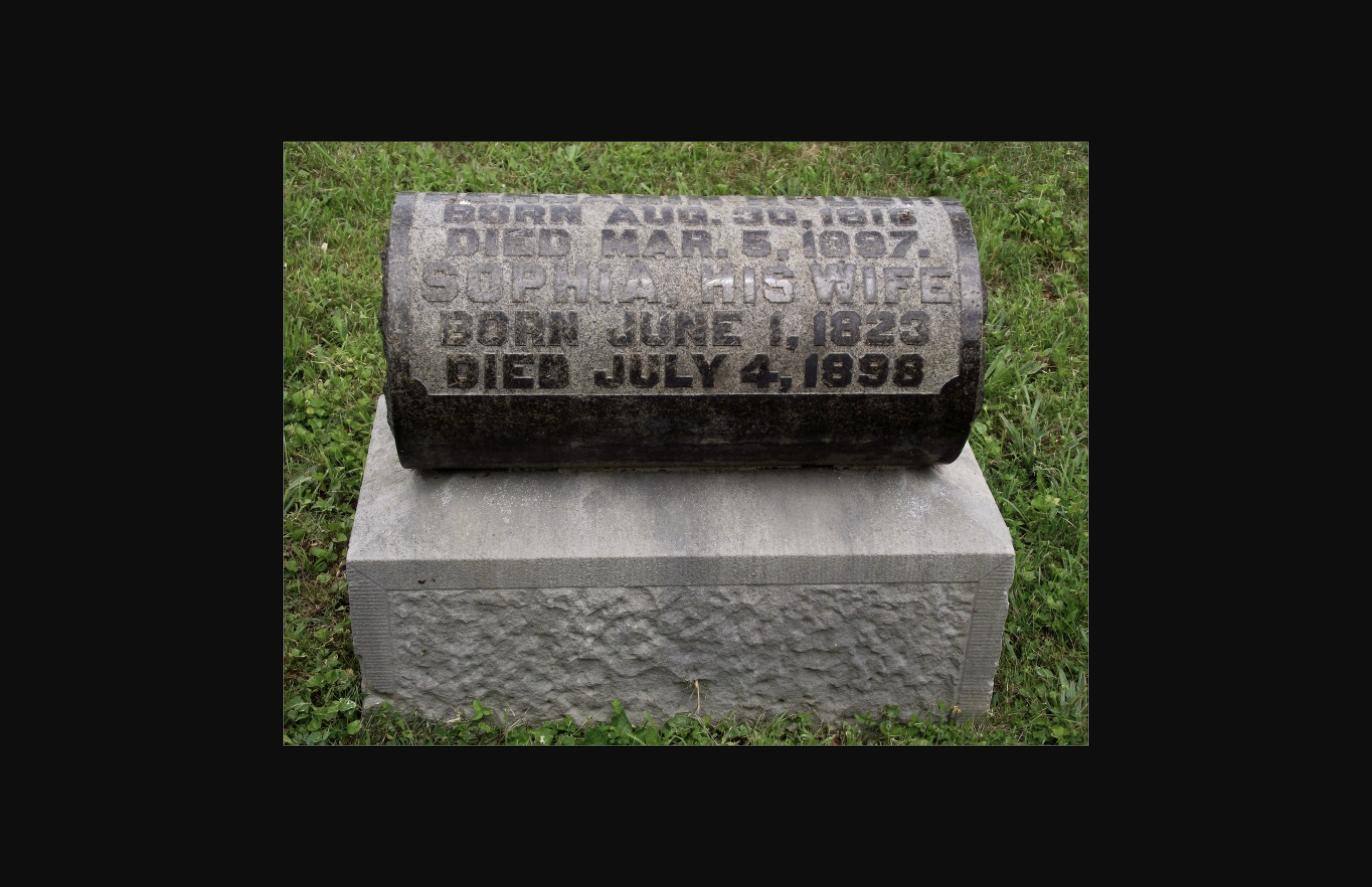
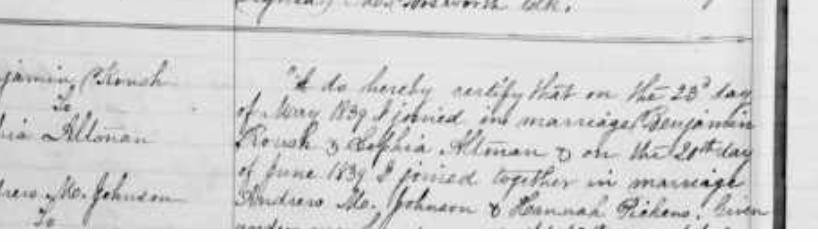
Benjamin "Bennie" Roush was born on 30 August 1816 at Graham Station, Mason County, West Virginia, and died on 5 March 1897. He married Sophia Altman on 23 May 1839 in Orange Township, Meigs County, Ohio, and farmed there before later moving to Syracuse, Ohio, and then back to Wagner District in Mason County, West Virginia. He is buried at Broad Run Cemetery in Mason County, beneath a stone reading "FATHER & MOTHER."
Evidence
Full dates: 30 Aug 1816 – 5 Mar 1897
Born at Graham Station, Mason Co., West Virginia. m. Sophia Altman 23 May 1839, Orange Township, Meigs County, Ohio — read from the Justice of the Peace’s own return. Farmed in Sutton Township, Meigs Co. (1850, 1860), Syracuse (1870), and Wagner District, Mason Co., W.Va. (1880). Buried Broad Run Cemetery, Mason Co.: “FATHER & MOTHER / BENJAMIN ROUSH / BORN AUG. 30, 1816 / DIED MAR. 5, 1897.” [ROUSH-20, ROUSH-36, ROUSH-36b].
Outstanding: Nothing above him has been worked. Roush = anglicised RAUSCH; the printed Ohio-valley Roush genealogies should be tested against the tree-only “John Blackbird Roush.”
Photographs (described)
Gravestone of Benjamin and Sophia RoushColor photograph of the Roush family gravestone
Evidence images (described)
1839 marriage return, Benjamin Roush and Sophia Altman — The 1839 marriage record for Benjamin Roush and Sophia Altman in Meigs County, Ohio, the couple who now rest together under one gravestone at Broad Run Cemetery.
Sophia Altman (1823 OH – 1898 Meigs Co. OH)
Ahnentafel #121 · his mother’s mother’s mother’s father’s father’s mother (6 generations back) · Documented — person and parent-link established
Sophia Altman was born on 1 June 1823 in Ohio and died on 4 July 1898 in Meigs County, Ohio. She was only fifteen years and eleven months old when she married Benjamin Roush in May 1839. The couple raised six known children — Moses B., Sarah Elizabeth, Mary Lovina, Maria Ann, Serepta Ann, and Dillia — and Sophia is buried beside Benjamin at Broad Run Cemetery.
Evidence
Full dates: 1 Jun 1823 Ohio – 4 Jul 1898, Meigs Co., Ohio
Fifteen years and eleven months old at her marriage — nine days short of sixteen. Buried beside Benjamin at Broad Run: “SOPHIA, HIS WIFE / BORN JUNE 1, 1823 / DIED JULY 4, 1898.” Six children known: Moses B., Sarah Elizabeth Kauff, Mary Lovina Findley, Maria Ann Goodnite, Serepta Ann, Dillia McDaniel [ROUSH-36, ROUSH-36b].
Outstanding: ⚠ Because she was a minor, a parental consent naming her father was filed in Meigs County in May 1839 — but Meigs County has no licence, bond or consent series on film (vols 1–24 are returns only). It is a loose paper in the Probate Court, off-line [ROUSH-37].
Photographs (described)
Gravestone of Benjamin and Sophia RoushColor photograph of the Roush family gravestone
Evidence images (described)
1839 marriage return, Benjamin Roush and Sophia Altman — The 1839 marriage record for Benjamin Roush and Sophia Altman in Meigs County, Ohio, the couple who now rest together under one gravestone at Broad Run Cemetery.
James Duckworth (~1813/18 Lancashire – 1874/80 OH)
Ahnentafel #122 · his mother’s mother’s mother’s father’s mother’s father (6 generations back) · Documented — person and parent-link established · Immigrant
James Duckworth was born about 1813 or 1818 in Lancashire, England, and died between 1874 and 1880 in Meigs County, Ohio. He worked as a collier — a coal miner — and married Ann Collins on 21 January 1839 at St Mary's Church in Bury, Lancashire, signing the register with a mark, as did his bride. He emigrated to the United States around 1850 or 1851, settling first in Pennsylvania and then in Meigs County, Ohio, where in 1874 a court inquest found him insane and committed him to the Lunatic Asylum of the State of Ohio at Athens.
Evidence
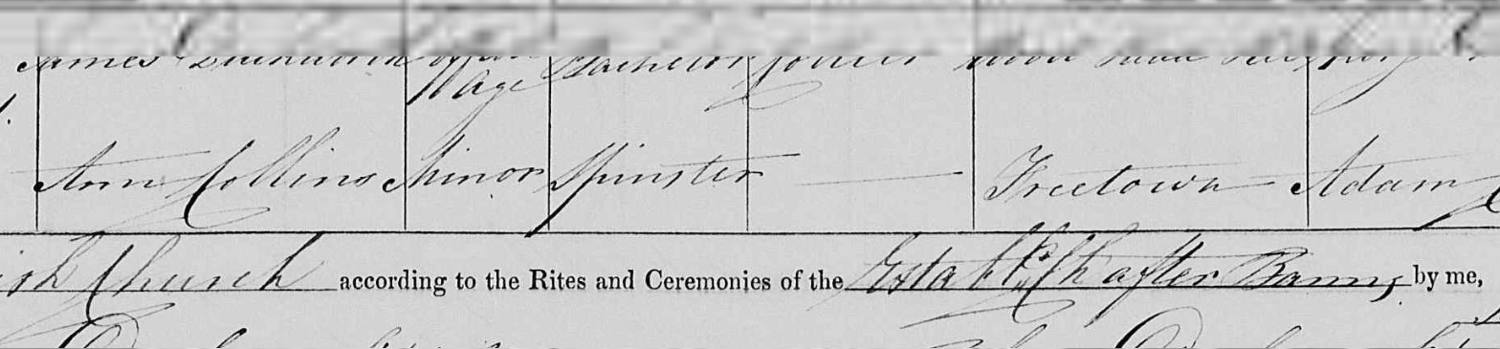
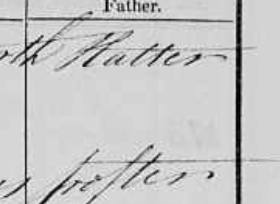
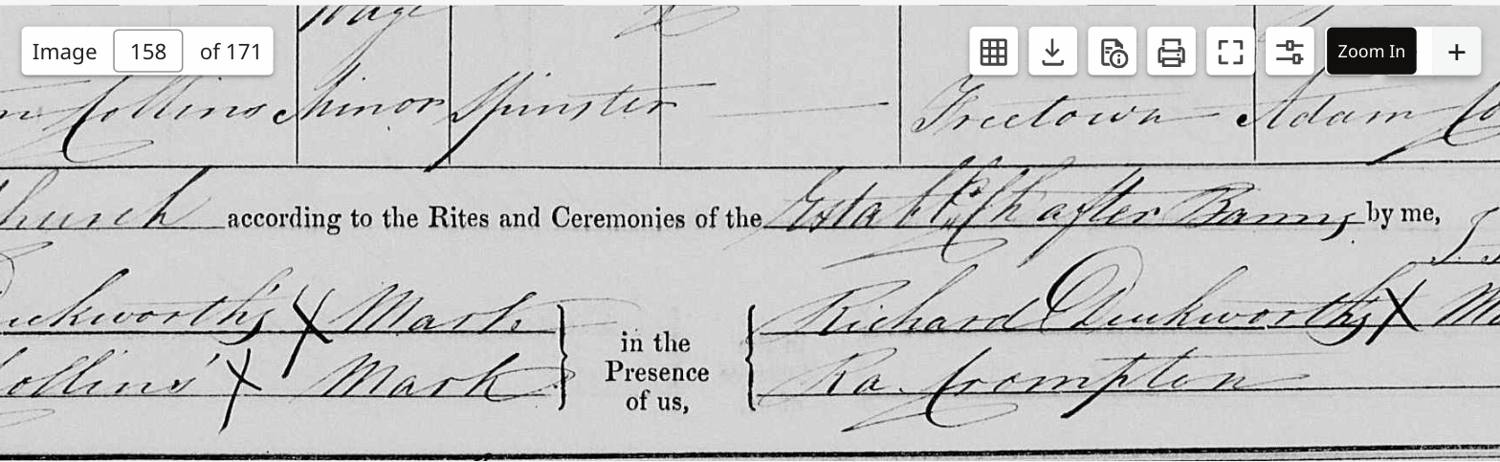
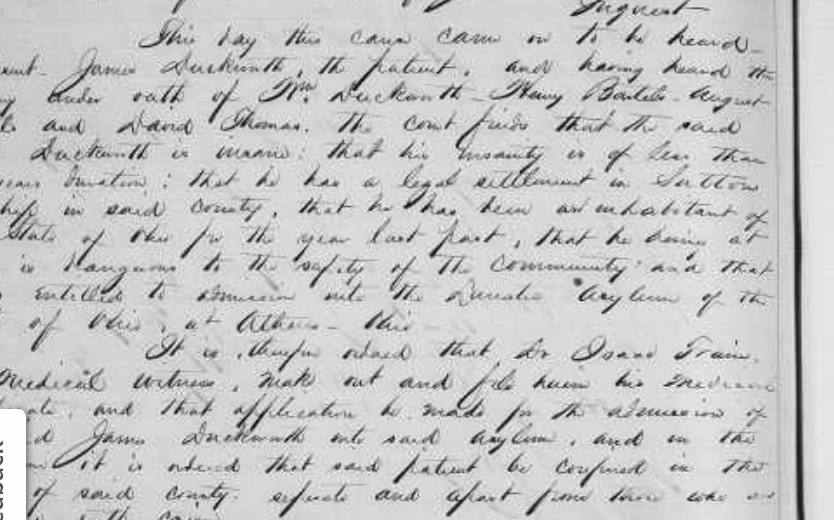
A COLLIER.“James Duckworth, of full age, Bachelor, Collier, of Wood Head Hill” — m. Ann Collins 21 January 1839 at St Mary, Bury, Lancashire, after banns, by J. F. Amos, curate; both signed with an ✗ mark; his father entered as GEORGE DUCKWORTH, HATTER [ROUSH-34]. Emigrated c. June 1850 × 1851; Pennsylvania, then Meigs County, Ohio. ⚠⚠ Meigs County Probate Journal p.288, inquest of 24 April 1874: “In the Matter of the Insanity of James Duckworth.” Found insane, of less than two years’ duration, legal settlement Sutton Township, entitled to the Lunatic Asylum of the State of Ohio at ATHENS; witnesses Wm Duckworth, Henry and August Bartels, David Thomas; medical witness Dr Isaac Irwin; Judge Stanbery [ROUSH-38].
Outstanding: ⭐ The Athens asylum admission and death registers, 1874–1880, would give his death and burial — and would close the story. There is no estate because a man sent to a state asylum leaves no will.
Evidence images (described)
1839 marriage register, James Duckworth and Ann Collins — The 1839 marriage register from Bury, England, recording James Duckworth's wedding to Ann Collins, the couple whose family later crossed the ocean to settle in Ohio.Marriage register detail — both fathers' names — A close-up of the marriage register's column for fathers, naming James Duckworth's father as George Duckworth, a hat maker, and Ann Collins's father as Adam Collins.Marriage register — the couple's marks and witness — Neither James Duckworth nor Ann Collins could write their own name; both signed their marriage register with an X, witnessed by a fellow Duckworth.1874 Meigs County probate inquest, James Duckworth — A sad 1874 probate record from Meigs County, Ohio, documenting the inquest that sent James Duckworth to the Athens insane asylum.
Ann Collins (b. ~1818 Lancashire – aft. 1860)
Ahnentafel #123 · his mother’s mother’s mother’s father’s mother’s mother (6 generations back) · Documented — person and parent-link established · Immigrant
Ann Collins was born after 21 January 1818 in Lancashire, England, and was still living after 1860. She was a minor of Freetown, in Bury, when she married James Duckworth in 1839, which is why her father's name was recorded in the marriage register at all; she, too, signed with a mark. Her maiden name was recovered from the 1924 Ohio death certificate of her eldest daughter, Mary Duckworth Treadwell, which named her mother as "Ann Collins, England."
Evidence
Full dates: b. after 21 Jan 1818 in Lancashire – living after 1860
A MINOR at her marriage — which is why her father is named in the register at all. Of Freetown, Bury. Signed with an ✗ mark. Her maiden name was recovered on 6 Aug 2026 from the 1924 Ohio death certificate of her eldest daughter Mary (Duckworth) Treadwell, which reads “MOTHER: ANN COLLINS, England” [ROUSH-33, ROUSH-34].
Outstanding: Her baptism at Bury c.1818–21, father Adam Collins. ⚠ Bury is 9 miles north of Manchester — the “Manchester” of the Ohio death certificates is the region, not the parish.
Evidence images (described)
1839 marriage register, James Duckworth and Ann Collins — The 1839 marriage register from Bury, England, recording James Duckworth's wedding to Ann Collins, the couple whose family later crossed the ocean to settle in Ohio.Marriage register detail — both fathers' names — A close-up of the marriage register's column for fathers, naming James Duckworth's father as George Duckworth, a hat maker, and Ann Collins's father as Adam Collins.Marriage register — the couple's marks and witness — Neither James Duckworth nor Ann Collins could write their own name; both signed their marriage register with an X, witnessed by a fellow Duckworth.
George Nease (1819 – 1899 Mason Co. WV)
Ahnentafel #124 · his mother’s mother’s mother’s mother’s father’s father (6 generations back) · Probable — the IDENTIFICATION or the LINK rests on one source, or is in conflict
George Nease was born on 10 December 1819, or possibly 21 November 1820, and died on 21 November 1899 in Mason County, West Virginia. He is believed to have married Nancy Roush on 15 December 1848, according to a 1928 family genealogy, and census records from 1850 and 1860 corroborate the marriage and the couple's growing family, including their son Lewis. No record apart from the genealogy has yet been found that directly states the father-son link to his own parents.
Evidence
Full dates: 10 Dec 1819 (or 21 Nov 1820) – 21 Nov 1899, Mason Co., WV
⭐ ADDED at PROBABLE, 8 Aug 2026, adversary-confirmed [ROUSH-61/-VERDICT]. The 1928 Roush genealogy (img 416): Nancy Roush “married George Nease Dec. 15, 1848… To them… 2. Lewis Nease, b. Nov. 20, 1854” — and the record side corroborates: 1850 census (George 31, Nancy 18, infant Susan M.) [ROUSH-45]; 1860 census with “Lewis J. Neoce,” 6, in the household [ROUSH-47]; his 1899 death register matching the book to the day [ROUSH-43]. No document states the father-link outside the book — hence Probable.
Outstanding: the WV VRR marriage record 1848 (browser); the 1870 household; his parents — see nodes 248/249 (Samuel-vs-Emanuel conflict).
Evidence images (described)
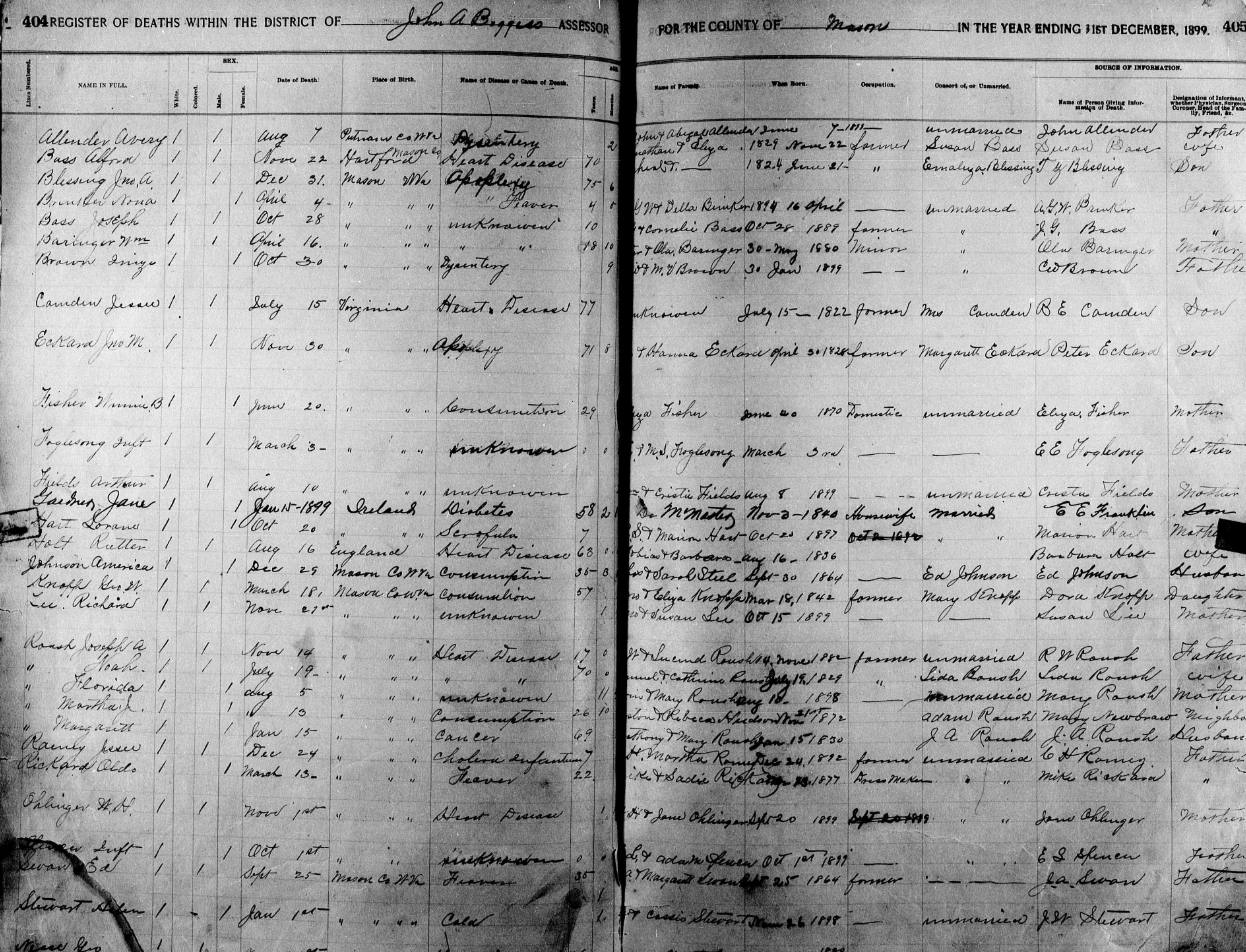
1899 Mason County death register with parents' names — A full spread of the 1899 Mason County death register, from the rare years when West Virginia's death books actually wrote down a dead person's parents.George Nease's 1899 death record, parents named — George Nease's 1899 death record names his parents as Samuel and Catherine Nease and gives his birth date as 21 November 1820, opening up another generation of the family.
Nancy (Roush) Nease (1832 – 1913)
Ahnentafel #125 · his mother’s mother’s mother’s mother’s father’s mother (6 generations back) · Probable — the IDENTIFICATION or the LINK rests on one source, or is in conflict
Nancy Roush Nease was born on 16 February 1832 and died on 21 July 1913. She is believed to have been the daughter of Anthony Roush and Elizabeth Rickard, and she married George Nease. She appears consistently across the 1850 census, as an eighteen-year-old wife, and again as the informant "Nancie Nease, wife" on George's own 1899 death record, though her parentage still rests on a single genealogical source.
Evidence
Full dates: 16 Feb 1832 – 21 Jul 1913; dau. of Anthony Roush × Elizabeth Rickard (book-only)
⭐ ADDED at PROBABLE, 8 Aug 2026, adversary-confirmed [ROUSH-61/-VERDICT]. The book’s Nancy Roush b. 16 Feb 1832 = the census wife (18 in 1850, b.~1832) = the informant “Nancie Nease, WIFE” on George’s 1899 death register [ROUSH-43/44]. Her maiden name ROUSH and parents (Anthony × Elizabeth Rickard) rest on the book alone — and open a possible SECOND patriot Roush line (Henry Sr. ?= DAR A098977) [ROUSH-61].
Outstanding: the unopened “Nancy (1913, ×2)” death-index entries [ROUSH-42] — the cheap decisive test; the Anthony Roush rung; Bertha married back into her grandmother’s family — narrative flagged.
Evidence images (described)
A document from the research fileA document from the research fileA document from the research file
Martha Jane Love's father
Ahnentafel #126 · his mother’s mother’s mother’s mother’s mother’s father (6 generations back) · Known unknown — the person existed; the name does not survive
The father of Martha Jane Love, who was born in Ohio on 30 January 1860, is not named in any record found so far. Her 1941 West Virginia death record names her mother but leaves the space for her father blank, and a search of an 1877 marriage license moved the likely search area to Athens County, Ohio, without yet finding him.
Evidence
Also recorded: name not recorded
KNOWN UNKNOWN. Martha Jane Love was born in Ohio, 30 January 1860. Her 1941 West Virginia death record names her mother and leaves the father blank.
Outstanding: an Ohio LOVE household with a daughter Martha Jane b. Jan 1860 — Meigs County is the obvious place to look, since that is where the Roushes and Duckworths were.
8 Aug 2026 [ROUSH-62]: the 1877 license moves the search to Athens Co., Ohio; no Love×McDonald marriage in the Athens or Meigs open-web indexes (read in full); the decisive 1860 Athens census household sits behind the FS login (queued).
Leah McDonald (b. Ohio)
Ahnentafel #127 · his mother’s mother’s mother’s mother’s mother’s mother (6 generations back) · Probable — the IDENTIFICATION or the LINK rests on one source, or is in conflict
Leah McDonald was born in Ohio. She was named as the mother of Martha Jane Love on Martha Jane's West Virginia death record of 12 August 1941, an account given eighty-one years after the birth it describes, so the identification is treated as probable rather than certain. Martha Jane's own 1877 marriage license shows she was born in Athens County, Ohio, and a marriage there between a Ranslier Graham and a Leah McDonald in 1865 may represent Leah's later remarriage as a widow, though this is not yet confirmed.
Evidence
⭐ NEW GENERATION, entered 7 August 2026. Named as the mother of Martha Jane (Love) Nease on Martha’s West Virginia death record of 12 August 1941 (WV VRR Id 5290412), which also gives her birthplace as Ohio.
Graded Probable deliberately: the identification rests on one record, and it is an informant’s statement made eighty-one years after the birth it describes.
Outstanding: everything else — her given dates, her husband, her own parents. A McDonald–Love marriage in Ohio, c.1855, would confirm her at a stroke.
⭐ 8 Aug 2026 [ROUSH-62]: Martha Jane’s 1877 marriage license IMAGE read: she was born ATHENS County, Ohio (search county corrected from Meigs). Live lead: “GRAHAM, Ranslier × McDONALD, Leah, 4 Oct 1865, Athens Co.” — a widow’s remarriage would explain the 1941 record’s maiden-name usage. Browser: the 1870 Ranslier Graham household (a ~10-year-old Martha in it confirms or kills).
Archibald "Archy" Bell (~1770/75 – bef. 1839 Sumter SC)
Ahnentafel #128 · his father’s father’s father’s father’s father’s father’s father (7 generations back) · Hypothesis — a candidate, not tied in
Archibald Bell — “Archy” to the clerks who wrote down his name — was born about 1770 to 1775, and if the reconstruction holds he was a son of William Rasor Bell, a planter of Salem in Sumter District who died leaving nine sons and a widow named Mary.
He farmed on both banks of Lynches Creek, the water that divides Sumter District from Darlington. He bought land in Darlington in 1806 and sold a hundred and twenty-seven acres there in 1817, between Bay Branch and Newmans Swamp; he was witnessing deeds across the creek in Sumter as early as 1812. His wife Martha released her dower twice, in 1809 and 1817, before a justice named John Huggins — whose family would later marry into his.
Martha died, and he married Margaret, and had five more children with names that read like a roll-call of his neighbours: Benjamin Sumter, Ezekiel Dixon, Hugh McCallum, Columbus Campbell. He was sued in 1830 for a witness fee. He was still buying land from Robert Severance in 1836, at sixty. He died in the autumn of 1839, weak in body but of sound mind, leaving two hundred and seventy-five acres, a set of blacksmith’s tools, thirteen geese, and a boy named Limus whom he directed to be sold to pay his debts.
Whether the John Bell he named first among his older children is the John Bell who went to Alabama about 1830 is the question this family has not yet answered.
Evidence
Full dates: b. about 1770–1775; d. before 22 October 1839, Sumter District, South Carolina
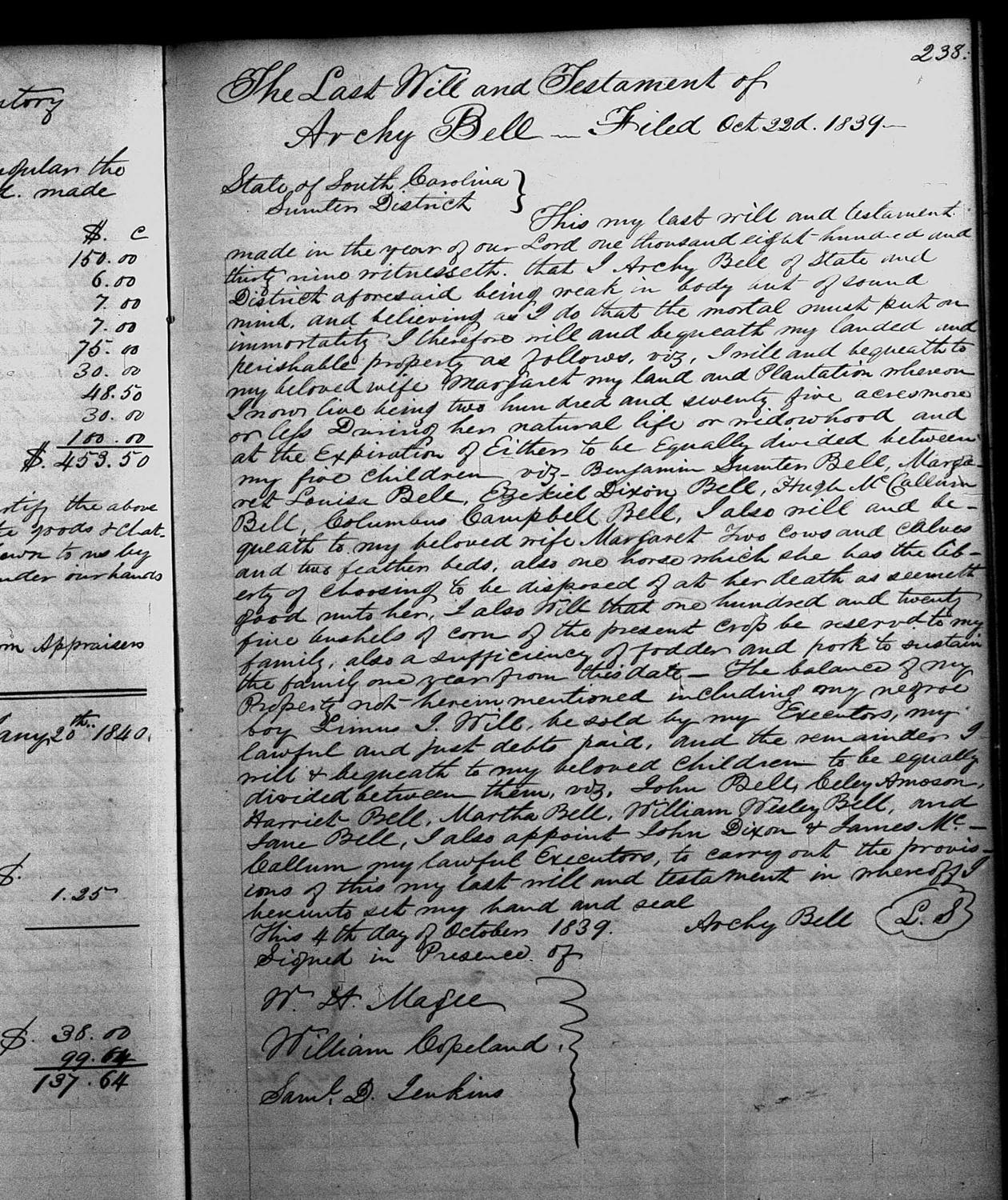
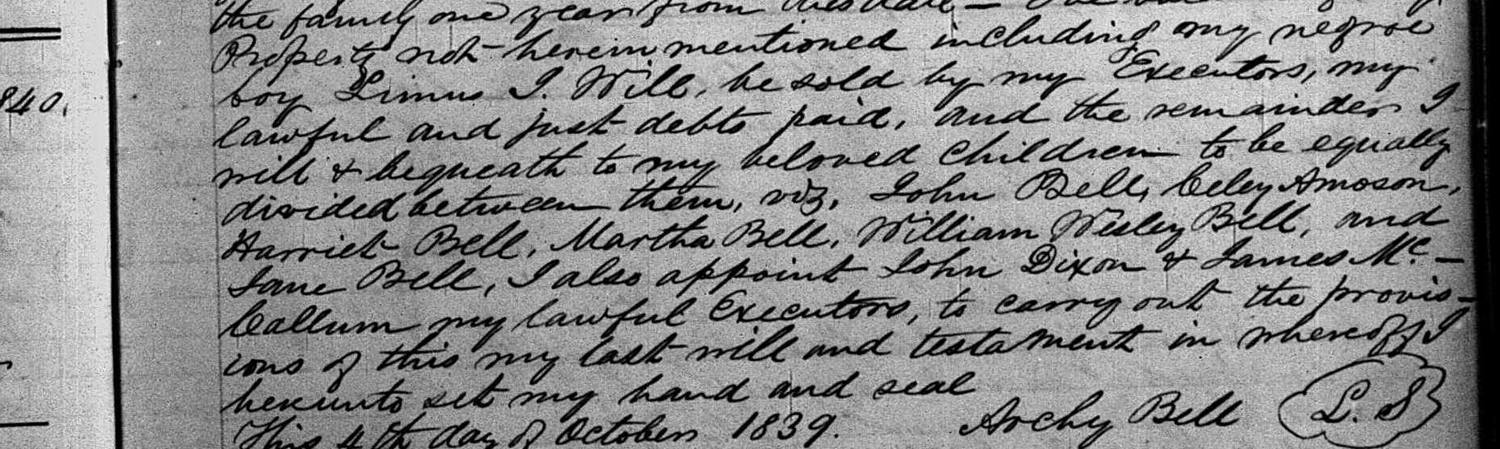
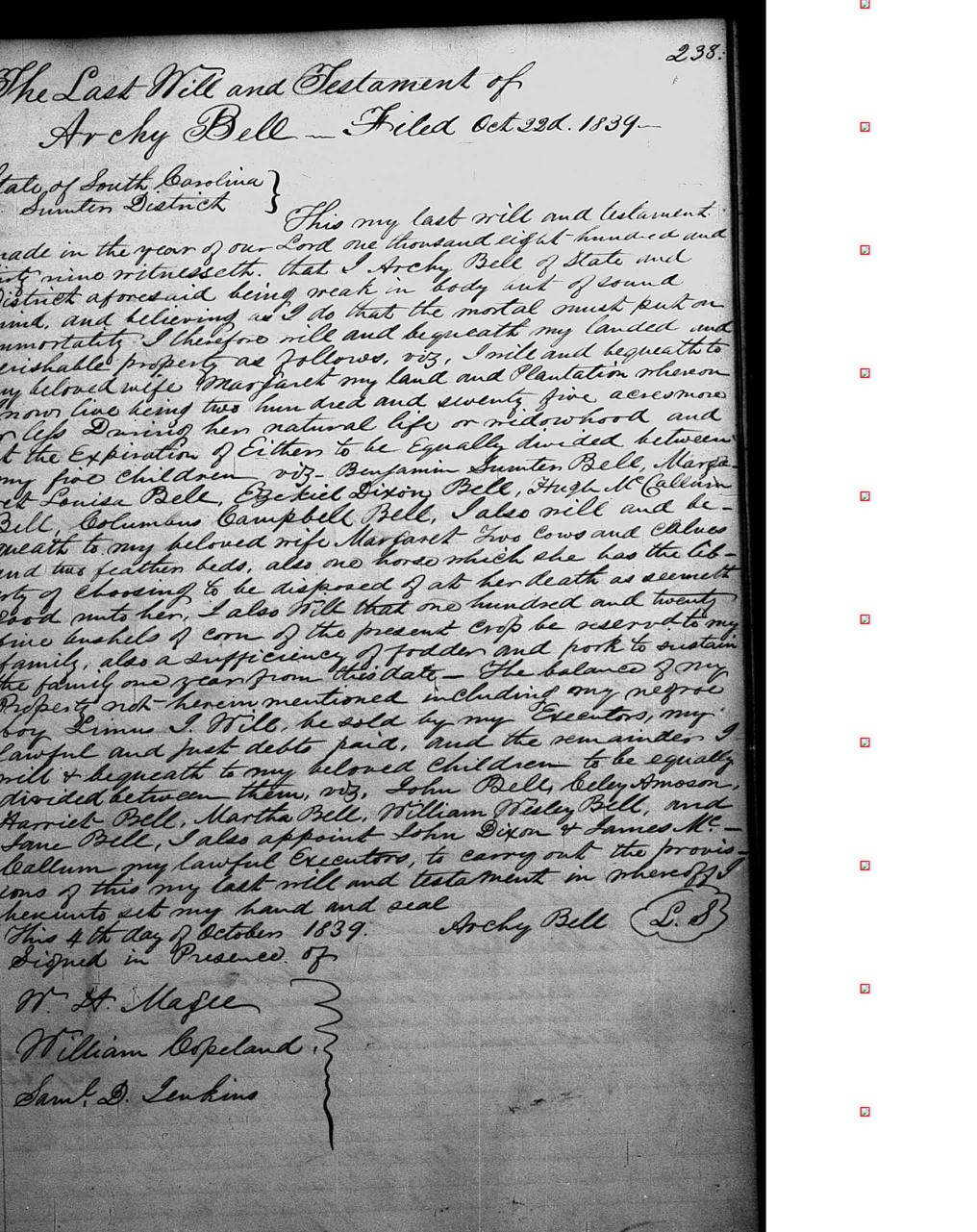
⭐⭐ A candidate with a documented life and no document tying him to us. He is graded hypothesis deliberately — but for a narrower reason than this node used to give. ⭐ Archy Bell’s own will names a son JOHN BELL:“the remainder I will & bequeath to my beloved children to be equally divided between them, viz, John Bell, Celey Amoson, Harriett Bell, Martha Bell, William Wesley Bell, and Jane Bell” — verified in the signed original, the clerk’s certified copy and the recorded will book [BELL-430]. ⚠ What is NOT documented is that this son John is OUR John F. Bell of Barbour County, Alabama. The open question is an identification, not a relationship — and a “John Bell Senr” was witnessing deeds in Darlington in 1820, so uniqueness cannot be assumed. What follows is the case, which is now a strong one.
⭐ He left a will [BELL-147]. Made 4 October 1839 and filed at Sumter District on the 22nd, it leaves his wife Margaret the 275-acre plantation for her life or widowhood, then to five children — Benjamin Sumter, Margaret Louisa, Ezekiel Dixon, Hugh McCallum and Columbus Campbell Bell. An 1846 partition establishes that those five are the children of a second marriage. The residue he leaves to six more: ⭐ “John Bell, Celey Amoson, Harriet Bell, Martha Bell, William Wesley Bell, and Jane Bell.”
⭐ That earlier family is dated, and it is dated to the right decade. William Wesley Bell is in the 1850 Darlington census aged 30, born 1811×1820 [BELL-160] — restated 10 Sep 2026 (self-correction #384): the 1860 census and an 1866 ration book both read ~1811 against 1850’s ~1820, and on the 1811 reading he has no slot in Archibald’s 1830 household at all. So the six were born roughly 1805×1820 — the window in which John Bell was born, 13 January 1807, and the window of Archibald’s marriage to Martha, who released dower in 1809 and 1817.
⭐⭐ And his household held a boy of exactly the right age, twice [BELL-159]. The 1820 Sumter schedule (page 115, indexed “Arel Bell”) tallies one male aged 10 and under 16 — John was thirteen. The 1830 schedule (page 66, indexed “Achable Bell”) tallies one male aged 20 and under 30 — John was twenty-three, and his family left for Alabama “about 1830.” Archibald himself is 45-and-upwards in 1820 and 50–60 in 1830. ⚠ But the bracket is not exclusive: of the seven Bell households on the 1830 Sumter schedule, the elder John Bell’s (p. 93) also holds an anonymous male 20–30 [BELL-166] — the census cannot choose between the two roofs.
⭐ The neighbours run for twenty-six years.Robert Severance is the household directly below him in 1820, sells him land in 1836, and his estate bounds Archibald’s farm in 1846. William Copeland is on the 1830 page and witnesses the will. The Amosons are on both pages, and a daughter married one of them.
⭐⭐ 11 Sep 2026 [BELL-721] — A NEW DEED, A SECOND DOWER RENUNCIATION, AND HIS NAME IN A CLERK’S OWN PEN.Archibald Bell → John B. Divine, 22 Feb 1817, Darlington Deed Book G p. 204: 127 acres “between Bay Branch and Newmans Swamp,” provably the tract he bought from James Hudson in 1810. ⭐ MARTHA BELL renounced dower on it on 24 Feb 1817, by mark, before John Huggins J.P. — a SECOND certified renunciation, eight years after the 1809 one, before the same magistrate. ⭐⭐⭐ And the proof clause calls him “ARCHEY BELL” — image-verified, in the same hand that wrote “Archibald” three times on the same page.That is the Arel/Achable/Archable index-mangling problem caught at its source: his neighbours called him Archey. ⚠ His residence formula oscillates and is quoted rather than smoothed: 1807 “of the same place” (Darlington) · 1810 “of the district of Sumpter” · 1817 “of the State and District aforesaid” (Darlington) — he held land in both. The 127 acres left the family in 1818 (Devine → James Reynolds). Outstanding — and these are the reasons the grade has not moved [BELL-148, BELL-162]: ⛔ No instrument names John Bell as his son, and none places the will’s John Bell in Alabama. ⭐ And the negative is stronger than “not found” — the receipt class most likely never existed. Record Book M, read at the ink [BELL-526]: no return was EVER filed on this estate. Archy Bell’s block (pp. 238–241) ends at Evan Benbow with nothing after it and the Ordinary’s printed qualification line “was duly qualified on the ___ day of ___ 18__” was left blank forever — while the estate on the facing page, in the same clerk’s hand, got a full return filed 20 Jan 1840 with $38.00 coming in from “W. Montgomery OF ALABAMA.” So the one document class that would style a legatee “John Bell of Alabama” moves from unfound toward improbable. ⛔⛔ The cheapest test that could have settled this is now PERMANENTLY closed, not merely unrun [BELL-562]: [BELL-162] named searching the estates of Thomas Bell and John Bell of Sumter as the one action that could materially raise this node — but the Sumter Probate Court’s own General Index to Estates 1784–1960 holds nine Bell entries in total, and there is NO John, Thomas, William Jr., James, Drury, Jesse, Benjamin or Robert Bell estate in Sumter County at any date, ever. The two-roofs problem can never be resolved from probate. ⛔ Two other Sumter Bell households in 1820 — Thomas Bell, on the line immediately above him, and John Bell — also held a boy of John’s age, and if those men are his brothers then the rivals are his nephews, sharing every neighbour and every migration route. ⛔ And the rival persists: in 1830 the elder John Bell’s household (the probable “John Bell Senr” of the 1839 bond) still holds a male 20–30, while Thomas Bell’s household has vanished from the schedule entirely, leaving his boy unlocated [BELL-166]. ⚠ The Darlington-vs-Sumter question has narrowed sharply: beyond the shared “Archy”/“Archibald” usage and the three surnames that cross the creek with him (Huggins, Chaney, Newman), the February 1839 resurvey of his own home plantation — the Sumter estate tract itself — is headed “South Carolina, DARLINGTON DISTRICT” by the deputy surveyor [BELL-170]. His home paperwork crossed the line; a single instrument equating the two men in words is still wanting. ⚠ The 1820 and 1830 tallies also leak by one boy, which is unexplained. ⭐ And the exclusion now runs one way [BELL-172]: no John Bell of the will’s generation is documentable in Sumter or Darlington District in 1840 or 1850 — the one right-age Sumter candidate resolves to James P. Bell by his own will — so the will’s John left the home districts, and ours is the only located right-age John with any documented tie to them. ⭐⭐ 12 Sep 2026 — THE NAMED RIVAL THIS FIELD HAS BEEN MISSING, AND HE IS STILL STANDING: A JOHN BELL OF YORK DISTRICT [BELL-735–BELL-746]. Under the Genealogical Proof Standard a convergent case is not proof while a named competing candidate stands unexcluded, and this one is age-perfect in two consecutive censuses — male 20–29 in York in 1830, male 30–39 in 1840 (roll 516 p. 304, one enslaved person, immediate neighbour John Springs). His father has no name in any record, which is exactly why he cannot be retired. ⭐ What was done about him on 11–12 Sep, so nobody re-runs it:all 324 York documents whose OCR contains “John Bell” were harvested and read — 93 kinship contexts, every one a false positive; not one instrument names his father, mother, sibling or child; the Withers will of 27 Oct 1845 (his last trace) shows him as a subscribing witness and nothing else, signing plain; all thirteen Bells in the 1850 York schedule were read off the manuscript — no John, no Bell widow, three of seven households not York-rooted; the mangled-surname escape is closed in both 1850 and 1860 and in both York and Chester (the one B400 collision, “Ball John 37 NC,” is excluded as North-Carolina-born); and no estate or guardianship was ever opened for any John Bell in York. ⚠ But he did NOT simply vanish: a John Bell was decreed against in York in 1848 and a “John Bell Junr” stands on Dr J. B. Hunter’s books in 1851 — so “absent from the 1850 schedule” is a fact about the schedule, not about the man (self-correction #437). ⛔⛔ A Catawba-leasehold argument that would have excluded him was raised and REFUTED by an adversary the same night [BELL-746]: the Pettus lease table’s “formerly X’s” field contradicts itself on the very tract, an unrelated adult James Davis was already leasing on Steel Creek in 1797, and the series — which names sons-in-law, daughters and heirs constantly — carries not one kin word in the rows at issue. ⭐ FOUR candidates now stand unexcluded: Christopher Bell of York’s seven unnamed heirs · Robert Bell of York’s own son John · a possible Broad-River-side York Bell family · an ordinary unrelated transfer. ⭐ 12 Sep, later — that last strand was TESTED and came back against it [BELL-748]: the 1833 York sale at which a “John Bell Sen” bought is Rev. William Dickson’s of CROWDERS CREEK — western York, the Broad River side — and not one Bell appears among his legatees, witnesses or receipt-signers. ⭐⭐ And an ironmaster’s ledger from that same neighbourhood carries two John Bells, tagging one “John Bell Mountain” while tagging a neighbour “James Moore Indian Land” two lines below in the same clerk’s hand — a clerk who used patronymics (“W’m Felts, James Son”) freely and reached for a place instead. So the Senior/Junior pair sits on the WESTERN side of the district while this rival’s whole documented world is EASTERN, on the Catawba Indian Land: “John Bell Senior of York” now reads as a third man, not as his father. ⭐ Excluded and off the board: the Pickens rival (born North Carolina, stated twice), John Bell Jr of Sumter (held a note in Aug 1821, when our man was fourteen), and the Georgia gold-lottery route (lot 891 was drawn by John F. BALL of Twiggs). ⭐⭐ What would settle it, named and reachable: the original 1830 Catawba lease — SCDAH holds the 128 originals returned in 1840, transfers signed and dated on the dorse, and Robert Bell’s son John signed cleanly three times in 1802–04, so a John Bell who MARKS that lease is a third man; and the Secretary of State, Papers Pertaining to State Grants on Catawba Indian Lands, 1798–1853, whose post-1840 neighbour affidavits recite who held a tract, from whom, and how — a series this project has never opened.
⭐ 22 Aug 2026 [BELL-484]: the Darlington Archibald (wife Martha, 1809–1820) and the Sumter Archy (wife Margaret by 7 Oct 1829) are now one man stated in the record — “Archd Bell of the district of Sumpter” buying the Darlington tract on 4 May 1810, and “Archey Bell … Margaret Bell the wife of the within named Archibald Bell” on one 1829 deed. His Boykin land came “sold to said A. Bell by General Cantey” — a purchase, not a descent from William Rasor Bell. He witnessed for Jonathan Newman of Sumter District in 1805 and beside a John Bell Senr in 1820 — association, never kinship. Still no document ties him to W.R.B.’s son Archibald; the estate bundle (Sumter Box 10 Pkg 3) was opened the same week — nine leaves, no division, no receipts [BELL-485].
⭐ [BELL-485]: his own estate packet is found (Sumter Bundle 113 Pkg 15): the original signed will of 4 Oct 1839 names wife Margaret, five younger children (Benjamin Sumter, Margaret Louisa, Ezekiel Dixon [#238 — not “Nixon”], Hugh McCallum, Columbus Campbell) and six older (John, Celey Amoson, Harriett, Martha, William Wesley, Jane) — and no father or brother; the sale bill shows the family buying its household back; J. W. Stuckey was guardian ad litem for the three youngest in 1846–47. William Rasor Bell’s own bundle is nine leaves with no division or receipts, the Ordinary’s books of 1809–39 were never filmed, and Sumter equity 1795–1870 holds no Bell partition — so the document that would tie 128 to 256 is not online anywhere now searched.
⭐⚠ 24 Aug 2026 [BELL-502–503, #229]: Archy is now documented holding and mortgaging (1815, to Zachariah Cantey) the 345-acre Lynches Creek tract whose 1785 survey was laid out for William Rasor Bell — the first document putting him on node 256’s ground — but a seventh adversary pass [BELL-512] kept the link at hypothesis: W.R.B. never owned the tract (a locative recital, not a title — and the recital’s companion word is now settled as HARRISON at the ink, an inherited 1780s adjoiner call, not a plat call [BELL-517]), Archy was a serial open-market buyer, and land never conveyed keeps its dead owner’s name for decades.
⛔ 25 Aug 2026 — the online case is CLOSED at the structure, not the query [BELL-514, BELL-517, BELL-518, BELL-521, BELL-522]: the Kershaw conveyance indexes 1791–1824 hold no Bell of ours in either direction (and Book A only opens in 1791, so 1786×91 is unanswerable there); no suit in five volumes of Sumter judgments 1804–26 ever touched the estate — proven in a record class where the Ordinary demonstrably sued his own administrators; the administrator Charles Williams (“of Georgetown district,” Durant in-laws, a rule-41 defaulting guardian in 1821) is dense in Sumter’s equity record 1819–27 with zero Bell connection; and the fiduciary volumes that would carry the one settling line — a distributee entry naming Archibald — were never filmed by anybody: they are SCDAH’s unfilmed Returns Books L 43049 (1816–1916) and Journals L 43051, paper in Columbia. The decisive documents are now all offline and named; the grade holds where seven adversaries left it.
⭐⭐ 9 Sep 2026 [BELL-666] — the widow, found whole. Margaret was a DIXON widow when Archy married her: her sons John H. Dixon — the executor Archy trusted with everything — and William B. Dixon were his stepsons, which is why he named a son Ezekiel Dixon Bell (as Hugh McCallum Bell honours the other executor). After Archy died she remarried a SEVERANCE, tripping the will’s widowhood condition and triggering the 1846–47 partition — and the “Margaret Severance” who bought the plantation on 3 May 1847 was the widow buying her own place back. Her 6 Jan 1849 will names four of the five second-family children — Columbus Campbell Bell is absent, presumed died 1839×1849. The estate never touched Equity (both index B-blocks read whole, with the Belvin partition as control): the whole settlement ran in Ordinary, and its citation names no residences.
Evidence images (described)
A document from the research fileA document from the research fileA document from the research fileA document from the research fileA document from the research fileA document from the research fileA document from the research fileA document from the research fileA document from the research fileA document from the research fileA document from the research fileA document from the research file
Martha Bell (fl. 1809–1817 Darlington SC)
Ahnentafel #129 · his father’s father’s father’s father’s father’s father’s mother (7 generations back) · Hypothesis — a candidate, not tied in
Martha Bell appears twice, briefly. In October 1809, and again in February 1817, her husband Archibald sold land in Darlington District, South Carolina, and each time she came before a justice of the peace — the same man both times, John Huggins — who examined her privately and separately from her husband, as the law required, to be sure a wife was not signing away her dower under his eye. She declared she did it freely and voluntarily, without compulsion, dread or fear of any person whomsoever. In 1809 she made her mark.
That is all we have of her, and whether she was John Bell’s mother is a hypothesis resting on her husband’s.
Evidence
Also recorded: wife of Archibald Bell by October 1809; living February 1817, Darlington District, South Carolina
⭐ “Martha Bell, the wife of the above named Archibald Bell” appeared twice before a Darlington District justice of the peace — 17 October 1809 and 24 February 1817 — and, examined privately and separately from her husband as the law required of a married woman, released her dower in land he was selling. In 1809 she made her mark. ⭐ The 1809 record, found 13 Aug 2026 [BELL-150], moves her eight years earlier than this file had her, and closes the gap between her documented marriage and John Bell’s birth in January 1807 to under three years.
⚠ She is the weaker of these two nodes and must be judged separately from her husband [BELL-148, BELL-162]. For Martha to be John Bell’s mother, three things must all hold: that the Darlington Archibald and the Sumter Archy are one man; that Martha was the first of his wives; and that the earlier family in his will is hers.
Outstanding: ⛔ No source anywhere states that Martha was the mother of anybody. ⛔ Every document naming her is a Darlington instrument, while every document of the will and the estate is Sumter — so she depends entirely on a merge that is still undocumented. ⚠ His 1839 will names a wife Margaret, and “children by his second marriage” establishes at least two marriages, not exactly two; a Martha who was wife number two of three, and stepmother rather than mother to the older children, fits every record equally well. ⚠ The 1830 Sumter schedule shows the woman of that house aged 30–40, who would have been only nine to nineteen in 1809 — so she is probably Margaret, and Martha is probably already dead. Her maiden name and her dates are unknown.
⭐ [BELL-484]: Martha living 20 Sept 1820 (dower, Sumter); Margaret is Archibald’s wife by 7 Oct 1829 (dower, Sumter) — the change falls 1820×1829, not c.1830.
⭐ 9 Sep 2026 [BELL-666]: the second wife is now documented in her own right — a Dixon widow who became Margaret Severance after Archy’s death (her own will, 6 Jan 1849). This sharpens the Martha→Margaret transition (1820×1829 per [BELL-647]) but still says nothing about which wife mothered John.
Evidence images (described)
A document from the research file
Joseph Eakins (d. 1805 New Hanover Co. NC)
Ahnentafel #144 · his father’s father’s mother’s father’s father’s father’s father (7 generations back) · Documented — person and parent-link established
Joseph Eakins died in early 1805 in New Hanover County, North Carolina. In 1790 he bought 400 acres on Moores Creek, described in the deed as a "Gentleman," sold that land in 1793, and in 1796 received a 210-acre North Carolina state land grant signed by Governor Samuel Ashe. After his death, his widow's year's provision was allotted in March 1805 and his goods were sold at auction that April for $1,657.57. The Eakins family cemetery still stands on land he once owned, with burials dating from 1797 to the present day.
Evidence
Full dates: d. early 1805, New Hanover Co., NC
Proven by his own estate file. In 1790 he bought 400 acres on MOORES CREEK as “Gentleman”; sold to Jacob Moore 1793; and in 1796 received a 210-acre North Carolina state land grant signed by Governor Samuel Ashe. His widow’s year’s provision was allotted March 1805 and his goods sold at auction that April for $1,657.57. The Eakins family cemetery still stands on that land, its oldest burial 1797 and its most recent 2019.
Outstanding: He reached New Hanover about 1788–90 from somewhere else — and that somewhere, not New Hanover, is where Gen 9 will be found. The tree’s Irish origin (Joseph Elijah Eakins & Isabella Wauchope) was tested and fails outright.
probably Elizabeth Pigford (New Hanover Co., North Carolina)
Ahnentafel #145 · his father’s father’s mother’s father’s father’s father’s mother (7 generations back) · Probable — the IDENTIFICATION or the LINK rests on one source, or is in conflict
Elizabeth Pigford was probably the widow of Joseph Eakins, though the marriage itself has not been directly documented. Four members of the Pigford family administered Joseph's estate and helped raise his children, and a Pigford later sold the family adjoining land in 1834 — a strong pattern of connection. Her father is believed to have been William "Lost Billie" Pigford, whose 1801 will names a daughter, "my daughter Elizabeth Aiken."
Evidence
Also recorded: widow of Joseph Eakins
Four Pigfords administer the estate and raise the children, and a Pigford sells the family the adjoining land in 1834 — strong, but the marriage itself is not documented.
⭐ 10 Aug 2026 [BELL-50/-VERDICT]: her father found — William “Lost Billie” Pigford’s 1801 will names “my daughter Elizabeth Aiken” (nodes 290/291 added). Adversary held THIS node at Probable with the “probably” intact: the will names no husband’s given name and is a book transcription; the will-book image + a dower-release deed are the path to Documented.